The history of espresso machines runs from steam-driven brewing in the late nineteenth century to spring-loaded levers, electric pumps and electronically controlled extraction. Angelo Moriondo’s 1884 machine helped establish pressure brewing, but the concentrated, crema-topped espresso familiar today emerged through later developments by Gaggia, Faema and others.
In short
- 1884: Angelo Moriondo patented a steam-driven coffee machine in Turin, designed for preparing coffee in quantity rather than today’s individual espresso shots.
- 1901 and 1905: Luigi Bezzera’s patent work preceded the commercial production of La Pavoni’s Ideale. The Ideale belongs to 1905, not 1903.
- 1947 and 1948: Gaggia patented his spring-lever mechanism, then introduced machines that made high-pressure, crema-topped coffee commercially practical.
- 1961: Faema’s E61 combined motor-driven brewing pressure with a heat exchanger and a heated brewing group.
- Modern machines: Separate boilers, electronic temperature control and programmable pressure profiles give more control over extraction.
Before modern espresso: Moriondo and steam pressure
Espresso was not a single invention that arrived complete. Early machines addressed the practical problem of preparing coffee quickly for public service; the drink’s familiar texture developed later. Keeping those two developments separate makes the history much easier to follow.
In Turin in 1884, Angelo Moriondo patented a machine that used steam pressure to push hot water through ground coffee. MUMAC, the museum of professional coffee machines, dates the patent to 30 June. Its account describes coffee prepared in quantity and collected before serving, rather than each customer receiving a separately extracted shot.
That distinction matters. Moriondo deserves a place in the development of pressure brewing, but calling his drink identical to a modern espresso would erase the changes that followed. His machine belongs at the beginning of the story, not at its technical conclusion.
For the wider setting, our coffee history guide follows the drink beyond machinery, while European coffeehouses covers the public spaces in which coffee was served.
Bezzera and Pavoni: coffee prepared for the customer
Luigi Bezzera’s contribution shifted attention towards preparing coffee individually. His company dates his Italian patent work to 1901. The surviving American patent describes a machine with a boiler, delivery controls and a removable coffee holder, allowing fresh grounds to be used for separate preparations.
A portafilter is that removable handle and filter basket holding the grounds. It connects to the group head, the part of the machine that delivers brewing water. These recognisable elements link early commercial machines to equipment still used by baristas.
Desiderio Pavoni’s role was to turn patent work into a manufactured product. La Pavoni’s own historical monograph places the Ideale in 1905. Its tall boiler and projecting brewing groups made it a substantial piece of bar equipment rather than a small domestic brewer.
Why 1901, 1903 and 1905 all appear
These dates refer to different events. Bezzera’s Italian patent work is dated to 1901; his American application was filed on 10 June 1902 and granted on 28 April 1903. The American document also names Pavoni as the assignee, the person receiving the patent rights. La Pavoni dates the Ideale to 1905.
Consequently, “the 1903 Ideale” is misleading. It mixes a patent-grant date with a machine’s commercial history. Patent applications, grants, transfers and product launches should not be treated as interchangeable milestones.
What early steam machines could not yet do
These machines used steam pressure as their driving force. Historian Jonathan Morris gives approximately 1.5 bar for early espresso brewing and describes a drink without the crema associated with later espresso. That is a historical approximation, not a verified operating specification for every surviving machine.
Their limitation was the connection between the boiler’s heat and its pressure. Later designers sought a way to generate substantial brewing pressure mechanically, without depending on steam to provide it.
Gaggia’s lever: pressure, texture and crema
Achille Gaggia’s work must also be separated into stages. His 1938 patent concerned the earlier Lampo brewing mechanism. The spring-loaded lever and piston followed in 1947, with commercial machines appearing in 1948. Treating all three dates as the invention of the same finished machine obscures the development.
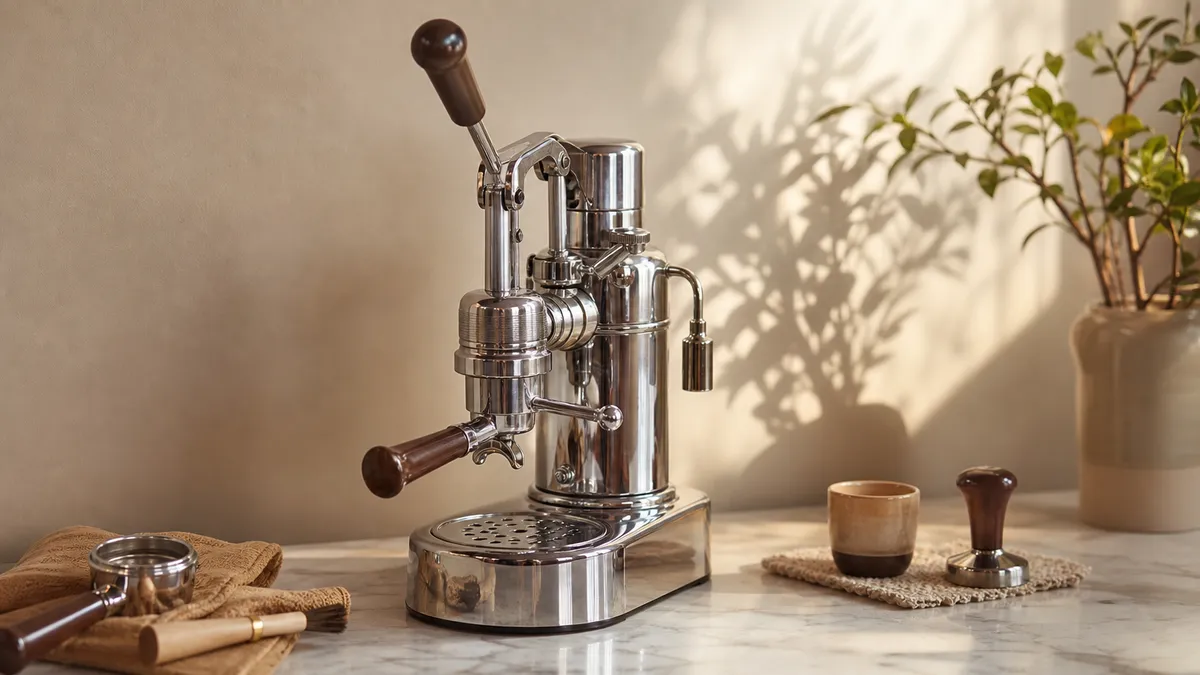
The crucial change was how pressure was produced. Instead of relying on boiler steam pressure, the mechanism used a piston driven by a spring. The operator charged the spring with a lever; the spring then pushed the piston down against the brewing water.
Museum of Design Atlanta describes these machines as reaching approximately 8 to 10 bar. This is best understood as the pressure class of the new system, not an assertion that every lever shot maintained an unchanging pressure throughout extraction.
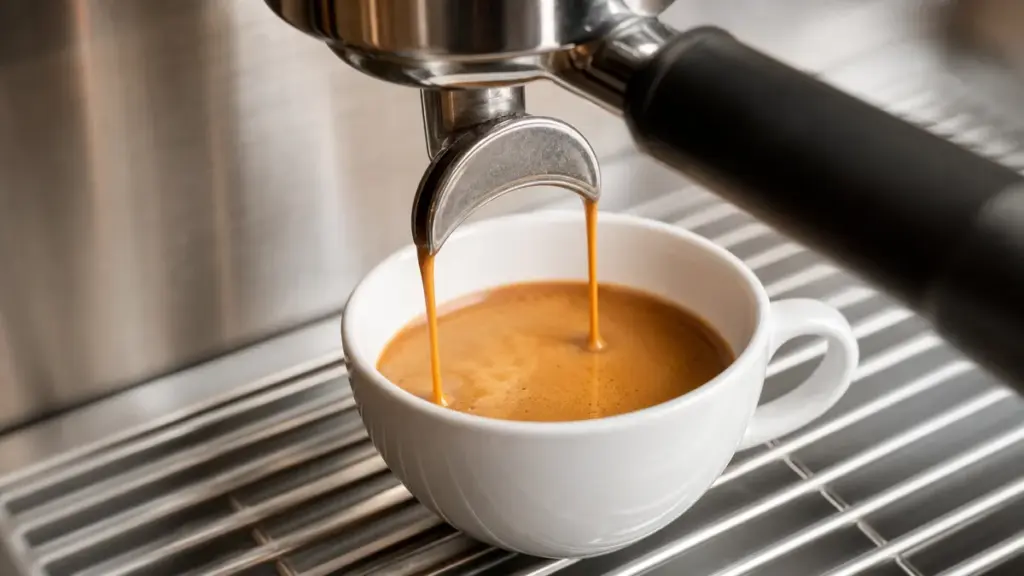
High-pressure brewing produced a visibly different drink: concentrated coffee with a tawny foam on its surface. Gaggia promoted this as crema caffè, distinguishing it from the coffee produced by earlier steam machines.
Crema is foam, not cream
Crema contains gas bubbles, principally carbon dioxide formed during roasting, within a complex coffee liquid containing dissolved compounds, dispersed oils and fine particles. A scientific review by Ernesto Illy and Luciano Navarini explains its formation and stability as a physical and chemical process, not the addition of dairy cream.
During pressurised extraction, carbon dioxide can dissolve in the brewing liquid. As the coffee leaves the machine and pressure falls, gas emerges as bubbles. Coffee compounds help stabilise the resulting foam.
The lever therefore changed more than the speed of preparation. It helped establish the appearance and texture that readers now recognise as espresso.
The Faema E61: pumps replace the spring
In 1961, Faema introduced the E61, developed under Carlo Ernesto Valente, commonly known as Ernesto Valente. A motor-driven pump supplied brewing pressure, replacing the spring-piston arrangement as the machine’s pressure source.
The distinction is easy to miss because an E61-style group can have a small operating lever. That lever controls the brewing mechanism; it does not charge a large spring that drives a piston through the shot. The electric pump does the pressure-generating work.
The E61’s importance lay in the combination of its systems:
- A motor-driven pump provided sustained brewing pressure.
- A heat exchanger, a separate water passage inside the hot boiler, heated incoming brewing water.
- A thermosyphon, circulation driven by temperature differences, helped keep the group hot between preparations.
- Pre-infusion wetted the grounds before full-pressure extraction.
This architecture separated the job of producing pressure from the job of heating water. Drawing water from an external supply also supported repeated coffee preparation without the same interruptions required to replenish an earlier boiler-fed system.
It is safer to describe the E61 as a commercially decisive pump machine than to attach every possible “first” to it. Its historical importance does not depend on claiming that all its components appeared nowhere else beforehand.
Espresso machine history: a short timeline
| Date | Verified milestone | What changed |
|---|---|---|
| 1884 | Moriondo’s Turin patent | Steam-driven pressure brewing for coffee prepared in quantity. |
| 1901 | Bezzera’s Italian patent work | Development towards individually prepared coffee. |
| 1905 | La Pavoni Ideale | Commercial production of the early bar espresso machine. |
| 1938 | Gaggia’s Lampo patent | An earlier stage of his work on mechanically pressurised brewing. |
| 1947 | Gaggia’s spring-lever patent | A spring and piston generated brewing pressure. |
| 1948 | Gaggia’s commercial lever machines | High-pressure, crema-topped coffee reached the bar. |
| 1961 | Faema E61 | Motor-driven pressure and heat-exchanger brewing. |
| 1970 | La Marzocco GS | Separate boilers and saturated groups in a significant commercial design. |
Timeline sources distinguish patent events from commercial introductions.
From separate boilers to electronic control
Once pump-driven pressure was established, designers could concentrate on controlling temperature, water delivery and repeatability.
Separate brewing and steam boilers
La Marzocco dates the introduction of its GS to 1970. It combined separate brewing and steam boilers with saturated groups, brewing groups connected to the coffee boiler so that hot water helped maintain their temperature.
Separating the boilers allows brewing water and steam production to be managed independently. A heat-exchanger machine can also brew and steam simultaneously; the distinction is not simply whether those tasks can happen together, but how their temperatures are controlled.
Claims about the “first dual-boiler machine” require caution. La Marzocco’s history emphasises its 1970 GS, while Faema’s heritage account describes a two-boiler TRR machine in 1960. These are different designs, so the clearer historical statement names the machine and its arrangement rather than declaring an uncontested first.
Electronic temperature control
A PID controller, short for proportional, integral and derivative controller, compares a measured temperature with a target and adjusts heater operation. In an espresso machine, its purpose is to reduce temperature variation rather than simply switch heating on and off across a broad operating band.
This is a different kind of progress from the leap to high-pressure brewing. It does not create a new drink category; it gives the operator finer control over the conditions used to make it.
Pressure profiling
Modern pressure profiling deliberately changes brewing pressure during a shot. La Marzocco’s Strada EP, for example, uses electronically controlled gear pumps and can record and reproduce pressure curves, according to the manufacturer.
Pressure and flow are related but are not interchangeable. The coffee bed resists water movement, so changing the grind or dose can change flow even when a machine follows the same pressure profile. Recording pressure alone does not guarantee an identical quantity of coffee in the cup.
Automation alongside manual control
Another development places more of the preparation inside the machine. Modern bean-to-cup systems can combine grinding and brewing, while integrated maintenance programmes automate specified rinsing and cleaning operations. These are manufacturer-described functions, not evidence that a machine needs no attention.
Seen this way, espresso machine history has two continuing directions: giving a skilled operator more control, and making a repeatable preparation easier to obtain without operating each stage manually.
FAQ
Were the first espresso machines electric?
No, electricity was not essential to the early design. Bezzera’s American patent includes a furnace heating the boiler, while the brewing force came from steam pressure. Heating method and pressure source are separate questions: a machine can use heat to make steam without having an electric pump.
Did “steamless” Gaggia machines have no steam at all?
“Steamless” referred to the change in brewing, not necessarily the absence of steam elsewhere in the machine. Gaggia’s innovation used mechanically generated pressure to push hot water through the coffee. The important historical distinction is between steam providing brewing pressure and a piston providing it, rather than whether a machine could produce steam.
Can a machine have modern temperature control and still use a lever?
Yes, a lever mechanism and electronic temperature control can coexist. La Marzocco’s Leva is a manufacturer-documented example combining lever brewing with PID temperature control. The lever concerns how brewing pressure is generated; the controller concerns temperature management. They solve different problems and need not belong to separate technological eras.
Where to go next
Continue from The History of Espresso Machines to History of Coffee for the broader chronology, or European Coffeehouses for the institutions surrounding the drink. The History of Instant Coffee offers a useful parallel history of convenience, while Coffee, Colonialism and Plantation History examines the production systems beyond the machine.
Sources
-
MUMAC, CoffeeCulture, 2019, and Le sale, undated. Moriondo’s patent and the distinction between bulk preparation and individual service.
https://www.mumac.it/en/news/coffeeculture-en
https://mumac.it/le-sale -
Bezzera, A company that is over a century old, undated. Company account of the 1901 patent milestone.
https://www.bezzera.it/en/bezzera -
Luigi Bezzera, United States Patent Office, Coffee-making machine, US726793A, 1903. Original patent text and filing history, reproduced by Google Patents.
https://patents.google.com/patent/US726793A/en -
La Pavoni; Elena Locatelli, La Pavoni. Dal 1905 macchine per caffè, 2005. Manufacturer monograph incorporating historical documents.
https://www.lapavoni.com/pdf/la_pavoni_monografia.pdf -
Jonathan Morris, Making Italian Espresso, Making Espresso Italian, Food and History, volume 8, issue 2, 2010; online publication 2011. Author’s preprint.
https://uhra.herts.ac.uk/id/eprint/2694/1/jm2.pdf -
Gaggia North America, Our History, undated. Lampo, spring-lever patent and commercial introduction chronology.
https://www.gaggia-na.com/pages/history -
Museum of Design Atlanta, Passione Italiana: The Art of Espresso, undated, Google Arts & Culture exhibition. Lever pressure and E61 history.
https://artsandculture.google.com/story/YgVxzyyXKVR5Iw -
Ernesto Illy and Luciano Navarini, Neglected Food Bubbles: The Espresso Coffee Foam, Food Biophysics, 2011. Scientific review.
https://link.springer.com/content/pdf/10.1007/s11483-011-9220-5.pdf -
Jonathan Morris, American Historical Association, The Faema E61 Espresso Machine, 2021; Faema, Heritage, undated.
https://www.historians.org/perspectives-article/the-faema-e61-espresso-machine-january-2021/
https://e71.faema.it/node/8 -
Carlo Ernesto Valente, United States Patent Office, Machine for making cream-coffee, US3314357A, 1967. Technical description of pump, heat-exchanger and circulation arrangements.
https://patents.google.com/patent/US3314357A/en -
La Marzocco, History of the La Marzocco GS, 2025; Company profile, undated; Built on Years of Dual Boiler Excellence, 2025; USA Product Collection, 2021.
https://www.lamarzoccousa.com/news/blog/history-of-the-la-marzocco-gs/
https://www.lamarzoccousa.com/about-us/company/
https://au.lamarzoccohome.com/blog/built-on-years-of-dual-boiler-excellence/
https://lamarzoccousa.com/wp-content/uploads/2021/03/3.2021_USA_ProductCollection_Web-1.pdf -
La Marzocco, Strada EP, undated; Strada EP Guidebook, undated; Coffea Arabica Machina 101: PID, Part 1, 2009; Leva, undated. Manufacturer technical explanations and claimed functions.
https://www.lamarzocco.com/mktcenter/machine/strada-ep/
https://profileeditor.lamarzocco.com/files/strada_ep_guidebook.pdf
https://www.lamarzoccousa.com/news/blog/prof-john-blackwell-coffea-arabica-machina-101-pid-part-1/
https://www.lamarzoccousa.com/commercial-products/espresso-machines/leva/ -
JURA, Key Technologies, undated, and JURA hygiene certified by TÜV Rheinland, undated. Manufacturer descriptions of automated preparation and maintenance programmes.
https://www2.jura.com/en/purchasing-advice/key-technologies
https://cee.jura.com/en/support/jura-hygiene
This article was researched using retrieved patents, museum interpretation, a peer-reviewed historical study, a scientific review and manufacturer documentation, distinguishing patent dates from product introductions and identifying competing priority claims.
Last checked: November 2026