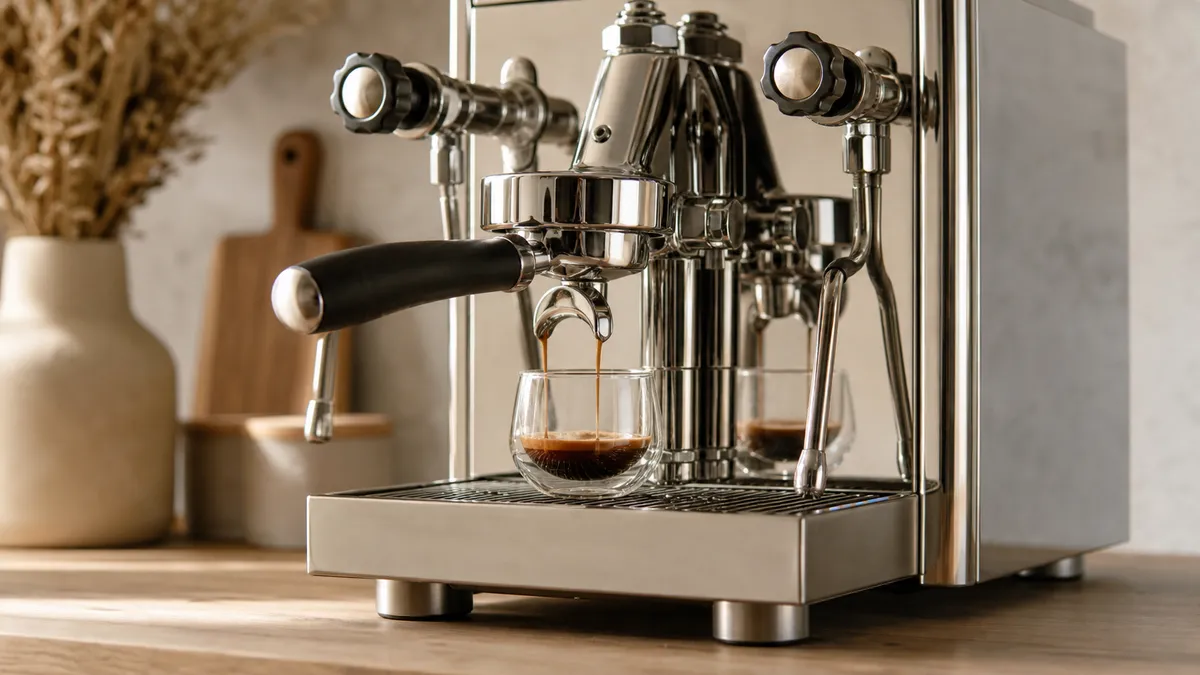
La Marzocco coffee machines are traditional espresso machines built for cafés, trained baristas and hands-on home enthusiasts, rather than push-button bean-to-cup convenience. The Florentine maker is known for separating coffee brewing from steam production, with machine designs that prioritise temperature control and barista workflow.
In short
- Founded in Florence in 1927 by brothers Giuseppe and Bruno Bambi.
- The Linea Micra, Linea Mini and GS3 are key starting points for home buyers.
- Commercial families include the Linea Classic S, Linea PB, GB5, Strada, KB90 and Leva.
- Dual boilers separate brewing and steaming; group-head designs differ between models.
- La Marzocco sits alongside Eversys in De’Longhi’s professional division, in which De’Longhi’s controlling stake increased to 88.02% on 16 October 2026.
La Marzocco at a glance
The first distinction is between an espresso machine and a complete coffee-making system. With the machines discussed here, you prepare ground coffee in a portafilter, the handled filter holder that locks into the machine, and steam milk separately. You need a suitable grinder and someone willing to learn the process.
For the wider market, start with our guide to coffee machine brands.
| Fact | Published position |
|---|---|
| Company | La Marzocco, founded by Giuseppe and Bruno Bambi |
| Country and heritage | Italy; founded in Florence, with production described by the manufacturer as handmade in Florence |
| Parent group | Part of De’Longhi’s professional division alongside Eversys |
| Main machine classes | Traditional commercial espresso, home espresso and selected light-commercial applications |
| UK support | La Marzocco UK provides home technical support and access to approved technicians and service centres |
Specifications and support arrangements below are manufacturers’ published claims, checked in November 2026. They are not findings from independent testing.
A short history of the Florentine maker
La Marzocco’s history helps explain its engineering priorities. Its best-known developments concern the arrangement of the boilers and the stability of the brewing system, not simply the appearance of the case.
- 1927: Giuseppe and Bruno Bambi founded La Marzocco in Florence.
- 1939: The company developed and patented a horizontal-boiler espresso machine. Arranging the boiler horizontally helped accommodate groups across the front of the machine.
- 1970: The GS introduced separate brewing and steam boilers with saturated groups. The initials refer to gruppo saturo, Italian for saturated group.
- Early 1990s: The Linea helped establish the brand during the expansion of American espresso bars.
- 16 October 2026: De’Longhi completed the increase of its controlling stake in the professional division containing La Marzocco and Eversys to 88.02%, from 61.56%.
That final point needs careful wording. The October 2026 transaction increased ownership of the existing professional division; it was not a fresh acquisition of La Marzocco alone. Nor does shared ownership mean that La Marzocco machines are interchangeable with De’Longhi’s domestic appliances.
Commercial La Marzocco coffee machines
Commercial buyers should compare peak workload, operating controls, installation requirements and local support before choosing a model. The number of groups, the brewing stations where portafilters attach, is only part of that assessment.
The Linea Classic S is a useful reference point. It combines separate coffee and steam boilers, electronic temperature control and saturated groups. It is offered with semi-automatic operation, where the barista stops the shot, or automatic volumetric operation, where the machine stops after a programmed water volume.
The Linea PB and GB5 families provide further commercial choices, with controls and configurations that should be checked against the exact model. Some configurations use scales to stop extraction by beverage mass rather than water volume.
The KB90 places particular emphasis on workflow. Its straight-in portafilter connection replaces the usual twisting engagement, while its automatic steam-flush feature cleans the brew path between extractions. These are design features to assess during a demonstration, not grounds for assuming a particular improvement in staff health or serving speed.
Strada and Leva broaden the range towards different approaches to extraction control and operation. Do not buy by family name alone: versions within a family can have materially different controls.
Who uses them?
La Marzocco’s commercial machines are aimed at cafés, roasteries, restaurants and other staffed coffee operations. Their attraction is understandable where someone is responsible for recipes, grinder adjustment, milk preparation and cleaning.
For a workplace, that makes a staffed hospitality area a more natural fit than an unattended tea point. Our judgement is that a traditional espresso machine should be chosen because people want to operate it, not because its café appearance is appealing.
Home machines: Micra, Mini and GS3
The following comparison uses operating style and intended application, rather than assuming that the largest machine produces the best drink.
| Model | Published distinguishing features | Who it suits | Main caution |
|---|---|---|---|
| Linea Micra | Dual boilers, integrated group, PID control and app settings | Home users wanting a compact, hands-on espresso setup | Do not assume domestic positioning establishes suitability for commercial service |
| Linea Mini | Dual boilers, shot timer and compatible brew-by-weight scales | Enthusiasts wanting more workflow assistance | Confirm the generation and included accessories |
| GS3 | Saturated group, dual boilers, digital display and AV or MP versions | Enthusiasts choosing between repeatable dosing and manual control | The operating version matters as much as the model name |
Linea Micra
The Micra puts the brand’s brewing and steaming approach into a compact home machine. Its paddle activates an electrical switch; it should not be mistaken for a mechanical pressure-profiling control.
The manufacturer lists app-based temperature adjustment, scheduling and automatic backflushing. It also specifies a 2-litre reservoir, so a permanent water connection is not necessary for ordinary reservoir operation.
Linea Mini
The current Mini adds workflow features including a built-in shot timer and compatibility with La Marzocco-branded brew-by-weight scales. With the compatible system, extraction can stop at a selected beverage mass.
Check what is actually included. Scale compatibility does not mean that every quotation includes the scale, and an older Mini should not be assumed to have the current model’s features.
GS3
The GS3 uses an exposed saturated group and is available in AV, auto-volumetric, and MP, mechanical-paddle, versions. Broadly, AV favours programmed water-volume delivery, while MP offers hands-on control of water flow and pressure.
That distinction is more useful than treating the GS3 as simply a larger Mini. For alternative approaches to enthusiast espresso, compare other traditional espresso makers.
Dual boilers and saturated groups explained
What dual boilers do
A brewing boiler heats water for espresso, while a separate steam boiler supplies steam for milk and hot water. Separating those jobs allows their temperatures to be controlled independently and permits brewing and steaming together.
This is about control and workflow, not an automatic guarantee of flavour. The operator still prepares the coffee and chooses when and how to extract it.
PID control is an electronic feedback system that regulates heating to maintain a selected temperature. It is a useful control feature, but a specification sheet alone does not establish how accurately a machine performs under every workload.
What a saturated group does
A saturated group connects directly to the coffee boiler, with water filling the boiler and group’s internal water space. Circulating hot water helps keep the group thermally stable, reducing temperature changes along the brewing path.
There is a terminology wrinkle. La Marzocco’s product literature describes the Micra and Mini as having integrated groups, while its engineering discussion also places their development within its saturated-boiler technology. The GS3 and Linea Classic S are explicitly described as having saturated groups.
For buyers, the sensible distinction is physical design, not a contest over labels. These systems share a temperature-stability objective, but the home machines are not simply scaled-down copies of every commercial boiler-and-group assembly.
Strengths and limitations
The criteria here are brewing control, practical workflow, ownership requirements and support. These are editorial assessments of documented designs, not reliability rankings.
Strengths
- Separate brewing and steaming systems: useful when preparing espresso and milk drinks together.
- A choice of operating controls: semi-automatic, volumetric, scale-based and manual options appear across the range.
- Documented UK support: a published route to technical assistance is valuable when choosing equipment that needs maintenance.
- Different home and commercial formats: buyers can choose an application rather than defaulting to a full-sized café machine.
Limitations
- Hands-on preparation remains: these are not a substitute for one-touch grinding, brewing and milk delivery.
- Accessories and installation matter: the machine is only one part of the setup.
- Features vary by version: a family name can conceal important differences in controls.
- Maintenance is unavoidable: water suitability, cleaning and servicing must be planned.
Published materials do not establish comparative failure rates or a guaranteed service life. A strong reputation should not be rewritten as proof that a machine never breaks.
Choosing and supporting one in the UK
Compare complete systems, not just machines
Rather than dividing the range into monetary bands, distinguish compact home equipment, more elaborate enthusiast setups and commercial installations.
Ask for itemised written quotations covering the machine, grinder, required accessories, delivery, installation, water treatment, commissioning, training and service arrangements. To assess ongoing ownership requirements, include coffee, milk, electricity, cleaning products, replacement filters and scheduled maintenance. Divide the resulting total for your chosen period by the drinks you realistically expect to serve.
Use this buying sequence:
- Define the setting: home, staffed workplace hospitality or commercial service.
- Describe the busiest period: include the drink mix and who will make it.
- Choose the controls: decide whether the operator or machine should stop extraction.
- Check the installation: obtain the exact UK dimensions, electrical requirements, water and drainage requirements.
- Confirm support: ask who attends faults, what the warranty excludes and how servicing is arranged.
Water and maintenance
Use the machine’s water specification, not a general assumption that filtered or bottled water must be suitable. La Marzocco’s published specification includes hardness, alkalinity, dissolved solids, chloride and other parameters.
Start with your local supplier’s water-quality information and have the proposed feed water assessed against the machine requirements. UK water suppliers publish hardness information, but no single national hardness figure can describe every installation.
La Marzocco UK’s home support page states a one-year warranty and recommends annual servicing by an approved technician. For consumer purchases, statutory rights exist independently of that warranty; business buyers should not assume that consumer protections apply to their purchase.
The deciding question for La Marzocco coffee machines is therefore practical: do you want barista-operated espresso, and can you support the equipment and routine it requires?
FAQ
Is a separate grinder necessary?
Yes, plan a suitable separate espresso grinder for the machines covered here. La Marzocco’s home-machine instructions and product descriptions leave grinding, dosing and tamping to the user. Ask for a demonstration using the proposed grinder, rather than judging the espresso machine in isolation from the preparation system.
Does “automatic” mean bean-to-cup?
No, automatic can describe the way an espresso shot stops. An auto-volumetric machine measures water delivery, while a scale-based system uses beverage mass. The operator still prepares the portafilter. If you want a different preparation routine, our Nespresso profile is a useful contrasting read.
Does the paddle provide pressure profiling on every model?
No, a paddle’s appearance does not establish what it controls. The Micra uses a paddle-operated electrical switch, while the GS3 MP has a mechanical valve arrangement for controlling flow and pressure. Check the exact model’s description and ask the demonstrator to show what changes when the paddle moves.
Should I buy a used machine?
Only after checking its identity, condition and support requirements. Ask for the serial number, service records, water-treatment history and an inspection by a suitably qualified technician. Confirm the installed features rather than relying on photographs or a model-family name. This is a purchasing checklist, not a claim that used machines are inherently unreliable.
Where to go next
Read Coffee Machine Brands for the wider market, then Rancilio, Lelit, Rocket, ECM and Profitec to compare other traditional espresso makers. Nespresso Coffee Machines provides a contrasting preparation approach if this profile has made you question whether hands-on espresso is what you want.
Sources
All undated pages below were retrieved in November 2026. Manufacturer statements are used for product design, positioning and support, not as independent evidence of reliability.
-
La Marzocco USA, “Company profile”, undated. Founders, founding year, Florence manufacturing description and historical development.
URL: https://www.lamarzoccousa.com/about-us/company/ -
De’Longhi Group, “Completed the closing of the transaction for the increase of the stake to 88% in the professional division”, 16 October 2026; “De’Longhi Group increases its stake in the Professional Division”, 15 October 2026. Ownership percentage, completion date and divisional structure.
URLs: https://www.delonghigroup.com/sites/default/files/De%20Longhi%20Group%20-%20Closing%20increased%20stake%20Prof%2016%20oct%202026.pdf
https://www.delonghigroup.com/sites/default/files/De%20Longhi%20Group%20-%20Professional%20Division%20stake%20increase%2015%20Oct%2026.pdf -
La Marzocco USA, “Product catalogue”, 2025. Machine families, operating configurations and application categories.
URL: https://lamarzoccousa.com/wp-content/uploads/2025/03/Productcatalog2025.pdf -
La Marzocco USA, “Linea Classic S” and “KB90”, undated. Commercial features and controls.
URLs: https://www.lamarzoccousa.com/commercial-products/espresso-machines/linea-classic-s/
https://www.lamarzoccousa.com/commercial-products/espresso-machines/kb90/ -
La Marzocco USA, “Linea Micra”, undated. Integrated group, paddle operation, reservoir and app functions.
URL: https://lamarzoccousa.com/home-products/espresso-machines/linea-micra/ -
La Marzocco USA, “Linea Mini”, undated; La Marzocco, “Linea Mini”, undated. Current workflow features and integrated-group description.
URLs: https://www.lamarzoccousa.com/home-products/espresso-machines/linea-mini/
https://lamarzocco.com/mktcenter/machine/linea-mini/ -
La Marzocco USA, “GS3”, undated. Saturated group, dual boilers and operating versions.
URL: https://www.lamarzoccousa.com/home-products/espresso-machines/gs3/ -
La Marzocco USA, “Dual boiler espresso machines keep your coffee brewing consistently”, 22 May 2025; “Sales brochure”, 2020. Boiler separation, saturated groups, PID control and GS development.
URLs: https://lamarzoccousa.com/news/blog/dual-boiler-espresso-machines-are-consistent/
https://lamarzoccousa.com/wp-content/uploads/2020/08/2020_USA_SalesBrochure.pdf -
La Marzocco UK, “Technical support”, undated. Home warranty, repair routes and servicing recommendation.
URL: https://www.lamarzocco.com/uk/en/technical-support/ -
La Marzocco USA, “Water specification”, undated; Thames Water, “Hard water”, undated. Machine water parameters and local variation in hardness.
URLs: https://lamarzoccousa.com/wp-content/uploads/2023/09/Water-Specifications.pdf
https://www.thameswater.co.uk/help/water-and-waste-help/water-quality/hard-water -
GOV.UK, “Accepting returns and giving refunds: the law”, undated; UK Parliament, Consumer Rights Act 2015, section 2, current online text. Warranty rights and the definition of a consumer.
URLs: https://www.gov.uk/accepting-returns-and-giving-refunds
https://www.legislation.gov.uk/ukpga/2015/15/section/2
This profile was researched from manufacturer product documentation, corporate ownership announcements, UK support information, water guidance and official consumer-law sources; no first-hand testing is claimed.
Last checked: November 2026