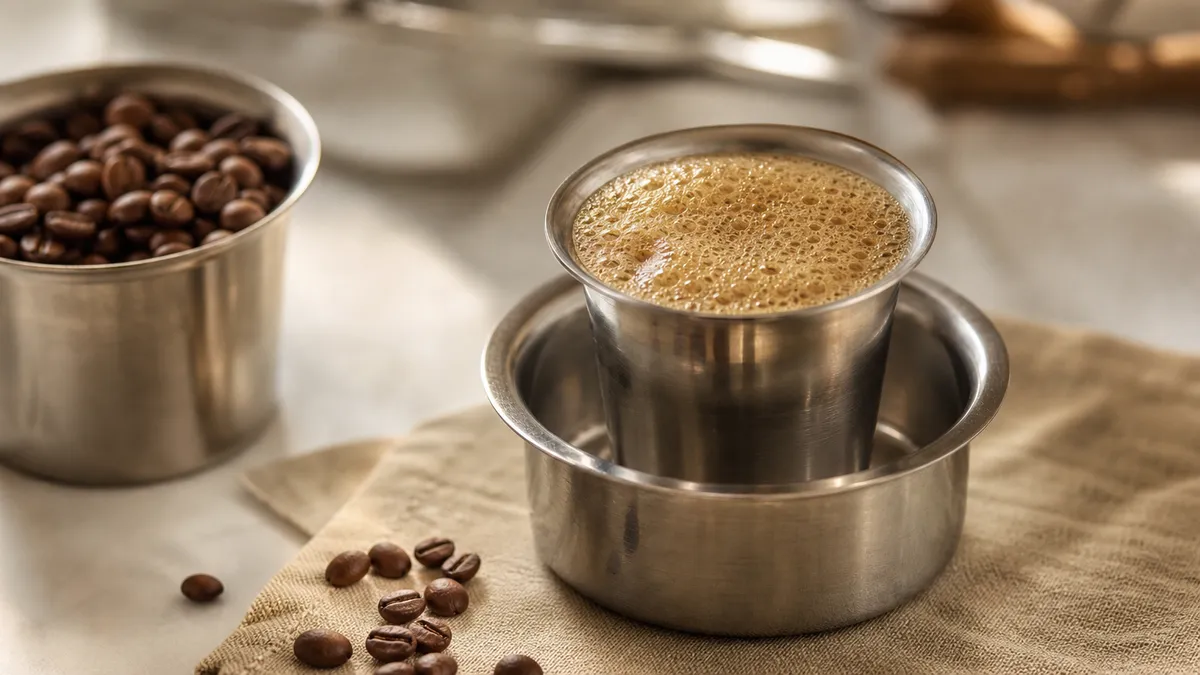
Indian filter coffee, or South Indian filter kaapi, is made by slowly dripping hot water through ground coffee in a two-chamber metal filter, then mixing the concentrated brew with hot milk and optional sugar. Pouring it between a tumbler and its accompanying dabarah bowl mixes the drink, cools it and creates its characteristic froth.
In short
- Choose ground coffee intended for an Indian filter, not instant coffee.
- An 80% coffee and 20% chicory blend is a useful starting point; 70:30 blends are another established option.
- Brew with water, then add milk to the collected decoction, the concentrated coffee in the lower chamber.
- The recipe below uses 30 g of blend and 120 g of water for two small servings.
- Pour between vessels close to the worktop. A long, theatrical stream is not necessary.
The filter, coffee and chicory
A traditional Indian filter has two stacking chambers, usually stainless steel or brass. The upper chamber has a perforated base; the lower one catches the brew. A removable pressing disc and lid complete the apparatus. It works by gravity, without paper or a pump.
The disc is not a cafetière plunger. It rests above the grounds rather than being pushed down through the finished drink. Stainless steel is a straightforward choice for beginners; with brass, follow the maker’s food-contact and care instructions.
Choosing the blend
For the familiar chicory-blended style, start with 70% to 80% coffee and 20% to 30% roasted chicory root. These are established blends, not a compulsory definition: pure-coffee versions also exist.
Arabica, robusta or a mixture can supply the coffee component. Karnataka and Tamil Nadu both grow coffee, but a packet’s actual origin and species depend on its producer, so check rather than assume.
Chicory is a root, not a coffee variety. It contributes body, deeper colour and earthy, bitter-sweet, caramel-like notes. A published food-science review supports its effects on flavour and viscosity, meaning how thick a liquid feels. Chicory itself contains no caffeine, although the coffee in the blend does.
Choose a medium-dark roast and ask for Indian filter grind. Fine to medium-fine is a useful starting description, but there is no single grind that suits every filter. Published guides differ substantially, and excessively fine powder can block the perforations.
For other preparations, browse our coffee recipes.
Indian filter coffee recipe
This is a suggested starting recipe adapted from published brewing guidance, not a laboratory-tested formula. Match the batch to your filter’s capacity, leaving room for both grounds and water.
Serves: 2 small drinks
Preparation: about 5 minutes
Dripping: allow 10 to 30 minutes
Total: roughly 15 to 35 minutes
Ingredients
- 30 g ground Indian filter coffee blend, preferably 80:20 coffee to chicory
- 120 g water, approximately 120 ml
- 200 ml pasteurised whole milk
- 0 to 8 g sugar, according to taste
The blend-to-water ratio is 1:4 by weight. This produces a concentrate for dilution with milk, not a mug of ordinary black filter coffee.
Equipment
- Two-chamber Indian coffee filter with disc and lid
- Scales, kettle and timer
- Small saucepan
- Two tumblers and dabarahs, or heatproof cups and a small pouring jug
Method
- Assemble the filter. Put the perforated upper chamber over the collection chamber on a stable, heatproof surface.
- Add the blend. Weigh in 30 g and level it. Set the disc gently on top, without packing the grounds firmly.
- Add hot water. Pour in 120 g of water at approximately 93°C. Add it slowly and evenly, without exceeding the chamber’s capacity.
- Cover and wait. Allow 10 to 30 minutes for dripping. The liquid collected below is the decoction. Do not push the disc to force water through.
- Heat the milk. As brewing finishes, heat 200 ml milk until it just begins to rise towards a boil, then remove it from the heat. Watch the pan closely.
- Mix each serving. Divide the decoction equally between two vessels. Add up to 4 g sugar and 100 ml hot milk to each. For your next batch, adjust the milk according to how strongly you want the coffee to show.
- Pour and serve. Transfer each drink between tumbler and dabarah, or cup and jug, until mixed and lightly frothy. Let it cool to a comfortable drinking temperature.
Water remains in the wet grounds, so the collected decoction will be less than the water added. Divide what you actually collect rather than expecting a fixed yield.
Approximate caffeine and its basis
Allow approximately 105 to 180 mg per serving under the calculation below, rather than treating this as a measured caffeine value.
The Coffee Board of India reported caffeine contents of 0.7% to 1.2% in sampled commercial filter-coffee blends. Applying that powder range to 30 g, assuming complete transfer into the decoction and dividing it equally, gives:
30 g × 0.007 to 0.012 × 1,000 mg/g ÷ 2 = 105 to 180 mg per serving.
Actual extraction may be lower, while a different blend may fall outside the sampled range. Added milk does not remove caffeine. Individual sensitivity varies; during pregnancy, NHS advice is no more than 200 mg daily from all sources. Do not use this estimate to judge a precise personal allowance; ask a midwife, GP or pharmacist where appropriate.
The tumbler and dabarah tradition
The tumbler is the drinking vessel; the dabarah is the broad bowl beneath it. You will also encounter spellings such as dabara and davara. Together they provide vessels for mixing and serving, rather than merely a cup and decorative saucer.
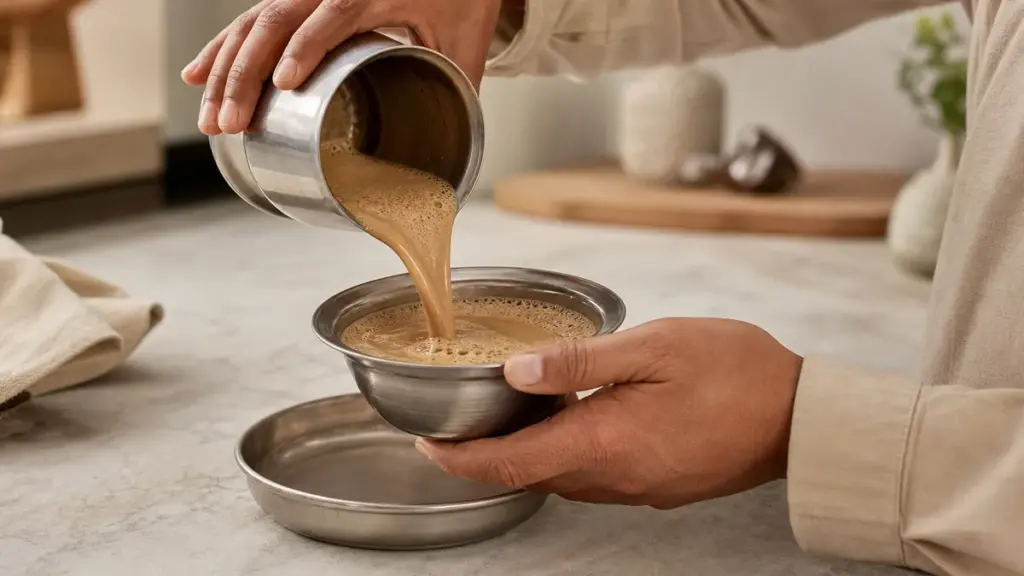
Pouring back and forth combines the decoction, milk and sugar, introduces air and releases heat. The resulting bubbles are part of the drink’s presentation. They are not espresso crema.
At home, begin with the vessels close together over a tray. Keep fingers away from hot rims and stop when the drink is mixed and pleasantly frothy. Height is optional; control is not.
Whole milk is a useful starting choice for a rounded drink. Barista-style oat drink is an alternative suggested by coffee producers, though it changes the flavour. Neither needs to pass through the coffee filter.
For another small metal-filter preparation, see Vietnamese iced coffee.
Adjusting the decoction
Change one variable at a time and keep a note of the blend, water and milk quantities. First decide whether the decoction itself tastes weak or whether you have simply added more milk than you prefer.
| Symptom | Likely cause | Fix |
|---|---|---|
| Little or no dripping | Grind too fine, compacted bed or obstructed holes | Let the filter cool, clean it and try a slightly coarser grind with lighter disc pressure |
| Thin, pale finished drink | Too much milk or insufficiently concentrated decoction | Reduce milk first; assess the decoction separately |
| Harsh, bitter finish | Blend preference or extraction conditions | Try a coarser grind or a different blend |
| Uneven results between batches | Changing dose, grind or dilution | Weigh ingredients and change only one setting |
There is genuine disagreement about the disc. RAANI’s guide retains it with light pressure; Kaveri’s guide omits it. Neither approach makes a successful cup inauthentic. Follow your filter’s instructions first, and avoid treating a manufacturer’s preferred technique as a universal rule.
A short history of filter kaapi
Coffee cultivation and the later milk-coffee tradition should not be given the same origin date.
- Around 1600: the Coffee Board recounts the traditional story of Baba Budan planting seven coffee seeds in Karnataka. This is an origin tradition, not evidence that today’s filter-coffee recipe existed then.
- Eighteenth century: the Board dates the beginnings of commercial Indian coffee plantations to this period.
- By the 1860s: commercial arabica cultivation had spread through hills in present-day Karnataka, Kerala and Tamil Nadu.
The precise invention date of the familiar metal filter is not established by the sources used here. Its continuing identity lies in the preparation and serving ritual: concentrated decoction, hot milk and the tumbler-and-dabarah pour.
FAQ
Can I use instant coffee powder?
No, instant coffee is not a replacement for grounds in this apparatus. It is intended to dissolve, whereas the filter holds ground coffee while water passes through it. You can make a milky instant drink, but it is a different preparation. Our Dalgona coffee recipe offers another way to use instant coffee.
Can I make the decoction ahead?
Yes, but keep it separate from the milk and refrigerate it promptly rather than leaving it out overnight. As a conservative household rule, cool it in a small clean container and refrigerate within two hours, at 0°C to 5°C. Following general FSA leftovers guidance, use it within 48 hours or freeze it.
Do I need the traditional serving set?
No, a heatproof cup and small pouring jug can perform the mixing step. Choose vessels with enough spare capacity to prevent spills and start with them close together. The tumbler and dabarah preserve the traditional presentation, but neither is essential to brewing the decoction itself.
Where to go next
Return to Coffee Recipes to choose your next preparation, or read Vietnamese Iced Coffee for another metal-filter method. Turkish Coffee provides a useful contrast to Indian filter coffee, while Dalgona Coffee explores a different route to a frothy drink.
Sources
- RAANI, “Brew Guide”, undated. Concentrated brewing ratio, traditional disc method, milk and aeration. URL: https://raanicoffee.com/pages/resources.
- Kaveri Coffee, “South Indian Filter”, 2026. Apparatus, alternative disc-free technique, milk options and serving ritual. URL: https://www.kavericoffee.com/blogs/brew-guides/south-indian-filter.
- Narasu’s, “Coffee & Tea” help and FAQs, undated. Commercial 80:20, 70:30 and pure-coffee options. URL: https://www.narasuscoffee.in/site/helpfaqs?help_category_id=5.
- Harshitha and colleagues, “Coffee and chicory blend: properties, nutrition, and health implications”, Journal of Food Science and Technology, 2025. Review of chicory’s sensory and physical contributions. URL: https://pmc.ncbi.nlm.nih.gov/articles/PMC12174007/.
- Coffee Board of India, “About Us”, undated. Cultivation history and the Baba Budan tradition. URL: https://coffeeboard.gov.in/aboutus.aspx.
- Coffee Board of India, Database on Coffee, January 2023. Arabica and robusta production in Karnataka and Tamil Nadu. URL: https://coffeeboard.gov.in/Database/DATABASE3_JAN2023.pdf.
- Coffee Board of India, Annual Report 2021 to 2022, printed page 50. Analytical results for commercial coffee-chicory powders. URL: https://coffeeboard.gov.in/RTI/CB_AR_Eng_2021-22.pdf.
- Coffee Board of India, Coffee Marketing, Part IV, paragraphs 1105 to 1111, undated. Grind-related clogging, extraction temperatures and variable percolation times. URL: https://coffeeboard.gov.in/CoffeeBoard/marketing-dept.pdf.
- NHS, “Foods to avoid in pregnancy”, current online guidance retrieved November 2026. Pregnancy caffeine limit. URL: https://www.nhs.uk/pregnancy/keeping-well/foods-to-avoid/.
- Food Standards Agency, “How to chill, freeze and defrost food safely”, current online guidance retrieved November 2026. Household refrigeration and leftovers guidance. URL: https://www.gov.uk/government/publications/how-to-chill-freeze-and-defrost-food-safely/how-to-chill-freeze-and-defrost-food-safely.
Researched from retrieved producer brewing guides, Coffee Board publications, a peer-reviewed review and current UK public-health guidance; the recipe is an editorial adaptation, not a claim of first-hand testing.
Last checked: November 2026