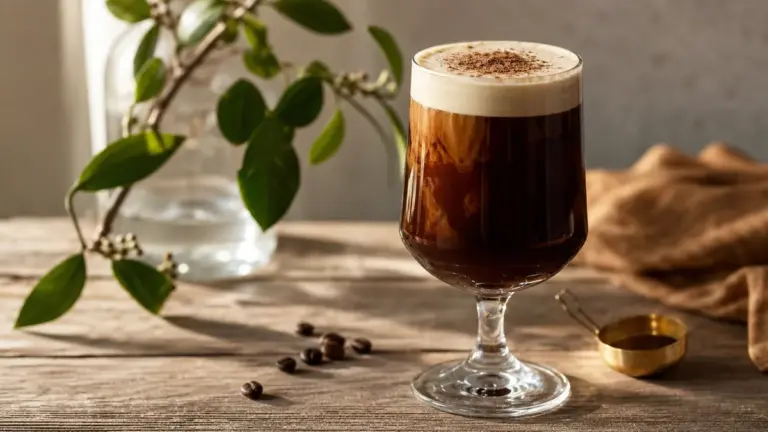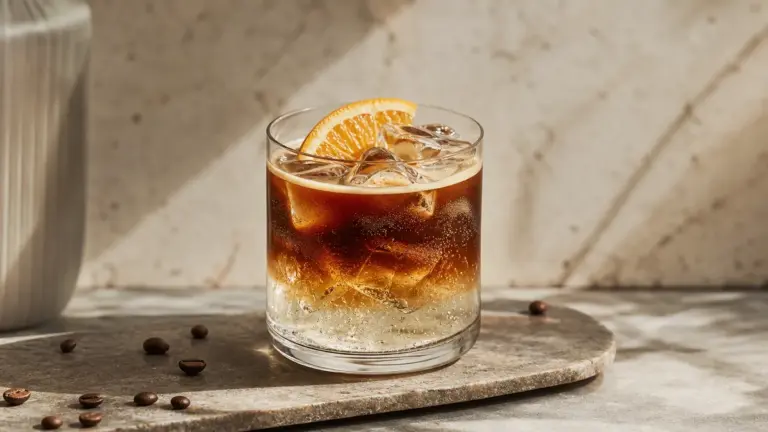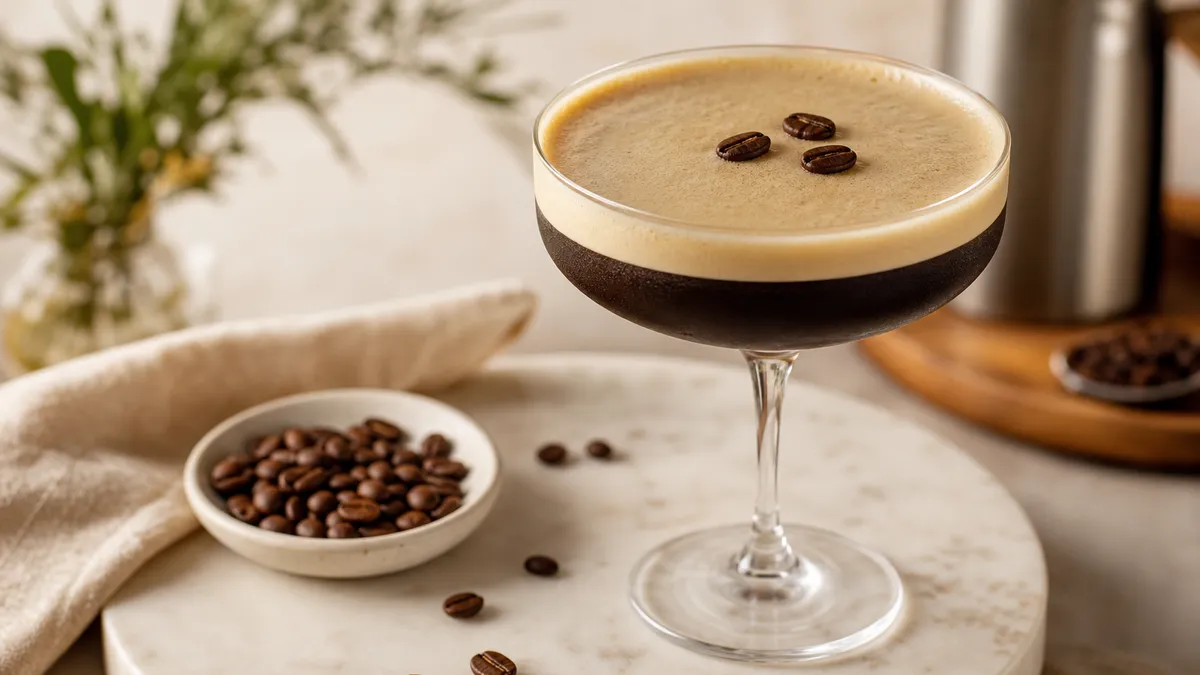
To make an espresso martini, shake measured espresso, vodka and coffee liqueur vigorously with ice, then strain into a chilled cocktail glass. Freshly brewed coffee supplies the flavour, while a hard shake creates the fine foam; other coffee cocktails range from creamy White Russians to refreshing cold brew drinks.
In short
- Start with 30 ml each of vodka, coffee liqueur and espresso, a published equal-parts recipe rather than the only accepted formula.
- Shake hard with ice for 15 to 20 seconds. Neither cream nor egg white is needed for the classic espresso martini.
- Measure every alcoholic ingredient: coffee liqueur contributes alcohol units as well as sweetness.
- UK units equal volume in ml multiplied by ABV percentage, divided by 1,000. Calculate each alcoholic ingredient separately, then add them.
- Coffee does not sober you up or restore alcohol-impaired coordination.
Espresso martini recipe
This version follows Kahlúa’s published equal-parts recipe. It is an approachable starting point, not a claim to reproduce the earliest drink exactly. Use it to establish a baseline before changing the sweetness.
Serves: 1
Time: allow approximately 5 minutes, including brewing
Equipment: espresso machine, cocktail shaker, ml measure, cocktail strainer, optional fine sieve, chilled coupe or martini glass
Ingredients
- 30 ml vodka
- 30 ml coffee liqueur
- 30 ml freshly brewed espresso, allowed to cool briefly
- Ice cubes, enough to half-fill the shaker
- 3 whole roasted coffee beans, optional garnish
No extra syrup is included in this version. If you prefer a sweeter result, try adding 5 ml sugar syrup to the next serving rather than pouring it in unmeasured. This is an editorial adjustment, not part of the equal-parts formula.
Method
- Chill the glass. Put it in the fridge while you prepare the ingredients, or chill it with ice and discard that ice before serving.
- Brew the espresso. Measure 30 ml of the finished coffee. Let it cool briefly while you measure the other ingredients.
- Load the shaker. Half-fill it with ice, then add the vodka, coffee liqueur and espresso.
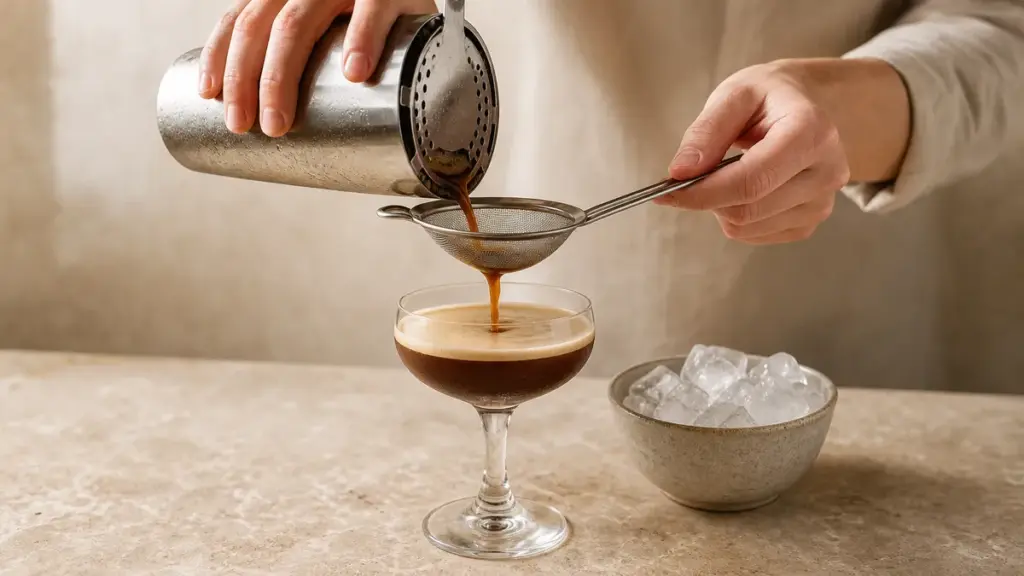
- Shake vigorously for 15 to 20 seconds. Hold both parts securely and use a firm back-and-forth movement.
- Strain immediately. Pour into the empty chilled glass. A fine sieve is optional if you want to catch small ice fragments.
- Finish gently. Allow the foam to settle, then place the beans on its surface.
Approximate caffeine: an illustrative estimate is about 45 mg per serving, assuming espresso at EFSA’s reference concentration of 80 mg per 60 ml, plus approximately 3 mg from 30 ml Kahlúa. Actual espresso can differ substantially, so this is not a measured result or a dependable upper limit. Other liqueurs need their own manufacturer’s figures.
Pregnancy and sensitivity note: the NHS advises avoiding alcohol in pregnancy and limiting caffeine from all sources to 200 mg daily. Individual sensitivity, medicines and medical conditions can change what is appropriate; ask a GP, pharmacist or midwife about personal concerns.
For drinks without spirits, the wider coffee recipes collection offers other starting points.
How to get a fine espresso martini foam
The pale cap is coffee foam, not whipped cream. Shaking introduces air and breaks it into bubbles; compounds in the coffee help those bubbles persist.
The chemistry needs a little care. A peer-reviewed review of food foams identifies protein-related and polysaccharide components as contributors to espresso foam stability. It also reports that coffee lipids can reduce foam formation and stability. The familiar explanation that shaking simply “emulsifies the oils into foam” is therefore incomplete: an emulsion contains liquid droplets, whereas a foam contains gas bubbles.
That research concerns espresso and food foams, not a controlled comparison of every cocktail recipe. The practical application is more modest: use coffee with sufficient flavour and body, shake decisively, and serve promptly.
Kahlúa’s published instructions use fresh, cooled espresso, so the coffee does not have to enter the shaker piping hot. Fresh brewing and vigorous shaking matter more than insisting that the shot must still be steaming.
| Symptom | Likely cause | What to try |
|---|---|---|
| Little foam immediately after pouring | Insufficient agitation | Use the full 15 to 20 second vigorous shake |
| Coffee flavour seems thin | Coffee too weak for this combination | Use espresso rather than substituting an equal volume of ordinary filter coffee |
| Drink tastes excessively sweet | Liqueur and any added syrup dominate | Omit extra syrup; record the liqueur used before changing proportions |
| Small ice chips spoil the texture | Fragments pass through the main strainer | Add a fine sieve when straining |
| Foam looks coarse after waiting | Bubbles have drained and merged | Shake close to serving time rather than preparing finished glasses ahead |
Treat these as troubleshooting suggestions, not guarantees. Change one thing at a time so you can tell which adjustment helped.
Choosing the coffee and liqueur
My preference is an espresso with chocolate, caramel or nut-like flavours for a first attempt. Those flavours give a useful reference point against the liqueur’s sweetness. A brighter, fruitier coffee is worth exploring afterwards, but there is no requirement to use a particular origin or roast.
Taste the coffee before mixing. If you dislike its harsh, burnt or sharply sour character on its own, start by improving the coffee rather than trying to hide it with syrup.
Measure espresso in ml for this cocktail, but do not confuse that serving measure with an espresso brewing recipe. Crema, the foam on freshly brewed espresso, makes volume an imperfect guide to the amount extracted.
Keep a note of the liqueur and its labelled ABV, meaning alcohol by volume. When changing products, reassess both the flavour balance and the alcohol calculation rather than assuming they are interchangeable.
Other classic coffee cocktails
These recipes each make one serving. They also show why “coffee cocktail” does not always mean a drink containing freshly brewed coffee: some obtain their coffee character entirely from liqueur.
Black Russian
Pour 50 ml vodka and 20 ml coffee liqueur over ice in a short tumbler and stir gently. These are the International Bartenders Association’s published measures.
Choose it when you want a short drink without cream or fresh coffee. Do not increase the liqueur casually when adjusting sweetness: that also changes the alcohol content.
White Russian
Kahlúa’s published version uses 30 ml vodka, 30 ml coffee liqueur and 30 ml cream, poured over ice, with the cream added last.
It suits someone who prefers a creamy drink rather than an espresso martini’s aerated texture. Cream also means milk is present, so check guests’ dietary requirements and follow the ingredient’s storage instructions.
Irish coffee
The IBA version combines 50 ml Irish whiskey, 120 ml hot coffee and 50 ml chilled cream, with sugar dissolved in the coffee before the cream is floated over it.
The technique is different from a shaken cocktail: the cream forms a separate top layer. Use the dedicated Irish coffee recipe for the full method rather than treating it as an espresso martini served warm.
For another coffee-led dessert, affogato takes a different route, pairing coffee with ice cream rather than building a cocktail.
Cold brew coffee cocktails
Cold brew is a practical alternative when you do not have espresso available. However, distinguish ready-to-drink coffee from concentrate: follow the product’s dilution instructions rather than substituting concentrate blindly.
Cold brew martini
Kahlúa publishes a version containing:
- 30 ml vodka
- 60 ml coffee liqueur
- 90 ml cold brew coffee
- Ice
Shake with ice for 15 to 20 seconds, then strain into a cocktail glass. It makes one comparatively large serving, so choose a glass that accommodates it.
This is a separate recipe, not a straight coffee substitution in the espresso martini above. Its larger liqueur measure must be included when counting units.
Cold brew soda
For one serving, fill a tall glass with ice. Add 30 ml coffee liqueur and 30 ml cold brew, stir, then top with 90 ml soda water. Finish with lemon if wanted.
These measures follow Kahlúa’s published recipe. The result has a longer, sparkling format without added vodka, but it still contains alcohol.
Add soda only after any shaking or vigorous mixing has finished. There is no need to put a carbonated ingredient in a sealed shaker.
For caffeine, use the cold brew manufacturer’s figure where available: multiply its stated mg per ml by the volume used, then add the liqueur’s contribution. There is no defensible single caffeine estimate covering every homemade concentrate.
If you would rather make an iced coffee without spirits, try Vietnamese iced coffee.
Responsible drinking and UK alcohol units
One UK alcohol unit is 10 ml, or 8 g, of pure alcohol. A cocktail is not automatically one unit, and neither its glass size nor its coffee content tells you how much alcohol it contains.
Use:
Units = volume in ml × labelled ABV percentage ÷ 1,000
For the equal-parts espresso martini above, assume, purely for this example:
- Vodka: 30 ml at 40% ABV
- Coffee liqueur: 30 ml at 16% ABV
- Espresso and ice: no alcohol
The calculation is:
- Vodka: 30 × 40 ÷ 1,000 = 1.20 units
- Liqueur: 30 × 16 ÷ 1,000 = 0.48 units
- Total: 1.68 UK units
Check your own bottles. These are example strengths, not a statement that every vodka or coffee liqueur has that ABV. Melting ice dilutes the drink’s alcoholic concentration but does not remove any of its alcohol units.
The NHS advises adults not to drink more than 14 units weekly on a regular basis, spreading consumption over 3 or more days if drinking that amount. This is lower-risk guidance, not a target.
Caffeine does not reverse alcohol’s effects on judgement or coordination. Do not use feeling more awake, or a unit calculation, as evidence that you can drive safely.
EFSA’s 2015 scientific assessment found that 100 mg caffeine close to bedtime can affect sleep in some adults. Count earlier coffees as well as the cocktail, and consider decaffeinated coffee for an evening serving.
Preparing ahead and serving safely
Measure ingredients rather than free-pouring, and make the alcohol content clear to guests. Offer a genuinely non-alcoholic alternative rather than simply omitting vodka while leaving coffee liqueur in place.
For preparation ahead, keep chilled ingredients refrigerated and shake individual servings close to service. FSA household guidance recommends a fridge temperature between 0 and 5°C. Follow cream and bottled coffee storage instructions, including use-by dates and directions after opening.
Who created the espresso martini?
The drink is credited to London bartender Dick Bradsell, originally under the name Vodka Espresso, commonly dated to 1983.
The precise venue is less secure than many retellings suggest. Fred’s Club in Soho appears in published accounts, while Kahlúa’s history names Soho Brasserie. These retrospective stories do not agree, so “created at Fred’s Club in 1983” should not be presented as an uncontested fact.
The practical legacy is clearer: espresso, vodka, coffee liqueur and sugar, shaken with ice. The equal-parts espresso martini here is a later published formulation, not a verified transcription of the first serving.
FAQ
Can I make an espresso martini without an espresso machine?
Yes, although the result becomes a variation rather than the espresso recipe above. The cold brew martini provides a fully measured alternative. Use the cold brew as directed, distinguishing concentrate from ready-to-drink coffee, and do not assume its caffeine content matches espresso. Keep the alcoholic measures recorded so you can calculate units.
Can I use decaffeinated coffee?
Yes, decaffeinated espresso can replace the espresso measure. However, using decaf coffee does not necessarily make the whole cocktail caffeine-free: coffee liqueur may also contain caffeine. Check the manufacturer’s information for both ingredients if caffeine matters to you, and remember that changing the coffee does not reduce the drink’s alcohol units.
Does an espresso martini need egg white?
No, the published espresso martini recipe used here contains neither egg white nor cream. Its foam comes from shaking the coffee mixture with ice. Before adding another ingredient, check the shake and serving timing. Adding egg white would create a different recipe and introduce an additional allergen.
Where to go next
Continue with Irish Coffee for a hot coffee cocktail, or Affogato for a simpler coffee dessert. Vietnamese Iced Coffee explores a sweet iced drink without spirits, while Coffee Recipes brings together the wider collection.
Sources
-
Kahlúa, “Espresso Martini Recipe”, undated, current page retrieved November 2026. Equal-parts formula, shaking method, cooled espresso and garnish.
https://www.kahlua.com/en-us/drinks/espresso-martini/ -
Kahlúa, “Frequently Asked Questions”, undated, current page retrieved November 2026. Manufacturer’s approximate caffeine information.
https://www.kahlua.com/en-ca/faq/ -
Narsimhan, G. and Xiang, N., “Role of Proteins on Formation, Drainage, and Stability of Liquid Food Foams”, Annual Review of Food Science and Technology, volume 9, 2018. Review of foam mechanisms, including espresso.
https://www.annualreviews.org/content/journals/10.1146/annurev-food-030216-030009 -
International Bartenders Association, “Black Russian” and “Irish Coffee”, undated, current recipes retrieved November 2026.
https://iba-world.com/iba-cocktail/black-russian/
https://iba-world.com/iba-cocktail/irish-coffee/ -
Kahlúa, “White Russian”, “Cold Brew Martini” and “Kahlúa Cold Brew Soda”, undated, current recipes retrieved November 2026.
https://www.kahlua.com/en/drinks/white-russian/
https://www.kahlua.com/en-au/drinks/cold-brew-martini/
https://www.kahlua.com/en/drinks/kahlua-cold-brew-soda/ -
NHS, “Alcohol units”, current guidance retrieved November 2026. Unit definition, calculation and weekly guidance.
https://www.nhs.uk/live-well/alcohol-advice/calculating-alcohol-units/ -
European Food Safety Authority, “Caffeine”, including conclusions from its 2015 scientific opinion; current page retrieved November 2026. Espresso reference caffeine content and sleep guidance.
https://www.efsa.europa.eu/en/topics/topic/caffeine -
NHS, “Foods to avoid in pregnancy”, current guidance retrieved November 2026. Alcohol avoidance and caffeine limit.
https://www.nhs.uk/pregnancy/keeping-well/foods-to-avoid/ -
National Institute on Alcohol Abuse and Alcoholism, “The Truth About Holiday Spirits”, undated, current page retrieved November 2026. Caffeine does not reverse alcohol impairment.
https://www.niaaa.nih.gov/publications/brochures-and-fact-sheets/truth-about-holiday-spirits -
Food Standards Agency, “How to chill, freeze and defrost food safely”, 2017, current guidance retrieved November 2026. Household refrigeration and storage guidance, published for England, Northern Ireland and Wales.
https://www.gov.uk/government/publications/how-to-chill-freeze-and-defrost-food-safely/how-to-chill-freeze-and-defrost-food-safely -
Kahlúa, “Espresso Martini Day”, undated; Time Out London, “Raise an espresso martini to cocktail legend Dick Bradsell”, 2016. Compared for conflicting retrospective origin accounts.
https://www.kahlua.com/en/newsroom/espresso-martini-day/
https://www.timeout.com/london/blog/raise-an-espresso-martini-to-cocktail-legend-dick-bradsell-022916
The piece was researched using published cocktail recipes, a peer-reviewed foam review and official health and food-safety guidance; calculations and editorial adjustments are identified separately.
Last checked: November 2026