
The main coffee drinks fall into a few families: concentrated espresso, espresso with water, espresso with milk, brewed coffee, and cold or sweetened variations. The easiest way to choose between coffee drinks is to compare their coffee base, milk texture and finished size, rather than relying on the name alone.
In short
- Names are guides, not universal specifications. Serving sizes and recipes vary between countries, cafés and machines.
- For a small milk drink, compare an espresso macchiato, cortado or piccolo.
- For texture, choose a flat white for a thin layer of fine foam, a latte for more milk, or a cappuccino for a more prominent foam layer.
- An Americano is diluted espresso, not filter coffee. A lungo is brewed longer through the grounds.
- When ordering somewhere unfamiliar, ask about the finished size and number of shots. These tell you more than “small” or “strong”.
Coffee drinks comparison chart
This chart compares the main espresso-based drinks by ingredients, approximate finished volume and milk balance. The sizes are indicative reference ranges drawn from the published examples below, not internationally fixed specifications or a survey of every café. Large chain drinks can sit outside them.
For milk drinks, the ratio means espresso to poured milk by approximate volume, including its foam. It is a guide to the finished drink, not a brewing ratio or an instruction for measuring cold milk into a jug. The ratios and size ranges are independent comparisons: do not combine their opposite endpoints into a recipe.
| Drink | What it contains | Indicative size | Espresso to milk | Choose it for |
|---|---|---|---|---|
| Espresso | Concentrated coffee | 25 to 40 ml | No milk | A short, undiluted coffee |
| Doppio | Double espresso | 50 to 80 ml | No milk | More espresso, without added water |
| Ristretto | A shorter espresso extraction | 15 to 25 ml | No milk | A smaller, concentrated shot |
| Lungo | A longer espresso extraction | 50 to 110 ml | No milk | A longer black coffee without separate dilution |
| Americano | Espresso and hot water | 150 to 260 ml | No milk unless requested | A longer espresso-based drink |
| Espresso macchiato | Espresso marked with milk or foam | 25 to 75 ml | Usually less than 1:1 | Espresso with a little softness |
| Cortado | Espresso and warm milk | 55 to 120 ml | Often about 1:1; versions vary | A small, balanced milk drink |
| Piccolo | A short coffee with textured milk | 75 to 105 ml | About 1:2 to 1:3 | A small, latte-like drink |
| Flat white | Espresso and finely textured milk | 135 to 180 ml | About 1:2 to 1:3 | Coffee flavour with a silky texture |
| Cappuccino | Espresso and milk with prominent foam | 150 to 210 ml | About 1:3 to 1:5 | A lighter, more aerated mouthfeel |
| Caffè latte | Espresso and a larger milk portion | 180 to 300 ml | About 1:3 to 1:9 | A milk-led coffee |
| Latte macchiato | Milk and foam with coffee added | 200 to 330 ml | About 1:5 to 1:7 | A tall, often layered milk drink |
Chart sources: Italian Espresso Institute, Nespresso’s published recipes, Lavazza’s Italian drinks guide, and NESCAFÉ Dolce Gusto’s drink definitions. Milk ratios are rounded interpretations of those examples; the doppio upper figure is twice the 40 ml espresso reference.
A mocha adds chocolate to espresso and milk, so its milk balance depends on the recipe. A long black combines espresso and hot water, conventionally with the water poured first. Neither needs its own supposedly universal ratio to be recognisable.
Understanding the espresso family
Espresso is coffee brewed by passing hot water under pressure through finely ground coffee. It is both a drink in its own right and the starting point for cappuccinos, lattes and many other café orders. For the preparation details behind these names, see our guide to espresso-based drinks.
Ristretto, espresso and lungo describe different extraction lengths. A ristretto is a shorter extraction; a lungo passes more water through the grounds. They are not simply the same finished espresso served in differently sized cups.
An Americano works differently: the espresso is brewed, then diluted with hot water. With a long black, the conventional sequence is hot water first, espresso afterwards, helping retain crema, the foam on top of espresso. Café recipes can overlap, so ask about dilution if you want a particular balance.
A doppio means a double espresso. It describes the coffee portion, not the size of the cup around it. That distinction becomes useful when ordering a longer drink: adding water changes dilution, whereas adding another espresso changes the coffee portion.
Milk drinks: ratios matter, but texture matters too
Milk drinks are not separated by a neat ladder of ratios alone. Foam contains air, so equal-looking milk portions can contain different amounts of liquid milk. Microfoam means milk containing very small bubbles, integrated into a smooth, fine texture rather than a separate mound of large bubbles.
Small milk drinks
An espresso macchiato remains recognisably an espresso, with a small addition of milk or foam. A cortado usually brings coffee and warm milk closer to equal proportions. A piccolo is a small milk drink with a latte-like character, although the coffee base and milk quantity vary between recipes.
These names do not guarantee identical drinks. Nespresso, for example, publishes a cortado recipe containing considerably less milk than coffee, as well as a larger cortado variation. Treat “equal parts” as a useful convention, not a rule every machine follows.
Flat white, cappuccino and latte
A flat white usually combines a relatively compact serving with a thin layer of fine microfoam. A latte contains more milk relative to coffee in the usual comparison, with a modest foam layer. A cappuccino makes the foam more prominent.
The familiar cappuccino diagram showing equal thirds of espresso, milk and foam is a teaching convention, not a universal recipe. The Italian Espresso Institute’s certified example instead starts with 25 ml espresso and 100 ml cold milk, expanded to about 125 ml by steaming, then served in a 150 to 160 ml cup. Our cappuccino guide explores that drink in more detail.
A latte macchiato reverses the emphasis of an espresso macchiato: it is milk marked with coffee. Espresso added to the milk and foam can produce visible layers. It is not another name for the small espresso-led drink.
Coffee beyond espresso
A complete drinks guide needs room for coffee that never starts with an espresso shot.
- Filter coffee includes automatic drip and hand-poured brewing. It is brewed directly with water passing through the grounds, rather than made by diluting espresso.
- Cafetière coffee, also called French press, is an immersion brew: coffee steeps in water before a mesh plunger separates the grounds.
- Instant coffee is brewed coffee that has been dried into soluble powder or granules, then dissolved in water.
- Café au lait means coffee with milk. It is useful to ask which coffee base the café uses rather than assume it is an espresso latte.
- Turkish coffee uses very finely ground coffee prepared in a small pot called a cezve and served unfiltered.
These are different brewing or serving traditions, not lesser versions of café espresso drinks. To move from recognising names to making drinks, browse the coffee recipes collection.
Cold, chocolate and dessert coffees
Iced coffee is an umbrella description, but it commonly means hot-brewed coffee served cold with ice. Cold brew refers to extraction with room-temperature or cooler water. The distinction concerns brewing, not just serving temperature: cold brew can also be served warm.
Other useful names include:
- Iced latte: espresso, cold milk and ice.
- Nitro cold brew: cold brew infused with nitrogen, producing a foamy appearance and distinctive texture.
- Mocha: espresso, chocolate and milk.
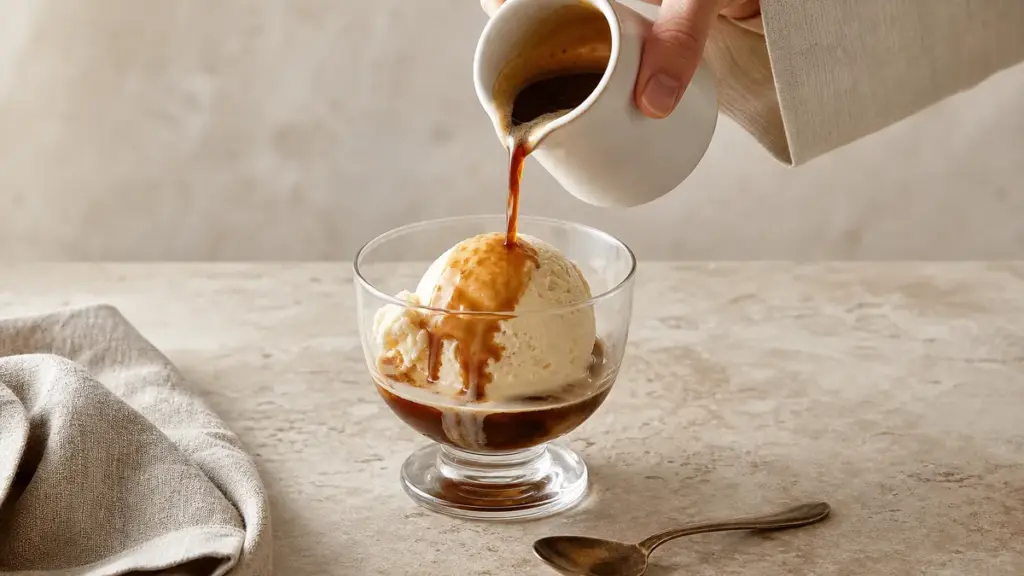
- Affogato: hot espresso poured over ice cream, sitting somewhere between coffee and dessert.
- Espresso con panna: espresso topped with whipped cream.
- Irish coffee: coffee combined with Irish whiskey, sugar and cream.
- Red eye: brewed coffee with espresso added.
For these drinks, ask about ingredients as well as size. Chocolate, cream, syrups and ice make a simple espresso-to-milk comparison less informative.
Regional differences: the UK, Italy and Australia
United Kingdom
Do not assume that a UK chain’s flat white matches a compact reference recipe. Costa’s published UK information, checked in November 2026, lists its default whole-milk flat white at 241 ml in store and 262 ml for takeaway, compared with Nespresso’s 150 ml reference recipe. These are company-specific examples, not competing international standards.
This is why checking the actual serving is more useful than deciding that a café has used the “wrong” cup.
Italy
In a traditional Italian bar, un caffè normally means an espresso. Ask for caffè latte if you want coffee with milk: latte alone means milk. Cappuccino is associated particularly with breakfast, but that is a cultural convention, not a restriction on what you may enjoy later.
The certified Italian espresso and cappuccino figures are useful reference points for that tradition. They should not be presented as rules governing every modern coffee shop.
Australia
Flat white, piccolo and long black are useful names to recognise on Australian menus. Published Australian manufacturer guidance describes the flat white as less milky than a latte, with a thinner microfoam layer, and the piccolo as a small drink with a higher coffee proportion than a latte. The long black convention is espresso poured over hot water.
Avoid making “always a double shot” part of the flat white definition. Breville’s Australian-style guidance includes a single-shot example, illustrating how recipes vary even within a familiar tradition.
How to order the coffee drink you actually want
Use this checklist rather than trying to memorise every possible menu name.
- Choose the family: black coffee, milk coffee, cold coffee or a sweetened variation.
- Describe the finished size: “a small milk drink” is a useful starting point; ask for the volume if the menu is unclear.
- Ask about the coffee portion: “How many shots are in that size?”
- Describe texture: little foam, silky textured milk or a more prominent foam layer.
- State the milk and extras: specify your preferred milk and whether you want chocolate or syrup.
- Confirm unfamiliar names: “Is your macchiato an espresso with a little milk, or a larger milk drink?”
For example: “A small flat white, please. How many shots does that contain?” Or: “An espresso macchiato, just the small espresso with a little milk.”
For home or office bean-to-cup machines, check the programmed recipe rather than assuming the button name fixes the ingredients. Published machine recipes allow different coffee, milk and foam quantities under familiar drink names.
The most useful coffee drinks vocabulary tells someone what you want to drink. Size, coffee portion and texture make that conversation much clearer.
FAQ
Is a flat white simply a small latte?
Not necessarily, although the drinks can overlap. Flat white recipes usually emphasise less milk and a thinner microfoam layer than a latte, but serving sizes and shot counts vary. If you want to compare two drinks in one café, ask about their coffee portions and finished volumes rather than relying on the names alone.
Does a larger cup always contain more espresso?
No. A larger drink can contain more milk or water without a proportionate increase in espresso. Published machine recipes show that coffee and added-liquid quantities can change independently. Ask how many shots are included in each size, particularly when you want more coffee flavour rather than simply more drink.
Is a mocha the same as a cappuccino with chocolate dusted on top?
No. Chocolate is an ingredient within a mocha, combined with espresso and milk. A cappuccino may have a light chocolate topping without becoming a mocha. If chocolate intensity matters to you, ask whether the café uses cocoa, chocolate sauce or another preparation, since the recipe determines the finished drink.
Where to go next
Use Coffee Recipes to choose a drink to make, then read Espresso-Based Drinks for the preparation principles behind the café menu. For a closer look at milk texture and traditional serving conventions, continue with Cappuccino.
Sources
-
Italian Espresso Institute, L’Espresso Italiano e il Cappuccino Italiano Certificati, December 2006. Certified espresso and cappuccino reference figures.
https://iei.coffee/en/espresso-italiano-certificato/ -
Nespresso Professional, Nespresso Momento Coffee & Milk User Manual, file identified as the 2024 version; recipe tables. Manufacturer-published recipes, not independent drink standards.
https://www.nespresso.com/static/us/solutions/b2b/product/machine/momento120_un_2024.pdf -
Nespresso Professional, How to Prepare a Beverage With or Without Milk, April 2023 file version. Finished-volume examples and milk-related variation.
https://www.nespresso.com/ecom/medias/sys_master/public/27119849668638/Momento-Milk-How-To-2023-04.pdf -
Breville, Flat White, Latte, Cappuccino, Macchiato, Ristretto and Piccolo, undated manufacturer guides, retrieved November 2026.
https://www.breville.com/ca/en/coffee-journey/recipes/flat-white.html
https://www.breville.com/ca/en/coffee-journey/recipes/latte.html
https://www.breville.com/ca/en/coffee-journey/recipes/cappuccino.html
https://www.breville.com/ca/en/coffee-journey/recipes/macchiato.html
https://www.breville.com/ca/en/coffee-journey/recipes/ristretto.html
https://www.breville.com/au/en/coffee-journey/recipes/piccolo.html -
Breville, Mocha, Affogato and Iced Latte, undated manufacturer guides, retrieved November 2026.
https://www.breville.com/ca/en/coffee-journey/recipes/mocha.html
https://www.breville.com/ca/en/coffee-journey/recipes/affogato.html
https://www.breville.com/ca/en/coffee-journey/recipes/iced-latte.html -
Lavazza, Italian Coffee Culture: Drinks, History & Etiquette and How to Make a Long Black Coffee, undated guides, retrieved November 2026. Used selectively for relevant terminology and preparation conventions.
https://www.lavazzausa.com/en/coffee-secrets/italian-style-coffee-history-types-culture
https://www.lavazzausa.com/en/recipes-and-coffee-hacks/how-to-make-long-black-coffee -
National Coffee Association, Brewing, Cold Brew Coffee and Instant Coffee, undated reference pages, retrieved November 2026.
https://www.aboutcoffee.org/brewing/
https://www.aboutcoffee.org/brewing/cold-brew-coffee/
https://www.aboutcoffee.org/brewing/instant-coffee/ -
NESCAFÉ Dolce Gusto, 30 Different Types of Coffee Explained, undated UK guide, retrieved November 2026. Used for named drink ingredients, not health or extraction claims.
https://www.dolce-gusto.co.uk/world-of-coffee/types-of-coffee-around-the-world -
Costa Coffee, Flat White, live UK menu and nutrition information, retrieved November 2026. Company-published serving figures for the default whole-milk selection.
https://www.costa.co.uk/menu/flat-white
This guide was researched by comparing published drink definitions, manufacturer recipes, Italian certification guidance and current UK menu information; no first-hand testing is claimed.
Last checked: November 2026