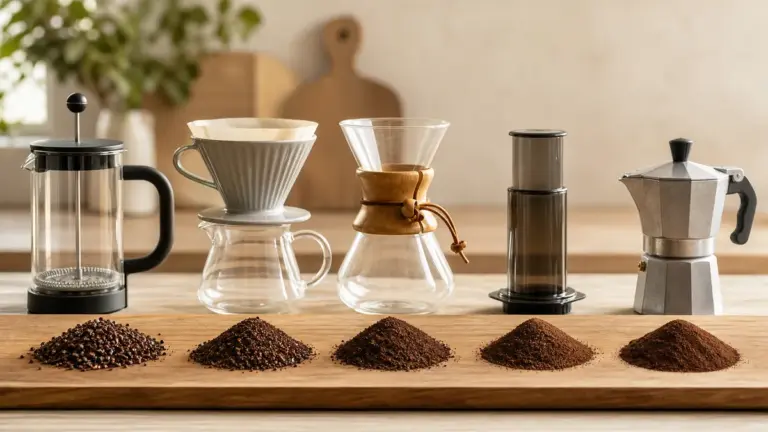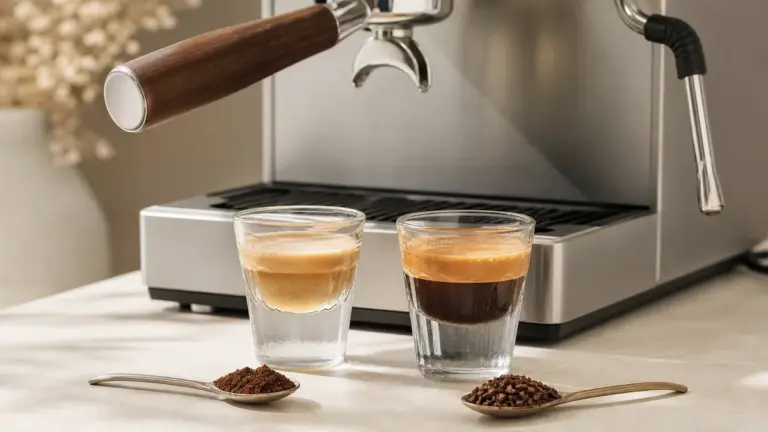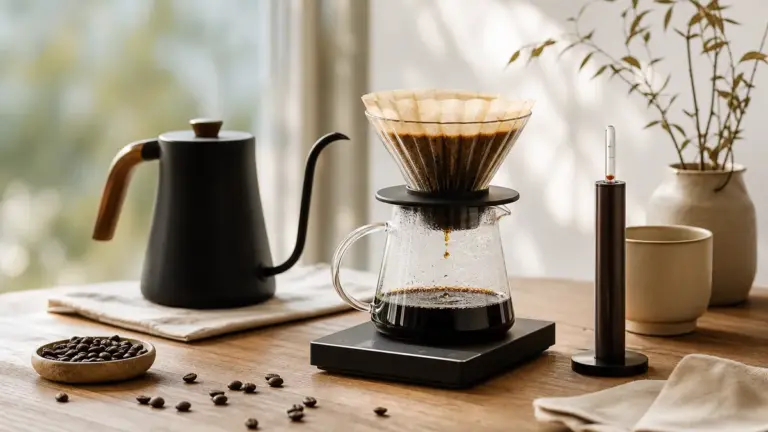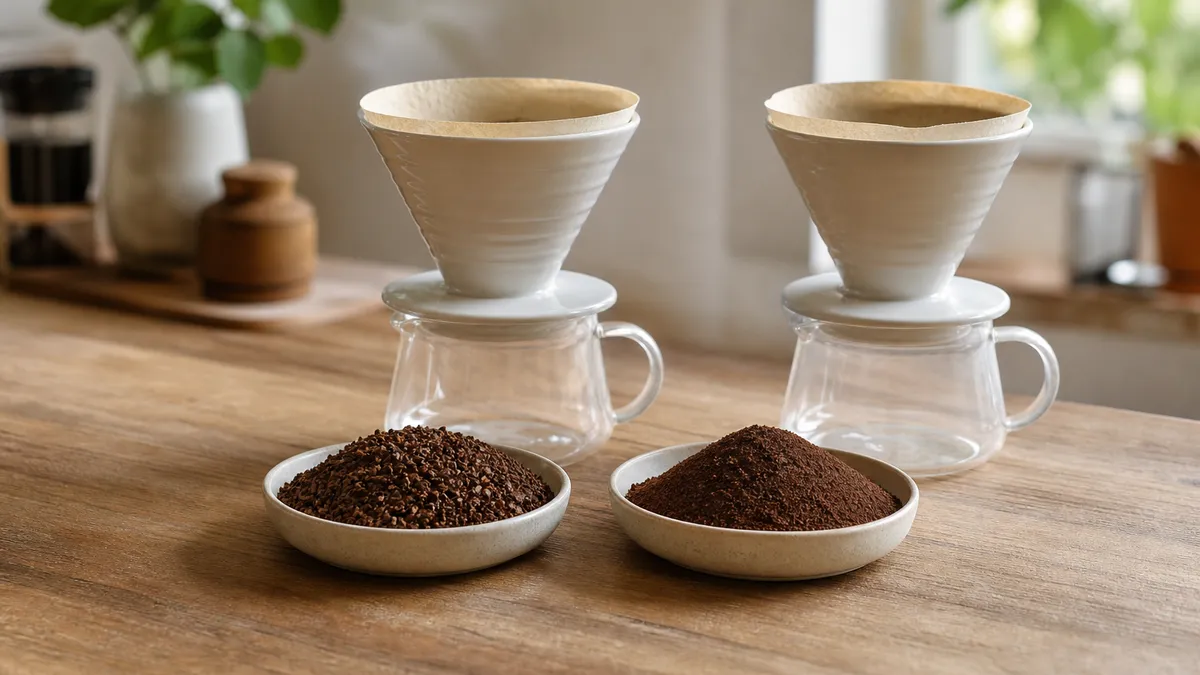
Grind size affects brewing by changing how quickly water extracts soluble material from coffee and how easily it flows through the grounds. Finer coffee generally extracts faster, but in pour-over and espresso it also increases resistance to flow, so grinding finer does not always produce a better or more evenly extracted drink.
In short
- In pour-over and drip brewing, grind changes both extraction speed and how quickly the coffee bed drains.
- In immersion brewing, you choose the steeping time: a finer grind does not automatically mean longer contact.
- Espresso needs resistance from the coffee bed, but excessive resistance can make extraction uneven.
- Channelling means water takes preferential routes through the grounds, leaving other areas less thoroughly extracted.
- Change grind while keeping the rest of your recipe steady, then judge the result by taste as well as time.
How grind size affects brewing
Extraction is the transfer of soluble material from roasted coffee into water. Grinding breaks the beans into smaller particles, exposing more surface and shortening the distance that dissolved material must travel from inside each particle.
There are two connected processes. Material at exposed, broken cells can dissolve relatively quickly; material deeper inside the particles takes longer to move through their internal pores. Smaller particles generally make that slower journey shorter.
However, a brewer contains more than individual particles. In methods where water passes through a bed of grounds, the spaces between those particles matter too. A grind change therefore affects both how readily coffee gives up soluble material and how readily water moves through it.
That distinction explains why the same adjustment behaves differently in a cafetière, a paper-filter dripper and an espresso basket. For the wider subject, start with grind size and extraction.
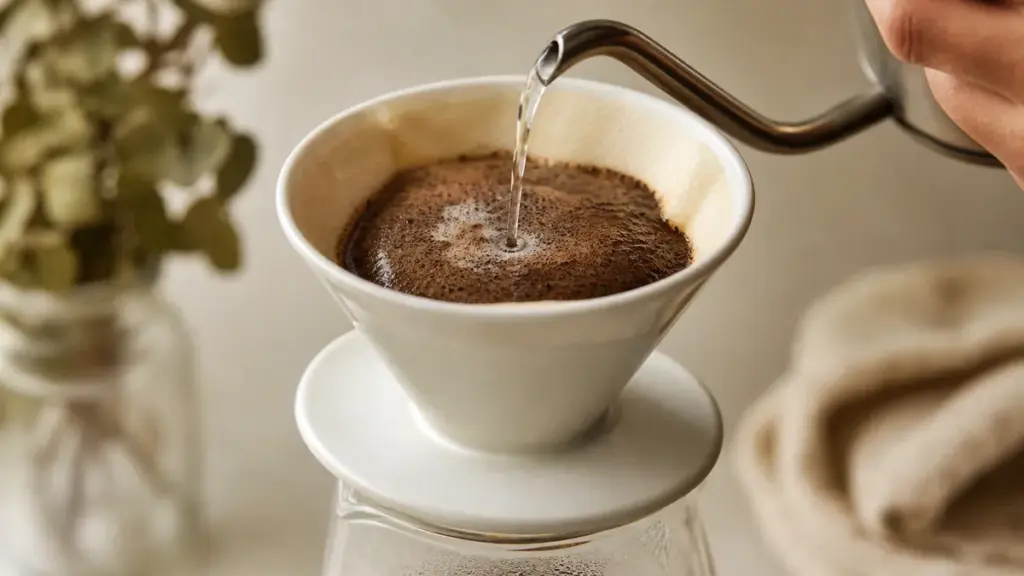
Percolation: grind changes the flow
Percolation means water travels through a bed of coffee, as it does in pour-over, automatic drip and espresso. Here, the bed acts as a porous filter: water must find connected passages between the particles.
A finer grind usually makes the bed less permeable, meaning water passes through it less easily. With the same brewer, dose and pouring routine, this commonly slows drainage. A coarser grind usually allows faster flow.
In a pour-over, grinding finer can therefore increase extraction in two ways: the smaller particles extract more readily, and slower drainage can extend the brewing process. These effects are linked, rather than being two entirely separate controls.
There are limits. A very restrictive bed may drain poorly without becoming evenly extracted. Water delivery, bed shape and the filter also influence the result, so a long brew is not proof of thorough extraction.
Read the drainage, not just the timer
Drawdown is the drainage of liquid from the coffee bed, particularly after pouring finishes. Watch whether the flow remains reasonably steady or slows markedly towards the end.
Manufacturer guidance for the V60 recommends trying a coarser grind when water drips through too slowly. That is a useful first adjustment, not a universal diagnosis: changing the paper, dose or pouring pattern can also change drainage.
Keep those variables steady while investigating grind. Otherwise, a faster brew may reflect a different filter or pouring routine rather than the adjustment you intended to test.
Immersion: contact time is a separate choice
In immersion brewing, coffee and water steep together instead of fresh water continuously passing through a stationary bed. A cafetière is the familiar example.
Grind still affects extraction speed, but it does not set the steeping time. If you brew two cafetières for the same duration, their scheduled contact time is the same even when their grinds differ. The finer particles generally release soluble material faster during that period.
This makes immersion easier to interpret in one respect: you can change grind without automatically changing drainage time. However, temperature, mixing and the amount of coffee relative to water still need to remain consistent for a useful comparison.
Extraction also slows as an immersion brew approaches equilibrium, the condition in which there is little further net transfer of soluble material into the surrounding liquid. Leaving coffee in water twice as long does not necessarily extract twice as much.
Controlled experiments and modelling have found that grind differences can have less influence on the eventual equilibrium extraction than on the speed of getting there. This does not mean grind is irrelevant: a practical steep may finish before that point, and the finding should not be transferred directly to flowing-water methods.
For the timing relationship in more detail, read extraction time and grind size.
Espresso: resistance is necessary, but more is not always better
Espresso forces water through a compact bed of finely ground coffee, often called the puck. Its resistance helps determine the flow rate produced by the machine.
With the same coffee dose, beverage yield and machine settings, grinding finer usually slows delivery. Grinding coarser usually speeds it up. This is why grind is such a useful adjustment when setting up an espresso recipe.
For a meaningful comparison, stop each shot at the same beverage mass rather than at the same time. Otherwise, the grind change also changes how much drink you collect, making its effect harder to interpret.
The complication is that increasing resistance does not guarantee an improvement. A bed that is difficult to penetrate evenly can produce inconsistent flow and leave some coffee less thoroughly extracted.
Experimental espresso research has found extraction yield falling at very fine settings, rather than increasing indefinitely. The researchers interpreted this as evidence of uneven flow. The practical lesson is not that coarse espresso is always preferable, but that “finer means more extraction” has a limit in a real coffee bed.
Channelling: when water takes easier routes
Channelling occurs when water flows preferentially through some parts of the bed rather than being distributed evenly. Grounds beside these routes receive a different history of flowing water from grounds elsewhere.
This matters because extraction is local. One region can be substantially more extracted than another, even though everything ends up mixed in the same cup.
Grinding finer cannot reliably correct poor flow distribution. If it increases resistance in an already uneven bed, the result may become less predictable rather than more thoroughly extracted. In espresso, this is one reason to keep preparation consistent before making repeated grind changes.
The same general concern applies to filter brewing. Research using flow models shows that bed geometry and water delivery can create differences in local extraction. Two brews with similar finishing times can therefore contain coffee extracted in different ways.
Treat flavour and repeatability as part of the diagnosis. A setting that produces an appealing cup reliably is more useful than one that occasionally reaches a chosen time but varies noticeably between brews.
A simple experiment: change only the grind
Use a pour-over comparison to see grind’s effects on both flow and flavour. The following is a controlled learning exercise adapted from Hario’s published method, not a claim that these settings suit every coffee.
- Set the recipe. Use 15 g of coffee and 250 g of brewing water, a coffee-to-water ratio of approximately 1:16.7 by weight. Set the kettle to 94°C.
- Prepare consistently. Use the same dripper and paper type. Rinse the paper, discard the rinse water and add medium-fine grounds.
- Keep the pouring routine steady. Wet all the grounds, wait 30 seconds, then continue with a repeatable circular pour until you reach 250 g. Note your pouring finish time and total drainage time.
- Change the grind slightly. Repeat with a somewhat coarser setting, keeping the beans, dose, water, temperature and pouring routine unchanged. Follow your grinder’s instructions for making adjustments.
- Compare rather than chase a target. Taste both at a similar drinking temperature. Record drainage, flavour and mouthfeel, then repeat the more promising setting to check whether the result is reproducible.
There is no need to make a large adjustment. The aim is to discover which direction helps your coffee, not to demonstrate the largest possible difference. See how to grind coffee for the practical preparation steps.
Troubleshooting the result
These are starting hypotheses, not diagnoses from a stopwatch alone.
| Symptom | Likely cause to investigate | First adjustment |
|---|---|---|
| Pour-over drains quickly and tastes thin or sharply sour | Insufficient extraction at that setting | Try slightly finer while preserving the pouring routine |
| Pour-over becomes much slower after grinding finer | Increased bed resistance | Return slightly coarser and compare flavour |
| Espresso barely delivers the intended yield | Excessive resistance for that recipe | Try slightly coarser with dose and yield unchanged |
| Finer espresso becomes less repeatable | Uneven flow may be limiting extraction | Check preparation consistency, then compare a coarser setting |
| Immersion coffee changes little after a longer steep | Extraction may be approaching a plateau | Compare grind at a fixed steep rather than extending time repeatedly |
Why the average particle size is not the whole story
Ground coffee contains a distribution of particle sizes, not identical fragments. Fines are the smaller particles within that distribution.
Their importance goes beyond extracting quickly. In controlled espresso experiments, increasing the proportion of fines reduced bed permeability and lengthened extraction time. The researchers found that both the size of the main particles and the share of fines helped explain extraction behaviour.
Consequently, two batches with a similar average particle size need not flow identically. Looking only at the larger, easily visible fragments can miss a meaningful difference.
That is why grind descriptions are starting points rather than complete recipes. Use the coffee grind size chart to choose an initial range, then assess the behaviour of your actual brewer.
Finally, distinguish strength from extraction yield. Strength describes the concentration of dissolved material in the drink; extraction yield describes how much of the original dry coffee mass has been extracted. Neither number, on its own, describes how evenly the bed was extracted or whether you will enjoy the result.
FAQ
Can I compensate for a coarse grind by brewing longer?
Often, particularly in immersion brewing, a longer steep can partly compensate for slower extraction from larger particles. It is not an exact exchange, however: extraction slows towards a plateau. In percolation brewing, changing grind also changes water movement, so extending the overall process does not necessarily reproduce the result of a finer grind.
Do fines always make coffee worse?
No. Fines influence resistance and extraction, but their presence alone does not establish poor quality. An espresso study that deliberately added fines found no consistent sensory penalty under its tested conditions. That sensory assessment was limited, so it does not prove that more fines are always beneficial either. Judge their effect within the complete recipe.
Should I change grind if the brew tastes good but finishes outside the suggested time?
Not automatically. A guide’s time belongs to its particular equipment, coffee and method; it is not a quality measurement by itself. First check that your result is repeatable. You can then compare a small grind adjustment, but there is little reason to abandon a consistently enjoyable cup solely to match a timer.
Where to go next
Read Extraction Time and Grind Size to separate the clock from the extraction process, then Grind Consistency and Taste for the effect of particle distribution. Use Coffee Grind Size Chart when choosing a starting setting: understanding grind’s impact on brewing helps you adjust from that starting point with a clear purpose.
Sources
-
Specialty Coffee Association. Home Coffee Brewers: Specifications and Test Methods, SCA Standard 310-2021, retrieved copy bearing © 2022. Definitions of strength and extraction, controlled testing and water requirements.
https://sca.coffee/research/coffee-standards -
Moroney and colleagues, Journal of Mathematics in Industry. Coffee extraction kinetics in a well mixed system, published online 2016. Modelling of surface dissolution and internal diffusion, compared with experimental data.
https://link.springer.com/article/10.1186/s13362-016-0024-6 -
Cameron and colleagues, Matter. Systematically Improving Espresso: Insights from Mathematical Modeling and Experiment, 2020. Experimental and modelling evidence concerning grind, flow and extraction.
https://pages.uoregon.edu/chendon/publications/2020/74.%20Matter%2C%20Espresso%20extraction.pdf -
Liang, Chan and Ristenpart, Scientific Reports. An equilibrium desorption model for the strength and extraction yield of full immersion brewed coffee, 2021. Controlled experiments and equilibrium modelling.
https://escholarship.org/content/qt37k3b0dp/qt37k3b0dp.pdf -
Wang and Lim, Applied Food Research. Effects of grind size, temperature, and brewing ratio on immersion cold brewed and French press hot brewed coffees, 2023. Experimental evidence for particle-size effects on extraction rate.
https://doi.org/10.1016/j.afres.2023.100334 -
Hario UK. Expert V60 Brew Guide, undated, accessed November 2026. Manufacturer method used as the basis for the comparison exercise.
https://www.hario.co.uk/pages/brew-guides-v60-expert -
Smrke, Eiermann and Yeretzian, Scientific Reports. The role of fines in espresso extraction dynamics, 2024. Controlled additions of fines, flow measurements and a limited sensory assessment.
https://www.nature.com/articles/s41598-024-55831-x -
Moroney and colleagues, PLOS ONE. Analysing extraction uniformity from porous coffee beds using mathematical modelling and computational fluid dynamics approaches, 2019. Spatial modelling of flow and extraction, with comparison against experimental data.
https://pmc.ncbi.nlm.nih.gov/articles/PMC6668809/
This article was researched using retrieved SCA documentation, primary extraction research and manufacturer brewing guidance; the comparison exercise is an editorial adaptation, not a report of first-hand testing.
Last checked: November 2026