Buying fresh coffee means choosing a clearly dated, well-protected bag in an amount you will actually use, rather than simply finding the newest roast. Check the roast date, ask when the roaster recommends brewing it, and judge the result in your cup.
In short
- A roast date tells you when coffee was roasted; a best-before date concerns quality, not safety.
- Ask the roaster about resting time. Coffee roasted today is not automatically ready to taste its best.
- Calculate how much you brew before choosing a bag size or subscription frequency.
- A one-way valve helps release gas, but does not prove that the coffee inside is fresh.
- Compare coffees using the same brewing method, water and measurements, rather than relying on bag aroma or bubbling alone.
Buying fresh coffee starts with the dates
A roast date is the date the beans were roasted. A best-before date marks the manufacturer’s quality guidance, provided the product has been stored as instructed. They answer different questions: one tells you the coffee’s age since roasting; the other does not.
Look for an explicitly labelled roast date rather than assuming that every printed date means the same thing. If the bag has only a best-before date, ask the seller whether the roast date is available. Do not subtract an assumed shelf life to calculate it: without the producer’s dating policy, that is guesswork.
Nor does a distant best-before date prove that a bag has just arrived from the roastery. It is useful information, but not a substitute for knowing when roasting happened.
How recent should the roast be?
There is no single ideal age for every coffee. After roasting, beans release carbon dioxide through a process called degassing. Roast profile affects this release, while packaging and storage affect how the coffee changes.
Ask the producer when they recommend opening that particular coffee for your brewing method. As an example, Square Mile recommends resting its filter coffee for 5 to 14 days and espresso coffee for 7 to 14 days after roasting. Those are that roaster’s recommendations, not universal expiry rules.
The practical distinction is between buying recently roasted coffee and insisting on brewing it immediately. Plan your next purchase around the recommended resting period, not just the day your current bag runs out.
For the wider buying framework, start with buying and storing coffee.
Where to buy: direct from roasters or supermarkets
Choose a seller on the strength of the information and coffee they supply, not the type of shop alone. Useful criteria are a clear roast date, sound packaging, advice suited to your brewing method and a quantity that fits your routine.
Buying direct from a roaster
Buying direct gives you the opportunity to ask specific questions before ordering:
- Does the listing show the roast date of the batch being dispatched?
- Is the coffee roasted after ordering, or selected from existing stock?
- When does the roaster recommend starting to brew it?
- Can they supply whole beans or a grind suitable for your brewer?
- Can deliveries be paused or adjusted if coffee starts accumulating?
Treat “roasted to order” as a description to clarify, not a complete freshness guarantee. Ask about dispatch timing and allow for any recommended rest after delivery.
Start with a manageable bag rather than committing to a large quantity of an unfamiliar coffee. If a subscription appeals, establish your actual consumption first. A regular delivery is useful only when its timing suits you.
For help assessing sellers beyond these freshness checks, see finding specialty coffee retailers.
Buying coffee in a supermarket
Apply the same checks on the supermarket shelf. Look for a roast date, compare dates within the same product line, inspect the seals and choose a sensible pack size.
Where only best-before dates are available, a later date can be a useful comparison between otherwise identical packs using the same dating policy. It still does not establish their roast dates, and comparing unrelated brands this way tells you little.
Do not dismiss a bag solely because it was bought in a supermarket, or accept one solely because it came from a small roaster. The useful evidence remains the date, protection and eventual flavour. If the information is limited, buy a small pack and assess it before repeating the purchase.
Buy an amount that matches your brewing
Work backwards from the coffee you use, not from the largest bag available.
Coffee needed in grams = grams per brew × brews per day × days between purchases.
For example, suppose you use 15 g per brew, make two brews each day and want seven days’ supply:
15 g × 2 × 7 = 210 g.
A 250 g bag would provide about 16 complete brews at that dose, or roughly eight days at two brews daily. These are planning calculations, not recommended consumption or a freshness deadline.
Include everyone sharing the coffee. In a workplace, count the days people are actually present rather than assuming identical use throughout the week. Also allow explicitly for coffee used while adjusting a grinder, rather than quietly treating every gram as a finished drink.
For pre-ground coffee, favour quantities you can finish promptly. Grinding increases exposed surface area and accelerates gas release and aroma changes. If you have no grinder, ask for a suitable grind rather than buying whole beans you cannot prepare properly.
Keep the detailed storage decisions separate from the shopping calculation. Buying and storing coffee beans covers the broader routine.
Check the bag, including its valve
Choose a sealed bag with no visible punctures, split seams or loose closures. For an unfamiliar product, ask how its packaging protects the coffee from oxygen.
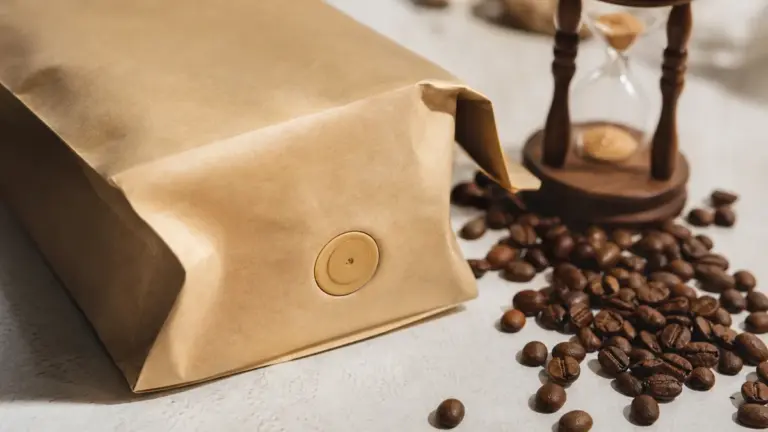
A one-way degassing valve lets carbon dioxide escape while restricting air entering through the valve. This allows coffee to release gas inside its packaging without the bag simply remaining open.
However, the valve is only one component. The bag material and seals matter too. Laboratory research on packaged coffee has found that barrier materials influence the retention of chemical freshness markers.
A valve therefore tells you something about the packaging, not when the beans were roasted. Likewise, a plump bag is not a reliable freshness certificate, and a flat bag is not sufficient reason to reject the coffee.
Avoid repeatedly squeezing a bag to force aroma through the valve. Read the date and inspect the packaging instead. For help interpreting the rest of the information, use how to read a coffee bag.
Check freshness with a repeatable tasting method
Once opened, smell the coffee, then assess it brewed. Record what you notice: a clear, recognisable aroma; a muted impression; or an unwelcome stale character. These are observations to investigate, not a laboratory measurement of age.
The following is a simplified home comparison inspired by SCA tasting mechanics, not a formal coffee assessment or safety test.
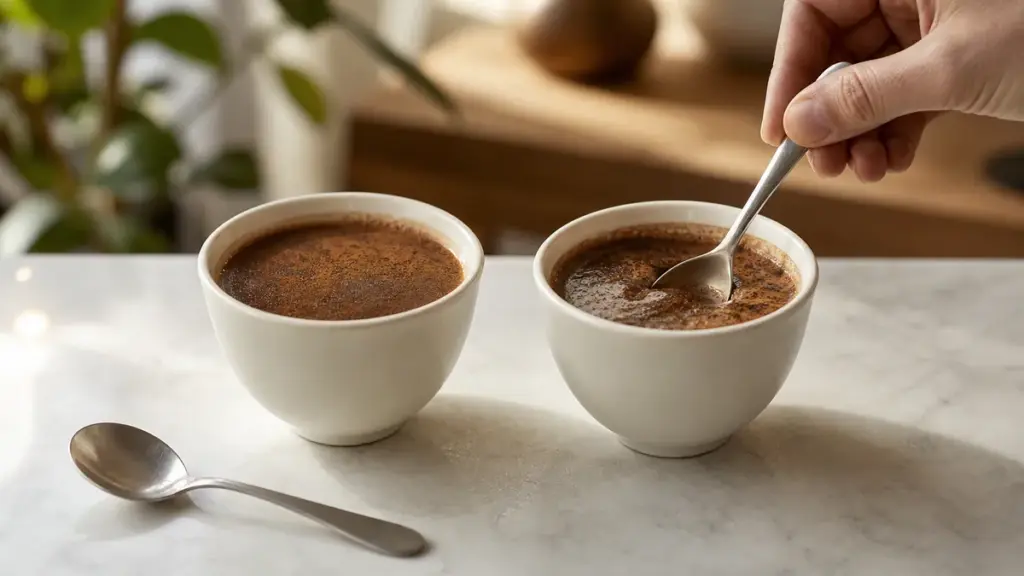
- Choose the comparison. Compare the new purchase with a coffee you know, preferably of a similar roast style. Use identical heatproof bowls and the same water.
- Measure each sample. Grind 12 g coffee per bowl to the same medium-coarse setting. Prepare 200 g water, approximately 200 ml, for each. This is a coffee-to-water ratio of about 1:16.7 by weight, selected here for a repeatable home comparison.
- Smell the dry grounds. Note the character as well as intensity. Keep your descriptions simple and specific.
- Add the water. Pour at 93°C, wetting all the grounds, and start a timer.
- Break the surface after four minutes. Gently stir the floating grounds and smell the released aroma. Skim off the remaining floating material with a spoon.
- Taste once comfortably cool. Revisit both bowls as they cool further. Record aroma, flavour and aftertaste without adding milk or sugar for this comparison.
- Check before deciding. If the result disappoints, repeat with clean equipment and unchanged measurements. Ask the roaster about resting and preparation before concluding that the coffee was stale.
The chosen dose is an editorial adaptation, not the SCA cupping dose. Its purpose is consistency between your own samples.
Troubleshooting a disappointing purchase
| Symptom | Likely cause | Fix |
|---|---|---|
| Aroma becomes noticeably weaker as the open bag ages | Aroma loss or changes during storage | Buy a smaller amount next time and follow the pack’s storage instructions |
| A very recent roast behaves differently from your usual coffee | Degassing may be affecting preparation | Ask the roaster about resting time and reassess afterwards |
| A bag with a valve still disappoints | Packaging alone cannot establish freshness or preference | Check the roast date and repeat the tasting consistently |
| One disappointing brew prompts an immediate rejection | Preparation and coffee differences have not been separated | Repeat with the same measured method before contacting the seller |
What freshness checks can and cannot tell you
The deeper distinction is between physical freshness, associated with gas release, and chemical freshness, associated with changes in aroma compounds. Laboratory work measures these separately because they are related but not interchangeable.
Bubbles during filter brewing and crema on espresso involve carbon dioxide. They can provide clues, but neither is a complete test of aroma retention or a verdict on flavour. A dramatic bloom does not override a disappointing cup.
Research also distinguishes chemical markers from sensory results. Measuring changes in volatile compounds is valuable, but it does not give a household buyer a universal day on which every coffee becomes unacceptable.
Use the roast date to organise purchases, the producer’s advice to choose when to begin brewing, and repeatable tasting to decide whether to buy again. Freshness information should help you find enjoyable coffee, not turn the calendar into the only judge.
FAQ
How should I buy fresh coffee as a gift?
Arrange delivery close to when the recipient will use it, allowing for the roaster’s recommended resting period. Check whether they own a grinder and which brewer they use before ordering. Include the coffee information and preparation advice, rather than removing everything except the beans when wrapping the gift.
What should I send a seller if a new bag disappoints?
Send photographs of the date, batch information and packaging, together with a short description of the problem. Include your brewer, dose, water amount, grind setting and preparation time where relevant. Ask whether the result matches their expectations and whether resting or preparation changes are worth trying before making another purchase.
Should I buy several different coffees at once?
Only buy several bags if you have a plan for using them without an open-bag backlog. For a first comparison, choose small quantities and keep clear notes about which coffee you brewed. Trying fewer coffees consistently is a more useful starting point than opening a collection you cannot finish.
Where to go next
Continue with Buying and Storing Coffee Beans to organise your ongoing supply, and How to Read a Coffee Bag to interpret the information behind a purchase. Finding Specialty Coffee Retailers helps you assess sellers, while Buying and Storing Coffee maps the wider subject.
Sources
-
Food Standards Scotland, Use-by and best-before dates, undated, current page retrieved November 2026.
URL: https://www.foodstandards.gov.scot/consumer-advice/food-labels/use-by-and-best-before-dates
Supports the distinction between quality dating and safety dating, and the importance of following storage instructions. -
Smrke et al., ZHAW, Time-resolved gravimetric method to assess degassing of roasted coffee, 2018, Journal of Agricultural and Food Chemistry.
URL: https://digitalcollection.zhaw.ch/entities/publication/4789f6f9-a182-4840-a313-54a3e8445aec/full
Primary experimental research on gas release after roasting, grinding and extraction. -
Square Mile Coffee Roasters, Rest Is Best, undated, current page retrieved November 2026.
URL: https://shop.squaremilecoffee.com/blogs/all/rest-is-best
Used only as a named producer’s resting recommendations, not an industry-wide standard. -
University of California, Davis Library, Technology and Coffee, undated.
URL: https://library.ucdavis.edu/exhibit/brewed-awakening/technology-and-coffee/
Explains the function of one-way valves in coffee packaging. -
Glöss et al., ZHAW, Freshness Indices of Roasted Coffee: Monitoring the Loss of Freshness for Single Serve Capsules and Roasted Whole Beans in Different Packaging, 2014, CHIMIA, volume 68.
URL: https://digitalcollection.zhaw.ch/bitstreams/56bef444-9ca4-42da-80b9-96d1f810c443/download
Primary laboratory research on volatile compounds and packaging barriers, with stated limits concerning sensory interpretation. -
Specialty Coffee Association, Coffee Value Assessment: Sample Preparation and Tasting Mechanics, SCA Standard 102-2024, 2024.
URL: https://sca.coffee/s/AW_SCA-102_Sample-Preparation_281024_Secured.pdf
Basis for the adapted comparison method’s temperature, timing and staged sensory assessment. -
Specialty Coffee Association, The Science of Coffee Freshness, Samo Smrke, Expo Lectures 2019, published 2019.
URL: https://sca.coffee/sca-news/podcast/81/the-science-of-coffee-freshness-samo-smrke-expo-lectures-2019-6lrbe
Researcher’s explanation of physical and chemical freshness, grinding and storage effects. -
Specialty Coffee Association, Preserving Freshness: A Race Against Time, 25 Magazine, issue 4, 2018.
URL: https://sca.coffee/sca-news/25-magazine/issue-4/preserving-freshness-race-time-25-magazine-issue-4-2spkp
Research synthesis covering aroma change, roast-dependent degassing and storage conditions.
This article was researched using retrieved coffee-science papers, SCA guidance, official food-date advice and a roaster’s published recommendations; shopping suggestions and calculations are identified as practical editorial guidance rather than first-hand testing.
Last checked: November 2026