Organic coffee farming is a certified production system that builds soil fertility and manages weeds, pests and diseases within strict rules on permitted inputs. The label verifies farming and handling requirements, not that coffee is pesticide-free, chemical-free or necessarily more flavourful.
In short
- Organic growers prioritise soil management and preventive crop protection, with only specified fertilisers and pesticides permitted.
- Certification involves inspections and traceability through the supply chain, not simply a farmer’s declaration.
- Yields depend on nutrition, shade, disease pressure and management. There is no universal organic coffee yield penalty.
- An organic premium can support producers, but certification alone does not guarantee a buyer or improved household livelihoods.
- For coffee packed in Great Britain, check the control-body code and agricultural-origin statement, not just a green-looking symbol.
What organic coffee farming means
Organic production starts with a different approach to managing the farm. Rather than relying on readily soluble mineral nitrogen fertilisers and a broad range of crop-protection products, growers must maintain fertility and plant health through organic methods, using restricted inputs where necessary.
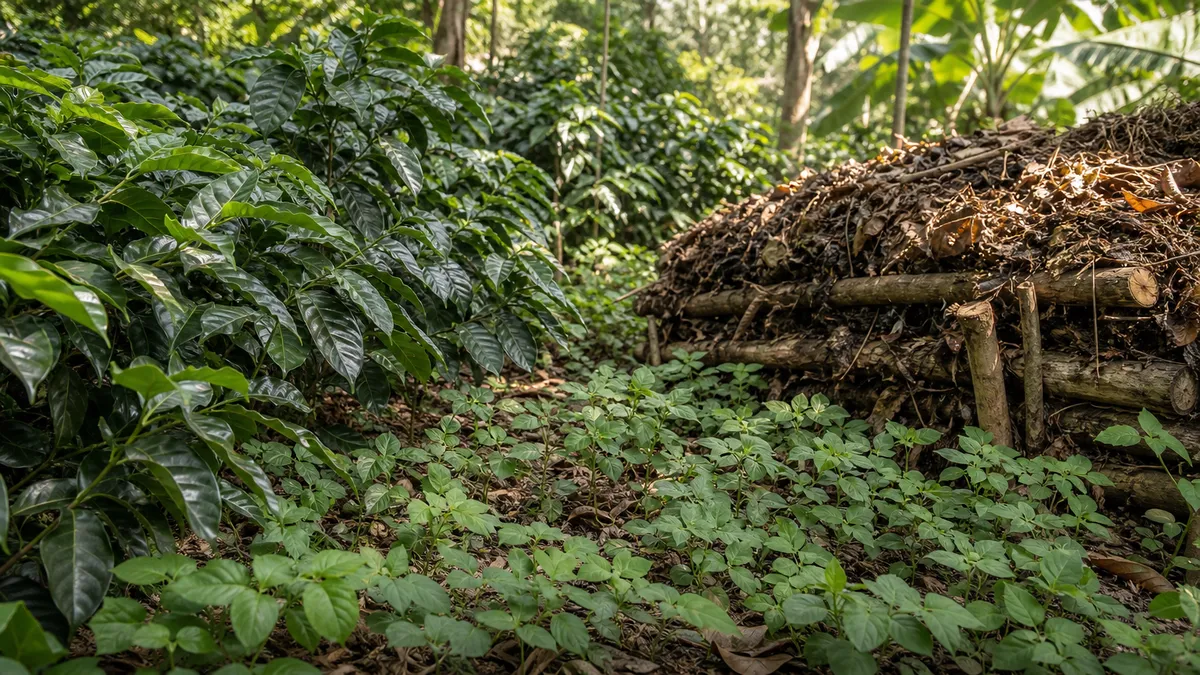
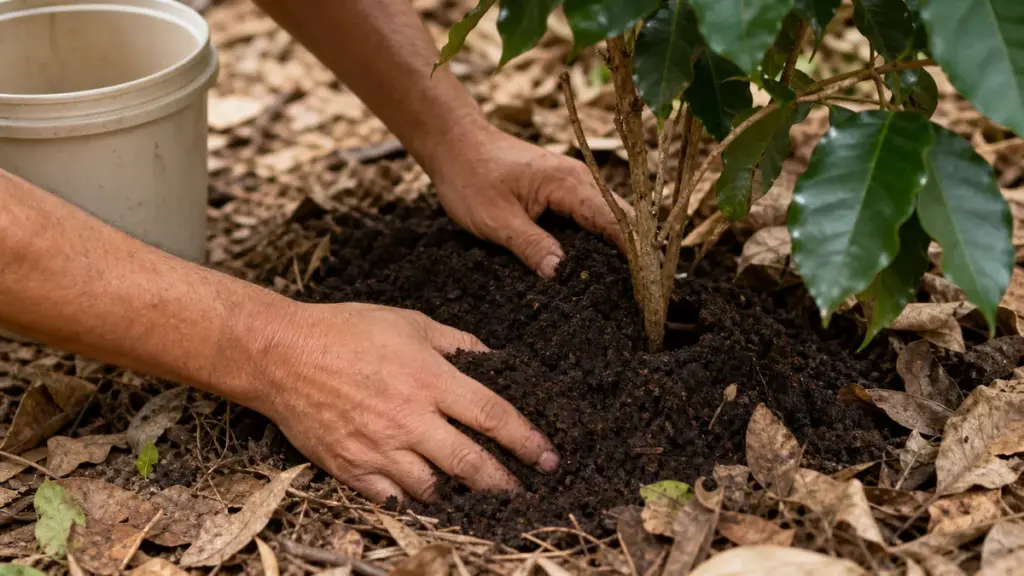
That does not mean leaving coffee shrubs to fend for themselves. Organic farming can involve substantial intervention: compost applications, cover crops, pruning, weed control and carefully selected treatments. The distinction is which methods and materials the applicable standard permits.
“Organic” is also a regulated marketing term. A farm that uses no purchased pesticides is not automatically entitled to sell its coffee as organic. Certification must establish compliance with the relevant rules.
For the wider growing process, our coffee farming guide explains where soil management, harvesting and processing fit together.
How certification works
A grower normally begins by registering with a recognised certification body and entering conversion, the supervised transition to organic management. During conversion, following organic methods does not immediately make the harvest eligible for sale as fully organic. The certifier assesses the land’s history and the applicable conversion requirements.
Inspection checks the management system as well as what is growing in the field. Records matter because an inspector needs to establish what entered the farm, what was applied and what left as certified produce. Under Great Britain’s system, approved control bodies inspect certified businesses at least annually.
Certification also extends beyond the farm. Organic and non-organic coffee must remain identifiable during handling and processing, with separation arrangements that prevent substitution or mixing. A certified farm is therefore only one part of the assurance behind a labelled bag.
For imports into Great Britain, the overseas certification must fall within the recognised countries, territories and control-body arrangements. An unfamiliar foreign certification symbol is not, by itself, proof that every UK marketing requirement has been met.
Which inputs are allowed?
Organic does not mean “nothing added”. Standards restrict both the substances available and the circumstances in which they may be used.
The following examples explain the approach, rather than providing a treatment list for growers. A product must satisfy the relevant organic standard and the pesticide or fertiliser rules of the country where it is used.
| Input or method | Organic position | Important qualification |
|---|---|---|
| Plant-based compost | Permitted within specified requirements | Ingredients and preparation matter |
| Livestock manure | Permitted subject to restrictions | Source and treatment can affect eligibility |
| Legumes and green manures | Used to support fertility | They are part of management, not a complete nutrient plan |
| Mineral nitrogen fertilisers | Prohibited under EU organic rules | Organic farming still requires nitrogen management |
| Selected pesticides, including some copper compounds | Can be permitted under conditions | Approval is not permission for unrestricted application |
Preventive methods take priority. These include choosing suitable varieties and encouraging natural pest control before resorting to permitted treatments.
Consequently, organic does not mean pesticide-free. Nor does it mean chemical-free: compost, water and copper compounds all contain chemicals. The useful question is whether an input is permitted, justified and used correctly, not whether it can be described as “natural”.
Pests and diseases remain a serious challenge
Organic certification does not make coffee resistant to infection or insect attack. It narrows the treatment options, making prevention and timely management especially important.
Coffee leaf rust is a fungal disease that damages leaves and can reduce production. Resistant varieties are an important tool, but resistance is not permanent or equally effective everywhere. World Coffee Research’s international trials show why a variety’s performance must be considered in its growing environment.
Copper-based fungicides can be available within organic systems, subject to the applicable rules. However, “permitted” does not mean environmentally harmless. Repeated copper applications can cause accumulation in soil, which is why restrictions and monitoring matter.
Coffee berry borer presents a different problem: an insect rather than a disease. Biological treatments can help. University of Hawai‘i guidance distinguishes organic and conventional formulations containing the insect-killing fungus Beauveria bassiana, illustrating why the complete product, not just its active organism, must be checked.
See coffee pests and diseases for the wider picture, or leaf rust and berry borer for those specific threats.
Yields and organic premiums: what the evidence shows
Yields depend on the comparison
It is misleading to attach one percentage yield reduction to all organic coffee. An intensive conventional plantation, a shaded organic farm and a low-input conventional smallholding are different starting points.
A long-term controlled experiment in Costa Rica provides a useful example. Schnabel and colleagues reported similar yields under moderate conventional and intensive organic agroforestry management: 5.3 and 5.0 tonnes of fresh coffee cherries per hectare per year, respectively. The difference was not statistically significant. These figures describe harvested fruit, not export-ready green beans.
The experiment also found that shade-tree choice strongly affected low-input organic performance. Its lesson is not that organic always matches conventional production, but that nutrition, shade and management intensity change the outcome. Results from one site are not a global forecast.
A premium is not a guaranteed livelihood
An organic premium is an additional payment associated with certified organic production. Organic certification itself is not a universal minimum-price agreement. Separate trading schemes may establish additional requirements: Fairtrade, for example, specifies an organic differential for eligible coffee traded on its terms.
Research also distinguishes a premium on coffee sold from the result for a whole household. Méndez and colleagues’ observational study of smallholder households in Central America and Mexico found higher payments associated with certified coffee, but many producers did not sell their entire harvest through certified channels. The authors found limited effects on wider livelihoods and could not attribute every difference solely to certification.
For a producer, the practical assessment must include saleable yield, additional labour, compost supply, certification administration and the proportion of the harvest a buyer will actually purchase as organic. For a workplace buyer, ask the supplier how the organic claim is verified and what it can substantiate about producer payments.
Benefits and limits of the organic label
Organic standards provide a defined, inspectable framework for soil management and restricted input use. This is more specific than an unsupported claim that coffee is “eco-friendly”.
The farming approach emphasises organic matter, legumes and biological processes. These practices are intended to maintain soil fertility and structure and prevent erosion. They are management requirements and objectives, however, not proof that every certified farm achieves identical environmental results.
There are important limits:
- Organic is not the same as shade-grown. Organic certification does not establish a particular shade canopy or wildlife habitat standard. Read shade-grown coffee when tree cover is your priority.
- Organic is not a flavour grade. Certification does not award sensory scores or guarantee that you will prefer the drink.
- Organic is not a complete social guarantee. Producer livelihoods depend on trading arrangements and circumstances beyond the farming standard.
- Organic is not a measured carbon footprint. Do not read a production certificate as a product-specific emissions assessment.
Likewise, related farming descriptions are not interchangeable certificates. Our guide to regenerative agriculture examines that approach separately.
For choosing coffee, treat organic status as one clear sourcing criterion. Ask separately about habitat, producer relationships and cup quality rather than expecting one mark to answer every question.
UK organic coffee labelling
The following rules were checked in November 2026. Great Britain means England, Scotland and Wales; Northern Ireland has different requirements.
Coffee produced or packed in Great Britain
Pre-packed organic coffee produced or packed in Great Britain must carry the appropriate control-body code and agricultural-origin information. GB-ORG-05, for example, identifies Soil Association Certification.
For coffee grown outside the UK, the usual agricultural statement is “Non-UK Agriculture”. A qualifying country-specific statement can be used instead. This describes where the agricultural ingredients were grown, not where the beans were roasted or packed.
Do not confuse a certifier’s logo with the mandatory code. There is no compulsory UK-wide organic logo replacing that code; certification marks have their own conditions of use.
The EU green-leaf logo is optional in Great Britain. If used, its EU labelling requirements must also be met, including the relevant EU agricultural-origin statement and its placement below the certifier code.
Northern Ireland and imported packs
Northern Ireland uses XI-ORG-XX codes for locally labelled products. The EU organic logo is mandatory on pre-packed organic food produced there, with the required origin information.
A finished pack imported from overseas can carry its overseas certifier’s code, so the absence of a GB code does not automatically invalidate it. Check the product’s certification and market requirements rather than insisting that every bag sold in Britain has identical markings.
What the ingredient threshold means
To describe a food product as organic, at least 95% of its agricultural ingredients must be organic, with strict conditions governing the remainder. This is not permission to mix ordinary coffee into otherwise organic plain beans: organic rules prohibit using the same ingredient in both organic and non-organic forms.
For an office purchase, check the exact product rather than relying on a supplier’s general sustainability statement. Organic farming is a specific, verifiable claim, not a substitute for checking the rest of your sourcing priorities.
FAQ
Can uncertified coffee be grown using organic methods?
Yes, a grower may use practices associated with organic farming without holding certification. That does not establish compliance with every organic requirement or allow the coffee to be marketed as organic in the UK. Ask for a precise description of the practices used, while keeping an uncertified farming claim distinct from certified organic status.
Does a GB organic code mean the coffee was grown in Britain?
No. The code identifies the control body responsible for certifying the relevant labelling operator, not the growing country. Coffee roasted and packed in Great Britain can therefore carry a GB code alongside “Non-UK Agriculture”. The agricultural-origin statement and any more detailed sourcing information answer a different question from the certification code.
Does organic coffee have to be tested for pesticide residues?
Certification does not mean every bag has undergone a laboratory residue test. Organic controls include inspections, and control bodies may sample and test products as part of their work. The assurance rests on compliance with production and handling rules, supported by checks, rather than a promise that every retail pack has an individual test certificate.
Where to go next
Start with Coffee Farming for the broader production system, then read Shade-Grown Coffee to separate organic certification from tree-cover claims. Regenerative Agriculture explores another farming approach, while Coffee Leaf Rust and Coffee Berry Borer explains two threats that organic growers must still manage.
Sources
-
Defra, “Organic farming: how to get certification and funding in Great Britain”, 2023. Production principles, restricted inputs and conversion.
https://www.gov.uk/guidance/organic-farming-how-to-get-certification-and-apply-for-funding -
European Commission, “Organic production and products”, current guidance retrieved 2026. Permitted substances, production principles and separation during processing.
https://agriculture.ec.europa.eu/farming/organic-farming/organic-production-and-products_en -
Soil Association Certification, “Organic Standards for Great Britain: Farming and growing”, version 1.3, 25 May 2023. Soil management and permitted fertilisers and pesticides.
https://www.soilassociation.org/media/sxrbpbgm/soil-association-farming-organic-standards-gb.pdf -
Defra, “Organic products: approved UK control bodies”, updated 20 August 2025. Inspection responsibilities and GB and XI identifying codes.
https://www.gov.uk/guidance/organic-food-uk-approved-control-bodies -
Defra, “Organic registers: lists of non-UK countries, territories, control bodies and control authorities”, updated 23 October 2026. Recognition of overseas certification for imports into Great Britain.
https://www.gov.uk/government/publications/organic-registers-lists-of-third-countries-or-territories-control-bodies-and-control-authorities -
World Coffee Research, “Coffee leaf rust knows no borders: neither does coffee science”, 2025. Research on resistance and environmental variation.
https://worldcoffeeresearch.org/es/news/2025/coffee-leaf-rust-knows-no-borders-neither-does-coffee-science -
University of Hawai‘i coffee extension programme, “CBB Control”, recommendations from 2020. Organic and conventional Beauveria bassiana formulations.
https://www.hawaiicoffeeed.com/cbb-control.html -
Organic Materials Review Institute, “Copper Accumulation”, revised 2022. Copper restrictions and soil accumulation.
https://www.omri.org/omri-articles/copper-accumulation -
Schnabel and colleagues, “Shade trees: a determinant to the relative success of organic versus conventional coffee production”, Agroforestry Systems, 2018. Controlled field experiment; author manuscript retrieved through the University of Nottingham.
https://nottingham-repository.worktribe.com/OutputFile/872386 -
Méndez and colleagues, “Effects of Fair Trade and organic certifications on small-scale coffee farmer households in Central America and Mexico”, Renewable Agriculture and Food Systems, 2010. Observational household and co-operative research.
https://www.uvm.edu/agroecology/wp-content/uploads/2020/04/MendezVEEtAl_EffectsFTOrganicCoffeeHouseholdsMesoamericaArticle_10.pdf -
Fairtrade International, “Fairtrade International secures a stronger safety net for coffee farmers”, 2026. Distinction between organic certification and Fairtrade’s organic differential.
https://www.fairtrade.net/uk-en/get-involved/resources/media-centre/fairtrade-international-secures-a-stronger-safety-net-for-coffee.html -
Smithsonian Migratory Bird Center, “The Essential Bird Friendly Toolkit”, retrieved 2026. Distinction between organic certification and shade or habitat requirements.
https://nationalzoo.si.edu/sites/default/files/documents/the_essential_bird_friendly_toolkit.pdf -
Defra, “Organic food: labelling and advertising rules”, updated 20 August 2025. Ingredient thresholds, origin statements, overseas codes and GB and Northern Ireland logo rules.
https://www.gov.uk/guidance/organic-food-labelling-rules -
Soil Association Certification, “Labelling Guidelines for UK organic food and feed products from 1st January 2021”, version 9, August 2022. Supplementary guidance on GB-packed products and optional EU-logo labelling, cross-checked against current Defra guidance.
https://www.soilassociation.org/for-business/soil-association-certification/organic-certification/food-and-drink/resources/
This article was researched using government guidance, published certification standards, agricultural research and specialist extension advice, distinguishing controlled experiments from observational findings.
Last checked: November 2026