Indonesian coffee is best known for a heavy body, gentle acidity and earthy, herbal or spicy flavours, especially in wet-hulled coffees from Sumatra. But Indonesia is not one cup profile: washed Java, citrus-like Bali coffees and carefully processed lots from Sulawesi and Flores offer quite different experiences.
In short
- Choose by island, region and processing method, not simply by the word “Indonesia”.
- Wet hulling, or giling basah, removes the protective parchment before the beans have finished drying.
- Published descriptions put wet hulling at roughly 30% to 50% moisture, but this is a range across practices, not a fixed specification.
- Washed and natural Indonesian coffees are also available; wet hulling does not define the whole country.
- Kopi luwak raises documented animal welfare concerns. It is unnecessary for exploring Indonesia’s coffee quality.
Indonesian coffee at a glance
Indonesia grows both arabica, Coffea arabica, and robusta, Coffea canephora. Robusta dominates national production, although many coffees sold by specialist UK roasters under regional Indonesian names are arabicas.
The fact panel below concentrates on arabica. Its altitude examples describe documented growing areas and lots, not the lowest and highest coffee farms in the country.
| Feature | Origin facts |
|---|---|
| Altitude | Gayo research describes coffee growing at 1,200 to 1,700 metres; documented Enrekang lots in Sulawesi grow at 1,500 to 1,800 metres. |
| Main varieties and names | Timtim or Tim-Tim, Ateng and other Catimor-derived material, S795, often traded as Jember or Linie S, and Typica. |
| Processing | Wet-hulled, fully washed and natural, with the balance varying between regions and producers. |
| Indicative harvest months | Sucafina lists Sumatra’s main crops as April to June and November to January; Java, April to August; Bali, April to July; Flores, May to September; Sulawesi, May to October. |
| Typical cup profile | Classic wet-hulled Sumatra: substantial body, restrained acidity, spice, herbs and earthy notes. Other lots can be cleaner, fruitier or more citrus-like. |
Harvest calendars are guides rather than promises. For example, Genuine Origin’s Kintamani factsheet gives May to October for its Bali supply, differing from Sucafina’s broader calendar. Ask about the actual lot’s harvest rather than assuming an island has one universal picking window.
For the wider regional context, begin with east and southeast asia.
Islands, regions and cup profiles
Sumatra: Gayo, North Sumatra and Kerinci
Sumatra supplies the best-known examples of Indonesia’s wet-hulled style. Gayo in Aceh and the North Sumatran highlands are particularly useful names to recognise; Kerinci is another producing area worth looking for.
The classic Mandheling description combines low perceived acidity with a weighty texture, spice and a little earthiness. “Body” means the coffee’s weight and texture in the mouth, rather than how bitter or concentrated it tastes.
However, heavy and earthy are not compulsory. Royal Coffee’s published tasting of a wet-hulled Jagong Jeget lot from Aceh describes citrus, caramel, plum and herbal notes alongside lively acidity. That is a useful corrective to the idea that all Sumatran coffee must taste dark and rustic.
Java: washed estates and regional differences
East Java’s Ijen Plateau is associated with established arabica estates and washed processing. Here the fruit is removed, the coffee is fermented and washed, and drying takes place before dry hulling.
Traditional estate descriptions emphasise good body, restrained acidity and a smooth texture, sometimes with an herbal finish. Do not automatically expect the same earthy intensity as a classic wet-hulled Sumatran coffee.
Java is also an origin name with a long trading history, not a guarantee that every coffee from the island shares one variety or processing method.
Sulawesi: Toraja, Mamasa and Enrekang
Toraja is the most familiar name, but Mamasa and Enrekang also matter. Wet hulling is widespread in these supply chains, while fully washed and natural lots provide alternatives.
Opal Coffee describes its washed Mamasa and Tana Toraja coffee as full-bodied, gently earthy and dark-chocolate-like, with low acidity and a clean finish. This illustrates why “washed” does not necessarily mean light-bodied or sharply acidic.
Sucafina also documents natural coffee from Angin Angin in Enrekang. Read the processing information before treating “Sulawesi” as shorthand for wet-hulled.
Bali, Flores and Papua
Bali’s Kintamani coffees are often associated with washed processing and sweet, citrus-like profiles. Genuine Origin documents a Kintamani lot dried in parchment and hulled only after reaching 11% moisture, a clear contrast with wet hulling.
Flores includes wet-hulled supply chains, but Bajawa also has a documented fully washed tradition. Sucafina describes one washed Bajawa coffee as full-bodied, with moderate acidity and maple syrup, walnut, raisin and cacao notes.
Indonesian Papua adds another producing area, including the Baliem and Kamu valleys. It should not be confused with the independent country of Papua New Guinea.
Indonesia’s variety should also discourage assumptions about its neighbours. Explore vietnamese coffee and coffee from laos separately rather than expecting a single Southeast Asian style.
What wet hulling, or giling basah, actually means
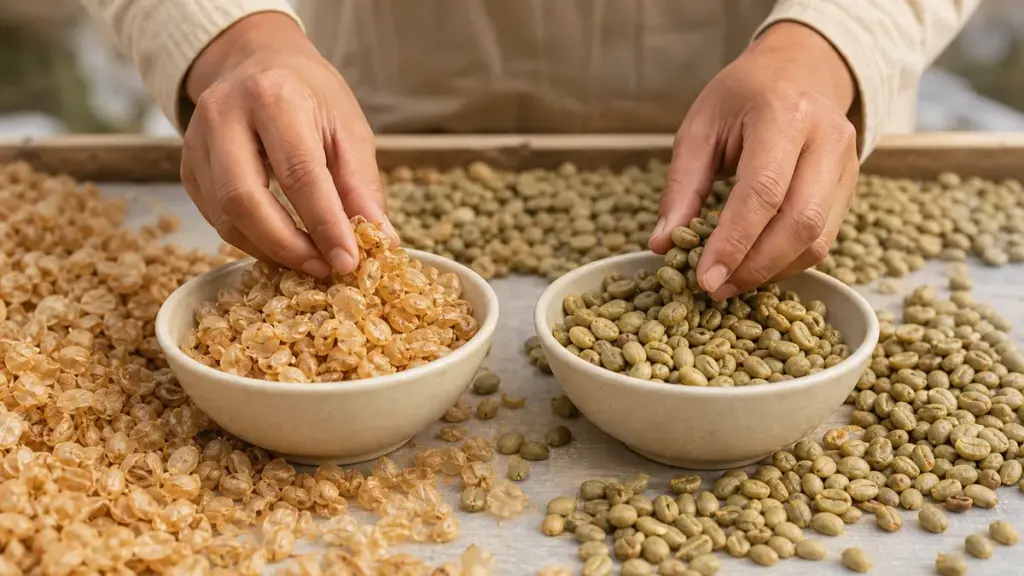
Wet hulling concerns when the parchment is removed. Parchment is the protective, papery layer surrounding the coffee seed after the fruit and sticky mucilage have been removed.
The typical sequence is:
- Pulp the cherries. Remove the outer fruit mechanically.
- Ferment and wash. Allow the sticky mucilage to break down, then wash it away.
- Partially dry the parchment coffee. Stop while the beans still contain substantial moisture.
- Hull while damp. Mechanically remove the parchment before drying is complete.
- Finish drying the exposed beans. Sort and prepare them for onward handling.
Published moisture figures differ. Sucafina describes 30% to 40% at wet hulling; an Indonesian Coffee and Cocoa Research Institute study reports 40% to 45%; an FAO project report describes North Sumatran practice at 40% to 50%.
Thus, roughly 30% to 50% is a useful span across reported practices, not an exact universal target. By comparison, dry hulling follows much fuller drying, commonly around 10% to 12% moisture; the FAO processing manual uses 12%, while the documented Bali lot was hulled at 11%.
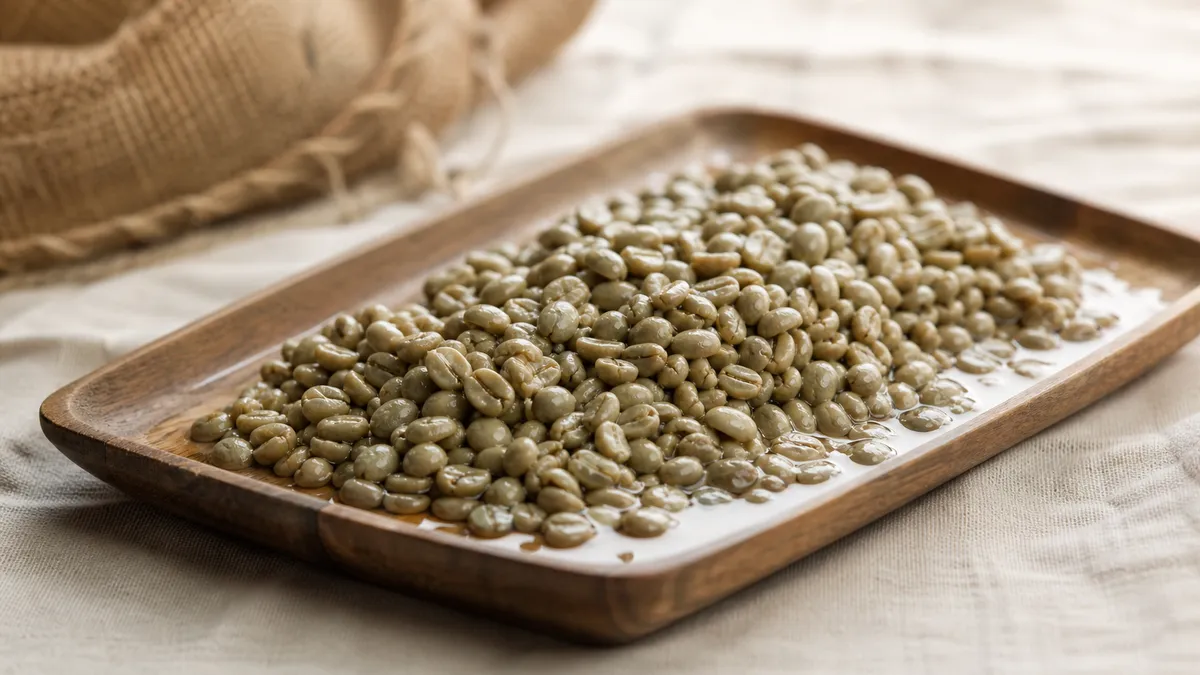
The beans are still soft and moisture-swollen when wet-hulled. Mechanical pressure can bruise, crush or split them, contributing to their irregular appearance. Wet-hulled green coffee is often blue-green or dark green, but colour alone cannot establish quality.
Why use it?
Sumatra’s humidity and unpredictable rainfall make drying difficult. Wet hulling also fits a trading system in which farmers sell partially dried parchment rather than holding coffee until it is fully dry.
Removing parchment changes the bean’s exposure during its final drying stage. Clean handling, drying surfaces and protection from rewetting therefore matter greatly.
Wet hulling is especially associated with Sumatra and is widespread in Sulawesi, with use elsewhere, including Flores. Calling it the standard for every Indonesian island is misleading: Java and Bali have important washed, dry-hulled coffees, and Flores itself offers contrasting approaches.
“Dry-hulled” does not mean “natural”. A washed coffee can be dried in parchment before dry hulling; a natural coffee dries inside the whole fruit before its dried outer layers are removed.
Earthiness: character, defect and evidence
Earthy is a sensory description, not an explanation of how a flavour arose. World Coffee Research’s Sensory Lexicon distinguishes musty/earthy, musty/dusty, mouldy/damp and woody attributes rather than treating them as interchangeable.
For buying purposes, seek specificity. Cocoa, dried herbs, spice and a sweet finish tell you more than an unexplained promise of “authentic earthiness”. A persistent damp, mouldy impression should not be excused merely because the bag says Sumatra.
There is evidence for processing differences, but it needs proportion. A small Gayo comparative study reported stronger body and lower perceived acidity with wet hulling, and its panel generally preferred those samples. However, the farm samples lacked independent replication, so it cannot prove that wet hulling always produces those results.
The FAO’s North Sumatran trial also found considerable variation. The evidence does not justify attributing every earthy, herbal or fruity note to the huller alone: fermentation, wet storage, drying and subsequent handling form part of the same chain.
Java’s coffee history
Java’s coffee story is also a colonial story, involving compulsory cultivation rather than simply the successful movement of plants.
- 1696: Arabica planting material was sent from India’s Malabar coast to Batavia, now Jakarta. The first planting attempt failed after flooding.
- 1699: A further shipment established successfully.
- 1706: According to World Coffee Research, a Typica plant travelled from Java to Amsterdam, becoming part of the variety’s wider international distribution.
- 1711: The Dutch East India Company exported coffee from Java to Europe.
The regional agricultural authority in Buleleng records that colonial farmers were compelled to grow coffee and received little benefit from the profitable trade. That context belongs alongside the familiar story of Java becoming an internationally recognised coffee name.
Varieties behind the regional names
The main names describe different things, so they should not be treated as interchangeable.
- Timtim or Tim-Tim: Indonesian naming associated with the Timor Hybrid, which originated from a natural cross between arabica and robusta.
- Ateng: Commonly described in Indonesian trade references as Catimor-derived material. Catimor is a family of breeding lines, not one single variety.
- S795: A variety bred in India from S288 and Kent. Indonesian trade references often use Jember or Linie S alongside S795.
- Typica: A historically important arabica variety whose international spread included Java.
World Coffee Research defines Catimor ancestry through crosses between Caturra and Timor Hybrid material. This does not make Catimor coffee simply “robusta”.
Local names on a bag are useful starting points, but ask for the producer’s identification where precision matters. A regional name, trade synonym and genetically verified variety are different levels of information.
Kopi luwak and animal welfare
Kopi luwak is made from coffee seeds recovered after civets have eaten the cherries and passed the seeds in their droppings. Traditional collection from wild animals is distinct from production involving captive civets.
A peer-reviewed observational study published in 2016 assessed 48 wild-caught common palm civets at 16 tourist-oriented plantations in Bali. It identified inadequate housing and negative welfare impacts, examining conditions including movement, shelter, hygiene, food and water.
Those findings concern the observed captive operations, not every possible wild-collected supply chain. Equally, a seller’s “wild” claim should not substitute for independently verifiable sourcing.
Our recommendation is to explore Indonesia through traceable, non-animal-processed coffee. The islands offer ample sensory interest without making animal digestion the attraction.
FAQ
Does Mandheling identify a particular farm?
No, Mandheling is not a farm identification. Royal Coffee describes its modern use as more of a marketing designation than a precise growing region. A bag carrying that name still needs supporting details: province, producer or cooperative, processing method and harvest information. Treat the name as a starting point, not complete traceability.
Is coffee from Java always the Java variety?
No, Java can describe the island of origin or a particular coffee variety. World Coffee Research classifies the Java variety as Ethiopian landrace material. Coffee grown on the island can belong to other varieties, including Typica and S795-related trade offerings. Check whether “Java” appears under origin or variety on the label.
How should I compare Indonesian coffees at home?
Compare a wet-hulled and a washed coffee using the same brewer, water and your usual weighed recipe. Choose broadly similar roast descriptions where possible, then record body, acidity, sweetness and finish separately. This is a practical tasting exercise, not a controlled experiment, but it can help identify which Indonesian styles you enjoy.
Where to go next
Read East and Southeast Asia to place Indonesian coffee within the wider growing region. Continue with Vietnam and Laos to explore those origins on their own terms, rather than carrying Indonesia’s wet-hulled reputation across the whole region.
Sources
-
AEKI, Indonesian Coffee Exporters Association, Indonesian Coffee: Data, Production, Exports, and the National Industry, 2026.
https://www.aeki-aice.org/en/Indonesian-coffee/ -
Sucafina, Indonesia, undated, retrieved November 2026. Regional harvest calendar, variety names and processing chain.
https://sucafina.com/na/origins/indonesia -
Sucafina, About Indonesia, 2013. Used selectively for regional descriptions, not its dated statistics or administrative boundaries.
https://www.sucafina.com/na/news/about-indonesia -
Sucafina, Angin Angin Sulawesi Natural and Flores FW, undated, retrieved November 2026. Producer-linked processing and lot descriptions.
https://sucafina.com/emea/offerings/angin-angin-sulawesi-natural
https://sucafina.com/emea/offerings/flores-fw -
Genuine Origin, Kintamani G1 Washed, undated factsheet, retrieved November 2026.
https://www.genuineorigin.com/site/images/factsheets/factsheet-GEN21IDK.pdf -
Opal Coffee, Sulawesi Toraja Washed, undated factsheet, retrieved November 2026.
https://opal.coffee/selections/indonesia/ -
Ismayadi, Marsh and Clarke, Indonesian Coffee and Cocoa Research Institute and FAO, Influence of Storage of Wet Arabica Parchment Prior to Wet Hulling on Moulds Development, Ochratoxin A Contamination, and Cup Quality of Mandheling Coffee, 2005, Pelita Perkebunan 21(2).
https://www.ccrjournal.com/index.php/ccrj/article/view/20 -
FAO, Anthony Marsh, Storage of Wet Arabica Parchment Prior to Wet Hulling, Project GCP/INT/743/CFC, Annex E.6, reporting the 2004/05 trial; publication year not stated.
https://www.fao.org/fileadmin/user_upload/agns/pdf/coffee/Annex-E.6.pdf -
FAO, Arabica Coffee Manual for Lao PDR, 2005, processing chapter.
https://www.fao.org/4/ae939e/ae939e08.htm -
Abubakar, Karim and Fahlufi, Syiah Kuala University, Flavor of Arabica Coffee Grown in Gayo Plateau as Affected by Varieties and Processing Techniques, 2011, conference proceedings 1(1), pages 70 to 75.
https://library.sweetmarias.com/wp-content/uploads/2020/08/Flavor-of-arabica-coffee-grown-in-Gayo-Palteau-as-affected-by-varieties-and-processing-techniques.pdf -
World Coffee Research, Arabica Varieties Catalog, live entries “S795”, “Typica”, “Java” and “History of Arabica”, retrieved November 2026.
https://varieties.worldcoffeeresearch.org/varieties/s795
https://varieties.worldcoffeeresearch.org/varieties/typica
https://varieties.worldcoffeeresearch.org/varieties/java
https://varieties.worldcoffeeresearch.org/arabica-2/history-of-arabica -
World Coffee Research, Sensory Lexicon, version 2.0, 2017.
https://worldcoffeeresearch.org/read-more/news/174-world-coffee-research-sensory-lexicon -
Royal Coffee, Indonesian Coffee Varieties & Cultivars, 2025; Crown Jewel Sumatra Jagong Jeget Junus Family Wet Hulled, 2024.
https://cdn.royalcoffee.com/wp-content/uploads/2025/10/02083855/Indonesian-Cultivars-v2.1-blog-ready.pdf
https://cdn.royalcoffee.com/wp-content/uploads/2024/05/07102543/Crown-Jewel-Sumatra-Jagong-Jeget-Junus-Family-Wet-Hulled.pdf -
Buleleng Department of Agriculture, Food Security and Fisheries, Sejarah Perkembangan Kopi, 2019.
https://distankan.bulelengkab.go.id/informasi/detail/berita/sejarah-perkembangan-kopi-44 -
Carder, Proctor, Schmidt-Burbach and D’Cruze, The Animal Welfare Implications of Civet Coffee Tourism in Bali, 2016, Animal Welfare 25, pages 199 to 205.
https://www.cambridge.org/core/services/aop-cambridge-core/content/view/555FA0D008AAF0E4980247EFE600EC1B/S096272860000751Xa.pdf/the-animal-welfare-implications-of-civet-coffee-tourism-in-bali.pdf
Researched through live retrieval of institutional references, original research and producer-linked trade documentation; sensory descriptions are attributed reports, not first-hand testing.
Last checked: November 2026