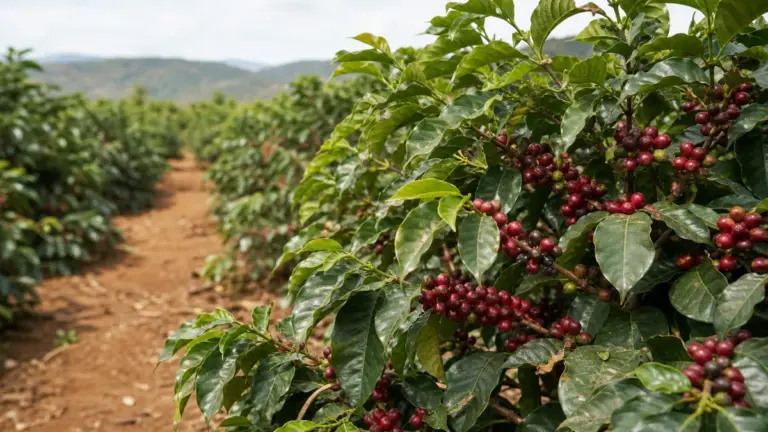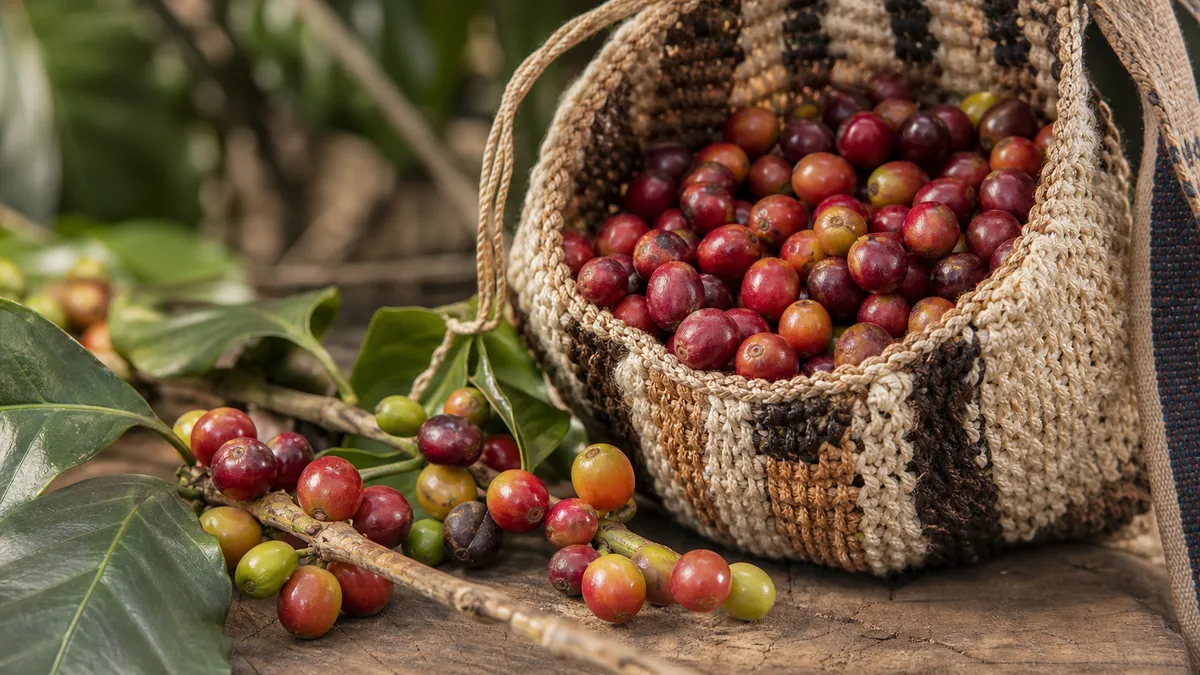
Papua New Guinea coffee can be sweet and citrusy, with lively fruit aromas, rounded body and refreshing acidity. Its defining story is highland garden coffee: small family-managed plots whose varieties, processing and difficult journeys to market matter more than any single national flavour description.
In short
- Look for the province, producer group and processing method, not just the country name.
- Eastern Highlands, Western Highlands, Jiwaka and Simbu are important names to recognise.
- Typica and Blue Mountain names connect to the Typica family, but not every traditional variety grown here is Typica-descended.
- Washed coffee is a useful starting point; natural and honey-processed lots are also available.
- Harvest calendars describe picking at origin, not when freshly roasted beans will reach a UK retailer.
Papua New Guinea coffee at a glance
The following panel separates national guidance from a specific exporter’s sourcing information. That distinction matters: an altitude or harvest window attached to one supply network should not quietly become a rule for the whole country.
| Feature | Origin reference |
|---|---|
| Altitude | CIC’s handbook describes production as concentrated at 1,200 to 1,600 metres above sea level. Volcafe lists 1,500 to 1,700 metres for its sourcing profile. Neither is an absolute national limit. |
| Main varieties | ACIAR lists Typica or Blue Mountain, Bourbon, Arusha, Mundo Novo, Caturra and Catimor among commonly grown arabica varieties. |
| Processing | Washed coffee is central to established production; Volcafe also documents natural and honey lots. |
| Harvest months | Volcafe gives April to June for its sourcing network. CIC’s highland management calendar places the main harvest in May and June; timing varies by location and season. |
| Typical cup profile | Volcafe describes smallholder grades as sweet and citrusy, with wild-fruit aromas, and its better wet-mill grades as having good body and acidity. These are trade descriptions, not guarantees for every lot. |
For a beginner, the simplest first purchase is a washed coffee with a named producer group or mill and tasting notes that appeal to you. Treat the panel as orientation, then read the details of the actual lot.
For the wider regional context, see our guide to Oceania.
Highland provinces and coffee gardens
Eastern Highlands, Jiwaka, Western Highlands and Simbu, also written Chimbu, form an important part of the country’s arabica-growing geography. Morobe, Southern Highlands and Enga also belong in the picture. Papua New Guinea coffee is not confined to a single valley or province.
CIC records commercial plantation production in Western Highlands, Eastern Highlands, Jiwaka and Morobe. Alongside these larger operations sits the family-managed coffee garden, the production system that gives this origin much of its character.
“Garden” does not mean a decorative planting or a few bushes maintained as a hobby. It describes coffee fitted into household land use and livelihoods. ACIAR’s smallholder training materials describe heavy reliance on family labour, simple processing equipment and comparatively low use of external agricultural inputs.
Coffee work therefore competes with growing food, other income-generating activities and family responsibilities. A garden may be commercially important without being managed like a specialist estate.
Shade trees and food crops can share this space. A peer-reviewed case study of highland smallholders describes mixed coffee gardens and identifies Casuarina oligodon as an important shade tree. However, it also records declining shade in some gardens, so a shaded setting should not be assumed from the country name alone.
This helps explain why “smallholder coffee” is useful background but insufficient buying information. Ask which smallholders, how their coffee was collected and who controlled processing. The human and agricultural setting matters, but the route from ripe cherry to exportable bean still needs explaining.
Typica, Blue Mountain and the variety question
Arabica, Coffea arabica, is a species. Typica, Bourbon and Mundo Novo are varieties within it. Keeping those categories separate makes Papua New Guinea’s coffee labels much easier to understand.
Typica is especially relevant here. ACIAR’s local training guide identifies Typica, also described as Blue Mountain variety Typica, among the country’s established commercial varieties. World Coffee Research likewise includes Blue Mountain among names associated with Typica.
That connection describes planting material, not geographical origin. A Papua New Guinea coffee carrying a Blue Mountain variety description remains Papua New Guinea coffee. It should not be read as coffee grown in Jamaica.
Mundo Novo provides another Typica connection, but a different one: World Coffee Research identifies it as a natural cross between Typica and Bourbon. It is therefore related to both families, rather than being simply another name for Typica.
Arusha needs particular care. CIC and ACIAR describe the Arusha grown in Papua New Guinea as a Bourbon-type selection. This article follows that local agronomic description rather than automatically placing Arusha under Typica.
The practical lesson is to resist turning a list of traditional varieties into a single family tree. “Typica-descended varieties” describes part of the country’s planting heritage, not all of it.
For an aficionado, a variety declaration is a starting point for questions rather than a complete explanation of flavour. Ask whether the lot contains several varieties, whether they were harvested together and whether the supplier has documented their identity. Do not assume that a familiar name establishes the exact composition of every garden supplying a mill.
Processing: where garden coffee becomes a lot
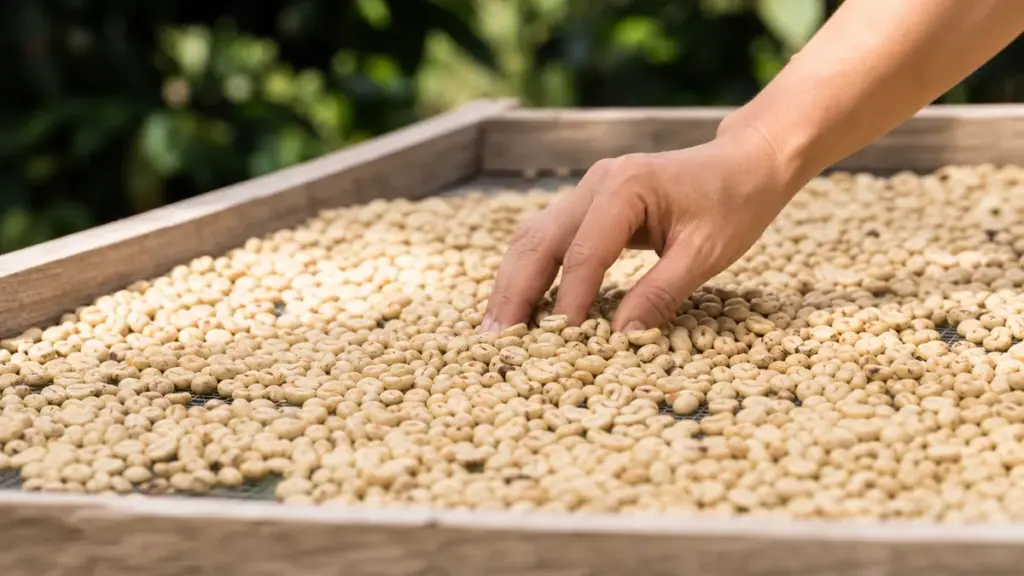
Washed processing is an important route for Papua New Guinea coffee. In plain terms, the fruit is removed and the beans are cleaned before they are dried inside their protective parchment layer.
ACIAR’s harvesting and processing guide describes the essential sequence:
- Harvest and sort the cherries. Separate unsuitable fruit rather than sending everything through together.
- Pulp the cherries. Remove the outer skin and much of the fruit.
- Remove the mucilage. This sticky coating can be broken down through fermentation and washed away, or removed mechanically.
- Dry the parchment coffee. Manage drying evenly and protect the coffee from dampness and contamination.
- Hull the dried parchment. Remove the protective layer to prepare green beans for subsequent sorting and sale.
This is an explanation of the process, not a recommendation for one fixed fermentation time. Local conditions and equipment matter.
Nor is every processing improvement about more elaborate fermentation. ACIAR reports successful trials of a demucilager, equipment that removes mucilage mechanically, with smallholder groups. Its value included more consistent coffee and less demanding processing work.
Natural and honey lots also exist. Volcafe lists both from its Lahamenegu wet mill, so “Papua New Guinea coffee is washed” is too absolute. Read the process declaration on the particular bag.
For buying purposes, I would give a clear processing account more weight than an elaborate origin story. “Grown in remote gardens” tells you something meaningful about production, but not whether cherries were sorted carefully or drying was well managed.
What does Papua New Guinea coffee taste like?
A useful expectation is sweetness supported by citrus-like brightness and fruit aroma, with enough body to avoid feeling insubstantial. That description follows an exporter’s account of its coffees, rather than a controlled survey of the entire origin.
Acidity here means a refreshing sensory quality, not automatically an unpleasant sour taste. When reading a roaster’s notes, look for the relationship between brightness, sweetness and texture instead of judging a coffee by one flavour word.
The most useful question is therefore not “Does Papua New Guinea taste fruity?” but “How does this particular coffee balance fruit, sweetness and body?” Ask the roaster to describe that balance without relying only on a string of tasting notes.
My suggested approach is to begin with a clearly documented washed lot. It offers a straightforward way into the origin without requiring you to disentangle a distinctive experimental process from the coffee’s other characteristics.
Avoid accepting mustiness or smoke contamination as an inevitable national style. ACIAR’s processing guidance explicitly warns about mould-related taints from poor drying and about smoke affecting stored coffee. Those are handling concerns, not a flavour identity that every buyer must learn to appreciate.
If one bag disappoints, change the producer group or processing source before dismissing the country. The origin label alone is too broad to settle the question.
Logistics: the journey is part of the quality story
Remoteness is not merely a romantic detail. It can determine how growers reach buyers and how coffee moves between processing, storage and export.
Mission Aviation Fellowship’s account of its work with CIC in Karimui, Simbu, documents communities dependent on aircraft to move coffee out. That is a specific example, not evidence that every Papua New Guinea coffee travels by air.
At the export end, Volcafe describes keeping coffee in the highlands before transporting it to Lae shortly before shipment. Between a household garden and that export route may lie several separate handling stages.
For a buyer, the useful questions concern those stages: who collected the coffee, where it was dried, how it was stored and whether batches remained identifiable. “Remote” is neither a quality defect nor a quality guarantee.
ACIAR’s research also identifies labour shortages, land pressure and post-harvest processing difficulties among smallholder challenges. Read these as reasons to value effective producer support and clear supply-chain information, not as grounds for assuming poor workmanship.
Choosing Papua New Guinea coffee in the UK
Use this order when assessing a bag or asking a roaster for more information:
- Identify the source. Prefer a named producer group, estate or mill to an unexplained national blend.
- Check the process. Establish whether it is washed, natural or honey-processed.
- Read the flavour description. Choose according to the sweetness, brightness and texture you enjoy.
- Clarify variety claims. Distinguish a mixed-variety lot from one presented as a specific variety.
- Ask about traceability. Find out whether a geographical or community name identifies the growers, a collection area or a wider commercial lot.
These are editorial buying criteria, not a ranking of farms or exporters. Detailed information is valuable because it lets you make an informed choice, not because a longer label necessarily means better coffee.
For a regional comparison, read Australia separately rather than treating neighbouring origins as interchangeable. To explore the broader grouping, return to the Oceania coffee guide.
The most rewarding way to approach Papua New Guinea coffee is to choose a well-described lot and follow its story beyond the country name: garden, varieties, processing and journey.
FAQ
Does Blue Mountain on the label mean the coffee comes from Jamaica?
No. In Papua New Guinea, Blue Mountain can describe Typica planting material rather than the coffee’s growing location. World Coffee Research includes Blue Mountain among Typica names, while ACIAR uses the description Blue Mountain variety Typica. Check the stated country of origin and ask the seller whether the wording describes variety or something else.
Is smallholder garden coffee automatically organic?
No. A low-input growing system does not, by itself, establish organic certification. ACIAR describes low use of external inputs in many smallholder systems, but that is a farming description rather than proof of certification. If certified organic coffee matters to you, ask the retailer for the certification applying to the actual product.
Can a Papua New Guinea coffee be traceable without coming from one farm?
Yes. A lot can be identified through a producer group or a documented collection and processing system rather than one estate. Ask what the named group represents and whether its coffee remains separate through processing. For buying purposes, meaningful answers to those questions are more useful than insisting that every good coffee must be single-farm.
Where to go next
Read Oceania to place Papua New Guinea within the wider region and choose your next origin to explore. Follow with Australia for a separate account of its coffee, rather than assuming regional neighbours share the same growing story.
Sources
- Coffee Industry Corporation, The Papua New Guinea Coffee Handbook, second edition, June 2016. Sections on growing areas, varieties, site suitability and the management calendar.
https://www.cic.org.pg/wp-content/uploads/2021/08/52029_CIC-Handbook.pdf - Australian Centre for International Agricultural Research, Curry, Tilden and Aroga, Smallholder Coffee Production in Papua New Guinea: A Training Package for Extension Officers and Farmers, introductory volume, Monograph 220, 2023.
https://www.aciar.gov.au/sites/default/files/2024-01/MN220_Intro_PDF.pdf - ACIAR, Knowing Your Coffee Tree, Farmer Training Guide, Unit 1, Module 1, Monograph 220, 2023.
https://www.aciar.gov.au/sites/default/files/2024-08/FTG_Unit1-M1-PDF_know-your-tree.pdf - ACIAR, Coffee Harvesting and Processing, Farmer Training Guide, Unit 3, Module 1, 2025.
https://www.aciar.gov.au/sites/default/files/2025-04/FTG_Unit3-M1-PDF_harvest-&-process.pdf - World Coffee Research, Arabica Coffee Varieties: Typica, undated live catalogue entry.
https://varieties.worldcoffeeresearch.org/varieties/typica - World Coffee Research, Arabica Coffee Varieties: Mundo Novo, undated live catalogue entry.
https://varieties.worldcoffeeresearch.org/varieties/mundo-novo - Tilden, Aranka and Curry, Ecosystem Services in Coffee Agroforestry: Their Potential to Improve Labour Efficiency amongst Smallholder Coffee Producers, Agroforestry Systems, published online 2023, journal volume 2024.
https://link.springer.com/article/10.1007/s10457-023-00917-0 - ACIAR, Improving Livelihoods of Smallholder Coffee Communities in Papua New Guinea, final report overview, FR2024-028, 2024.
https://www.aciar.gov.au/publication/asem-2016-100-final-report - ACIAR, Coffee Resilience: How PNG’s Farmers Are Leading the Way in Sustainable Coffee Production, 15 May 2025.
https://www.aciar.gov.au/sustainable-coffee-production-PNG - Volcafe, PNG Coffee Exports, Papua New Guinea, undated live sourcing profile. Used for the exporter’s own processing, logistics and sensory descriptions, not independent performance assessment.
https://www.volcafe.com/network/png - Mission Aviation Fellowship International, Burnt Coffee Now a Thing of the Past: MAF Flights Give Livelihood to Farmers, 22 April 2026.
https://mafint.org/news/2026-burnt-coffee-now-thing-past-maf-flights-give-livelihood-farmers
Researched using CIC agronomic guidance, ACIAR training and research publications, World Coffee Research variety entries, peer-reviewed agroforestry research and explicitly attributed first-party supply-chain accounts.
Last checked: November 2026