Kenyan coffee is best known for bright, intense fruit flavours, lively acidity and substantial sweetness, often with berry, citrus and floral notes. To choose a bag, look beyond “Kenya AA”: the named producer or washing station, processing details and roaster’s tasting notes tell you more than bean size alone.
In short
- AA and AB primarily describe bean size; PB identifies rounded peaberries. None is a cup-quality score.
- SL28 and SL34 are traditional varieties associated with high quality potential; Ruiru 11 and Batian add important disease resistance.
- Washed processing is characteristic, often involving fermentation, washing and a clean-water soak, but “double fermentation” is not a uniform recipe.
- Central Kenya is a major producing area, but coffee also comes from western Kenya and the Rift Valley.
- The Coffee Act 2026 permits auction and direct sales, alongside international-exchange sales. Not every Kenyan coffee passes through an auction.
Kenya coffee at a glance
| Feature | Origin facts |
|---|---|
| Altitude | The Coffee Directorate’s flavour handbook gives 1,400 to 2,400 metres above sea level as its national overview range, not a boundary for every farm |
| Main varieties | SL28, SL34, Ruiru 11, Batian and K7 |
| Main processing | Predominantly washed, with natural, honey and other experimental processes also practised |
| Harvest months | The 2023/2024 official yearbook gives April to July for the early crop and September to December for the late crop; timing varies geographically |
| Typical cup | Bright acidity, berry and citrus flavours, pronounced sweetness, floral aromas and a full body |
The panel draws on the Agriculture and Food Authority’s Coffee Directorate publications. Harvest dates describe picking in Kenya, not when a particular shipment reaches a UK roaster.
For the wider geographical context, start with east african coffee.
What does Kenyan coffee taste like?
The characteristic washed Kenyan cup combines freshness with weight: clear fruit flavours, an energetic, mouth-watering acidity and enough sweetness to hold them together. The Coffee Directorate describes citrus, blackberry and floral notes, while the Nairobi Coffee Exchange also identifies fruity, wine-like character.
“Acidity” here describes a sensory impression, not a judgement about whether the coffee will agree with your stomach. Think of the refreshing sharpness within fruit, rather than assuming the word means an unpleasantly sour drink.
Treat tasting notes as directions, not promises. A bag described as berry-like should interest someone who enjoys vivid fruit, but it need not taste like a particular fruit cordial. Nor does every Kenyan lot share an identical profile: the official flavour handbook explicitly recognises differences between growing areas.
A useful buying question is therefore: “Does this particular lot sound appealing?” That is more productive than expecting every Kenyan coffee to reproduce one famous flavour.
Where Kenyan coffee grows
Central Kenya is a major coffee-growing area, extending around Mount Kenya and south towards Nairobi. Familiar producing counties include Nyeri, Kirinyaga, Murang’a, Kiambu, Embu and Meru.
Coffee also grows well beyond that central group. Official production records include Kericho, Nandi, Bungoma, Kisii, Nyamira, Nakuru and other counties. Western Kenya and the Rift Valley belong in the picture, rather than being treated as footnotes to Nyeri.
For buying purposes, distinguish the geographical name from the organisation behind the coffee. A county identifies an area; a co-operative society identifies a growers’ organisation; a “factory” commonly identifies the processing station receiving its members’ cherries. An estate may grow and process its own crop.
That distinction matters when reading a label. A named factory can represent coffee from many smallholdings, rather than one farm. Royal Coffee’s account of Mahiga, for example, describes farmers delivering to a processing centre within the Othaya Farmers Co-operative Society.
Use regional names to organise your exploration, not as fixed flavour guarantees. Keep a note of the factory, harvest and roaster as well as the county, so a coffee you enjoyed is easier to recognise again.
SL28, SL34, Ruiru 11 and Batian
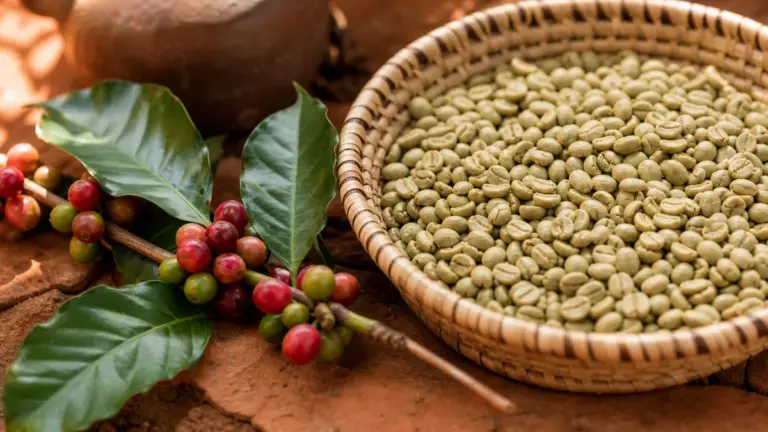
These are varieties of arabica coffee, Coffea arabica, not grades or processing methods. Their names describe plant material, whereas AA or AB describes the physical sorting of the harvested beans.
SL28 and SL34
The “SL” prefix comes from Scott Agricultural Laboratories, where selections were made in Kenya during the 1930s.
World Coffee Research describes SL28 as drought tolerant, with very good cup quality potential, but susceptible to major coffee diseases. Its genetic background is Bourbon-related. SL34 has exceptional quality potential and is adapted to high-altitude conditions with good rainfall, but is also vulnerable to important diseases.
The two should not be treated as interchangeable genetic names. World Coffee Research reports a Typica-like background for SL34, despite the historical association of its source tree with “French Mission” coffee. Traditional names and genetic evidence do not always tell exactly the same story.
Ruiru 11 and Batian
Ruiru 11, released in 1985, is a compact, high-yielding composite F1 hybrid. “F1” means the first generation from a deliberate parental cross; “composite” here means that the variety comprises related sibling plants rather than one identical genetic line.
World Coffee Research describes Ruiru 11 as tolerant to coffee leaf rust and resistant to coffee berry disease. Its breeding programme combined disease resistance, compact growth and cup-quality objectives.
Batian, released in 2010, is a tall composite variety resistant to leaf rust and coffee berry disease. Its ancestry includes SL28 and SL34 among several other contributors.
For drinkers, the useful distinction is between quality potential and a guaranteed result. A variety name is informative, but it is not a substitute for evaluating the finished lot. Do not reject a coffee simply because Ruiru 11 or Batian appears alongside the SL varieties.
Washed processing and double fermentation
Washed processing removes the fruit flesh and sticky mucilage surrounding the seed before drying. Mucilage is the slippery layer left after pulping; fermentation helps break it down so it can be washed away.
The Kenya Coffee Sustainability Manual describes this sequence:
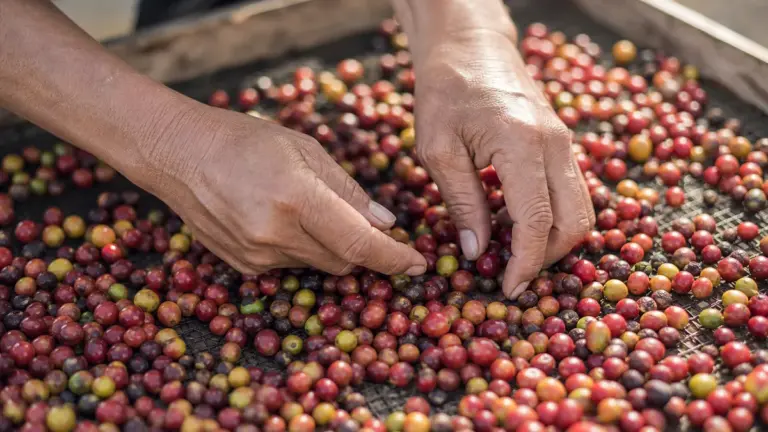
- Pick and sort ripe cherries, then pulp them on the day of harvesting.
- Ferment the pulped coffee, monitoring whether the parchment feels gritty rather than slippery.
- Wash between stages, allowing further fermentation if needed.
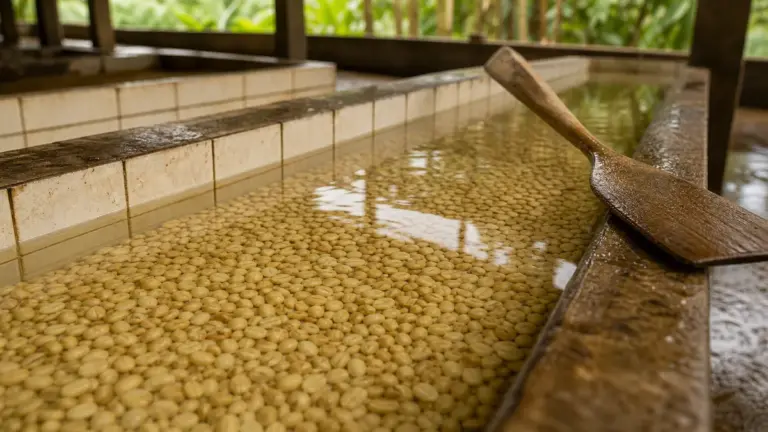
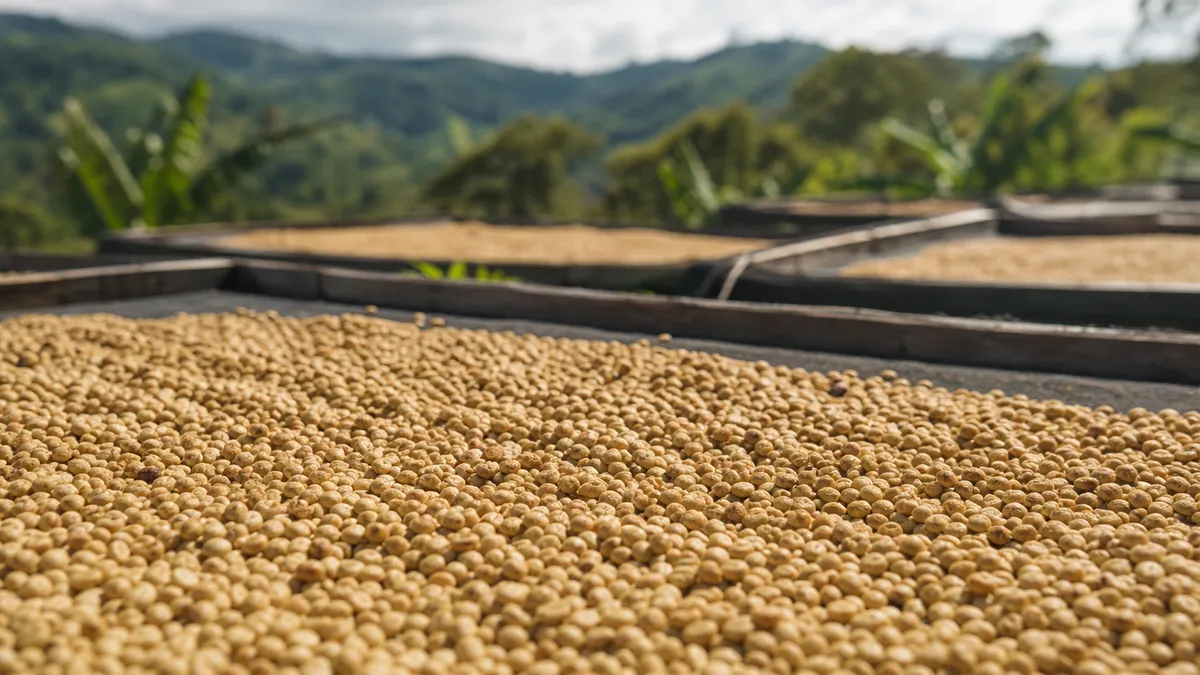
- Wash and grade in channels, then soak the better parchment categories overnight in clean water before drying on tables.
“Parchment” is the protective husk still surrounding the bean at this stage.
The terminology needs care. “Double washed” and “double fermentation” are sometimes used for fermentation followed by washing and a soak. A Rwanda training protocol describes post-fermentation soaking as double fermentation and identifies it with Kenya.
However, Royal Coffee distinguishes genuinely separate fermentation stages from that broader usage. Its Mahiga account describes two fermentations with washing between them, followed by a separate clean-water soak, while calling that specific double-fermentation practice rare.
The practical conclusion is not that one description must fit every factory. Fermentation, washing and soaking are characteristic; two distinct fermentations plus a soak require lot-specific confirmation. Ask for the actual sequence rather than assuming the label specifies it.
AA, AB and PB: what the grades mean
Kenyan coffee grades are often mistaken for a ranking of drinking quality. For these familiar labels, physical size and shape are the starting point.
| Grade | What it primarily identifies | What it does not establish |
|---|---|---|
| AA | A larger screen-size category of flat beans | That it will taste better than every AB or PB |
| AB | A smaller flat-bean size category than AA | That it is defective or unsuitable for speciality coffee |
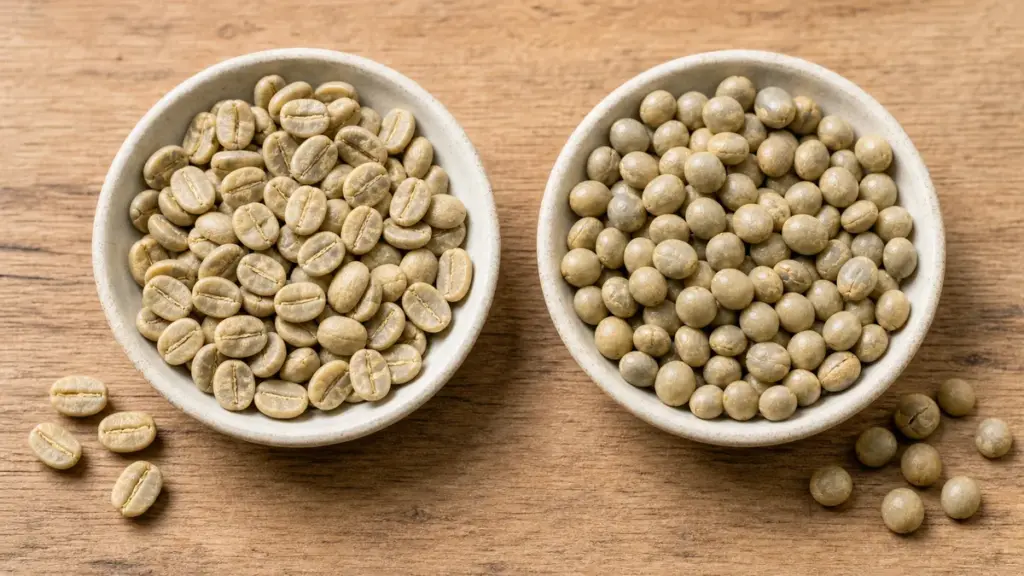
| PB | Peaberries, rounded beans formed when one seed develops in the cherry | A separate variety or guaranteed superior flavour |
Screens are sieves used to separate beans by dimensions. PB is the important qualification to the shorthand “size grades”: it identifies a distinctive bean shape, not simply the next step in a large-to-small ladder.
Kenya’s wider grading system also considers other physical characteristics, and cup assessment remains separate from size alone. The Nairobi Coffee Exchange explicitly recognises taste and aroma as factors beyond screen size.
Consequently, “AA is best” is not a sound buying rule. Choose the lot whose flavour description and traceability you prefer. If comparing grades, ask whether the coffees came from the same producer and harvest; otherwise, many differences besides size are involved.
The Nairobi Coffee Exchange and direct sales
The Nairobi Coffee Exchange, or NCE, provides a central auction marketplace where licensed participants trade Kenyan coffee. Its published resources include sales catalogues, auction information and market reports.
The auction route connects growers, co-operatives, mills, brokers and buyers. Coffee is processed and graded into identifiable lots before trading, while catalogues and samples allow buyers to assess what is being offered. It is an organised market, not simply a sale of undifferentiated “Kenyan coffee”.
What the Coffee Act 2026 permits
Kenya’s Coffee Act 2026 received assent on 13 March 2026 and commenced on 27 March 2026. It establishes the Coffee Board of Kenya and provides a new statutory framework for the sector.
Section 72 expressly permits sales through:
- auction in an exchange;
- direct sales;
- an international exchange;
- other methods prescribed through the statutory process.
Direct selling is therefore not an exception outside the legal system. Section 73 sets requirements for direct-sale contracts, including exchange sampling for quality analysis and market comparison, with an exception for future-sale contracts. Relevant licensing and reporting requirements still apply.
For a UK buyer, the useful question is which route a particular lot followed. Neither “auction bought” nor “directly sourced” proves better flavour or a better outcome for growers by itself. Ask who produced, processed, exported and imported the coffee, rather than treating the trading route as a quality badge.
Choosing Kenyan coffee in the UK
My suggested order of priorities is flavour description, named producer or factory, processing detail, then physical grade. This puts the information most relevant to drinking enjoyment ahead of the most prominent letters on the bag.
For a first purchase, ask a roaster for a washed Kenyan lot that expresses fruit and sweetness without an aggressively sharp profile. If the description is unfamiliar, ask what the coffee feels like to drink: delicate or substantial, gently fruity or intensely bright.
Keep comparisons manageable. Try another coffee from the same factory, or compare two clearly identified lots, rather than changing origin, process and roast style together.
When exploring neighbouring origins, use the separate guides to ethiopian coffee, tanzanian coffee and burundian coffee. Kenyan coffee is most useful as a starting point for discovering your preferences, not as a template that every East African coffee must follow.
FAQ
Does Kenyan coffee contain added fruit flavouring?
Fruit tasting notes do not, by themselves, mean flavouring has been added. They describe perceived aromas and flavours, using familiar foods as reference points. Kenya’s official flavour handbook uses berry, citrus and floral descriptors for coffee. If a product is flavoured or uses additional ingredients during processing, ask the seller to explain that separately rather than inferring it from the tasting notes.
Can a Kenyan coffee contain several varieties?
Yes, a Kenyan lot can contain several varieties. Royal Coffee’s Mahiga documentation lists SL28, SL34, Ruiru 11 and Batian together, illustrating why a factory lot need not be a single-variety coffee. Ask the roaster whether the listed varieties describe the actual lot or the varieties generally grown by its supplying farmers.
Is a Kenyan natural coffee incorrectly labelled?
No, Kenyan coffee can be natural processed. Washed processing is predominant, but the Coffee Directorate also records natural, honey and other experimental methods. Natural processing therefore does not invalidate the origin. It does mean you should read the particular lot’s processing and flavour description rather than expecting it to match the classic washed profile.
Where to go next
Read East Africa to place Kenya within the wider growing region, then Ethiopia to explore another origin in detail. Tanzania and Burundi are useful next reads for building a comparison based on named origins rather than assuming one regional flavour.
Sources
-
Agriculture and Food Authority, Coffee Directorate. The Kenyan Coffee Flavor Wheel, undated online handbook, retrieved November 2026. Production altitude, varieties, processing and sensory descriptions.
https://www.afa.go.ke/download/3279/ -
Agriculture and Food Authority, Coffee Directorate. Coffee Yearbook 2023/2024, reporting edition 2023/2024, online file published 2025. Growing counties, harvest periods and value-chain routes.
-
World Coffee Research. Arabica Varieties Catalog, live entries, undated, retrieved November 2026:
SL28: https://varieties.worldcoffeeresearch.org/varieties/sl28
SL34: https://varieties.worldcoffeeresearch.org/varieties/sl34
Ruiru 11: https://varieties.worldcoffeeresearch.org/varieties/ruiru-11
Batian: https://varieties.worldcoffeeresearch.org/varieties/batian -
Kenya Coffee Platform and KALRO Coffee Research Institute. Kenya Coffee Sustainability Manual, undated PDF, hosted 2021; Module 10, especially sections 10.4 to 10.7.
https://www.globalcoffeeplatform.org/wp-content/uploads/2021/03/KCS-MANUAL-review-03112020.pdf -
Nairobi Coffee Exchange. Understanding Kenya Coffee Grades and Kenya Coffee Origin, undated live pages, retrieved November 2026.
https://www.nairobicoffeeexchange.co.ke/kenya-coffee-origin/coffee-grades
https://www.nairobicoffeeexchange.co.ke/kenya-coffee-origin -
Kenya Law. Coffee Act, No. 8 of 2026, Gazette publication, 2026; particularly sections 4 and 72 to 76.
https://new.kenyalaw.org/akn/ke/act/2026/8/eng%402026-03-27/publication -
Royal Coffee. Crown Jewel Kenya Double Fermented Washed Othaya Mumwe, CJ1628, 2025 publication file. Primary importer account of Mahiga’s supplying growers, varieties and processing sequence.
https://cdn.royalcoffee.com/wp-content/uploads/2025/08/18162632/Crown-Jewel-Kenya-Double-Fermented-Washed-Othaya-Mumwe-CJ1628.pdf -
JICA Rwanda, hosted by Rwanda Digital Coffee School. Processing protocol document, undated retrieved edition; fermentation terminology, page 28.
https://www.rwandadigitalcoffeeschool.com/pdf/202603/1773494506_processing-protocol-document-en.pdf
This article was researched using retrieved official Kenyan publications, enacted legislation, World Coffee Research variety records and primary processing documentation, with differing uses of “double fermentation” distinguished rather than combined.
Last checked: November 2026