You need a water filter for your coffee machine when your supply needs treatment to meet the machine maker’s water requirements, reduce scale formation or remove an unwanted taste. You may not need one if your tap water already suits the machine and tastes clean: check the local water analysis and the machine manual before buying.
In short
- Choose by treatment, not appearance: a taste filter does not necessarily reduce hardness.
- Look up your water supplier’s postcode report, then test the water actually feeding the machine.
- A jug suits manual filling; a compatible tank cartridge treats water inside the reservoir; an in-line system serves a plumbed-in machine.
- Treat SCA brewing-water guidance and the manufacturer’s machine-protection limits as different checks.
- Follow the specified replacement and maintenance instructions, including any descaling requirements.
Why water matters to coffee
Water has two jobs: extracting flavour from the grounds and passing through the machine without causing avoidable deposits or damage. Those jobs overlap, but water that produces an enjoyable cup is not automatically suitable for every boiler or heating system.
Hardness comes mainly from dissolved calcium and magnesium. Heating water containing carbonate hardness can produce limescale, the deposits familiar from kettles. A filter intended for scale protection must address that problem, rather than simply make the water smell fresher.
Taste involves another measurement: alkalinity, the water’s ability to neutralise acids. Bicarbonate commonly supplies this buffering action. Higher alkalinity can soften coffee’s perceived acidity; too much for a particular coffee and brewing method can leave it tasting muted.
Activated carbon can reduce chlorine and other taste-impairing substances. Ion-exchange materials can alter hardness, but their effect depends on the particular treatment. The useful question is therefore not “Is this water filtered?” but “What does this filter change?”
For the wider equipment checklist, see brewing accessories. Here, the priority is choosing treatment that matches your water and machine.
Find your local water hardness first
Start with your drinking-water supplier, rather than a general map of hard-water areas. Thames Water, for example, provides a postcode-based water-quality lookup. Other suppliers publish their own reports or provide hardness information on request.
Record the numerical result and its units. A description such as “moderately hard” is less useful than the underlying measurement because hardness categories are not universally defined.
UK reports commonly express hardness in milligrams per litre as calcium carbonate, written mg/L as CaCO₃. This is a common reporting basis, not a measurement of visible chalk floating in the water.
Machine manuals and filter instructions may instead use German degrees, °dH, or Clark degrees. United Utilities publishes these approximate conversions:
- mg/L as CaCO₃ × 0.056 = German degrees.
- mg/L as CaCO₃ × 0.07 = Clark degrees.
Keep total hardness, calcium hardness and alkalinity separate. They may use the same reporting units without measuring the same thing. If a filter’s sizing instructions require carbonate hardness, do not substitute the supplier’s total-hardness figure without checking.
Finally, test the actual supply at the machine. An office drinking-water outlet may already have treatment upstream. Follow the machine maker’s test-strip instructions, and ask a filtration installer for the additional measurements their proposed system requires.
Choosing water filters for coffee machines
Choose using four criteria: the treatment required, compatibility, water demand and maintenance responsibility. The container shape is secondary.
The examples below describe manufacturers’ published treatment claims, not independent performance testing or brand rankings.
| Filter format | Who it suits | What to check | Main limitation |
|---|---|---|---|
| Filter jug | Homes and manually filled workplace machines | Explicit hardness-reduction claim, cartridge life and machine compatibility | Someone must filter and refill the water consistently |
| In-tank cartridge | A machine designed for a compatible reservoir filter | Exact cartridge type, activation procedure and replacement instructions | Compatibility and maintenance are machine-specific |
| In-line filter | Plumbed-in office and commercial machines | Water analysis, treatment medium, flow, capacity and any bypass setting | Needs correct specification and installation |
Filter jugs
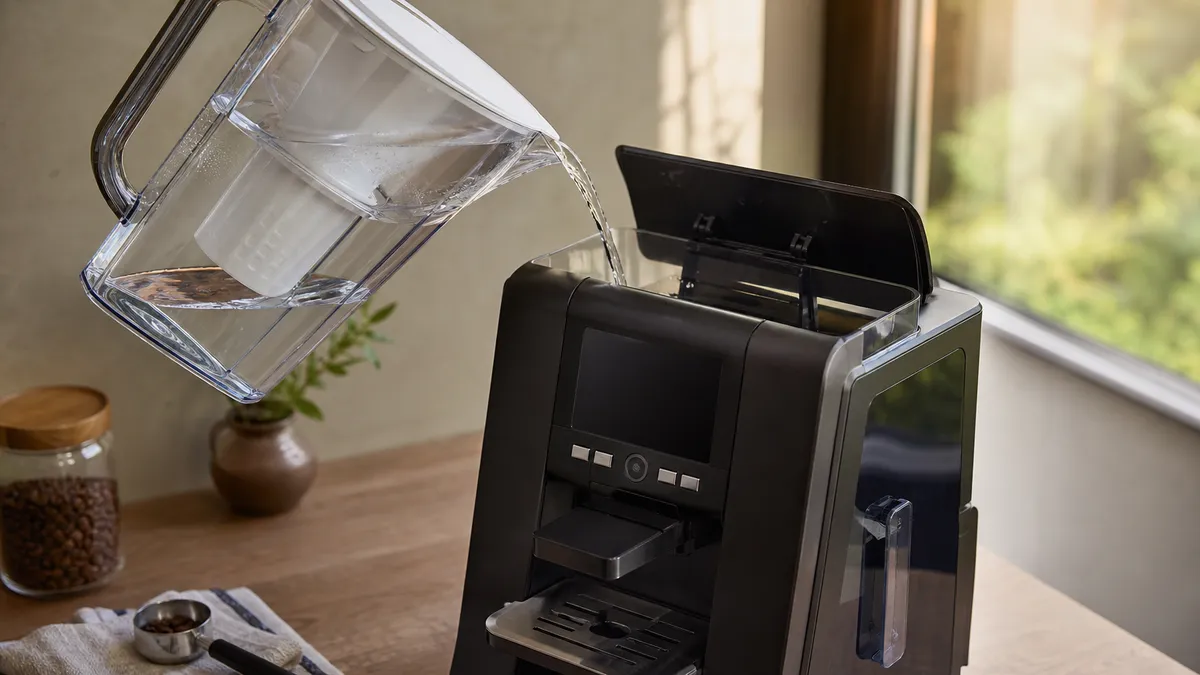
A jug offers a straightforward way to treat water before filling a reservoir. However, cartridges differ: check for an explicit limescale-reduction claim if scale protection is your aim.
For example, BRITA describes MAXTRA PRO cartridges as combining activated carbon with ion-exchange material. Its MicroDisc technology, by contrast, is described as reducing taste-impairing substances while allowing calcium and magnesium to pass through. Both filter water, but they are not interchangeable treatments.
A jug is a sensible choice only if its treated water meets the machine’s requirements and somebody follows the replacement schedule.
In-tank cartridges
An in-tank cartridge sits in the machine’s reservoir. Buy the exact compatible type and follow the preparation, fitting and filter-recognition procedure in the manual.
Do not assume the machine knows a cartridge has been fitted simply because it is physically present. Some machines require filter activation in their settings. Likewise, tell the machine when a filter has been removed if its instructions require this.
In-line systems
An in-line system treats the incoming supply to a plumbed-in machine. Coffee-specific systems may combine hardness reduction, activated carbon and particle filtration.
Some have a bypass, which allows a controlled proportion of water to avoid the hardness-reduction stage. The setting affects both the resulting water composition and cartridge capacity. It is a commissioning adjustment, not a dial to turn until the coffee tastes stronger.
Ask the installer to document the incoming analysis, selected treatment, bypass setting where applicable and expected replacement point.
What SCA water guidance actually tells you
The Specialty Coffee Association’s brewing-water guidance is useful, but it is not a universal espresso-machine warranty specification.
SCA Standard 310-2021, Home Coffee Brewers: Specifications and Test Methods, section 7.1.4, specifies test water that is:
- Free of odour and chlorine.
- Equivalent to 50 to 175 mg/L as CaCO₃ for calcium hardness.
- Equivalent to 40 to 70 mg/L as CaCO₃ for alkalinity.
- Within pH 6 to 8.
These are brewer-testing conditions in that edition. The hardness figure is specifically calcium hardness, not total hardness.
You may also encounter the older SCAE/SCAA target of 150 mg/L total dissolved solids, 68 mg/L calcium hardness and 40 mg/L alkalinity. Those figures appear in the association’s earlier water research material. They should not be mixed with later ranges and presented as one undated standard.
For practical buying, apply two checks: does the treated water meet the machine manufacturer’s requirements, and does it produce coffee you enjoy? Passing a brewing-water benchmark does not, by itself, establish suitability for every machine.
Scale protection and descaling are different jobs
Filtration treats incoming water; descaling removes deposits already present. Fitting a new cartridge does not descale an existing machine.
Nor is there one maintenance rule for every filtered machine. De’Longhi advises regular cleaning according to the machine instructions. JURA states that descaling is unnecessary when its specified CLARIS filtration system is used correctly. Follow the instructions for your exact machine and filter combination rather than applying either statement to all equipment.
For an office installation, cartridge demand should reflect all water passing through the filter, not just coffee served. Ask the supplier to account for rinsing, hot-water dispensing and the machine’s other water uses.
Request itemised written quotations covering the filter head, cartridge, installation, testing, replacements and servicing. Ask who monitors consumption and who takes responsibility when the machine is idle during holidays.
Set up and maintain the filter properly
Use this commissioning checklist rather than a universal flushing recipe. Preparation volumes and procedures vary between products.
- Check compatibility. Match the treatment to the machine’s published water requirements and the incoming analysis.
- Prepare and flush it. Follow the filter’s instructions exactly, using potable cold water where specified.
- Configure the machine. Complete any hardness entry, filter activation or replacement reset required by its manual.
- Record the starting point. Note the installation date, meter reading where fitted, cartridge type and relevant settings.
- Assign the next action. Record the replacement trigger and the procedure after a period without use.
Replacement depends on both throughput and elapsed time. As a product-specific example, BRITA’s jug manual gives MAXTRA PRO a maximum life of 150 litres or four weeks. Its professional PURITY C instructions require replacement at the applicable capacity or specified interval, and no later than 12 months after commissioning, whichever comes first. These are manufacturer limits, not promises for every water supply.
Keep the jug and reservoir clean. BRITA’s jug instructions say to store filtered water somewhere cool and use it within 24 hours. Professional systems have their own instructions for flushing after inactivity.
| Symptom | Likely cause to investigate | What to do |
|---|---|---|
| Chlorine-like smell remains | Treatment is unsuitable, exhausted or incorrectly prepared | Check the cartridge’s stated function and replacement instructions |
| New scale appears despite filtration | Insufficient hardness reduction, exhausted capacity or incorrect setup | Re-test the supply and review the specification with the supplier |
| Jug water passes through very slowly | Cartridge preparation or seating problem | Follow the manufacturer’s troubleshooting procedure |
| Descale prompt remains after fitting a cartridge | Filter has not been recognised, or the model requires another procedure | Consult the exact machine manual rather than dismissing the warning |
Taste: improve the water without chasing purity
The aim is suitable water, not the fewest possible dissolved minerals. Alkalinity changes how coffee acids are perceived, while hardness and other dissolved substances contribute to the water’s chemistry.
SCA-published technical discussion also distinguishes filter coffee from espresso: their different concentrations mean the same water need not affect their acidity equally. This is expert technical guidance, not proof of one universally best mineral recipe.
For a useful comparison, keep the coffee, dose, grind and brewing method unchanged while comparing two waters that the machine maker permits. Taste them as they cool. Treat any preference as a result for that coffee and setup, not a new universal rule.
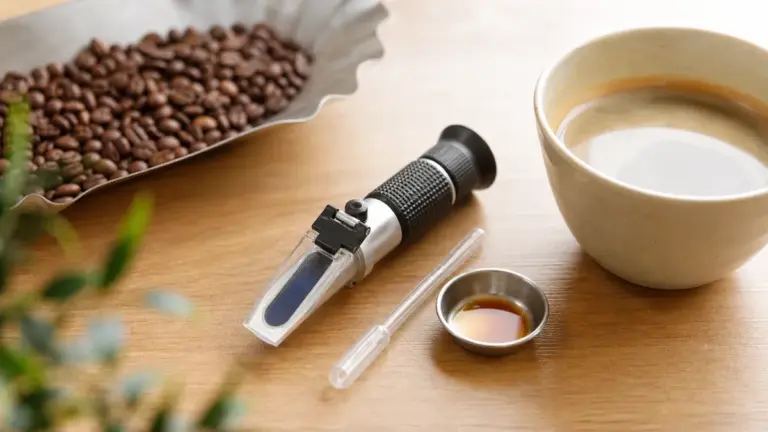
A coffee refractometer answers a different question about the brewed drink. It does not replace the water measurements required to specify a filter.
FAQ
Can I use distilled water instead of fitting a filter?
Not unless your machine manufacturer permits it. Distilled water is not a universal shortcut to suitable brewing water: De’Longhi’s EC9885 instructions, for example, explicitly prohibit it. Check the exact manual before using distilled water, reverse-osmosis water or a remineralised blend, and obtain written guidance if the requirements are unclear.
Does a whole-building water softener make a coffee filter unnecessary?
Not automatically. A softener and a coffee filter may perform different jobs, so check the treated outlet rather than assuming everything is covered. JURA notes that softeners do not remove taste and odour substances such as chlorine. Give the machine supplier the post-treatment analysis and ask what, if anything, remains necessary.
Does using another cartridge brand automatically remove my consumer rights?
No. GOV.UK explains that statutory consumer rights exist independently of a warranty or guarantee. That does not make every cartridge suitable or every resulting fault the seller’s responsibility. Check compatibility and warranty terms, retain maintenance records and distinguish a consumer purchase from a business contract when seeking advice.
Can a normal filter jug make unsafe water safe?
Do not rely on it for that purpose. BRITA’s jug instructions specify municipally treated drinking water and state that official boil-water advice still applies after filtration. A coffee-machine filter is not a substitute for resolving a water-safety problem or following instructions from the water supplier.
Where to go next
Read Brewing Accessories to put water filters for coffee machines alongside the other tools your setup needs, then Coffee Refractometers if you want to investigate brewed-coffee strength. Coffee Cups, Glassware and Travel Mugs helps with choosing what to serve the finished drink in.
Sources
-
Drinking Water Inspectorate, Water Hardness / Hard Water, undated, current page retrieved November 2026.
https://www.dwi.gov.uk/consumers/learn-more-about-your-water/water-hardness-hard-water/
Official explanation of hardness and local variation. -
Thames Water, Water quality, undated, current page retrieved November 2026.
https://www.thameswater.co.uk/help/water-and-waste-help/water-quality
Supplier postcode lookup for local water information. -
United Utilities, Water hardness, 2025 factsheet.
https://www.unitedutilities.com/globalassets/documents/pdf/10586_6335-water-hardness-factsheet-2025-web-acc.pdf
Reporting units, conversion factors and variation in hardness descriptions. -
Specialty Coffee Association, Home Coffee Brewers: Specifications and Test Methods, SCA Standard 310-2021, section 7.1.4, 2021, retrieved copy hosted by CoffeeGeek.
https://coffeegeek.com/wp-content/uploads/2023/10/SCAGoldCupStandard.pdf
Primary standard specifying brewer-test water. -
Speciality Coffee Association of Europe, Why Does Water Quality Matter?, undated research report.
Earlier SCAE/SCAA water targets, used here only for historical comparison. -
Specialty Coffee Association, Water and Coffee Acidity: How to Adapt Your Water for Different Extraction Methods, 25 Magazine, issue 9, undated webpage.
https://sca.coffee/sca-news/25/issue-9/english/water-and-coffee-acidity-how-to-adapt-your-water-for-different-extraction-methods-25-magazine-issue-9-pxjby
Technical discussion of alkalinity, brewing concentration, scale and corrosion constraints. -
BRITA, Water Filter Jugs Instruction Manual, EMEA, 2025.
Manufacturer’s treatment, preparation, replacement and hygiene instructions. -
BRITA, FAQ: Filters and Cartridges, undated, current pages retrieved November 2026.
https://www.brita.co.uk/faq/filters-cartridges
https://www.brita.co.uk/pages/faq-maxtra
Manufacturer’s distinctions between cartridge treatments and jug troubleshooting. -
BRITA, PURITY C Instruction Manual, undated retrieved edition.
https://www.brita.co.uk/dam/jcr%3A3d9b1ede-ad33-49ea-aca7-6b3b8e11f7fe/brita-filter-purity-c-instruction-manual-INT.pdf
Professional filter selection, commissioning, capacity and replacement instructions. -
JURA, FAQs about maintenance and hygiene, undated, current page retrieved November 2026.
https://www2.jura.com/en/purchasing-advice/optimum-maintenance/faq
Manufacturer’s CLARIS descaling, activation and softener guidance. -
De’Longhi, EC9885 Coffee Maker: Instructions for Use, undated retrieved edition; and Coffee Basics: the Importance of Water Quality, undated.
https://www.delonghi.com/medias/EC9885M-308287
https://coffeelounge.delonghi.com/en-int/discover/coffee-basics-the-importance-of-water-quality/
Manufacturer’s water restrictions and maintenance advice. -
GOV.UK, Accepting returns and giving refunds: the law, undated, current page retrieved November 2026.
https://www.gov.uk/accepting-returns-and-giving-refunds
Official guidance separating statutory rights from warranties.
This article was researched using retrieved standards, official water-supplier information, government guidance and manufacturers’ instructions; no first-hand filter testing is claimed.
Last checked: November 2026