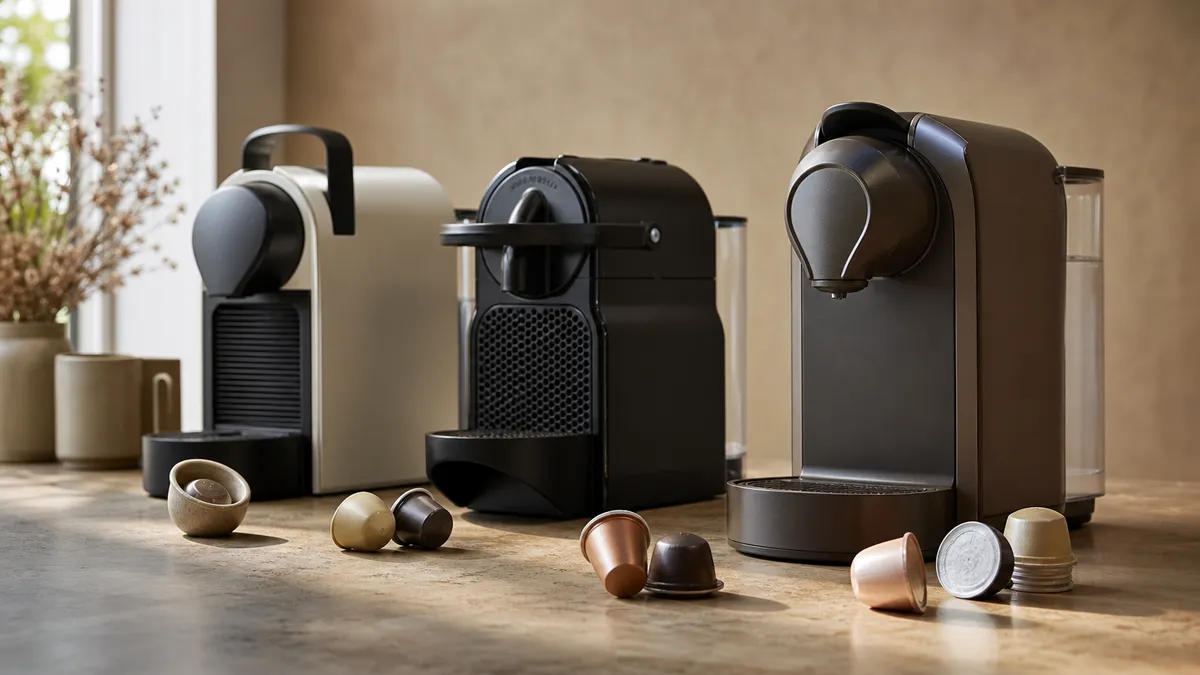
Dolce Gusto and Tassimo suit people who want a choice of ready-made drinks, including milk coffees and hot chocolate; Lavazza A Modo Mio is the more focused choice for espresso and coffee made with separately added milk. Choose the drinks and milk method first, then the machine: these are different capsule systems, not interchangeable ways to brew the same pods.
In short
- Many Dolce Gusto cappuccinos and lattes need two pods, one for coffee and one for powdered milk.
- Tassimo reads a barcode on each T DISC to set the water volume, temperature and brewing time.
- A Modo Mio uses ground-coffee capsules; milk drinks need a separate frother or a milk-equipped machine such as Deséa.
- Compare finished drinks per pack, not simply the number of capsules.
- Dolce Gusto Original plastic pods and Tassimo T DISCs use green Podback bags where the collection service requires bags. Lavazza Eco Caps have a separate industrial-composting route.
Dolce Gusto, Tassimo and Lavazza A Modo Mio compared
The criteria here are drink choice, milk preparation, user control, capsule supply and disposal. The recommendations are editorial judgements based on the systems’ published features, not results from hands-on testing.
This comparison covers the familiar Dolce Gusto Original plastic-pod system. Do not assume that products labelled Dolce Gusto NEO belong to the same format.
| Criterion | Dolce Gusto Original | Tassimo | Lavazza A Modo Mio |
|---|---|---|---|
| How it works | Water passes through a pod; manual or automatic volume control depends on the machine | A barcode tells the machine how to prepare each T DISC | Water passes through a pre-dosed, compacted ground-coffee capsule |
| Main drinks | Espresso, longer coffees, milk coffees and chocolate drinks | Black coffees, milk coffees and branded chocolate drinks | Espresso and longer coffees; add milk separately |
| Milk method | Many recipes use a powdered-milk pod | Many recipes use a concentrated dairy preparation in a separate T DISC | Fresh milk in a separate frother or a machine milk system |
| Main limitation | Milk recipes can require a pod change and give limited ingredient control | Dependence on the T DISC menu and barcode system | No equivalent all-in-one chocolate-and-milk capsule menu |
| Best suited to | A household wanting varied drinks without handling fresh milk | People wanting automatically set recipes and familiar drink brands | Espresso drinkers and people who prefer choosing their own milk |
For the wider equipment choice, start with our coffee machines guide. The practical question here is narrower: which capsule menu would you still want to drink after the novelty has worn off?
How each system works
Dolce Gusto: choose the pod and set the serving
Nescafé Dolce Gusto is a Nestlé system. Its Original machines use plastic pods, with the manufacturer claiming maximum pump pressure of up to 15 bar. That is a pump specification, not a taste score or proof that the coffee is better than a lower-pressure system.
On automatic machines, you normally match the machine’s serving bars to those printed on the pod. Manual models require you to stop the flow yourself. For a two-pod milk drink, prepare both pods in the order specified on the pack.
The important distinction is between coffee extraction and ingredient mixing. A black-coffee pod contains roast and ground coffee, while a milk pod supplies ingredients that water turns into the milk component. Dolce Gusto’s published cappuccino ingredients, for example, include whole milk powder and sugar.
Tassimo: the T DISC supplies the instructions
Tassimo belongs to JDE Peet’s, with Bosch supplying its familiar UK machines. Each T DISC carries a barcode, which the Intellibrew reader uses to select water volume, temperature and brewing time.
Bosch’s published Tassimo specifications include pump pressure of 3.3 bar. This is evidence for describing Tassimo as a lower-pressure system than Dolce Gusto, but it should not be treated as a universal specification for every machine ever sold.
Milk-based recipes commonly involve a coffee T DISC and a separate dairy T DISC. These are not necessarily powdered-milk equivalents of Dolce Gusto pods: Tassimo’s Costa Cappuccino ingredient list identifies a concentrated ultrafiltered milk preparation, alongside coffee, water, sugar and other ingredients.
A Modo Mio: a capsule espresso system
A Modo Mio is Lavazza’s espresso-focused capsule system. The coffee is already ground, measured and compacted inside the capsule, so the user does not grind or tamp it. Tamping means compressing ground coffee into a bed before brewing.
Choose a coffee capsule, insert it and use the machine’s dispensing controls. The important difference from the other two systems is what happens next: cappuccino or latte requires milk prepared outside the coffee capsule.
Lavazza offers milk-equipped machines such as Deséa, or a separate Milk Easy Plus frother for use beside a coffee-only machine. This gives you a different workflow, rather than simply a different selection of milk pods.
Drink menus and milk: the biggest everyday difference
Dolce Gusto’s range covers short coffees, longer coffees, cappuccinos, lattes and chocolate drinks. Tassimo’s UK catalogue includes Costa and L’OR milk coffees, Kenco coffees and Cadbury hot chocolate. A Modo Mio’s capsule range concentrates on coffee blends, including espresso, lungo and decaffeinated options.
Lungo means a longer coffee extraction. It is not a guarantee that a capsule will produce a satisfying oversized mug, so check the recommended serving for the particular blend.
For milk drinks, decide between sealed ingredients and separately handled milk.
Dolce Gusto and Tassimo let you prepare their milk-pod recipes without opening a milk carton. The trade-off is that the recipe determines the milk preparation and any added sugar. Check the current ingredients rather than assuming that “cappuccino” means only coffee and unsweetened milk.
With A Modo Mio, you choose the milk and quantity yourself. That is useful if you dislike sweetened milk preparations or want to use a particular dairy or plant-based product. However, you must also fill and clean the milk equipment, and check the frother manufacturer’s instructions for suitable ingredients.
My preference would be A Modo Mio for someone who cares primarily about espresso and wants control over added milk. For someone who wants several ready-formulated drinks with minimal ingredient handling, I would shortlist Dolce Gusto and Tassimo instead. That is a judgement about the workflow, not a claim that one system wins every taste comparison.
Machines: choose controls before appearance
Within each system, compare the functions you will actually use.
Dolce Gusto’s published range distinguishes manual machines such as Piccolo XS from automatic models such as Genio S. Genio S Plus adds features including temperature control and Espresso Boost, according to the manufacturer. Automatic stopping is worth prioritising if different people will use the machine.
Tassimo’s central barcode method remains the defining feature, but not every model offers identical controls. My Way allows adjustment of drink intensity, temperature and volume. Check the exact model rather than assuming that every Tassimo has those options.
For A Modo Mio, the first decision is coffee-only versus milk-equipped. A separate frother means another appliance on the worktop; Deséa combines coffee preparation with its dedicated milk-drink arrangement.
Before ordering, check:
- Whether your usual mug fits beneath the outlet.
- Access for removing and filling the water tank.
- Clearance to open the capsule compartment.
- How used capsules are removed or collected.
- Which parts require cleaning after milk drinks.
Treat published specifications as manufacturer claims. They do not establish long-term reliability, noise in your kitchen or how much you will enjoy the coffee. Our pod and capsule machine guide explains the broader compromises without tying the choice to these three systems.
Capsules: availability and compatibility
Dolce Gusto says its popular pods are available through major UK supermarkets as well as its own online shop. Tassimo likewise directs customers to its website and supermarkets. Lavazza sells A Modo Mio capsules directly online.
Availability of the specific drink matters more than the existence of the brand. Before committing, check your usual retailer for the black coffee, decaf or milk recipe you would buy repeatedly. An extensive online catalogue is less helpful if you only want to replenish supplies during the weekly shop.
Read the full system name on every pack. Lavazza also sells capsules for other formats, including Nespresso Original-compatible capsules, which are not A Modo Mio capsules. Similarly, the name of a coffee brand alone does not establish which machine its product fits.
If you are also considering Nespresso, use our Original and Vertuo comparison rather than treating all capsule machines as one category.
Cost per cup: compare complete drinks
Use finished servings as your starting point. A Dolce Gusto cappuccino pack containing eight coffee pods and eight milk pods makes eight complete drinks, not sixteen. Apply the same check to Tassimo’s paired coffee-and-milk recipes.
For your own comparison:
- Divide the pack total by the stated number of finished drinks.
- Add separately purchased milk where applicable.
- Account for any extra coffee capsule you routinely use.
- Include delivery, cleaning products, descaler and water filters where required.
- For an ownership comparison, spread the machine and any separate frother over your expected number of drinks.
Keep the assumptions consistent: the same daily consumption, ownership period and drink mix. Record whether your figures include VAT, especially when comparing workplace quotations.
For a workplace, also include staff cleaning time, milk storage and waste collection. Get itemised written quotations showing equipment, consumables, maintenance and any supply commitment separately. Do not assume that a household machine’s advertised features establish its suitability for repeated shared-office use.
Recycling and composting in the UK
Dolce Gusto and Tassimo: Podback plastic collections
Both systems participate in Podback. Where the service requires a bag, their plastic pods belong in a green Podback bag, not the bag intended for aluminium capsules.
The brands’ instructions allow different participating plastic pod brands to share the appropriate bag. Drain remaining liquid, but there is no need to empty out the coffee grounds.
Use the postcode-based Recycle Checker before deciding how to return them. Collection arrangements differ: participating shops may require filled bags, while some recycling centres accept pods tipped loose into designated containers. Do not put loose pods in ordinary household recycling on the assumption that plastic means locally accepted.
Lavazza Eco Caps: industrial composting, not the garden
Lavazza describes Eco Caps as industrially compostable and explicitly says they should not go into home compost or the garden. Use a council food-waste collection only if the council specifically accepts these capsules.
The alternative is the Lavazza Eco Caps programme operated by TerraCycle. Its acceptance rules are brand-specific: non-Eco Caps capsules, other brands and outer packaging are excluded. Check current enrolment and return instructions before relying on it.
“Compostable” describes a material under specified processing conditions. It does not mean that every food-waste service accepts it, or that it will break down properly in a garden heap.
For Dolce Gusto, Tassimo and Lavazza A Modo Mio alike, choose a disposal route you can realistically maintain, not just a favourable word on the packaging.
FAQ
Can I use my own milk with Dolce Gusto or Tassimo?
Yes, you can choose a black-coffee pod or T DISC and add milk separately instead of buying a paired milk recipe. For frothy milk, use separate suitable equipment. This changes the drink from the manufacturer’s formulated recipe and gives you control over the milk you add, but creates an additional preparation and cleaning step.
Are these machines making instant coffee?
Not necessarily: the coffee components discussed here include roast and ground coffee, which the machine brews with water. Milk and chocolate products work differently because they contain prepared ingredients. Check each drink’s ingredient list rather than assuming that everything inside a capsule is either ground coffee or instant powder.
Do I have to use two capsules for every drink?
No. Black coffees generally use a single coffee capsule or T DISC, while many Dolce Gusto and Tassimo milk recipes require a separate milk component. A Modo Mio milk drinks use a coffee capsule plus separately prepared milk. Always follow the particular pack’s instructions and count complete servings when comparing supplies.
Where to go next
Read Pod or Capsule Coffee Machines for the wider strengths and limitations of capsule brewing, then Nespresso Original vs Vertuo if you want to compare another major system. Coffee Machines is the next stop if this comparison has left you wanting to consider machines beyond capsules.
Sources
- Nestlé UK & Ireland, Nescafé Dolce Gusto machines, undated, retrieved November 2026. Brand attribution and manufacturer pressure claims. URL: https://www.nestle.co.uk/en-gb/brands/coffee/nescafe-dolce-gusto-machines.
- Nescafé Dolce Gusto, Find the Best Dolce Gusto Machine for You and How to Use Our Coffee Pods FAQs, undated, retrieved November 2026. Machine controls, serving bars and UK purchasing channels. URLs: https://www.dolce-gusto.co.uk/compare-coffee-machines; https://www.dolce-gusto.co.uk/faqs/how-to-use-coffee-pods.
- Nescafé Dolce Gusto, Cappuccino Coffee Pods, undated, retrieved November 2026. Published ingredients and paired-pod pack contents. URL: https://www.dolce-gusto.co.uk/cappuccino-pods.
- Tassimo, Sustainability at Tassimo and Tassimo Intellibrew Technology, undated, retrieved November 2026. JDE Peet’s attribution and barcode-controlled brewing. URLs: https://www.tassimo.com/gb/cp/tassimo-world/sustainability; https://www.tassimo.com/ie/cp/tassimo-world/intellibrew.
- Bosch, Freestanding Appliances 2019, 2019 catalogue. Published Tassimo pump specifications, used as historical model evidence rather than a universal current specification. URL: https://media3.bosch-home.com/Documents/MCDOC03188052_Bosch_FS_2019_E-CAT_LR.pdf.
- Tassimo, Costa Cappuccino, Coffee Pods and My Way Machine Assistance, undated, retrieved November 2026. Dairy ingredients, current drink examples, adjustable settings and purchasing channels. URLs: https://www.tassimo.com/gb/p/costa-cappuccino; https://www.tassimo.com/gb/coffee-pods; https://www.tassimo.com/gb/cp/coffee-pod-machines-support/my-way-machine-assistance.
- Philips/Saeco, Super-automatic espresso machine HD5720/31, version 1.2.1, 7 March 2019. Manufacturer description of pressed coffee inside A Modo Mio capsules. URL: https://www.documents.philips.com/assets/20220624/530a98315bfb4d849ff1aebe0167c6b9.pdf.
- Lavazza, Capsule and Bean-to-Cup Coffee Machines for Home and Lavazza A Modo Mio Coffee Capsules, undated, retrieved November 2026. Coffee and milk arrangements, capsule range and format distinction. URLs: https://www.lavazza.co.uk/en/coffee-machines; https://www.lavazza.co.uk/en/coffee-capsules-pods/a-modo-mio. Conflicting capsule-weight wording on the latter page was not used.
- Nescafé Dolce Gusto, Podback, undated, retrieved November 2026. Plastic-pod green bags and collection arrangements. URL: https://www.dolce-gusto.co.uk/faqs/podback.
- Tassimo, Podback Recycling, undated, retrieved November 2026. Green bags, mixed participating plastic pods, draining and location-specific returns. URL: https://www.tassimo.com/gb/cp/tassimo-world/recycling.
- Lavazza, Frequently Asked Questions, recycling section, undated, retrieved November 2026. Industrial composting, exclusion of home composting and conditional council acceptance. URL: https://www.lavazza.co.uk/en/faq.
- TerraCycle UK, The Lavazza Eco Caps Composting Programme, undated, retrieved November 2026. Accepted waste, exclusions and enrolment conditions. URL: https://www.terracycle.com/en-GB/brigades/lavazza-uk.
Researched from manufacturer product information, technical literature and the collection programme operator’s instructions; recommendations compare published features, with no first-hand machine testing claimed.
Last checked: November 2026