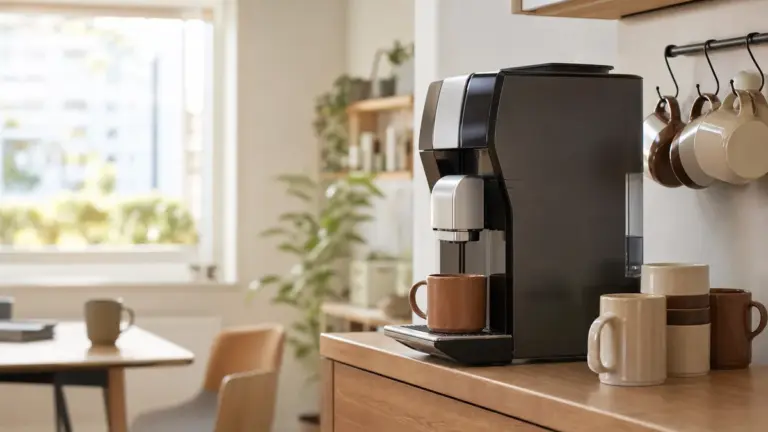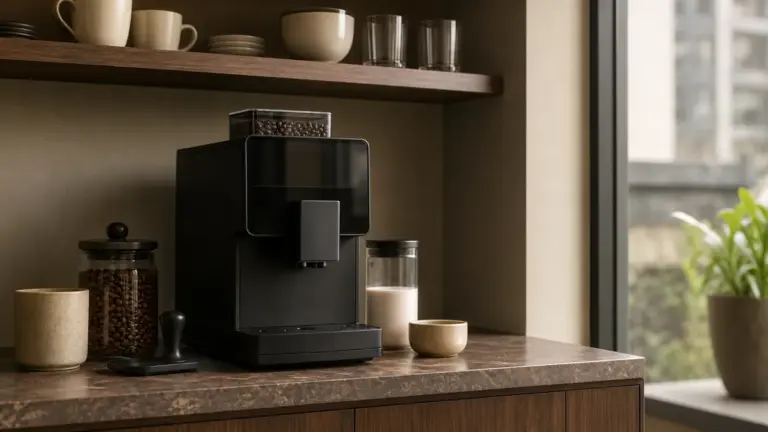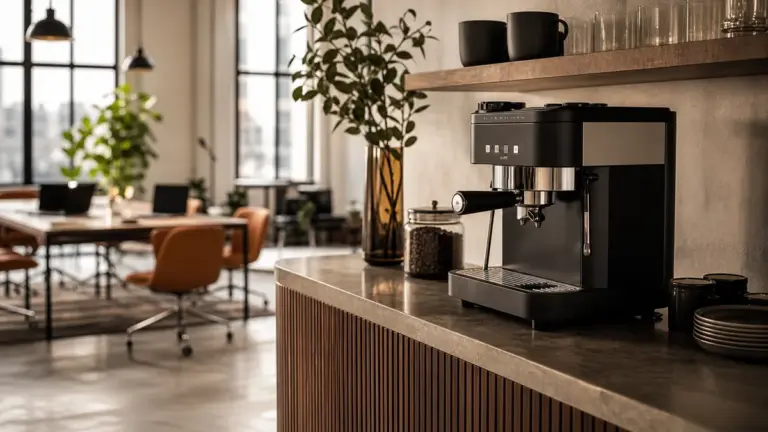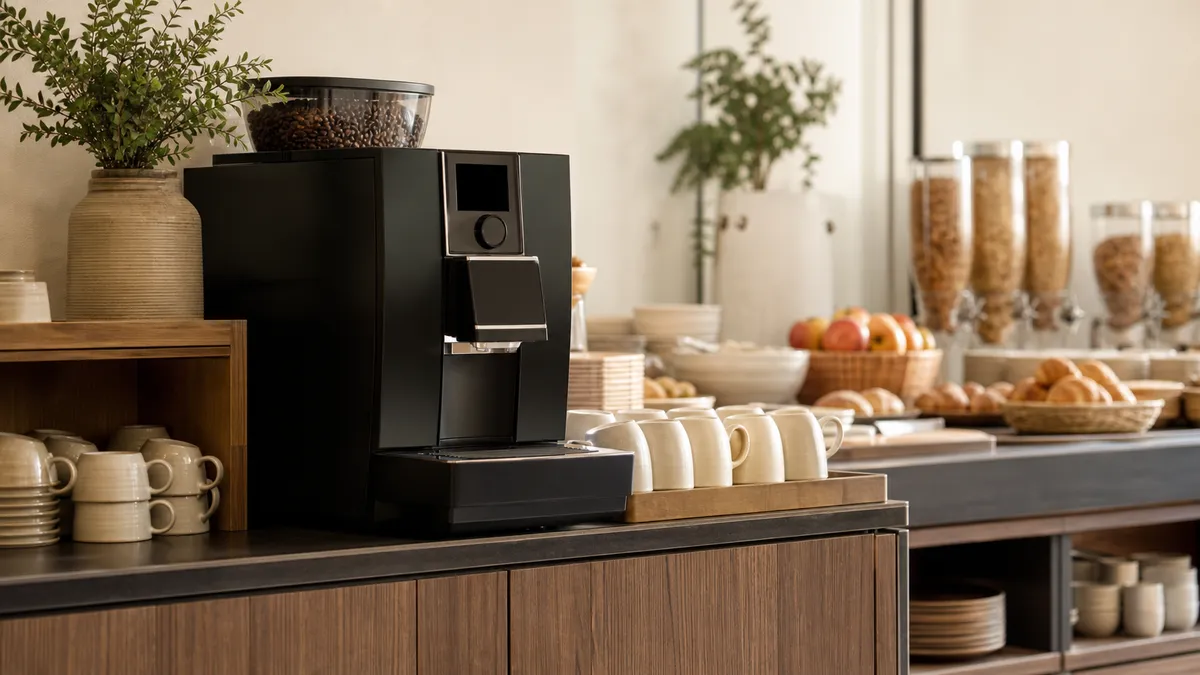
Coffee machines for hotels, restaurants and cafés should be chosen around who makes the drinks and how concentrated demand becomes. A commercial super-automatic usually suits guest self-service or waiter-operated coffee service, while a traditional espresso machine suits a staffed bar where trained people control preparation; batch filter coffee is also worth considering for breakfast and events.
In short
- Separate guest-operated breakfast stations from staff-operated restaurant and café service when writing your requirements.
- Record daily drinks and the busiest 15 or 30 minutes, including the actual proportion of milk drinks.
- Treat manufacturers’ daily capacities as claimed specifications, not promises about queues or mixed-drink output.
- Assign named responsibility for milk hygiene, replenishment and cleaning, even with automatic equipment.
- Request a realistic demonstration, an installation survey and itemised written quotations before committing.
Match the machine to the service, not just the venue
A hotel can need several different coffee services: breakfast self-service, waiter-served restaurant drinks, conference refreshments and a staffed lounge bar. Do not assume one machine type must cover them all.
Start with a service map. Where will orders arrive, who will prepare them, where will finished drinks go, and who will replenish ingredients? Our wider workplace coffee guide provides the starting framework, but hospitality needs particular attention to guest movement and service peaks.
Here, traditional means an espresso machine using a removable portafilter, the handled holder for ground coffee, with preparation controlled by staff. Super-automatic means commercial bean-to-cup equipment that automates grinding, dosing and brewing; suitable milk-equipped models also prepare complete milk drinks.
The comparison below uses four criteria: operator involvement, drink control, service pattern and operational limitations. It is a workflow recommendation, not a ranking of brands.
| Option | Best service fit | Main advantage | Main limitation |
|---|---|---|---|
| Traditional espresso machine and grinder | Staffed café bar or restaurant with trained coffee staff | Hands-on control of espresso and milk texture | Requires preparation skills and a workable bar layout |
| Super-automatic with automatic milk | Hotel breakfast self-service or waiter-operated restaurant station | Programmed drinks with fewer manual preparation steps | Still needs replenishment, cleaning and demonstrated peak capacity |
| Batch filter brewer and suitable servers | Breakfast black coffee, conferences and group service | Coffee is brewed ahead of individual dispensing | Does not make espresso or textured milk drinks |
For a café built around espresso preparation, I would normally start with a traditional system. For a restaurant where waiting staff alternate between drinks and tables, I would start by demonstrating a super-automatic. Those are editorial starting points: the actual menu and staffing plan should decide.
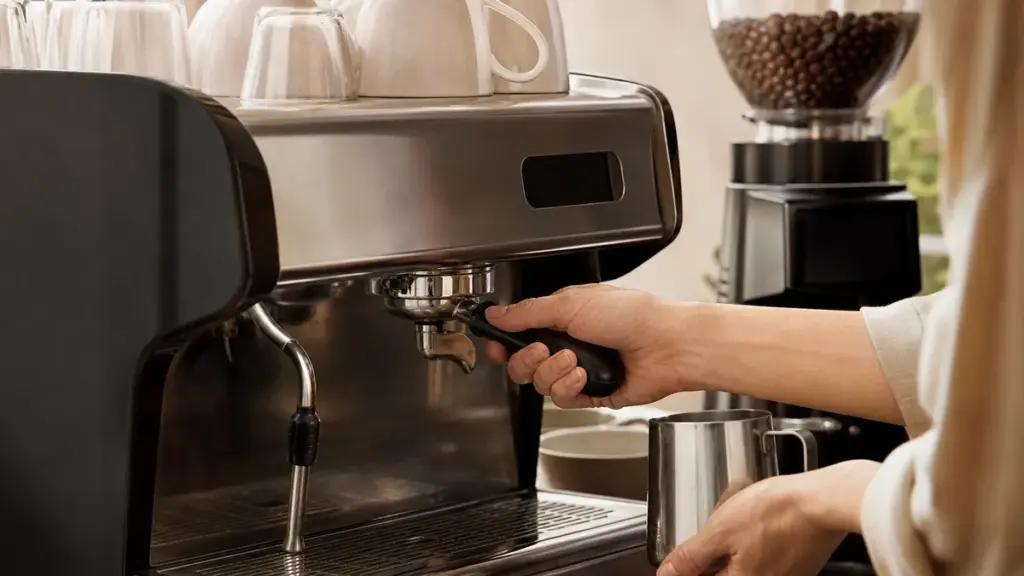
Size coffee machines for hotels, restaurants and cafés around peaks
Daily volume tells only part of the story. Ask suppliers to distinguish their recommended daily workload from hourly beverage output, and to identify the drink sizes and test conditions behind any throughput figure.
For example, Franke’s October 2025 New A Line brochure lists claimed daily capacities of 200 cups for the New A600 and 250 cups for the New A800. Neither figure, by itself, establishes how quickly a breakfast queue will clear.
Use customer or guest headcount to estimate demand, then replace the estimate with operating records where available. The following matrix contains invented planning examples, not industry averages or machine-sizing guarantees. Each daily figure assumes only the stated service uses that machine.
| Illustrative service and headcount | Assumed coffees per person | Drinks per day | Assumed busiest period | Equivalent hourly demand |
|---|---|---|---|---|
| Hotel breakfast, 100 guests | 1.5 | 150 | 60 drinks in 30 minutes | 120 drinks |
| Restaurant, 80 diners | 0.5 | 40 | 20 drinks in 15 minutes | 80 drinks |
| Café, 160 customers | 1 | 160 | 30 drinks in 15 minutes | 120 drinks |
The hourly equivalents are arithmetic, not evidence that demand continues at that rate. Their purpose is to expose the difference between a modest daily total and a demanding rush.
Specify the menu alongside the figures: espresso, black coffee, cappuccino, latte, decaf and hot water. Ask for a timed demonstration using your cups and likely drink mix, including replenishment and any interruptions. Count completed drinks handed over, not merely brewing cycles.
Design breakfast service around guest movement
For hotel breakfast, evaluate the whole station rather than the machine alone. Put cups before the dispensing point and provide a clear place to add milk or sugar afterwards, without blocking the next guest.
Choose a deliberately short guest-facing menu. During a demonstration, ask someone unfamiliar with the machine to select a drink, position the cup and collect it. Check reach, visibility, cup clearance, spills and how staff will help someone who cannot use the controls comfortably.
If many guests want black coffee, demonstrate batch filter alongside individual bean-to-cup preparation. Commercial batch brewers can brew into separate containers, allowing brewing and serving to be organised as different tasks. Agree batch quantities and replacement routines around actual uptake rather than filling every container automatically.
Consider whether tea hot water should have its own dispensing point. This is a layout decision to test against your breakfast pattern, not an automatic requirement.
Hotel conference breaks deserve a separate demand calculation. The meeting and reception guide is a useful companion where drinks arrive in short, scheduled bursts.
Plan staffing, training and milk together
Traditional equipment requires practical skills in espresso preparation, milk texturing and workflow. The Specialty Coffee Association’s barista education covers these areas, but training should also address your own recipes, equipment and service sequence.
Allocate responsibility for opening checks, grinder adjustment, drink quality and closing cleaning. Teach enough people to cover the rota rather than relying on one enthusiastic barista.
A super-automatic changes these tasks; it does not remove them. Staff still need to recognise an unsuitable drink, replenish ingredients correctly, manage waste containers and complete the manufacturer’s cleaning procedures. JURA’s GIGA X8 instructions, for example, distinguish automatic rinsing from daily milk-system cleaning and daily dismantling and rinsing of the milk outlet when milk has been prepared.
Milk and allergy management
Ask suppliers to demonstrate the full milk journey: refrigerated storage, connection, dispensing, replenishment and cleaning. Follow the equipment instructions and your food-safety procedures rather than assuming a milk fridge and an automatic rinse make the system self-managing.
For plant-based drinks, investigate shared pipes, outlets, jugs, steam wands and cleaning equipment. A selectable second milk option is not, on its own, evidence that a drink is safe for someone with a milk allergy.
The Food Standards Agency requires food businesses to provide allergen information and manage allergens effectively. Its buffet guidance calls for information for individual items rather than one statement covering the whole buffet; translate that into clear, accessible information for the drinks offered at breakfast.
Keep staff able to explain the ingredients and the assessed cross-contamination risks. Do not describe a drink as milk-free solely because its recipe uses a plant-based alternative.
Check installation and service support before ordering
Ask for a site survey covering electrical supply, water connection, drainage, ventilation, counter support and access for maintenance. Include the grinder, milk refrigerator, cup storage, waste handling and cleaning space on the layout, not just the brewer.
Obtain the local water supplier’s hardness information and have the installer check the water against the chosen manufacturer’s requirements. Hardness varies with the supply: Yorkshire Water, for example, provides a postcode lookup and offers detailed local information on request. Where hardness is reported as mg/L as calcium carbonate, that is a common reference unit for hardness, not a measurement of visible scale.
In England and Wales, plumbed-in installations must comply with the Water Supply (Water Fittings) Regulations 1999, including appropriate backflow prevention. Ask the installer to confirm the applicable requirements elsewhere in the UK.
In Great Britain, machines incorporating steam pressure systems need assessment against the Pressure Systems Safety Regulations 2000. Steam counts as a relevant fluid at any pressure. Check with the supplier and HSE guidance on pressure systems, including whether a written scheme of examination and examination by a competent person are required before use.
What the service contract should specify
Request written answers covering:
- Support hours, including weekends and breakfast service.
- Response time versus the time allowed to restore service.
- Preventive maintenance, parts, labour and exclusions.
- Water-treatment responsibilities and filter replacement.
- Staff training and refresher arrangements.
- Temporary replacement equipment and its installation requirements.
- Responsibility for any statutory pressure-system examinations.
HSE distinguishes statutory examination from routine maintenance. Do not assume a general service agreement includes both.
For England, include grounds disposal in the operating plan. Simpler Recycling has required in-scope workplaces to separate food waste, including coffee grounds, since 31 March 2025; micro-firms with fewer than 10 full-time-equivalent employees have until 31 March 2027. The employee count applies across the business, not simply one hotel or restaurant. Other UK nations have separate arrangements.
Compare the whole operating commitment
Get itemised written quotations against the same menu, demand assumptions and contract period. Include equipment, installation, water treatment, servicing, cleaning products, replacement parts, utilities and staff time.
For your own cost-per-drink calculation:
- Estimate completed drinks by type over a stated period.
- Calculate beans from the programmed dose in grams and milk from the recipe volume in millilitres.
- Add measured allowances for recipe adjustment, rejected drinks and unused milk or batch coffee.
- Add equipment and installation expenditure allocated over your chosen period, plus servicing, consumables, utilities and labour.
- Divide the total by completed drinks, keeping the VAT basis consistent.
Do not confuse ingredient VAT with the treatment of finished drinks. HMRC generally zero-rates coffee and milk supplied as food, while hot drinks supplied in hospitality catering are standard-rated. Have your finance adviser confirm the treatment relevant to your operation.
For a hotel staff room rather than guest service, use the shared-workspace guide instead of carrying guest-service assumptions into the staff refreshment area.
When to get specialist advice
Bring in a hospitality coffee specialist before specifying equipment where breakfast, restaurant and conference demand overlap, the installation needs alteration, or losing one machine would interrupt service.
Involve an appropriately qualified installer and, where applicable, a pressure-systems competent person. Seek food-safety advice where allergen controls depend on shared milk equipment.
The most useful final test for coffee machines for hotels, restaurants and cafés is a realistic service demonstration. Give the supplier your menu and peak order pattern, then watch preparation, handover, replenishment and cleaning as one complete operation.
FAQ
Can one machine serve breakfast and the restaurant?
Yes, provided its location, workload and operating arrangements suit both services. Map overlapping demand before deciding: breakfast guests and restaurant staff may need access at the same time. Ask the supplier to demonstrate the combined pattern and explain how service would continue during cleaning, replenishment or a breakdown.
Should a hotel offer decaf through the same machine?
It can, but the decaf preparation method needs checking before purchase. Ask whether the configuration uses a separate hopper and grinder, a ground-coffee entry point or another arrangement, and demonstrate the complete preparation sequence. Assess whether guests can operate it reliably or whether decaf should be staff-assisted.
Is a second machine better than one larger machine?
Neither arrangement is automatically better. Two machines can provide separate serving points and some resilience, but also create additional cleaning and replenishment tasks. Compare both layouts against simultaneous demand and the service you could maintain if one unit stopped. Check whether shared utilities or accessories would undermine that resilience.
Where to go next
Read Coffee for Every Workplace for the broader selection framework, and Coffee Machines for Meeting Rooms and Reception Areas for conference and lounge refreshments. Coffee Machines for Shared Workspaces helps separate staff refreshment needs from the guest-service specification.
Sources
-
Specialty Coffee Association, Education: Courses, undated, current page retrieved November 2026. Barista preparation, milk and workflow education.
https://sca.coffee/education/courses/ -
Franke Coffee Systems, The New A Line, October 2025 brochure, document 590.0739.837/10.25/CH-EN. Served and self-service applications and claimed daily capacities.
https://www.franke.com/content/dam/franke/language-masters/en/coffee-systems/documents/brochures/en/en_new_a_line_franke_cs_brochure.pdf.coredownload.pdf -
Bravilor Bonamat, B10 HW container right 400V, undated, current UK manufacturer page retrieved November 2026. Batch brewing into separate containers.
https://www.bravilor.com/en-gb/products/filter-coffee-machines-en-gb/b10-hw-r/ -
JURA, GIGA X8 Instructions for Use, undated retrieved edition, sections 3 and 5. Automatic preparation and milk-system maintenance.
https://us.jura.com/-/media/global/pdf/manuals-global/professional/GIGA-X8-G2/download_manual_jura_giga_x8.pdf?la=en -
Food Standards Agency, Allergen guidance for food businesses, updated 17 July 2026. Applies to England, Northern Ireland and Wales.
https://www.gov.uk/government/publications/allergen-guidance-for-food-businesses/allergen-guidance-for-food-businesses -
Yorkshire Water, Check your water hardness, undated, current page retrieved November 2026.
https://www.yorkshirewater.com/your-water/water-hardness/ -
Drinking Water Inspectorate, Water Hardness / Hard Water, undated, current page retrieved November 2026. Local variation, hardness units and scaling.
https://www.dwi.gov.uk/consumers/learn-more-about-your-water/water-hardness-hard-water/ -
UK legislation, The Water Supply (Water Fittings) Regulations 1999, SI 1999/1148, particularly Schedule 2, paragraph 15.
https://www.legislation.gov.uk/uksi/1999/1148/pdfs/uksi_19991148_en.pdf -
Health and Safety Executive, Pressure Systems Safety Regulations 2000 (PSSR) and Introduction to pressure equipment, undated, current guidance retrieved November 2026.
https://www.hse.gov.uk/pressure-systems/pssr.htm
https://www.hse.gov.uk/pressure-systems/about.htm -
Department for Environment, Food & Rural Affairs, Simpler recycling: workplace recycling in England, updated 3 October 2025.
https://www.gov.uk/guidance/simpler-recycling-workplace-recycling-in-england -
HM Revenue & Customs, Food products (VAT Notice 701/14) and Catering, takeaway food (VAT Notice 709/1), both updated 8 June 2026.
https://www.gov.uk/guidance/food-products-and-vat-notice-70114
https://www.gov.uk/guidance/catering-takeaway-food-and-vat-notice-7091
This article was researched using manufacturer documentation and official education, food-safety, water, tax, waste and workplace-safety sources; the demand matrix is illustrative arithmetic, and no first-hand machine testing is claimed.
Last checked: November 2026