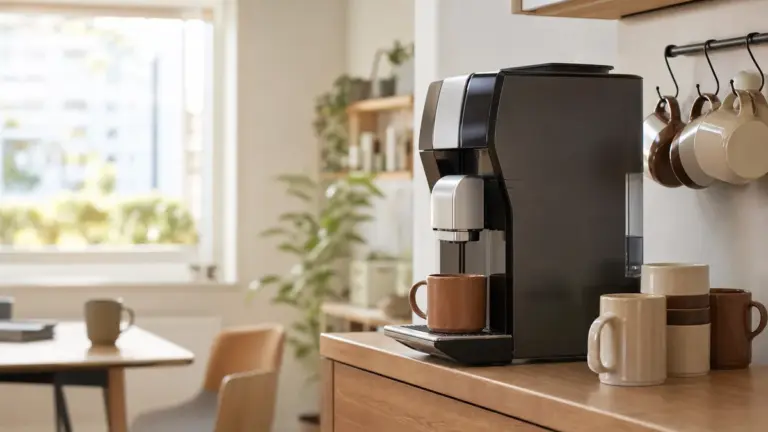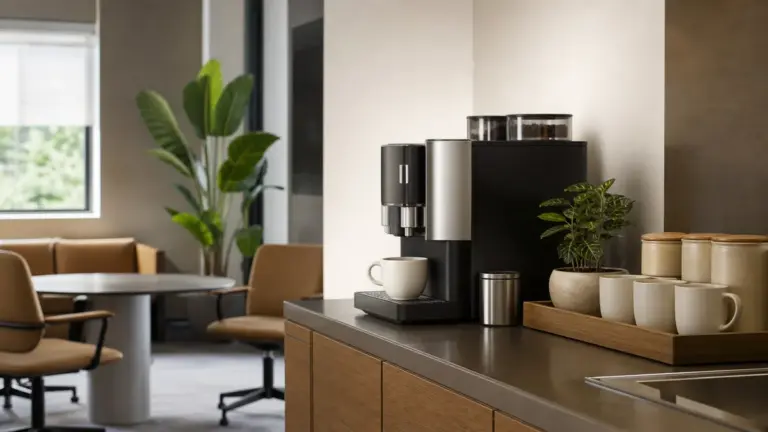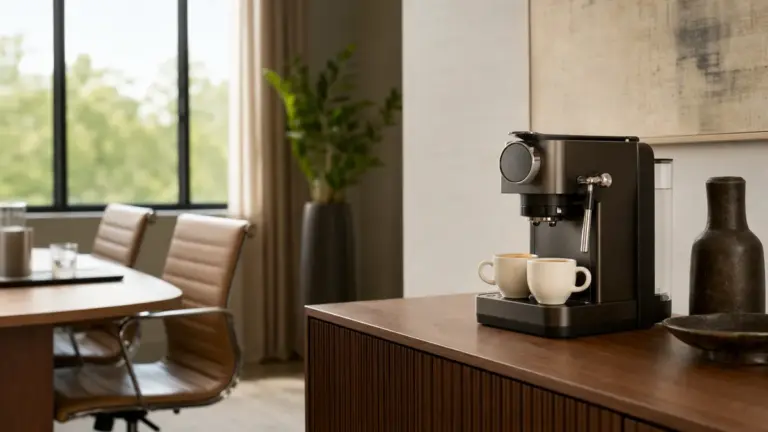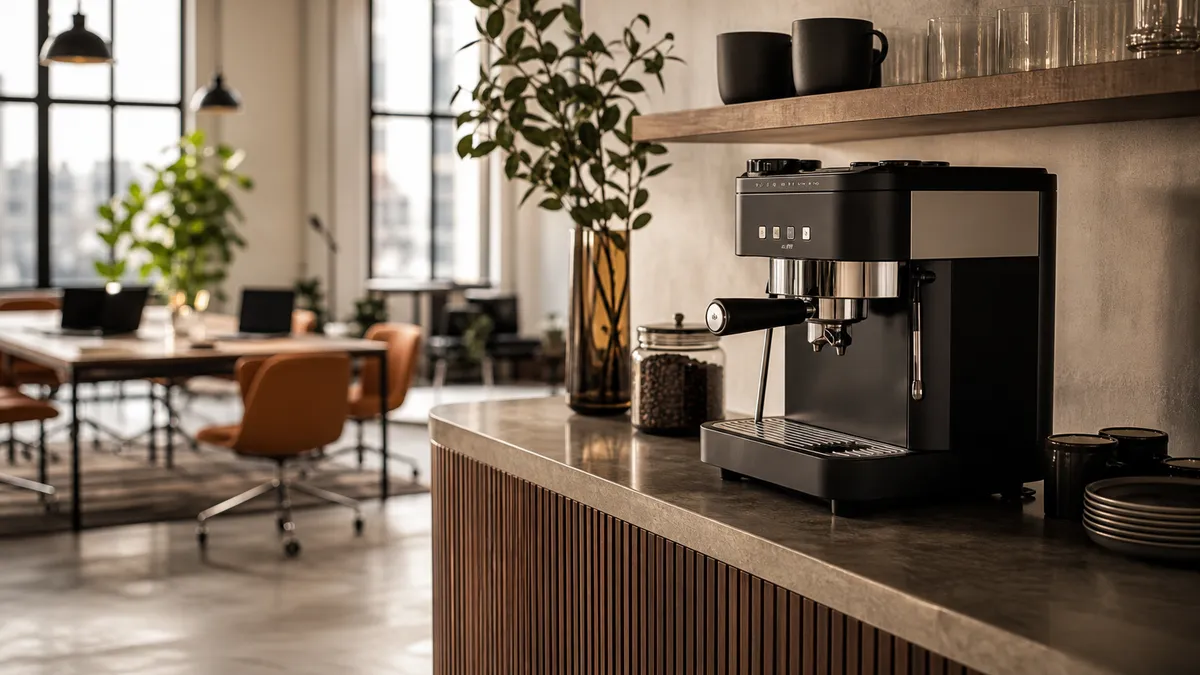
Coffee machines for shared workspaces should be chosen for busy periods, straightforward self-service and clearly assigned cleaning, not simply the number of desks. A commercial bean-to-cup machine is a sensible starting point for mixed coffee habits, but the right arrangement also depends on who can use it, how drinks are paid for and how dairy and plant-based drinks are handled.
In short
- Count resident staff, members, day-pass users and visitors separately, then estimate actual drinks.
- Test the busiest period with your intended drink sizes, milk choices and payment method.
- Specify lockable ingredient containers and protected settings where users are not supervised.
- Automatic milk rinsing does not replace the machine’s prescribed cleaning routine.
- Decide whether coffee is included, paid per drink or restricted by member access before choosing payment hardware.
What makes shared-workspace coffee different?
Start with three user groups: the workspace operator’s employees, resident members and occasional users such as visitors or event guests. They need not have identical entitlements. Staff might have unrestricted access, members an inclusive allowance and visitors access through reception.
Write that policy before approaching suppliers. Include opening hours, evening access, guest arrangements and who can authorise a drink when a payment or membership system fails.
Our recommendation is to prioritise a short, clear menu over extensive personalisation. Familiar drinks, recognisable milk choices and obvious cup positioning make a better starting point than asking every newcomer to navigate strength, temperature and foam settings.
For the wider choice between workplace settings, see coffee for every workplace. Here, the deciding issue is shared responsibility: someone must own replenishment, cleaning and fault reporting even when nobody “owns” the kitchen.
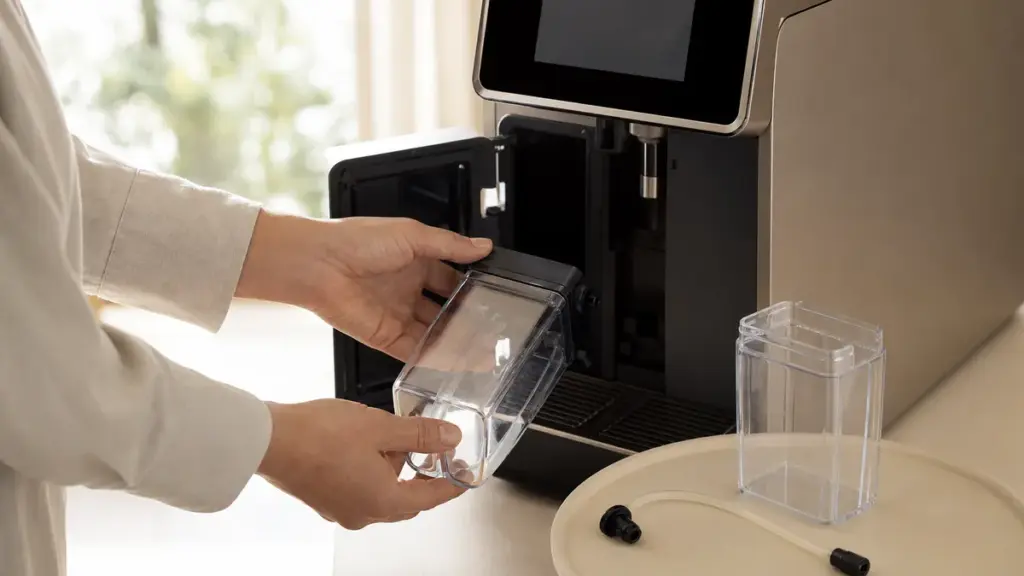
Choosing coffee machines for shared workspaces
Assess machines against five criteria: demonstrated peak output, cleaning workload, access control, ingredient security and local service support. The following is an editorial decision guide, not a ranking based on independent machine testing.
| Arrangement | Best suited to | What to demonstrate | Main limitation |
|---|---|---|---|
| Commercial bean-to-cup with refrigerated milk | Mixed demand for black coffee and milk drinks | Repeated milk drinks, replenishment and full cleaning | Requires an assigned milk-care routine |
| Black-coffee bean-to-cup with separate chilled milk | Workspaces happy to add cold milk themselves | Cup clearance, accessible fridge and ingredient information | Does not provide automatic lattes or cappuccinos |
| Bean-to-cup plus batch filter brewer | Sites with both individual orders and concentrated black-coffee demand | How users move between the two services | Two preparation and cleaning routines |
| Two commercial self-service machines | Busy sites needing separate access points or some continuity during faults | Combined output and operation with one unavailable | More space and equipment to maintain |
For robustness, ask for written confirmation that the proposed machine and warranty cover your intended commercial self-service use. Request the maintenance schedule, service exclusions, replenishment procedure and a demonstration of the parts users will touch.
Lockable hoppers, powder canisters and service doors deserve attention in an unsupervised kitchen. WMF’s published 5000 S+ brochure, for example, lists lockable product containers and a lockable front panel. These are access controls, not a reason to describe a machine as tamper-proof.
Protect recipe settings and reserve ingredient filling for trained people. Keep cleaning chemicals outside public reach, and provide a clear fault-reporting route rather than inviting members to troubleshoot inside the machine.
Capacity: count drinks and test the queue
Use attendance rather than registered membership. Add event demand separately, and record the busiest interval as well as the daily total.
The matrix below contains illustrative planning scenarios, not surveyed consumption figures or manufacturer recommendations. It assumes two drinks per regular daily user and one per visitor or event guest.
| Regular daily users | Visitors or guests | Assumed daily drinks | Starting point for a supplier demonstration |
|---|---|---|---|
| 20 | 10 | 20 × 2 + 10 × 1 = 50 | One commercial self-service machine |
| 40 | 20 | 40 × 2 + 20 × 1 = 100 | One machine, tested against the busiest interval |
| 75 | 30 | 75 × 2 + 30 × 1 = 180 | Higher-output machine or two access points |
| 120 | 60 | 120 × 2 + 60 × 1 = 300 | Multiple machines or a divided service |
Replace those assumptions with attendance records and a drink count before ordering.
Manufacturer daily ratings are useful screening figures, not queue promises. Specifications checked in November 2026 illustrate the distinction: Franke lists the new A600 at up to 200 cups daily; WMF recommends 250 cups daily for the 5000 S+, while explaining that performance depends on configuration, cup sizes and settings. These are manufacturers’ claims, not independently verified results.
Run a realistic acceptance test
Ask the supplier to reproduce your proposed menu and busiest order sequence. Include payment, cup placement, dairy and plant-based selections, automatic rinses and any replenishment interruptions.
For an illustrative calculation, 20 orders arriving within 15 minutes require an average completion rate of 80 drinks per hour during that interval: 20 ÷ 15 × 60. That is a demand calculation, not a machine rating, and closely grouped arrivals can still create a queue.
Put cups before the ordering point and lids, stirrers and waste after collection. Consider a separate hot-water point so tea users do not need to join the coffee queue.
For larger installations, large-office coffee planning covers the wider question of distributing equipment across a building.
Inclusive coffee, contactless payment or QR access?
An inclusive membership perk is the simplest policy to explain: eligible users select a drink without a separate purchase. If access must be restricted, ask suppliers to demonstrate member cards, credentials or another supported authorisation method. Do not assume integration with your existing building-access system.
Paid-per-drink service needs a payment arrangement that works with the exact machine configuration.
- Contactless reader: a card or phone is presented at the machine. MDB, short for Multi-Drop Bus, is a communication standard connecting a vending controller with peripherals such as payment readers. Some office coffee machines instead use CCI, the Coffee Credit Interface. A Nayax-style reader is not automatically compatible with every machine.
- QR or app-based release: users scan or identify the machine, select a drink and obtain authorisation through their phone. JURA’s Pocket Pilot 2.0 is a documented browser-based example using Payment Connect on compatible machines; it does not require a downloaded app.
- Mixed entitlement: staff or members receive inclusive access while visitors pay. Treat this as a requirement to demonstrate, not a standard feature of all payment systems.
Test failed payments, unavailable ingredients and loss of connectivity. Agree who handles refunds and how reception can assist someone without a suitable phone or payment card.
Ask an accountant to confirm VAT treatment, particularly where coffee forms part of membership. Coffee ingredients sold as food can be zero-rated, while hot drinks supplied in the course of catering are standard-rated. Do not assume that putting coffee into an inclusive package settles its tax treatment.
Hygiene and plant milk need an owner
Choose a named operator and a trained deputy. Their checklist should cover the manufacturer’s cleaning programme, milk containers and fridge, removable components, touch surfaces, drip tray and grounds container.
Automatic rinsing is useful, but it is not the same as cleaning. Franke’s A600 manual explicitly distinguishes rinsing from daily cleaning and requires additional attention to removable components. Ask the supplier to demonstrate the complete routine, including chemicals, dismantling and the time when drinks are unavailable.
Keep a completion record and define when a hygiene fault means taking milk drinks out of service. Follow the instructions for the installed model rather than copying another machine’s routine.
Plant-based choice is not an allergen guarantee
Decide whether users need cold plant-based milk to add themselves or automatically prepared plant-based milk drinks. For automatic service, ask the supplier to identify every shared component, including hoses, valves, mixers and outlets.
A second milk container or a between-drink rinse is not sufficient evidence for an allergen-free claim. Obtain the manufacturer’s written explanation of the milk paths and cleaning controls, then assess the actual installation and handling practices.
Where drinks are supplied by a food business, allergen information must be accurate and accessible. For an unattended point, our recommendation is written information beside the machine and within the ordering journey, identifying the actual ingredients used. Update it whenever milk, powders or recipes change.
The Food Standards Agency’s technical guidance applies to England, Wales and Northern Ireland, with separate guidance signposted for Scotland. It distinguishes vegan claims from allergen-free claims and says precautionary warnings should follow a risk assessment, not replace hygiene controls.
Installation and waste in a shared building
Have the supplier survey the complete installation: machine, milk fridge, payment equipment, ventilation clearances, refill access, electrical supply, drainage and isolation points. Agree responsibilities with the landlord before installation.
For a plumbed-in machine in England and Wales, the Water Supply (Water Fittings) Regulations 1999 include backflow-prevention requirements. Ask the installer to document the appropriate arrangement; installations elsewhere need the applicable national rules checked.
Use your local water supplier’s report and an on-site assessment to specify treatment against the machine manufacturer’s requirements. Thames Water, for example, provides a postcode-based water-quality lookup. Do not choose a filter from a supposed UK-wide hardness figure.
In Great Britain, steam-boiler equipment may fall under the Pressure Systems Safety Regulations 2000. Check with the supplier and HSE guidance on pressure systems, including whether a written scheme of examination and examination are required.
For England, Simpler Recycling includes coffee grounds as food waste. The rules took effect on 31 March 2025, with qualifying micro-firms having until 31 March 2027. The micro-firm test concerns employees across the business, not desks or memberships. Agree the collection arrangement with the building operator, and do not put compostable packaging into food waste merely because it carries that description. Rules elsewhere differ.
Supplier models and comparing the whole service
Ask suppliers to quote against the same written specification. Compare outright ownership with a service agreement, equipment lease or rental, and a managed coffee service, without assuming any includes daily cleaning or replenishment.
Get itemised written quotations covering installation, water treatment, payment integration, training, consumables, planned maintenance, breakdown attendance, replacement-machine arrangements and end-of-contract obligations. Confirm permitted beans, ingredient commitments and who retains payment-system and usage-data access.
To calculate your own cost per cup, choose one assessment period. Add the equipment commitment attributable to that period, ingredients, cleaning materials, filters, servicing, utilities, payment processing, waste and staff time; divide by drinks actually served. State whether VAT is included and how recoverable VAT is treated.
For coffee machines for shared workspaces, make approval depend on the demonstrated service, not the longest feature list: acceptable queues, manageable cleaning and a written allocation of responsibilities.
FAQ
Can members bring their own coffee beans?
Our recommendation is to keep bean filling under operator control. This preserves the agreed recipes and gives someone responsibility for checking that the correct ingredient enters each container. If members want another coffee or decaf, assess a dedicated option with the supplier rather than allowing an informal rotation through a communal hopper.
Should every floor have a coffee machine?
Not necessarily: compare walking routes, peak demand and the staffing available to maintain each point. Several locations may suit the building, but each needs an assigned cleaning and replenishment routine. Ask suppliers to demonstrate both a central arrangement and distributed service where either could work, then choose against your recorded demand.
What should happen when the machine is unavailable?
Provide a documented fallback and a visible reporting route. Decide whether reception can offer another preparation method, whether another machine is accessible and who contacts the supplier. The contract should distinguish fault acknowledgement, attendance and restoration of service, rather than leaving “support” undefined.
Where to go next
Read Coffee Machines for Medium-Sized Offices for a more stable resident-user setting, and Coffee Machines for Large Offices for distributed service. Coffee Machines for Meeting Rooms and Reception Areas helps with visitor provision, while Coffee Machines for Hotels, Restaurants and Cafés is the useful next read if staffed hospitality becomes part of the offer.
Sources
- Franke, A600 coffee machine, live UK product specification, undated, checked November 2026.
https://www.franke.com/gb/en/coffee-systems/products/fully-automatic-coffee-machines/a600-coffee-machine.html - WMF, WMF 5000 S+ brochure, April 2025 edition.
https://assets.wmf-coffeemachines.com/f/267357/x/73e61d830a/wmf-coffee-machines-5000splus-brochure-en.pdf - Franke, A600 User Manual, document 20109362, model FCS4043, undated retrieved copy hosted by DSL.
https://www.dslinc.com/wp-content/uploads/2025/01/20109362_User-manual_A600_en.pdf - Nayax, Understanding MDB Levels and How They Affect Vending Operations and What is the CCI Protocol?, undated live support documents.
https://nayax-u.nayax.com/article/understanding-mdb-levels-and-how-they-affect-vending-56001
https://nayax-u.nayax.com/article/what-is-a-cci-protocol-2517 - JURA, Pocket Pilot 2.0, product sheet, June 2024 revision.
https://www.jura.com/-/media/global/pdf/produktblaetter/Pocket-Pilot-2/download_produktblatt_pocketpilot_2.pdf?em_force=true&hash=40D46C484291EE928E55B6E5F3F87A16&la=en - Food Standards Agency, Food allergen labelling and information requirements technical guidance, updated 29 October 2026.
https://www.gov.uk/government/publications/food-allergen-labelling-and-information-requirements-technical-guidance/food-allergen-labelling-and-information-requirements-technical-guidance - HMRC, Food products (VAT Notice 701/14) and Catering, takeaway food (VAT Notice 709/1), both updated 8 June 2026.
https://www.gov.uk/guidance/food-products-and-vat-notice-70114
https://www.gov.uk/guidance/catering-takeaway-food-and-vat-notice-7091 - UK legislation, The Water Supply (Water Fittings) Regulations 1999, SI 1999/1148, particularly Schedule 2.
https://www.legislation.gov.uk/uksi/1999/1148/pdfs/uksi_19991148_en.pdf - Thames Water, Water quality, undated live customer guidance.
https://www.thameswater.co.uk/help/water-and-waste-help/water-quality - HSE, Pressure Systems Safety Regulations 2000 (PSSR), undated live guidance.
https://www.hse.gov.uk/pressure-systems/pssr.htm - DEFRA, Simpler recycling: workplace recycling in England, updated 3 October 2025.
https://www.gov.uk/guidance/simpler-recycling-workplace-recycling-in-england
Research used manufacturer specifications and operating instructions alongside official food-safety, tax, installation and waste guidance; planning scenarios are explicitly illustrative, and no first-hand machine testing is claimed.
Last checked: November 2026