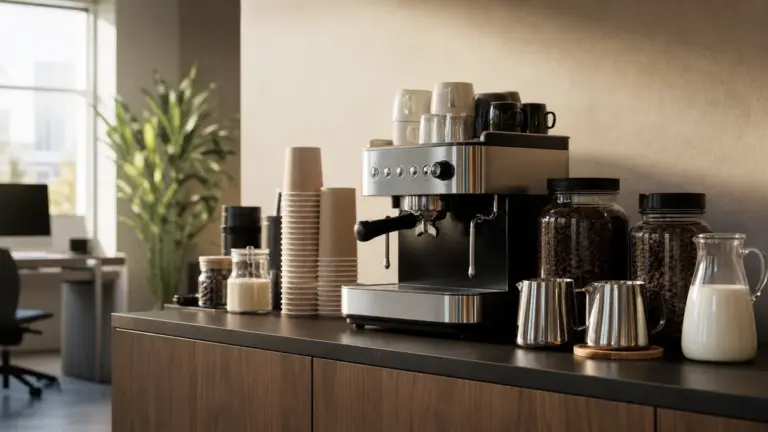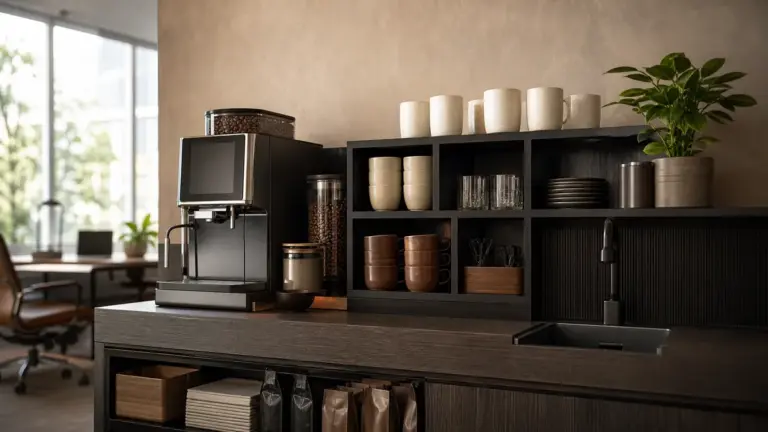
Good coffee in the workplace means drinks people enjoy, equipment that meets demand, and a clean, welcoming place to take a break. Start with reliable drinking water and welfare facilities, then choose coffee provision around the people using it, the busiest periods and the work needed to keep it running.
In short
- Treat coffee as an optional perk, separate from statutory drinking water and welfare provision.
- Short-break research supports modest improvements in energy and fatigue, not a blanket claim that better coffee increases productivity.
- Plan around people actually attending, daily drinks and peak queues, not the organisation’s total headcount.
- Give cleaning, replenishment and fault reporting named owners, with cover for absence.
- Compare complete written quotations, including installation, consumables, servicing, water treatment and contract conditions.
Why coffee breaks matter, and what the evidence actually says
The strongest case for a coffee break concerns the break itself, not the contents of the mug. A 2022 systematic review and meta-analysis combined experimental and quasi-experimental research on short breaks. It found small improvements in vigour, meaning feelings of energy, and reduced fatigue, but no statistically significant improvement in overall performance.
That does not establish that installing a coffee machine improves productivity, retention or collaboration. Nor does a staff survey showing enthusiasm for better coffee prove that people subsequently work more effectively. Keep satisfaction, wellbeing and measured performance separate when evaluating a workplace perk.
A sensible practical response is to make breaks usable: somewhere to sit, permission to step away when work allows, and drinks that suit different preferences. Measure whether staff like the provision without turning their break into another performance target.
The workplace coffee hub brings the individual topics together when you need more detail than this overview.
Build an inclusive coffee culture
Begin by asking what people actually want. Include those who drink tea, choose decaffeinated coffee, avoid milk or prefer water, rather than letting the keenest espresso drinker design everything.
Set clear expectations about shared supplies and housekeeping. If refreshments are employer-provided, explain what is included and how shortages are reported. If staff organise their own supplies, make participation voluntary and keep statutory drinking water provision separate.
Social coffee breaks should be invitations, not attendance tests. Offer a quieter place to pause as well as somewhere to chat, and avoid making informal coffee gatherings the only place where useful work information is exchanged.
Our office coffee culture guide explores these everyday habits in depth. The useful starting point is simple: make the facility welcoming without expecting everybody to use it in the same way.
Match the equipment to demand
Before comparing machines, record attendance, drink preferences and the busiest periods. For a hybrid workplace, investigate both the quieter day and the day when several teams arrive together.
Use this illustrative matrix to begin the conversation. These are planning assumptions, not recommended caffeine intakes or machine capacity ratings.
| People on site who choose coffee | Assumed coffees per person daily | Calculated daily coffees | What to investigate |
|---|---|---|---|
| 10 | 2 | 20 | Refill effort, cleaning and a simple backup |
| 30 | 2 | 60 | Queues, milk storage and replenishment |
| 60 | 2 | 120 | Peak throughput, servicing and alternative provision |
Count visitors separately. Also include hot water demand if the same equipment will serve tea drinkers.
Choose between instant coffee, filter brewing, bean-to-cup and manually operated espresso by comparing workflow rather than status. Ask who prepares each drink, whether batches are appropriate, what training is needed and who will clean the equipment. A long drinks menu is not automatically a useful one.
For shortlisted machines, obtain the manufacturer’s published specifications. Treat output figures as claimed capacities, then ask the supplier to demonstrate your expected sequence of drinks, including milk drinks, refilling and cleaning interruptions. Compare waiting time and operator effort as well as flavour.
Design a station people can actually use
Plan the whole journey: finding a clean cup, making a drink, adding milk, disposing of waste and returning the cup. Test it with people carrying bags, using mobility aids or reaching controls from different positions.
Leave room for preparation and for opening the machine’s service panels. Check access to the water tank, grounds container, fridge, sockets and any isolation valve before agreeing the layout. Ask the supplier for installation clearances rather than estimating them from a photograph.
Keep queues away from doorways and main circulation routes. Place milk and additions where users can finish their drinks without blocking the next person. Consider grinder noise before locating the station beside desks or meeting rooms.
Finally, provide a practical route for washing cups and cleaning surfaces. A small, orderly station is a better starting point than a large installation with nowhere to put used mugs. See creating a coffee-friendly office environment for the wider balance between refreshment space and working space.
Make the perk work for staff and visitors
Choose a manageable core offer before adding extras. Ask staff to taste the proposed coffee and assess it black as well as with their usual additions. Record preferences rather than declaring one style objectively best.
For visitors, agree who offers refreshments and prepares them. Provide a straightforward choice of coffee, tea and water, with decaffeinated coffee where practical. Avoid leaving a guest to navigate unfamiliar controls during a meeting.
Keep ingredient packaging available so hosts can check what they are serving. Shared equipment and utensils can transfer allergens, so do not describe a drink as allergen-free merely because its chosen ingredients appear suitable. Agree a preparation process that addresses the visitor’s needs, and explain honestly when cross-contact cannot be controlled.
Judge the perk through availability, cleanliness, waiting time and staff feedback. Keep any claim about improved employee satisfaction separate from a claim about business performance.
Give maintenance a named owner
Agree the operating routine before installation:
- Assign responsibility. Name who checks supplies, completes cleaning, reports faults and covers absence.
- Get written instructions. Follow the equipment manufacturer’s cleaning, milk-handling and water-treatment requirements.
- Check the water locally. Obtain the local water supplier’s water-quality information and ask the machine supplier to specify any treatment needed.
- Practise the routine. Have the people responsible complete the cleaning and replenishment tasks during handover.
- Plan for interruption. Agree the response to faults and provide an alternative way to obtain drinks.
For a plumbed-in installation in England and Wales, have the installer confirm compliance with the Water Supply (Water Fittings) Regulations 1999, including appropriate backflow protection against reverse flow into the water supply. Do not assume the same legislation covers every UK nation.
In Great Britain, equipment incorporating a steam boiler may fall under the Pressure Systems Safety Regulations 2000. Ask the supplier to establish the machine’s position against HSE guidance, including whether a written scheme of examination and examination before use are required. Routine servicing is not a substitute for resolving those duties.
Understand the full cost without relying on a headline figure
Request itemised written quotations using the same specification and comparison period. Include equipment provision, installation, plumbing, electrical work, training, coffee, milk, cleaning products, filters, servicing, repairs, waste collections and internal staff time.
State your own assumptions: occupied days, daily drinks, coffee dose, milk-drink share, expected wastage, equipment term and service coverage. Identify which items include VAT and whether your organisation can recover it.
For a non-monetary example, the matrix’s middle scenario assumes 60 coffees daily. If the chosen recipe uses an assumed 8 g of beans per drink, that means 480 g daily before waste, adjustment drinks or visitors. This is an illustration, not a recommended dose.
To calculate your workplace’s cost per cup, add all attributable expenditure over the chosen period and divide by drinks actually served. Use the same VAT basis throughout and include internal labour consistently.
HMRC generally treats coffee beans and milk supplied as food differently from hot drinks supplied in the course of catering: the former are generally zero-rated, while the latter are standard-rated. Do not apply one VAT assumption to every item or confuse the treatment of ingredients with that of a catering service.
Make sustainability specific
Start with measurable actions: record discarded coffee and milk, adjust purchasing to attendance, provide washable cups with a workable washing routine, and ask what happens to each waste stream. Avoid describing a whole system as sustainable because one component has an environmental claim.
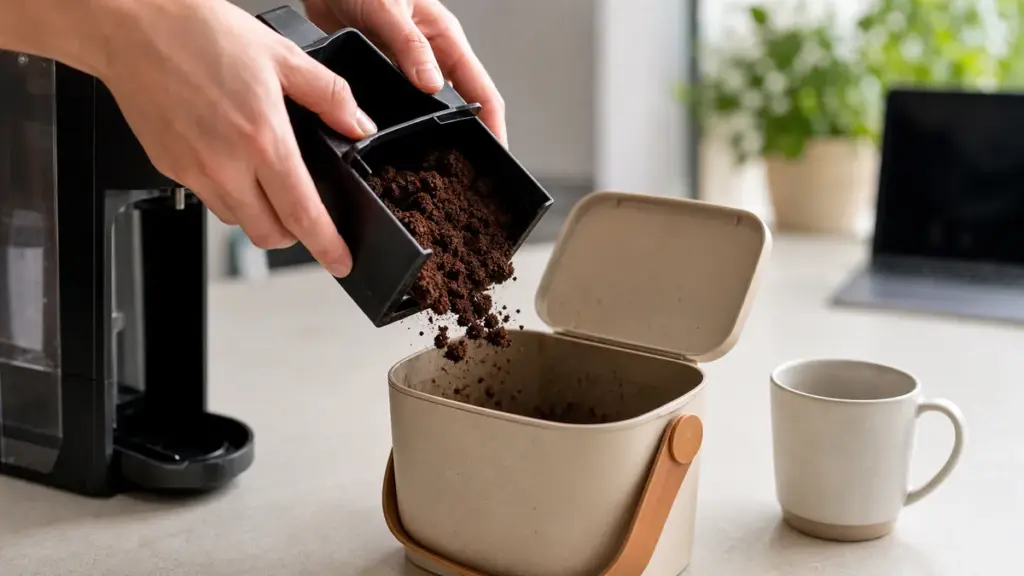
In England, Simpler Recycling requires workplaces with at least 10 full-time-equivalent employees to separate food waste, including coffee grounds, from 31 March 2025. Micro-firms have until 31 March 2027; the employee count applies across the business, not just one location.
Packaging labelled compostable or biodegradable does not belong in that food-waste collection. Arrange an appropriate dedicated route where available. Check the separate requirements for Scotland, Wales and Northern Ireland rather than applying England’s timetable throughout the UK.
Know the legal baseline: water and welfare, not free coffee
In Great Britain, the Workplace (Health, Safety and Welfare) Regulations 1992 distinguish essential facilities from optional refreshments:
- Regulation 22: provide adequate wholesome drinking water, readily accessible, with suitable drinking vessels unless people can drink easily from a suitable jet.
- Regulation 25: provide suitable, sufficient and readily accessible rest facilities, together with meal facilities where required.
The accompanying HSE Approved Code of Practice says eating facilities should include somewhere to prepare or obtain a hot drink. It also says workers need means to heat their food where hot food cannot be obtained in or reasonably near the workplace during their working hours.
These provisions do not require employers to supply free coffee. A coffee station also does not, by itself, establish that all welfare requirements are met. Northern Ireland has its own Workplace (Health, Safety and Welfare) Regulations, dating from 1993.
FAQ
How can we gather useful feedback without surveying everyone constantly?
Use a short review after introduction, then a simple ongoing reporting route. Ask about taste, availability, queues, cleanliness and missing choices, rather than a single satisfaction score. Review responses alongside stock use and faults, and explain which changes you will make. This is a suggested management approach, not a validated research instrument.
Should visitors and staff have different coffee?
Not necessarily; start by testing whether one provision meets both needs. Separate arrangements may be useful where meeting service clashes with staff demand, but define the operational reason first. Check who prepares drinks, how ingredients are identified and whether meeting-room service leaves the shared station unavailable or untidy.
What should we check before moving an existing coffee machine?
Arrange a fresh site assessment rather than assuming the original installation arrangements will transfer. Ask the supplier to check power, water connections, drainage where applicable, ventilation clearances and service access. Update responsibility for cleaning and fault reporting too. Treat the move as an opportunity to reassess actual workplace demand.
Where to go next
Use Coffee in the Workplace to navigate the wider topic, then read Office Coffee Culture for shared habits and inclusive breaks. Creating a Coffee-Friendly Office Environment is the next practical read when turning coffee in the workplace into a usable space.
Sources
-
S1. PLOS ONE, Albulescu and colleagues. A systematic review and meta-analysis on the efficacy of micro-breaks for increasing well-being and performance (title shortened), 2022. Experimental and quasi-experimental evidence on breaks, not a trial of workplace coffee provision.
https://journals.plos.org/plosone/article?id=10.1371/journal.pone.0272460 -
S2. UK legislation. The Workplace (Health, Safety and Welfare) Regulations 1992, SI 1992/3004, revised text, particularly Regulations 22 and 25.
https://www.legislation.gov.uk/uksi/1992/3004 -
S3. Health and Safety Executive. Workplace health, safety and welfare: Approved Code of Practice and guidance, L24, second edition, 2013, particularly paragraphs 225 and 229 to 233.
https://www.hse.gov.uk/pubns/priced/l24.pdf -
S4. Northern Ireland legislation. Workplace (Health, Safety and Welfare) Regulations (Northern Ireland) 1993, SR 1993/37, original instrument.
https://www.legislation.gov.uk/nisr/1993/37/pdfs/nisr_19930037_en.pdf -
S5. UK legislation. The Water Supply (Water Fittings) Regulations 1999, SI 1999/1148, including Schedule 2, paragraph 15 on backflow prevention.
https://www.legislation.gov.uk/uksi/1999/1148/pdfs/uksi_19991148_en.pdf -
S6. Health and Safety Executive. Pressure Systems Safety Regulations 2000 (PSSR), undated web guidance, accessed 2026.
https://www.hse.gov.uk/pressure-systems/pssr.htm -
S7. HM Revenue & Customs. Food products (VAT Notice 701/14), updated June 2026.
https://www.gov.uk/guidance/food-products-and-vat-notice-70114 -
S8. HM Revenue & Customs. Catering, takeaway food (VAT Notice 709/1), updated June 2026.
https://www.gov.uk/guidance/catering-takeaway-food-and-vat-notice-7091 -
S9. Department for Environment, Food & Rural Affairs. Simpler recycling: workplace recycling in England, updated October 2025.
https://www.gov.uk/guidance/simpler-recycling-workplace-recycling-in-england -
S10. Food Standards Agency. Precautionary allergen labelling, 2023, particularly the sections on shared equipment, cleaning and separate utensils. Applied here to practical risk management, not as a determination that every office is a food business.
https://www.gov.uk/government/publications/precautionary-allergen-labelling/precautionary-allergen-labelling
This article was researched using peer-reviewed research, legislation and official guidance; planning scenarios and management recommendations are identified separately from research findings, and no first-hand equipment testing is claimed.
Last checked: November 2026