Office filter coffee machines and bulk brewers make sense when several people want black coffee at roughly the same time, especially during meetings, training sessions and shared breaks. Choose the batch size around what people will drink while the coffee still tastes fresh, not simply the largest machine the kitchen can accommodate.
In short
- Size for the busiest break as well as the working day. Daily cups alone can conceal a queue.
- Compare litres per hour, then convert using your actual serving size: 19 litres equals 76 servings of 250 ml before losses.
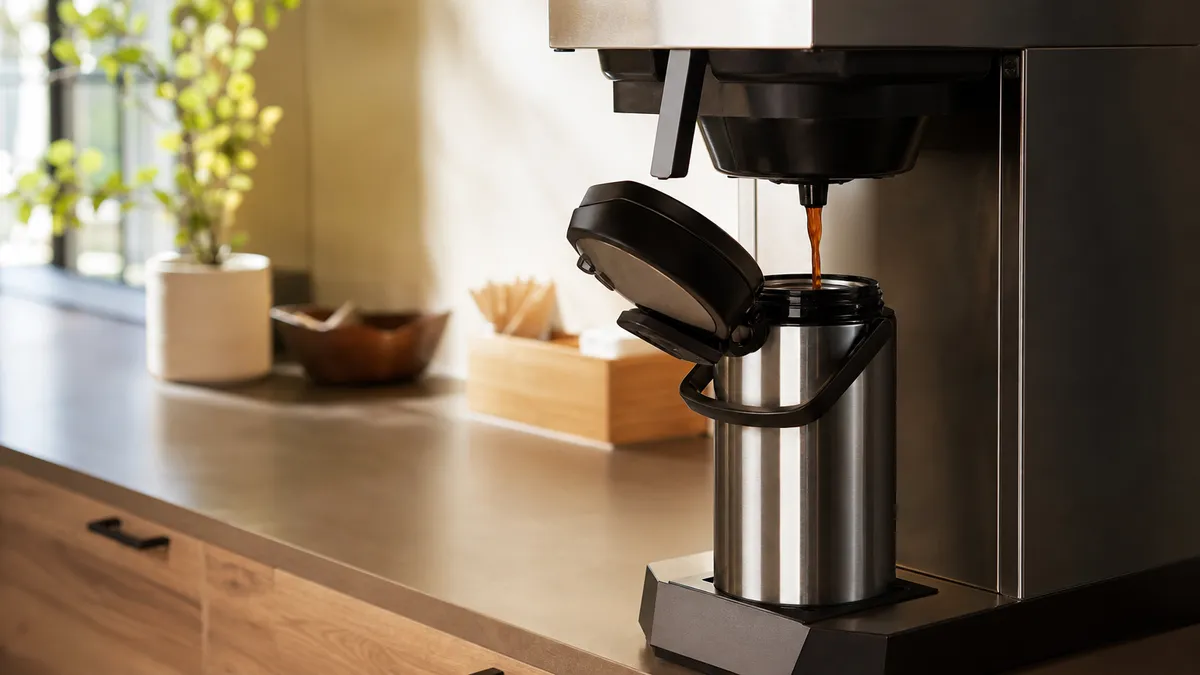
- Thermal jugs and airpots let you move coffee away from the brewer and serve without a hotplate.
- As a starting quality policy, aim to serve thermal-held coffee within 60 minutes, then assess your particular coffee and container.
- SCA home-brewer certification is not commercial-duty approval. Check the exact model, programme and intended use.
When office filter coffee machines make sense
A batch brewer passes hot water through ground coffee held in a filter, collecting several servings in a jug, airpot or larger container. Unlike a machine preparing individual drinks to order, it separates brewing from serving: prepare the coffee before a break, then let people pour.
Choose by peak demand, acceptable holding time, drink preferences and available staff attention, in that order. Batch brewing is a strong candidate when a substantial group wants the same coffee together; it is less convincing when occasional users expect different drinks throughout the day.
The compromise is variety. One batch cannot simultaneously be regular coffee, decaf and a personalised milk drink. For the wider choice of systems, start with office coffee machines.
Match the container to the service
A thermal jug is an insulated pouring vessel, useful on a meeting table. An airpot is an insulated dispenser, commonly operated by a pump or lever, which can remain on a refreshment station while people serve themselves.
Larger bulk brewers fill removable urns or containers, often with dispensing taps. Check whether these are vacuum-insulated, electrically heated or both: not every stainless-steel container preserves coffee in the same way.
Glass jugs on hotplates suit coffee that turns over promptly. For meetings away from the kitchen, our preference is an insulated container: it gives more freedom over placement and avoids relying on a hotplate at the serving point.
Size for daily demand and the busiest break
Treat headcount as a planning input, not a machine rating. The following scenarios assume two filter coffees per person per working day, with 250 ml of black coffee per serving. They are illustrations, not measured consumption averages.
| People drinking filter coffee | Assumed daily servings | Daily coffee volume | Arrangement to investigate |
|---|---|---|---|
| 10 | 20 | 5 litres | Small batches timed around demand |
| 25 | 50 | 12.5 litres | Airpot brewer with spare containers |
| 50 | 100 | 25 litres | Programmable bulk brewer or separate stations |
| 100 | 200 | 50 litres | Bulk system with planned replenishment |
Do not brew the daily total at opening time. Map when those servings are needed, then choose batches that can be consumed within your freshness policy.
For a meeting, calculate attendees × expected coffee uptake × serving volume. If 40 attendees each take one 250 ml coffee, the requirement is 10 litres before any allowance for refills or waste. Having that volume ready matters more than a headline hourly rating.
Read throughput figures carefully
Manufacturer specifications checked in November 2026 illustrate the different scales available. These are published claims, not independently measured results or a ranked shortlist.
| Brewer example | Published batch capacity | Published hourly output | Practical implication |
|---|---|---|---|
| Marco BRU F60M | 2.2 litres | Not stated in the retrieved sheet | Manual-fill brewer dispensing into a separate airpot |
| Bravilor Bonamat TH | 2.2 litres | 19 litres | Manufacturer also states approximately 7 minutes per batch |
| Marco JET Twin | 6 litres per urn | Not stated in the retrieved sheet | Larger batches, programmable recipes and insulated urns |
The Bravilor figure converts to 19,000 ml ÷ 250 ml = 76 servings per hour, before waste and handling allowances. Do not assume a supplier’s undefined “cup” matches your office mug.
Ask for a demonstration of consecutive batches, including warm-up, reheating, basket preparation and container changes. Check minimum batch size too: a machine sized for conferences must still make an acceptable batch on a quiet afternoon.
Holding times: hot is not the same as fresh
A container can keep coffee hot after its flavour has become dull or bitter. BUNN’s commercial brewing guidance recommends ideal holding times of 20 minutes in an open decanter and 60 minutes in a closed container.
Nestlé Coffee Partners’ operating card for a specific FETCO system allows two hours in preheated servers. These are different operating recommendations for different arrangements, not a universal freshness deadline.
For an office, start with the shorter closed-container target and taste the coffee through the intended service period. Record brewing time, keep lids closed as designed and reduce batch size if coffee repeatedly remains unused.
Preheat containers according to their instructions and empty the preheating water before brewing. Do not assume an advertised heat-retention period is a guarantee of equally good flavour throughout.
What SCA certification does and does not tell you
The Specialty Coffee Association, or SCA, operates a Certified Home Brewer programme. Certification concerns brewing performance under its tests; it does not by itself establish suitability for continuous workplace service.
The SCA’s current standards directory lists SCA-310 Home Coffee Brewers: Specifications and Test Methods. It separately lists SCA-315 Café Batch Coffee Brewers: Specifications and Test Methods as under development. Its retrieved commercial certified-equipment page lists espresso machines, not a directory of certified commercial batch brewers.
That distinction matters when suppliers advertise “SCA-standard commercial brewing”. Ask which programme, standard edition and exact model support the claim. Neither commercial model in the table above is described here as SCA-certified.
Temperature, contact time and even extraction
The publicly accessible 2017 home-brewer requirements specify water reaching 92°C within the first minute, staying at least that hot thereafter and never exceeding 96°C. They specify contact time of more than 4 but less than 8 minutes, alongside extraction-uniformity testing.
These are historical home-programme requirements, not verified current commercial certification limits. Their practical lesson remains useful: assess temperature at the coffee bed, suitable contact time and even wetting, rather than accepting a boiler-temperature setting as proof of brewing quality.
Extraction means dissolving material from the grounds into the water. A supplier demonstration should show repeatable flavour at the batch sizes you will actually use.
Power, water and installation
Do not confuse single-phase with 13 A plug-in. A single-phase machine can still require a higher-capacity supply.
For example, Marco lists JET 6 versions at 2.8 kW and 5.6 kW, and its service manual distinguishes a moulded-plug version from a higher-powered flex-connected version. The JET Twin specification lists 5.6 kW. Do not assume a twin bulk brewer can use an ordinary socket because a smaller model can.
Ask the supplier and a competent electrician to confirm the exact UK model’s connection, circuit requirements and isolation arrangements before ordering.
Manual-fill machines avoid a permanent mains-water connection, but someone must refill them. Plumbed-in equipment needs an appropriate installation: in England and Wales, the Water Supply (Water Fittings) Regulations 1999 include backflow-prevention requirements. Elsewhere in the UK, have the installer identify the applicable local rules.
Obtain hardness information from your own water supplier and agree treatment with the brewer supplier. Hardness reflects dissolved calcium and magnesium; scale can accumulate on heating components. There is no useful single hardness figure for every UK workplace.
A repeatable meeting and events routine
Assign someone to own preparation and replenishment. An unattended brewer is not an unattended service plan.
- Confirm demand. Count expected coffee drinkers and choose the serving volume before selecting batches.
- Prepare the service point. Use stable surfaces, accessible cups and a safe route for moving filled containers.
- Preheat the server. Follow its instructions, then empty it completely.
- Measure coffee and water. Use the supplier’s commissioned recipe, recording coffee in grams and brew water in millilitres or grams.
- Brew when ready. Fit the correct filter, level the grounds and wait for the machine’s ready indication.
- Allow drawdown to finish. Do not remove the receiving container while coffee is still dripping.
- Record brewing time and replenish deliberately. Keep regular and decaf clearly distinguished in actual service.
For longer events, plan fresh batches around breaks rather than preparing everything at once. Confirm whether urns need power at their serving position, and keep milk separate from the black-coffee container.
Cleaning and troubleshooting
Follow the brewer and container manuals, including instructions for removable lids, pumps, taps and seals. Rinsing between batches and detergent cleaning are different tasks; neither replaces descaling where the manufacturer requires it.
The FETCO operating card retrieved for this guide specifies rinsing baskets and servers after each brew, daily external and sprayhead-area cleaning, and weekly detergent cleaning. That is an example, not a schedule to impose on every make.
| Symptom | Likely cause to investigate | Fix |
|---|---|---|
| Weak coffee | Incorrect dose or brewing before ready | Check the recorded recipe and ready indication |
| Stale or burnt-tasting coffee | Dirty server or excessive holding | Clean correctly and shorten holding time |
| Basket overflow | Wrong filter or excessive dose | Check filter compatibility and specified dose |
| Short batch | Restricted water supply or blocked filter | Follow troubleshooting instructions; arrange service if needed |
In England, used coffee grounds count as food waste under Simpler Recycling. Workplace separation requirements took effect on 31 March 2025, with micro-firms employing fewer than 10 full-time-equivalent staff exempt until 31 March 2027. Confirm disposal arrangements for used filter papers with your collector; other UK nations have separate rules.
Assessing cost per cup and pairing with bean-to-cup
Calculate cost per cup from coffee actually served, not theoretical brewer output. Record coffee used per batch, batches brewed, servings consumed and coffee discarded.
For your own calculation, include beans or ground coffee, filter papers, milk, water treatment, cleaning products, energy, preparation labour, equipment, installation and servicing. Allocate equipment expenditure over a stated ownership period, add operating expenditure for that same period, then divide by consumed servings. Get itemised written quotations and use a consistent VAT basis.
HMRC generally zero-rates coffee and milk sold as food; hot drinks supplied in the course of catering are generally standard-rated. Do not assume ingredients and a supplied catering service have identical treatment.
A complementary arrangement is to allocate meeting coffee to batch brewing and individual drink orders to bean-to-cup. Evaluate each machine against the demand left after that split, rather than sizing both for every possible drink.
For alternatives, compare pods and bean-to-cup or traditional espresso and bean-to-cup. Office filter coffee machines earn their place when a well-timed batch is more useful than another individual drinks menu.
FAQ
Can we use pre-ground coffee rather than buying a grinder?
Yes, provided its grind and dose suit the brewer and filter basket. Ask the coffee supplier to commission a recipe for your chosen batch size, then keep preparation consistent. Include opened-pack handling in the routine and compare taste before deciding whether grinding at the workplace is worthwhile.
Should a meeting room have its own brewer?
Not necessarily: a compatible airpot or thermal jug can bring coffee from a central preparation point. This avoids brewing during the meeting, but someone still needs to organise delivery, replenishment and cleaning. Check container capacity, dispensing clearance and the route between kitchen and room before adopting that arrangement.
Can a home brewer serve a small office?
Possibly, but home-brewer certification alone is not enough to decide. Ask the manufacturer to confirm workplace use, warranty coverage and the expected duty pattern. A small office brewing occasional shared batches presents a different requirement from a training centre making consecutive batches throughout the morning.
Where to go next
Read Office Coffee Machines to place batch brewing within the wider workplace options, then Bean-to-Cup vs Traditional Espresso Machines for Offices if individual espresso-based drinks remain important. Office Capsule Coffee Machines explores another approach to occasional demand, while Fresh Milk vs Powdered Milk Office Machines helps with the milk-service side of a mixed setup.
Sources
-
Bravilor Bonamat, “TH”, undated manufacturer specification, retrieved November 2026. Published capacity, brewing time and electrical rating.
https://www.bravilor.com/de/products/filter-coffee-machines-de/th/ -
Marco Beverage Systems, “BRU”, 2024 global specification sheet, retrieved November 2026. Manual-fill models and airpot requirements.
https://marcobeveragesystems.com/wp-content/uploads/sites/2/2025/02/MARCO_GBL_2024_BRU.pdf -
Marco Beverage Systems, “JET”, 2024 global specification sheet, and “1000850,851 Jet6 Service Manual.c”, revision c, publication date not stated, retrieved November 2026. Batch capacities, power variants and electrical connections.
https://marcobeveragesystems.com/wp-content/uploads/sites/2/2025/02/MARCO_GBL_2024_JET.pdf -
BUNN, “Coffee Basics”, May 2021 revision. Brewing control and holding recommendations.
https://resource.bunn.com/assets/web/pdfs/BUNN-CoffeeBasics_Brochure_web.pdf -
Nestlé Coffee Partners Solutions Lab, “FETCO CBS 50 Series Single & Twin 1.5 Gal Brewer”, equipment card SFS-007-WPS-ECD-00786, December 2020. Operation, cleaning, troubleshooting and system-specific holding policy.
-
Specialty Coffee Association, “Standards”, “Certified Home Equipment” and “Certified Commercial Equipment”, current directories retrieved November 2026. Programme scope and standard-development status.
https://sca.coffee/research/coffee-standards
https://sca.coffee/certified-home-brewer
https://sca.coffee/certified-commercial-equipment -
Specialty Coffee Association, “Certified Home Brewer: Minimum Certification Requirements”, 2017 document. Historical temperature, contact-time and extraction-uniformity requirements.
https://sca.coffee/research/coffee-standards -
Health and Safety Executive, “Maintenance priorities in catering”, CAIS12(rev2), July 2017. Competent maintenance, electrical checks and safe equipment use.
https://www.hse.gov.uk/pubns/cais12.pdf -
UK legislation, “The Water Supply (Water Fittings) Regulations 1999”, SI 1999/1148, Schedule 2. England and Wales, including backflow prevention.
https://www.legislation.gov.uk/uksi/1999/1148/schedules/made/data.xht?wrap=true -
Drinking Water Inspectorate, “Water Hardness / Hard Water”, undated, and Thames Water, “Water quality”, undated, retrieved November 2026. Hardness, scaling and local supplier information.
https://www.dwi.gov.uk/consumers/learn-more-about-your-water/water-hardness-hard-water/
https://www.thameswater.co.uk/help/water-and-waste-help/water-quality -
DEFRA, “Simpler recycling: workplace recycling in England”, updated 3 October 2025. Coffee grounds, commencement date and micro-firm exemption.
https://www.gov.uk/guidance/simpler-recycling-workplace-recycling-in-england -
HMRC, “Food products (VAT Notice 701/14)”, current version retrieved November 2026, and “Catering, takeaway food (VAT Notice 709/1)”, updated 8 June 2026. Ingredient and catering VAT treatment.
https://www.gov.uk/guidance/food-products-and-vat-notice-70114
https://www.gov.uk/guidance/catering-takeaway-food-and-vat-notice-7091
This guide was researched from retrieved manufacturer documents, SCA programme information and official UK guidance; specifications are manufacturer claims, calculations use stated assumptions, and no first-hand equipment testing is claimed.
Last checked: November 2026