Bean-to-cup machines are worth shortlisting for offices with regular demand and someone responsible for cleaning; pod machines suit intermittent use and individually chosen coffees. Neither is automatically the better-value option: compare the complete service, milk arrangements, peak-time capacity and waste collections, not just the coffee ingredients.
In short
- Count people actually attending the office, then measure drinks during the busiest break.
- Compare equivalent recipes: one capsule is not necessarily equivalent to your preferred bean-to-cup drink.
- Include installation, servicing, cleaning, filters, electricity, milk waste and recycling in your assessment.
- Treat household pod recycling separately from business collections.
- In England, Simpler Recycling already applies to workplaces with 10 or more full-time-equivalent employees; micro-firms must comply by 31 March 2027.
Bean-to-cup vs pod machines: the practical comparison
Use these criteria before considering particular machines. The recommendations are editorial judgements about workplace suitability, not claims that either technology always performs better.
| Criterion | Bean-to-cup | Pod or capsule | Decision test |
|---|---|---|---|
| Coffee preparation | Grinds whole beans and brews automatically | Brews a pre-portioned capsule of ground coffee | How much control do you want? |
| Coffee choice | Change beans, subject to hopper and grinder arrangements | Change compatible capsules between drinks | Is individual choice essential? |
| Milk drinks | Fresh milk or powdered topping, depending on configuration | Integrated milk system, separate frother or other system-specific arrangement | Test the complete milk workflow |
| Routine work | Beans, grounds, rinsing and cleaning | Capsule loading, emptying, rinsing and cleaning | Assign an owner |
| Busy periods | Depends on brewing and milk-system capacity | Depends on brewing positions and capsule handling | Demonstrate your actual drink mix |
| Waste | Loose grounds plus ingredient packaging | Used capsules plus outer packaging | Confirm the collection route |
| Best starting fit | Regular shared demand with managed upkeep | Intermittent use or varied individual choices | Compare complete written proposals |
This is a comparison between machine types, not between domestic and commercial equipment. Specify office use, expected workload and warranty coverage explicitly. For the broader shortlist, start with office coffee machines.
How each machine works
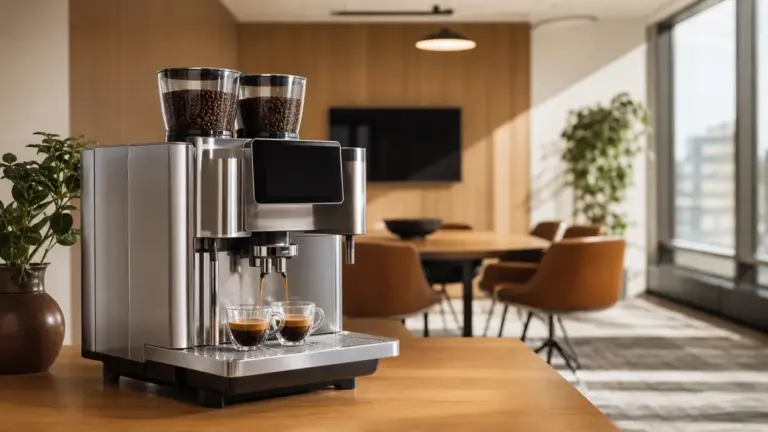
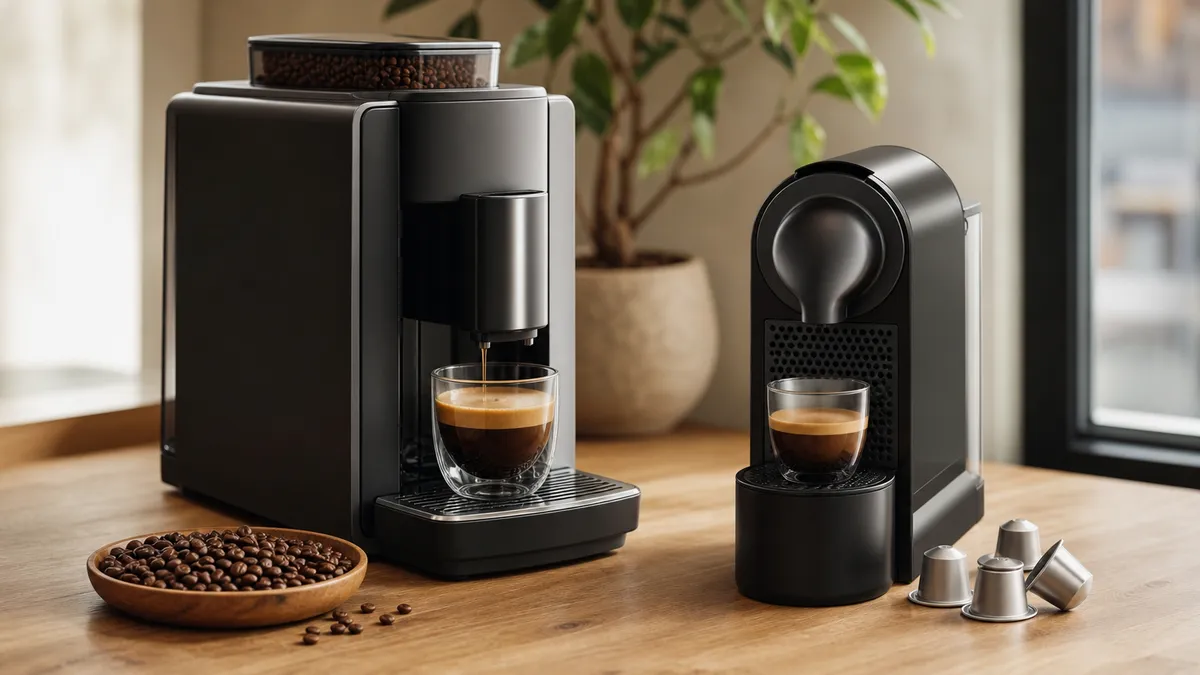
An espresso-style bean-to-cup machine stores whole beans in a hopper, grinds a portion, brews the coffee internally and deposits spent grounds in a container. Depending on the model, users can adjust strength, drink volume and other recipe settings.
A capsule machine takes a sealed portion of ground coffee in a compatible capsule. The machine brews through it, after which the capsule must be removed or emptied from an internal collection container. Here, “pod” means these capsule systems, rather than soft paper coffee pods.
The practical distinction is where preparation happens: bean-to-cup machines handle grinding and portioning inside the machine; capsule systems arrive pre-portioned. Neither removes the need for cleaning, water management or replenishment.
For compatibility and capsule-specific buying questions, see office capsule machines.
What makes up the total running cost?
There is no reliable universal break-even point between beans and capsules. A comparison needs equivalent drinks, the same assessment period and a realistic attendance forecast.
Ask suppliers for itemised written quotations, separating:
- Set-up: machine, delivery, installation, water connection, electrical work, milk equipment and training.
- Ingredients: beans or capsules, milk, powdered topping, chocolate and other consumables.
- Maintenance: servicing, replacement parts, cleaning products, filters, descaling and any applicable pressure-system examinations.
- Operation: electricity, water, staff cleaning time and replenishment.
- Waste and disruption: ingredient spoilage, discarded drinks, business recycling, breakdown cover and replacement-machine arrangements.
Check minimum ingredient commitments, contract duration, exclusions and end-of-contract obligations. A bundled proposal can be difficult to compare unless its inclusions are clear.
A worked consumption model
The following is an illustrative planning example, not a claim about typical office consumption:
- 20 coffee drinkers attend each working day.
- Each drinks two coffees daily.
- The office operates for 220 days annually.
- Each bean-to-cup drink uses 10 g of beans.
- The capsule comparison initially assumes one capsule per drink.
- Milk drinks account for 60% of drinks, using 100 ml of milk each.
- Equipment and installation are assessed over three years.
- Service follows each supplier’s proposed schedule.
- Cleaning time, energy, water and waste are measured separately.
That produces 40 drinks daily and 8,800 annually. Before wastage, the bean requirement is 88 kg annually, the capsule requirement is 8,800 capsules, and milk consumption is 528 litres.
Replace those assumptions with your trial results. If the preferred capsule recipe requires two capsules, count both; if the bean-to-cup recipe uses another dose, recalculate the bean requirement.
For each proposal, add annual ingredients, maintenance and operating expenditure to one-third of the equipment and installation total. Divide by 8,800 drinks to calculate your own fully allocated cost per cup. Record wastage separately rather than hiding it in the recipe dose.
Keep the VAT basis consistent
VAT treatment checked in November 2026. Coffee supplied as an ingredient and dairy milk are generally zero-rated. HMRC also accepts plain and flavoured plant-based alternative milks as zero-rated foods. Machines, servicing and filters are normally standard-rated.
Use VAT-inclusive totals if VAT cannot be recovered. Where it can be recovered, compare figures excluding only the recoverable VAT, with finance confirming any restrictions.
Do not confuse ingredient purchases with catering supplies. Hot drinks supplied in the course of catering are generally standard-rated, while HMRC gives separate treatment for drinks supplied to employees without payment.
Taste, drink choice and milk
Neither format guarantees better flavour. Make taste a selection test rather than accepting “freshly ground” or “consistent” as a verdict.
Ask each supplier to prepare your actual drinks, at the intended serving size. Compare black coffee first, then milk drinks, without identifying which machine made each sample. Record aroma, bitterness, acidity, body and whether the coffee remains noticeable through the milk.
Bean-to-cup offers ingredient and recipe flexibility, although switching beans depends on the machine’s hopper and grinder arrangement. Capsules make it straightforward to select a different compatible coffee for the next drink, but the available choice depends on that capsule system.
Milk changes the workload
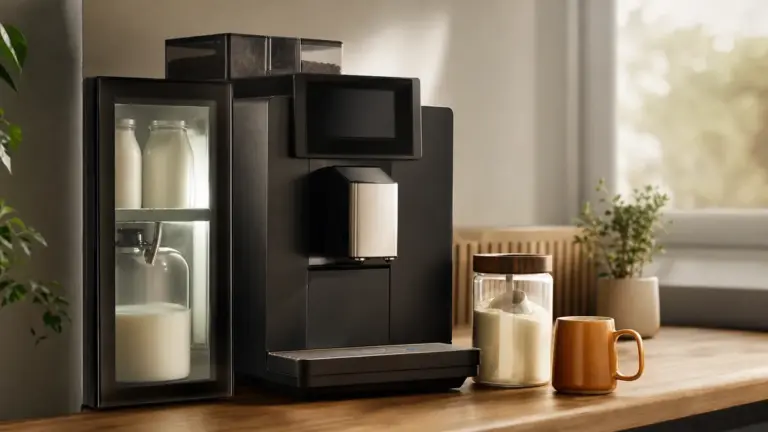
Bean-to-cup equipment can use fresh milk or powdered topping, depending on its configuration. Capsule equipment may have integrated milk preparation or require a separate appliance. Do not compare a coffee-only capsule machine with a complete automatic milk-drink system as though they offer the same service.
For fresh milk, include refrigeration, replenishment and the manufacturer’s milk-system cleaning routine. Powder-based equipment has a different preparation and cleaning workflow; inspect that too.
Ask suppliers to demonstrate dairy and plant-based recipes, explain shared milk paths and provide written cleaning instructions. A pod machine with fresh milk is not a maintenance-free solution.
Match capacity to the busiest break
Headcount helps estimate consumption, but it does not describe the queue. Use actual daily attendance, visitor demand and drinks ordered during the busiest period.
This matrix assumes two drinks per attending coffee drinker per day. It is a planning aid, not a machine rating.
| Daily coffee drinkers | Illustrative daily drinks | Starting shortlist | Peak-time check |
|---|---|---|---|
| 5 | 10 | Compact office capsule or small office bean-to-cup | Intermittent use and cleaning ownership |
| 20 | 40 | Both formats | Run the busiest break’s drink sequence |
| 50 | 100 | Commercial bean-to-cup or professional capsule equipment | Parallel preparation, replenishment and backup |
Ask for a timed demonstration including cup placement, drink selection, capsule loading where relevant, milk preparation and any interruptions. Manufacturer daily-output recommendations are not promises about queue length.
For illustration, a station occupied for 60 seconds per completed drink needs 10 minutes to finish 10 drinks sequentially. That is arithmetic, not a performance claim. Two outlets also do not prove that two complete milk drinks can be made simultaneously.
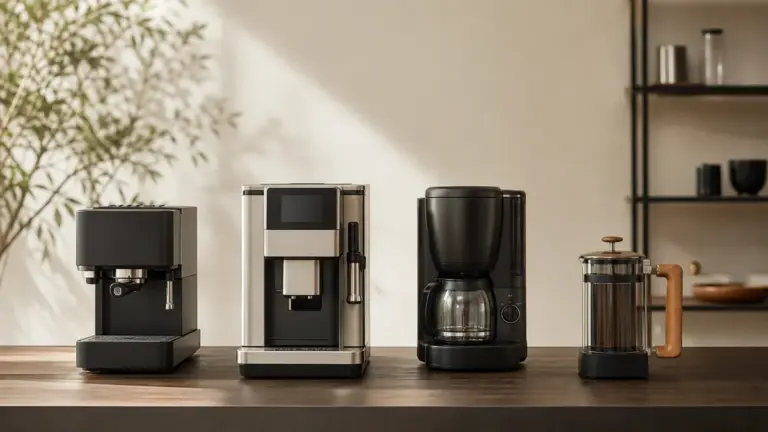
If meeting-room demand is mainly large quantities of black coffee, consider filter machines and bulk brewers rather than forcing every drink through an individual brewing cycle.
Space, plumbing, power and servicing
Measure the complete installation, including milk equipment, storage, recycling containers and access for cleaning. Allow space above and beside the machine for filling, removing containers and servicing.
Both formats include tank-fed equipment, while water-connection requirements vary by model. Get the supplier to specify the required water supply, drainage, electrical connection and clearances before ordering. A compact-looking machine is not evidence that the whole installation fits.
For plumbed installations in England and Wales, the Water Supply (Water Fittings) Regulations 1999 require suitable backflow protection, preventing contaminated water returning towards the supply. Scotland and Northern Ireland have separate requirements.
Use your local water supplier’s hardness information and the machine manufacturer’s instructions when specifying treatment and maintenance. There is no single water-hardness figure suitable for every UK office.
Some machines with steam boilers can fall within the Pressure Systems Safety Regulations 2000 in Great Britain. Ask the supplier to confirm applicability and consult HSE guidance; do not assume that every automatic machine is exempt.
Finally, name the person responsible for daily care and their deputy. Confirm what happens during breakdowns and whether routine cleaning remains your responsibility under the service agreement.
Pod waste, business recycling and Simpler Recycling
Bean-to-cup produces loose grounds; capsule machines leave coffee enclosed in a used capsule. These require different collection arrangements.
Household recycling is not a business collection contract. Podback’s household scheme should not be treated as an office waste service. Its council-partner guidance describes collections through household waste and recycling services.
Arrange an explicitly business-eligible route instead. Verified examples include Nespresso Professional’s business capsule collection and TerraCycle’s Coffee Pods and Capsules Zero Waste Box, which provides business waste-transfer documentation. These are examples, not endorsements: check accepted capsules, postcode coverage, storage instructions and paperwork.
What Simpler Recycling does and does not do
In England, workplace requirements took effect on 31 March 2025, with micro-firms employing fewer than 10 full-time-equivalent staff given until 31 March 2027. The employee count applies across the business, not just one office.
Coffee grounds are food waste under the guidance. However, Simpler Recycling does not itself establish a collection route for mixed-material used capsules. Confirm their destination with the business waste provider.
Packaging labelled compostable or biodegradable, including compostable coffee pods, must not go into the standard food-waste collection under this guidance. It needs a dedicated route or appropriate residual-waste handling.
Scotland, Wales and Northern Ireland have separate arrangements. Avoid declaring either machine type environmentally superior solely from its packaging: this comparison does not establish a whole-life environmental ranking.
Which option suits your office?
Shortlist bean-to-cup first when demand is regular, staff want a shared coffee menu and someone can manage cleaning and replenishment.
Shortlist capsules first when demand is intermittent, individual coffee selection matters and a suitable business collection route is available.
For either option, require a taste trial, a peak-period demonstration, installation requirements and an itemised written quotation. The right bean-to-cup vs pod machines decision is the one that still works during the busiest break and when the usual machine caretaker is away.
FAQ
Can an office use a domestic pod machine?
Only choose one if the manufacturer’s intended use and warranty terms cover your workplace application. Physical fit and acceptable taste do not establish suitability for repeated office use. Obtain written confirmation of workload suitability, servicing arrangements and warranty coverage before making it the office’s main machine.
Is a second machine a sensible backup?
It can be, but assess the extra work as well as the resilience. A second machine needs its own replenishment, cleaning and waste arrangements. Decide whether you need another brewing station for queues, a separate decaffeinated option, or emergency cover during repairs, then specify equipment for that purpose.
How should we compare electricity consumption?
Ask for consumption information using the same operating pattern, not just the machines’ power ratings. Include warm-up, idle periods, drink preparation, cleaning and separate milk refrigeration. If comparable data are unavailable, arrange a monitored workplace trial and record attendance and drink counts alongside electricity use.
Where to go next
Read Office Coffee Machines to build the wider procurement checklist, and Best Types of Coffee Machine for Offices if neither format quite fits. Office Capsule Coffee Machines develops the capsule shortlist, while Bean-to-Cup vs Traditional Espresso Machines for Offices examines the alternative for workplaces considering hands-on preparation.
Sources
-
Bravilor Bonamat, Esprecious and FreshMilk brochure, undated. Manufacturer documentation for grinding, recipe settings and fresh milk versus powdered topping.
https://cdn.b2b.bravilor.com/media/product/8.060.300.33001/brochures/619423/BRO_Esprecious-FreshMilk_EN.pdf -
Nespresso, Zenius user manual, 2014. Intended use, capsule compatibility, installation and maintenance instructions.
https://www.nespresso.com/shared_res/manuals/zenius/www_Zenius_Z2_Nespresso%28EN_DE_FR_IT_ES_NL_SE_DK_FI_NO_RU_PL_CZ_GR_RO_HU_PT_TR_AR%29.pdf -
JURA, X10 product information and maintenance guidance, undated live page. Manufacturer-claimed drink options, daily-output recommendation and milk-system cleaning requirements.
https://www.jura.com/en/professional/machines/x10-dark-inox-eb-15764 -
Nespresso Professional, Nespresso Momento range, undated live page. Manufacturer-published examples of capsule equipment with differing milk and installation configurations.
https://www.nespressoforbusiness.co.uk/machines/nespresso-momento/ -
HMRC, Food products, VAT Notice 701/14, updated 2026; Catering, takeaway food, VAT Notice 709/1, updated 2026. Ingredient and catering VAT treatment, including employee catering.
https://www.gov.uk/guidance/food-products-and-vat-notice-70114
https://www.gov.uk/guidance/catering-takeaway-food-and-vat-notice-7091 -
HMRC, VAT Food Manual VFOOD7660, manual updated 2024; How much VAT you must charge, undated live guidance. Alternative milks and the default standard-rating rule.
https://www.gov.uk/hmrc-internal-manuals/vat-food/vfood7660
https://www.gov.uk/how-vat-works/how-much-vat-you-must-charge -
UK legislation, Water Supply (Water Fittings) Regulations 1999, Schedule 2, paragraph 15. Backflow protection in England and Wales.
https://www.legislation.gov.uk/uksi/1999/1148/contents/made?view=plain -
HSE, Pressure Systems Safety Regulations 2000, undated live guidance. Applicability and examination requirements for qualifying pressure equipment.
https://www.hse.gov.uk/pressure-systems/pssr.htm -
Thames Water, Water quality, undated live guidance. Postcode-based local water information and hardness.
https://www.thameswater.co.uk/help/water-and-waste-help/water-quality -
DEFRA, Simpler recycling: workplace recycling in England, updated 2025. Commencement dates, employee-count rules, coffee grounds and compostable packaging.
https://www.gov.uk/guidance/simpler-recycling-workplace-recycling-in-england -
Cherwell District Council, Podback FAQs, undated live guidance. Primary local collection guidance describing Podback’s household service.
https://www.cherwell.gov.uk/info/10/rubbish-and-recycling/1085/podback-scheme/2 -
Nespresso Professional, How to recycle your business coffee pods, undated live guidance; TerraCycle, Coffee Pods and Capsules Zero Waste Box, undated live product guidance. Business collection routes, accepted materials and waste-transfer documentation.
https://www.nespresso.com/pro/uk/en/recycling
https://shop.terracycle.com/en-GB/products/coffee-pods-zero-waste-box
Research combined retrieved manufacturer documentation, HMRC guidance, legislation and primary waste-service information; suitability recommendations are editorial judgements, and numerical workplace examples are explicitly stated assumptions rather than testing results.
Last checked: November 2026