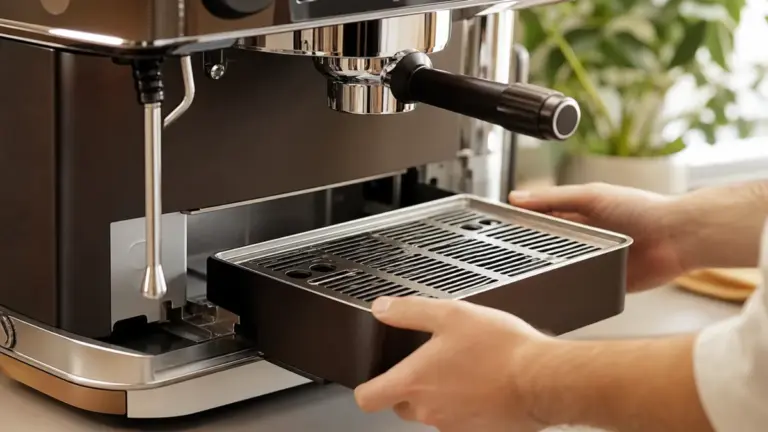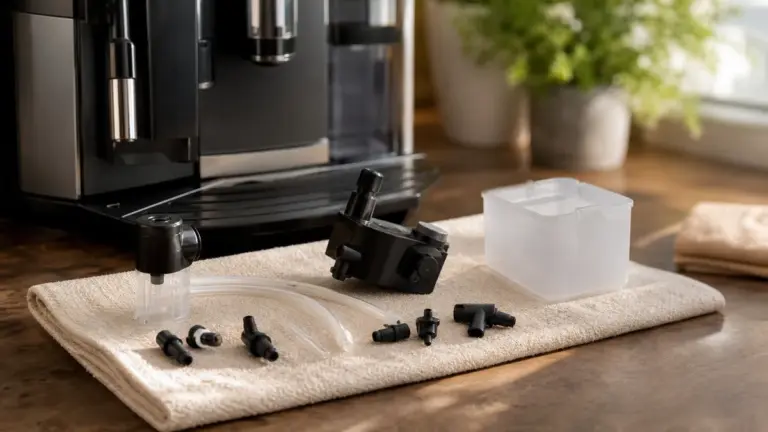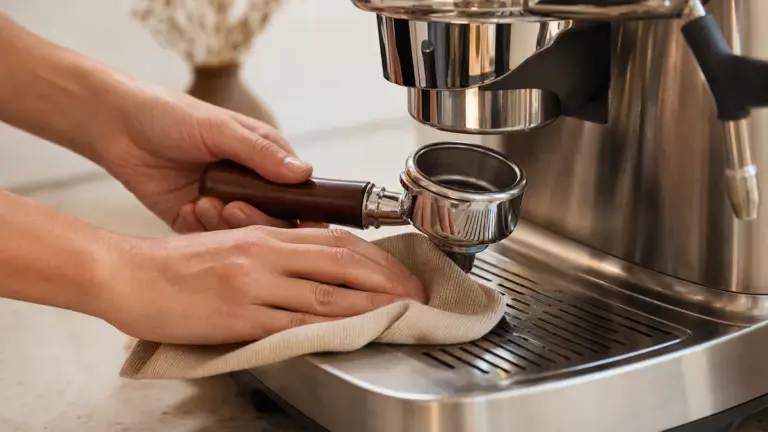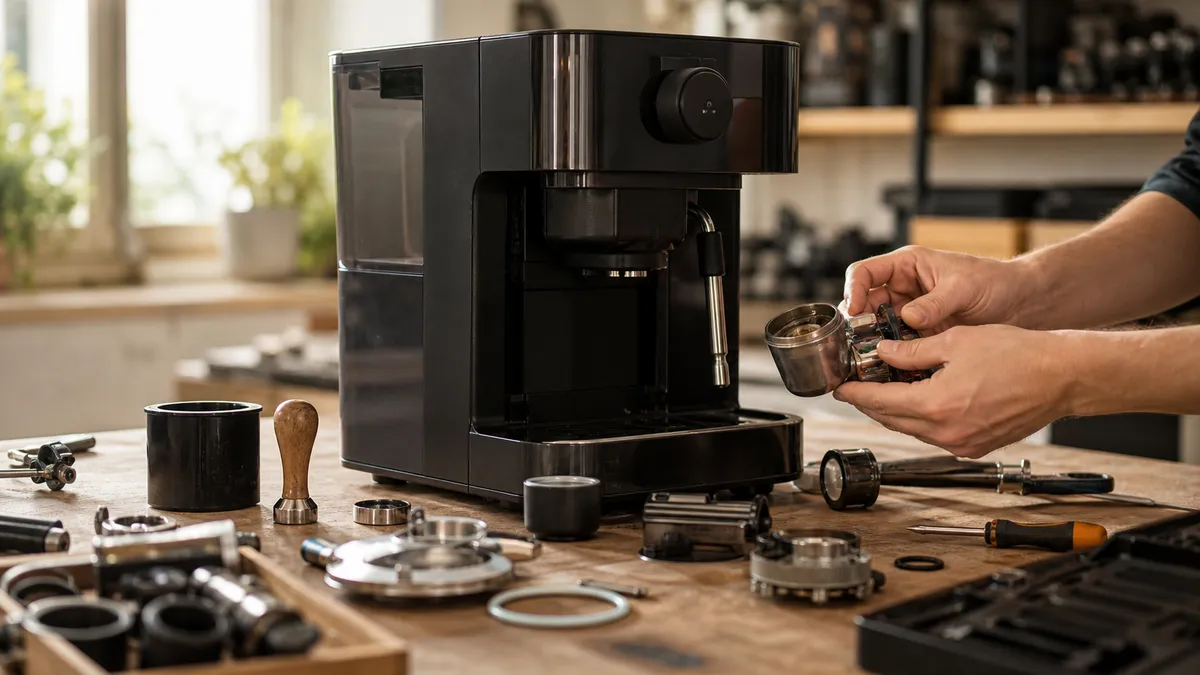
Repair a broken coffee machine when a competent repairer can identify the fault, obtain suitable parts and return an otherwise useful machine to safe service. Replace it when a dependable repair is unavailable, the wider condition is poor or the machine no longer suits its workload, rather than deciding by age alone.
In short
- Check your rights with the seller and any warranty provider before authorising an independent repair.
- Compare an itemised repair quotation with an equivalent replacement, including installation, servicing and disruption.
- Ask about parts for your exact model, not simply whether the brand is still trading.
- Treat age as context: condition, usage and repair history deserve more weight.
- If repair is unsuitable, arrange electrical reuse or recycling rather than putting the machine in an ordinary bin.
Start with safety and a diagnosis
Stop using a machine with a damaged cable or plug, burn marks, smoke or a burning smell. Switch off and disconnect it only if safe to do so; otherwise keep clear and arrange safe isolation. HSE guidance says electrical repairs should be undertaken by someone with the necessary skills, knowledge and experience.
Do not remove covers to investigate a suspected internal fault. Manufacturer instructions may explicitly prohibit this: JURA’s A1/A100 manual, for example, warns against opening the machine and directs repairs to authorised service centres. Follow the instructions for your own model.
For a machine without warning signs, check only the user-accessible items described in its manual. Record the symptoms and any displayed error before arranging help. Our coffee machine troubleshooting guide covers those initial checks; this article concerns the decision once further attention is needed.
Give the repairer the model, serial number, purchase date, maintenance history and a clear description of what happened. “Water appeared underneath during rinsing” is more useful than “it leaks”. Ask for a diagnosis that identifies both the failed component and any underlying problem, rather than authorising a succession of speculative replacements.
Compare repair with the value of a useful replacement
The right comparison is not simply the repair quotation against what you originally paid. It is the complete repair route against a replacement that does the job you actually need.
Request itemised written quotations. For repair, include diagnosis, parts, labour, transport or an on-site visit, testing and the repair warranty. Ask what happens if inspection reveals additional faults, and require approval before extra work proceeds.
For replacement, include the machine, delivery, installation, any plumbing or electrical alterations, commissioning, compatible accessories and removal of the old equipment. Compare ongoing servicing, consumables and maintenance requirements over the same intended period of use. Keep both quotations on a consistent VAT basis.
You can then work out your own comparison:
- Add the items needed to complete each route.
- Add the ongoing commitments over your chosen period.
- Consider the repairer’s assessment of remaining condition and likely future work.
- Record non-financial differences, including downtime, support and suitability.
Avoid treating an arbitrary percentage of the original purchase price as a universal cut-off. Our editorial recommendation is to judge the complete machine and the confidence attached to the repair, not just the size of one bill.
Money already spent belongs in the history, not in the justification for another repair. Equally, replacing a machine with unnecessary extra features is not a like-for-like comparison.
Weigh age, condition and workload together
An old machine is not automatically beyond repair, and a relatively recent one is not automatically worth restoring. Ask the engineer to assess the machine as a whole: is this an isolated fault in otherwise serviceable equipment, or one problem among several?
Useful evidence includes:
- The service record and whether previous repairs resolved their faults.
- Recorded drink counts or operating hours, where available.
- The condition of the water circuit, heating components, grinder and brew mechanism, as applicable.
- Any corrosion, leakage or damage affecting other components.
- Whether the machine still suits its present use.
Do not accept a remaining-life promise based only on the machine’s birthday. Ask what the assessment is based on and which important components were inspected.
In an office, record daily drinks, the busiest serving period and how much disruption the workplace can tolerate. If the machine never met demand comfortably, restoring it will not solve that mismatch. Conversely, a supported machine that meets the workload deserves a fair repair assessment.
For symptom-specific explanations, use common coffee machine faults, rather than assuming that similar symptoms always mean the same failed part.
Check whether parts and repair support really exist
“Parts available” needs a more precise answer. Ask whether the required component is available for your exact model and production version, whether it is in stock and whether a delivery date is confirmed.
Ask the repairer to distinguish between:
- New manufacturer-supplied parts.
- Compatible replacement parts.
- Refurbished or recovered components.
None of those descriptions, by itself, establishes suitability. Ask who supplies the part, why it is appropriate and what warranty applies. For an electronic module, also ask whether configuration, software or manufacturer access is needed.
Check support beyond the present fault. A repair may restore operation, but your decision should also consider access to other important parts and someone willing to service the machine afterwards. A discontinued model is a reason to investigate support, not an automatic instruction to discard it.
What does the UK right to repair actually cover?
Two different things are often called a “right to repair”: a consumer’s remedies against a seller, and product-specific obligations on manufacturers to provide parts or repair information.
Your rights against the seller
For a personal purchase from a trader, the Consumer Rights Act 2015 requires goods to be of satisfactory quality, fit for purpose and as described. Contact the seller before commissioning your own repair if you think the machine failed to meet those requirements.
For qualifying faulty goods, there is normally a short-term right to reject within 30 days. After that, repair or replacement is generally the first remedy, subject to the statutory conditions.
A fault appearing within the first six months is generally presumed to have existed at delivery unless the trader establishes otherwise. After six months, the consumer generally needs evidence that the problem was inherent rather than subsequent damage or ordinary wear.
If a statutory repair or replacement fails, further remedies can become available. An expired manufacturer warranty does not, by itself, extinguish statutory rights. Equally, those rights are not a guarantee against every later breakdown.
Office purchases need separate treatment. The Act’s consumer definition concerns an individual acting wholly or mainly outside their trade, business, craft or profession. A business purchase should be assessed against the supply contract, warranty and applicable business law, not automatically treated as a household consumer claim.
Manufacturer parts obligations
The rules commonly called the “Right to Repair Regulations” introduced repairability provisions for specified product categories in Great Britain. They are not a blanket promise of spare parts for every electrical appliance.
As checked in November 2026, the official product-specific framework does not establish an equivalent coffee-machine spare-parts entitlement. Do not assume that rules for washing machines or dishwashers apply to a bean-to-cup machine. Government guidance also distinguishes Great Britain and Northern Ireland requirements; check the applicable position rather than treating every UK product rule as identical.
Find a repairer and agree the work
Start with the manufacturer’s official support service, particularly while a warranty or service agreement may apply. Ask it to confirm any claimed authorised status.
An independent specialist is another route to investigate. Ask whether they regularly repair your machine class and exact model, can obtain the necessary parts and will document their diagnosis. General electrical competence matters, but also ask about relevant coffee-equipment experience.
Before booking, establish:
- What the initial assessment includes.
- Whether the quotation is provisional or based on inspection.
- The parts, labour and transport included.
- What testing will follow the repair.
- The completion estimate and repair warranty.
- Who authorises additional work.
For a domestic machine, a local Repair Café may help assess repairability. The Repair Café Foundation advises contacting organisers to check whether a suitable repairer will be present. Treat it as a community repair opportunity, not a substitute for a contracted commercial service.
For ongoing care after a successful repair, return to coffee equipment care and repairs.
Make the environmental comparison honestly
Repair and continued use fit the waste hierarchy’s preference for preventing waste and enabling reuse before recycling. That supports investigating repair, but it does not prove that every repair has a lower overall environmental impact than every replacement.
Consider the parts required, transport, expected additional use and electricity consumption during operation. Without a model-specific lifecycle assessment, a precise carbon claim would be speculative. A newer machine’s efficiency claim alone does not settle the whole comparison.
If replacement is necessary, ask whether the old machine can be professionally refurbished. Be explicit about faults rather than passing it on as working.
Coffee machines are electrical equipment and can enter electrical recycling routes. Householders can check local facilities through Recycle Your Electricals. For workplace equipment, confirm that the receiving service accepts business waste and provides the appropriate documentation; do not assume a household collection arrangement covers it.
Repair or replace: the decision checklist
Use this framework after diagnosis, not instead of it.
| Criterion | Supports repair | Supports replacement |
|---|---|---|
| Safety | Competent repairer confirms a safe repair is achievable | No dependable route back to safe service |
| Fault and condition | Defined fault; wider condition is serviceable | Several unresolved problems or substantial wider damage |
| Parts and support | Suitable parts and continuing service support confirmed | Essential parts or necessary technical access unavailable |
| Suitability | Machine still meets the required workload | Capacity or functions no longer suit the workplace |
| Complete comparison | Repair scope, testing and warranty are clear | Replacement offers the more dependable overall route |
Before approving either route, check that you have:
- [ ] Contacted the seller or warranty provider where relevant.
- [ ] Obtained a written diagnosis and itemised quotation.
- [ ] Confirmed parts availability and expected completion.
- [ ] Compared equivalent capabilities and ongoing commitments.
- [ ] Agreed testing, warranty and approval for extra work.
- [ ] Planned continued maintenance or responsible disposal.
If an important answer is missing, seek clarification or a second opinion before committing.
FAQ
Should I get a second opinion if someone says the machine is beyond repair?
Yes, particularly when the explanation is vague. Ask whether “beyond repair” means unsafe, technically unrepairable, unsupported by available parts or simply outside that repairer’s service offering. Request the diagnosis in writing. Another specialist may assess it differently, but do not keep operating a machine whose safety is uncertain.
Can I send a machine away with water still inside?
Follow the manufacturer’s or repairer’s transport instructions rather than improvising. Ask which removable containers to empty, which accessories to include and whether any internal draining procedure is required. Do not assume emptying the tank empties the whole machine. Photograph its condition and use the packaging specified by the receiving service.
What should I ask for when the repaired machine comes back?
Ask for a written record of the diagnosed fault, parts fitted, work completed and testing performed. Confirm the repair warranty and any maintenance changes recommended. Before returning an office machine to general use, arrange a controlled handover and check for normal operation, leakage and unresolved warnings in accordance with the service instructions.
Where to go next
Read Coffee Machine Troubleshooting for safe initial checks, then Common Coffee Machine Faults to understand the symptoms you need to describe to a repairer. Coffee Equipment Care and Repairs brings the maintenance guidance together, helping you look after whichever machine emerges from your repair or replace decision.
Sources
-
Health and Safety Executive, “Introduction to electrical safety”, current online guidance, retrieved November 2026.
https://www.hse.gov.uk/electricity/introduction.htm
Supports the safety warnings and competence requirements. -
JURA, “A1/A100 Instructions for Use”, manufacturer manual, undated edition retrieved November 2026.
https://uk.jura.com/-/media/global/pdf/manuals-global/home/A1-A100/A1-A100.pdf
Provides the model-specific example of restrictions on opening and repairing a machine. -
UK Parliament, Consumer Rights Act 2015, section 2, 2015.
https://www.legislation.gov.uk/ukpga/2015/15/section/2/enacted?view=plain
Defines “consumer” for the distinction between personal and business purchases. -
House of Commons Library, “Consumer Rights Act 2015”, research briefing, 9 July 2025.
https://researchbriefings.files.parliament.uk/documents/SN06588/SN06588.pdf
Explains faulty-goods remedies and the burden of proof. -
Which?, “Faulty product? How to get a refund, repair or replacement”, current online guidance, retrieved November 2026.
https://www.which.co.uk/consumer-rights/advice/what-do-i-do-if-i-have-a-faulty-product-aTTEK2g0YuEy
Cross-checks the practical consumer-rights explanation. -
GOV.UK, “Accepting returns and giving refunds: the law”, current online guidance, retrieved November 2026.
https://www.gov.uk/accepting-returns-and-giving-refunds
Confirms that warranties do not replace statutory rights. -
House of Commons Library, “Right to Repair Regulations”, research briefing, 2021.
https://commonslibrary.parliament.uk/research-briefings/cbp-9302/
Explains the Great Britain regulations and their product-specific approach. -
Department for Energy Security and Net Zero and Office for Product Safety and Standards, “Regulations: ecodesign of energy-consuming products”, updated 8 April 2026.
https://www.gov.uk/guidance/placing-energy-related-products-on-the-uk-market
Provides the current official product framework and territorial distinctions. -
Repair Café International Foundation, “Repair Café FAQ”, undated online guidance, retrieved November 2026.
https://www.repaircafe.org/en/faq/
Explains the community repair model and checking local expertise. -
Scottish Government, “Applying the waste hierarchy: guidance”, Part 2, 2017.
https://www.gov.scot/publications/guidance-applying-waste-hierarchy/pages/4/
Supports the waste-prevention and reuse principles, not a quantified coffee-machine carbon comparison. -
Material Focus, Recycle Your Electricals, “What electronics can be recycled?”, undated online guidance, retrieved November 2026.
https://recycleyourelectricals.org.uk/how-to-recycle-electronics/what-electronics-can-be-recycled/
Identifies coffee machines as recyclable electrical equipment and provides a collection-point locator. -
GOV.UK, “Dispose of business or commercial waste: Your responsibilities”, current online guidance, retrieved November 2026.
https://www.gov.uk/dispose-business-commercial-waste
Supports the distinction between household disposal arrangements and business waste responsibilities.
This guide was researched using UK official guidance, consumer-rights commentary, a manufacturer manual and repair and recycling organisations; the decision framework is editorial guidance, not a machine inspection or lifespan prediction.
Last checked: November 2026