When an office coffee machine breaks down, stop using it if there is any sign of electrical damage, leaking water near electrics, overheating or uncontrolled steam. Otherwise, record the display message, follow the model’s operator checks and call the service provider if the fault persists, without opening internal covers or attempting electrical or pressure-system repairs.
In short
- Keep user checks to tasks explicitly allowed in the machine’s operating instructions.
- Photograph the complete error message before restarting or changing anything.
- Check accessible supplies, containers and removable parts before booking a breakdown visit.
- Ask whether your contract promises a response, an engineer’s attendance or a completed repair.
- Keep the machine out of service until any safety-related fault has been assessed and cleared.
First, make the machine safe
A breakdown is not automatically a repair task for office staff. HSE says damaged electrical equipment should be removed from use and repairs undertaken by someone competent for the work. A person who can clean a milk outlet is not necessarily competent to repair a heater, pump or control board.
Stop use immediately if you notice:
- A damaged plug, exposed wiring, scorch marks or a burning smell.
- Water reaching electrical equipment or escaping from inside the cabinet.
- Unexpected steam escaping from the casing, rather than a normal outlet.
- Repeated operation of electrical protective devices, such as a circuit breaker.
Switch off and disconnect only where this can be done safely. Do not touch a wet plug, socket or machine; keep people away and contact facilities staff. If safely accessible, close the machine’s identified water isolation valve to limit a leak, but do not disconnect hoses or fittings.
Mark the machine as out of service and tell reception or the facilities team. This prevents the next person from switching it back on to “see whether it works now”.
For the wider maintenance plan, see office installation and maintenance.
Safe quick checks before calling for a repair
For a machine with no danger signs, use this sequence. It is a fault-reporting checklist, not permission to dismantle equipment.
- Identify the machine. Find the model, serial number and asset record without moving heavy equipment or reaching underneath it. Open the matching operator manual, not instructions for a similar-looking model.
- Record the symptom. Photograph the display and note which drink or operation failed. Was the machine starting, grinding, dispensing, rinsing or cleaning?
- Check operator-accessible items. Follow the displayed instructions for the water tank, bean hopper, grounds container, drip tray and doors. Refit parts gently, without forcing catches.
- Check for a site issue. Ask facilities whether power or water supplies have been interrupted. For a plumbed-in machine, have an authorised person check its identified supply valve; do not adjust pressure regulators or filter bypass settings.
- Perform only the prescribed recovery. Complete an operator cleaning or restart procedure only if the manual permits it and there are no safety concerns. Do not keep restarting a machine that immediately returns to the same fault.
- Escalate and record the result. Note what was checked and whether it changed the symptom. Leave persistent faults for the service provider.
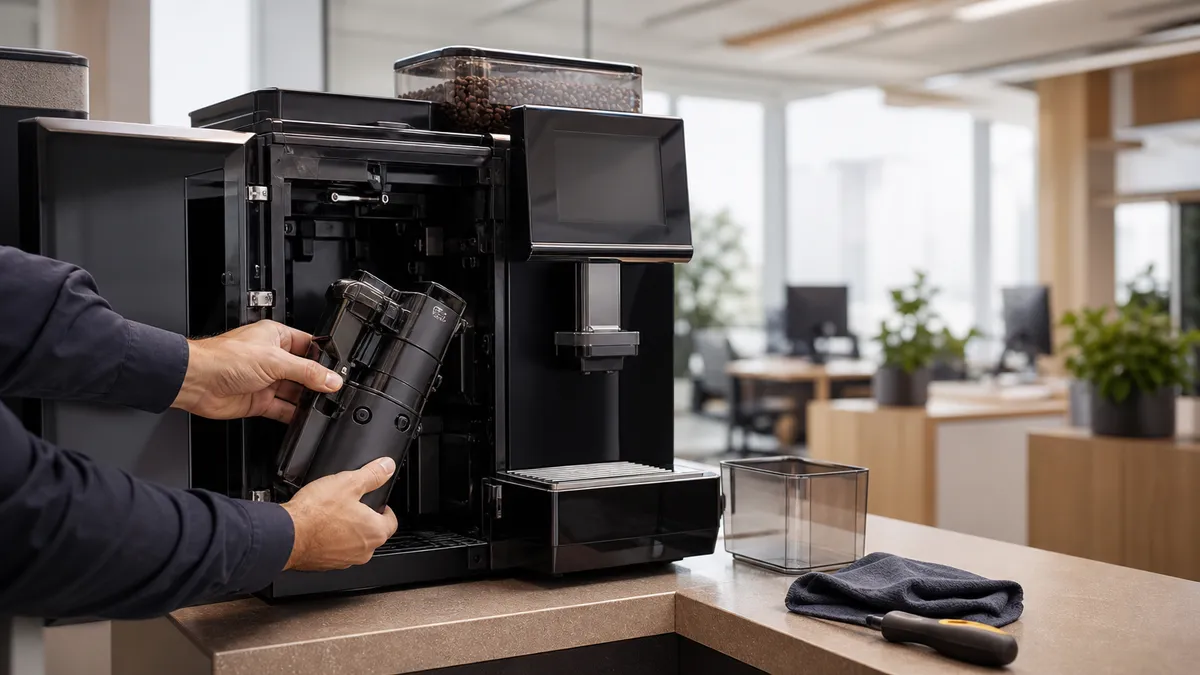
Do not reach into a grinder, force a stuck brew mechanism or defeat a door switch. Remove a brew unit only where the manual explicitly treats it as an operator-removable part.
Common symptoms and their limits
The examples below draw on JURA’s published operator troubleshooting. They illustrate possible causes, not diagnoses for every office machine.
| Symptom | Possible cause | Safe operator action |
|---|---|---|
| Water, beans or waste-container message | Supply needs replenishing or a container needs attention | Follow the displayed instruction and refit accessible parts |
| Tray message persists after emptying | On some models, tray contacts are dirty or wet | Clean and dry only the contacts identified in the manual |
| Coffee emerges in drips | Grind too fine or scale-related restriction | Consult the model’s instructions; do not assume descaling is always appropriate |
| Milk splutters or foam is poor | Dirty milk outlet or unsuitable settings | Complete the prescribed milk-system clean; escalate if unresolved |
| An unfamiliar error remains | Fault beyond the listed operator remedies | Record the message and contact support |
Cleaning and descaling are different procedures. Do not improvise with a chemical simply because the machine has stopped dispensing. Use descaling and servicing for the planned maintenance approach, rather than treating every slow drink as a breakdown.
How to handle error messages
Treat the exact message as evidence, not a diagnosis. A refill prompt, a maintenance reminder and a technical error can require different responses.
Read the whole screen, including any instructions behind an information symbol. Record the code, wording and circumstances before clearing it. Avoid copying a reset sequence from an online discussion unless the manufacturer confirms that it applies to your exact model.
For example, JURA’s GIGA X8 instructions distinguish routine container and maintenance prompts from other error messages requiring shutdown and customer support. That distinction matters more than finding a supposedly universal meaning for an error number.
If a message returns after the specified operator action, stop repeating that action. Tell support both the original message and what happened afterwards. A photograph of an unchanged error is more useful than “it still does not work”.
When to call the engineer
Call immediately for a safety concern. For a non-hazardous operational fault, contact the service provider when the manual’s permitted checks do not resolve it, a mechanism jams, or the problem repeatedly returns.
Internal electrical work requires task-appropriate competence. Pressure-system work also needs specialist knowledge: switching off a machine is not an instruction to loosen a boiler fitting, open a valve or remove a protective device.
In Great Britain, machines incorporating steam boilers can fall within the Pressure Systems Safety Regulations 2000. Steam is covered at any pressure, and qualifying systems require a written scheme of examination and examination by a competent person. Check the machine’s position with the supplier and HSE guidance; routine servicing is not a substitute for statutory examination.
See boiler safety and PSSR compliance for that separate duty.
Give support a useful fault report
Prepare a single message containing:
- Model, serial number, site address and service agreement reference.
- Exact error wording and photographs.
- When the fault began and whether it is constant or intermittent.
- Whether coffee, milk, hot water or all functions are affected.
- Any recent cleaning, filter change, relocation or supply interruption.
- Checks already completed, plus details of leaks, smells or unusual sounds.
- Your site contact, access arrangements and machine isolation status.
Ask who should attend. A machine technician, an electrician and a pressure-system examiner perform different roles, even where one provider coordinates them.
What should a service contract cover?
Read the actual agreement rather than relying on the phrase “full cover”. As checked in November 2026, Franke’s published UK terms contain exclusions involving matters such as inadequate cleaning, limescale, unsuitable water supplies and unauthorised interventions. Those are examples from one manufacturer, not universal terms.
Ask for written answers to these questions:
- Scope: Are diagnosis, travel, labour, replacement parts and repeat visits included?
- Timing: Does the commitment mean telephone response, attendance or restored operation? What working hours and geographical limits apply?
- Exclusions: How are wear parts, accidental damage, blockages, water quality and missed maintenance treated?
- Continuity: Is a loan machine included, subject to availability, or arranged separately?
- Responsibilities: Who maintains filters, records cleaning and arranges any pressure-system examination?
- Authorisation: Must you obtain approval before another company works on the machine?
Request itemised written quotations for anything outside the agreement. Include diagnosis, parts, labour, transport, temporary equipment and any necessary recommissioning in the comparison, with the VAT basis stated.
Keep cleaning and service records together. They help establish what happened and support discussions about whether the fault falls within the agreed cover.
Repair or replace the machine?
Use the diagnosis, repair history and future support as your decision criteria, rather than the machine’s age alone.
Repair is the stronger candidate when the engineer identifies a contained fault, suitable parts remain available and the machine still meets the workplace’s needs. Ask what caused the failure and whether the proposed work addresses that cause.
Replacement deserves investigation when faults recur, essential parts are unavailable, safe operation cannot be assured or the machine no longer suits demand. Replacing a machine without resolving an unsuitable water supply or installation issue leaves the underlying problem unanswered.
Get both proposals in writing. For a repair, ask about parts availability, expected completion, work warranty and any remaining defects. For replacement, include removal, installation, water treatment, staff training and servicing requirements.
Avoid an arbitrary percentage rule for deciding between them. Compare the complete proposals and the disruption each involves, using your own itemised quotations rather than a generic calculation.
Reducing downtime and returning to service
Give one person ownership of the fault log, with a deputy for absences. Keep the manual, support contact and service reference accessible without needing the broken machine’s screen.
Maintain the manufacturer’s cleaning schedule and arrange servicing according to its instructions and your agreement. Keep approved cleaning products and routinely replaced operator parts available through an organised consumables and supplies plan.
For continuity, identify an alternative drinks point or a safely installed backup method before a failure. If a loan machine is offered, confirm its water, electrical, cleaning and operating requirements rather than assuming it can be connected in the same way.
After repair, obtain a job sheet recording the fault, work completed and any outstanding actions. Ask the technician to explain the return-to-service procedure, including cleaning, rinsing and functional checks.
Where pressure-system repairs are involved, the written scheme may require examination before reuse. Do not assume that a completed repair automatically settles that requirement.
FAQ
Can we keep serving black coffee if the milk system fails?
Only if the manufacturer or service provider confirms that the remaining functions can be used safely. A milk-only dispensing problem does not establish that the rest of the machine is unaffected. Ask support whether milk drinks can be disabled and what cleaning is required; leave the whole machine out of use if there is leakage or another safety concern.
Should we factory-reset the machine?
Not as a routine first response to a breakdown. Record the fault and follow the model’s troubleshooting instructions instead. A reset changes settings rather than establishing why the machine failed. If support requests one, ask which configuration needs recording first and who will restore the workplace’s operating settings afterwards.
What if an intermittent fault disappears before the engineer arrives?
Keep the appointment or ask the service provider how to proceed, rather than assuming the fault is resolved. Supply photographs, timings and a record of the drinks or cycles affected. Any previous burning smell, electrical damage, uncontrolled steam or water near electrics still needs assessment, even if the machine appears normal again.
Where to go next
Read Office Coffee Machine Descaling and Servicing to separate preventive maintenance from breakdown recovery, and Commercial Boiler Safety and PSSR Compliance for pressure-system responsibilities. Office Coffee Consumables and Supplies helps organise approved supplies, while Office Coffee Installation and Maintenance puts office coffee machine breakdowns and repairs into the wider workplace plan.
Sources
-
HSE, Introduction to electrical safety, undated live guidance. Damaged equipment, maintenance and competent repair.
https://www.hse.gov.uk/electricity/introduction.htm -
HSE, Work using electrically powered equipment, undated live guidance. Visual checks, disconnection and removing suspect equipment from use.
https://www.hse.gov.uk/electricity/electricequip.htm -
HSE, Work on electrical equipment, machinery or installations, undated live guidance. Task-specific competence and repair safety.
https://www.hse.gov.uk/electricity/withequip.htm -
JURA, GIGA X8 Instructions for Use, Type 748, undated retrieved edition, chapters 6 and 7. Operator messages and model-specific troubleshooting.
https://cee.jura.com/-/media/global/pdf/manuals-global/professional/GIGA-X8-G2/download_manual_jura_giga_x8.pdf?la=en&sc_lang=en -
JURA, GIGA X8 Professional Instructions for Use, Type 722, document J71239/GIGA X8/en/201607, 2016. Safety boundaries, approved maintenance and operator troubleshooting.
https://us.jura.com/-/media/global/pdf/manuals-global/professional/GIGA-X8/download_manual_jura_giga_x8.pdf?hash=AD61CFE9AC2CD7C205669BBC575B0553A8AF4109&la=en -
HSE, Pressure Systems Safety Regulations 2000 (PSSR), undated live guidance. Relevant fluids, written schemes and competent examination.
https://www.hse.gov.uk/pressure-systems/pssr.htm -
HSE, Safety of pressure systems, L122, second edition, 2014. Maintenance, repairs, examination and records.
https://www.hse.gov.uk/pubns/priced/l122.pdf -
Franke Coffee Systems UK, Sales Terms and Conditions, undated live version, clauses 9 and 11. Examples of service and warranty conditions and exclusions.
https://www.franke.com/gb/en/coffee-systems/legal-documents/terms-and-conditions.html
Researched using retrieved manufacturer operator manuals, published UK contractual terms and HSE guidance; no first-hand machine testing was undertaken.
Last checked: November 2026