Gaggia coffee machines offer two quite different routes to home espresso: hands-on portafilter machines, including the Classic family, and automatic bean-to-cup machines that grind and brew for you. Choose between them by deciding how much coffee preparation you want to do yourself, then compare the exact model’s temperature controls, milk system and cleaning requirements.
In short
- The Classic E24 has a brass boiler and a 58 mm portafilter, but you still prepare the coffee and steam the milk yourself.
- The Classic range now includes the UP and GT, so “Gaggia Classic” no longer describes one specification.
- Bean-to-cup families include Brera, Anima, Magenta, Cadorna and Accademia, with different milk arrangements and controls.
- Ownership needs a distinction: Versuni markets Gaggia domestic machines, while Evoca operates Gaggia Professional.
- Gaggia lists Caffe Shop Ltd, trading through Gaggia UK Direct, as its UK contact. Confirm warranty coverage for the particular machine and seller.
Gaggia at a glance
The most useful starting point is the distinction between a machine that helps you practise espresso-making and one that takes over the preparation. Neither approach is inherently the right choice for every household.
| Fact | Published position |
|---|---|
| Company and brand | Gaggia, an Italian coffee-machine brand with separate domestic and professional activities |
| Domestic group relationship | Versuni includes Gaggia in its home-appliance brand portfolio |
| Professional group relationship | Evoca operates Gaggia Professional and describes acquiring the professional branch |
| Country | Italian origins; Gaggia describes its domestic manual and automatic ranges as made in Italy |
| Main home machine classes and UK support | Portafilter espresso and automatic bean-to-cup; Gaggia’s international directory lists Caffe Shop Ltd and Gaggia UK Direct |
This profile assesses suitability from published features, manuals and support terms, not first-hand testing. Its criteria are user involvement, milk preparation, temperature control, routine maintenance and clarity of UK support. For the wider shortlist, start with coffee machine brands.
Gaggia’s history and who owns it now
Gaggia’s connection with espresso is substantial, but its commercial heritage should not be confused with the specification of a modern kitchen machine.
The manufacturer’s history gives these milestones:
- 1938: Achille Gaggia filed his Lampo patent on 5 September, developing coffee preparation using pressurised hot water rather than steam.
- 1948: Gaggia’s professional history dates the company’s foundation in Milan and the beginning of Classica production to this year.
- 1977: The Baby brought Gaggia’s espresso-machine development into the home.
- 1991: The Classic entered the range, establishing the name still used for its best-known domestic portafilter family.
The ownership distinction
It would be misleading to describe all Gaggia home machines simply as an Evoca-owned range. The primary sources distinguish the domestic and professional businesses.
Versuni currently lists Gaggia among the brands it markets. Its legal footer identifies Gaggia as a registered trademark of Koninklijke Philips N.V. Evoca, meanwhile, says it acquired the professional branch, and its group history refers to licences for the Gaggia brand in the professional market.
For a home buyer, Versuni’s domestic portfolio and Gaggia’s domestic support directory are therefore the relevant starting points. Evoca’s Gaggia Professional business is a separate purchasing and servicing context, not evidence that a domestic Classic is a commercial machine.
Classic and other manual Gaggia coffee machines
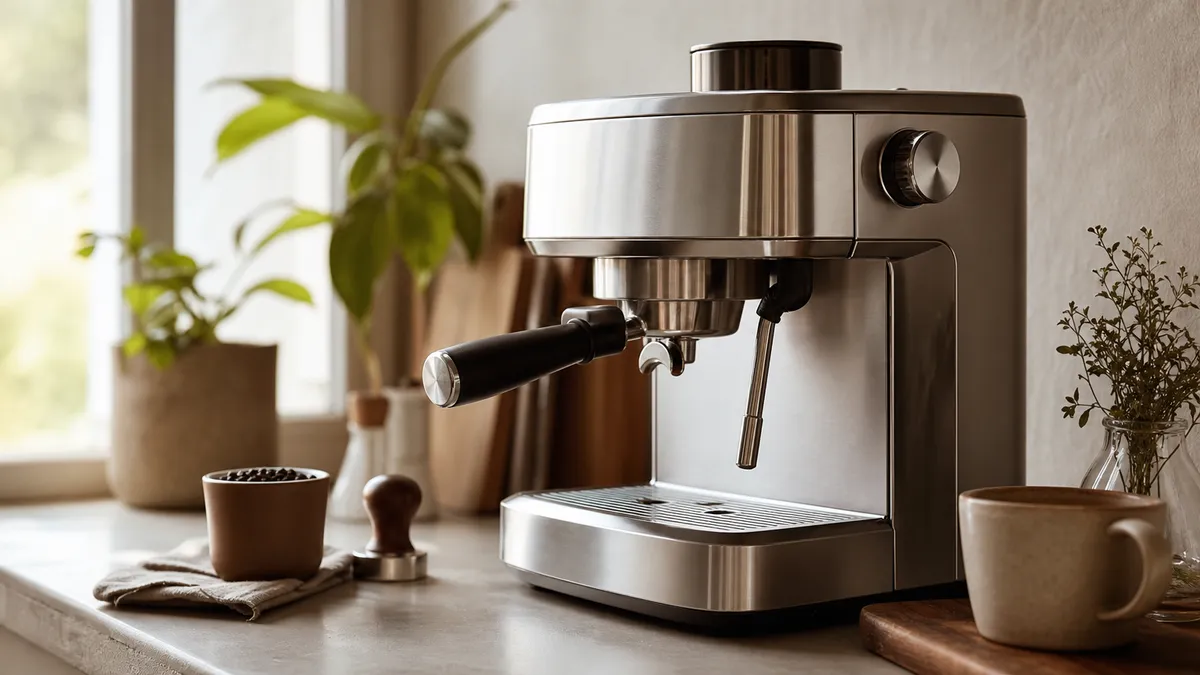
“Manual” here means hands-on coffee preparation, not necessarily a lever-operated machine. You fill a portafilter, the handled holder containing the coffee basket, fit it to the machine and control the brewing process.
Classic E24: the traditional hands-on choice
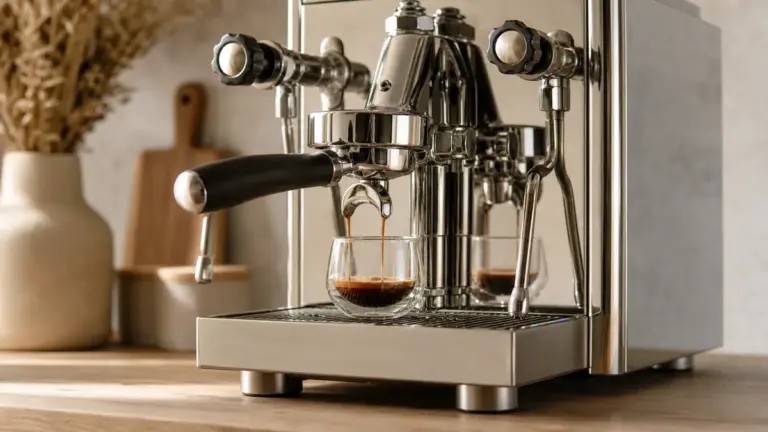
Gaggia’s published E24 specification includes a brass boiler, stainless-steel 58 mm portafilter and a professional-style steam wand. It has rocker switches rather than the adjustable digital temperature interface found on newer Classic variants.
The attraction is direct involvement. You can change how you prepare the coffee and learn to texture milk yourself. The qualification is that the machine does not take responsibility for those decisions.
For freshly ground coffee, plan the grinder alongside the machine rather than as an afterthought. Ask for a demonstration using the basket and coffee preparation you intend to use, not merely a demonstration that water comes through the group.
The E24’s workflow also matters. Its manual instructs you to brew the espresso, switch to steam preparation, and lower the boiler temperature before immediately making another coffee. For someone usually making one drink, that sequence may be perfectly acceptable. For a household repeatedly alternating espresso and milk drinks, it deserves a practical demonstration.
Classic UP and GT: different controls, different workflows
Do not assume that advice about an older Classic applies to every current model.
Gaggia lists the Classic UP with adjustable brewing-temperature control using a PID, an electronic controller that regulates heating, plus adjustable pre-infusion and a brew-pressure gauge. Pre-infusion wets the coffee before the main extraction.
The Classic GT uses separate brewing and steam boilers. Gaggia also lists PID temperature control, programmable pre-infusion and an adjustable overpressure valve, which controls the brewing circuit’s pressure limit.
Our assessment is that the UP deserves attention from buyers who want more factory-fitted brewing controls, while the GT is the more relevant comparison when separate brewing and steaming systems are a priority. These are feature-based judgements, not independently measured performance rankings.
Gaggia also lists Espresso-series and Carezza machines. Compare their own controls and supplied baskets rather than treating them as smaller Classics.
Gaggia’s bean-to-cup range
Gaggia’s automatic machines combine grinding, dosing and brewing. The main choice then becomes how the machine handles milk and how much personalisation you need.
The UK catalogue lists Brera, Anima, Magenta, Cadorna and Accademia families, among others. These names are useful signposts, but the full model suffix matters: a machine with a manual frother is a different everyday proposition from one with an integrated milk carafe.
| Route | Main involvement | Best suited to | Main qualification |
|---|---|---|---|
| Classic E24 | Prepare coffee and steam milk yourself | Someone who wants to learn hands-on espresso | Brewing and steaming require a managed sequence |
| Classic UP | Hands-on preparation with additional brewing controls | A learner who wants adjustable temperature and pre-infusion | Extra controls do not automate coffee preparation |
| Classic GT | Hands-on preparation with separate boilers | An enthusiast prioritising brewing and steaming facilities | More settings and systems to understand |
| Automatic with manual frother | Machine prepares coffee; user froths milk | Mainly black-coffee drinkers who occasionally want milk drinks | Milk preparation remains a separate task |
| Automatic with milk carafe | Machine prepares coffee and dispenses milk | Households prioritising convenient milk drinks | The milk system adds cleaning responsibilities |
Magenta, Cadorna and Accademia
The Magenta Prestige illustrates the carafe-equipped route: Gaggia lists automatic milk preparation, adjustable coffee settings and a removable brew group. The brew group is the internal assembly that holds and compresses the ground coffee for brewing.
The Cadorna Prestige adds four user profiles, allowing different drink preferences to be stored. That is potentially useful when household members want different settings without changing them before every drink.
Accademia occupies the more elaborate end of Gaggia’s domestic automatic range. Shortlist it because its particular controls and milk arrangements meet your needs, not simply because it sits above another family in the catalogue.
Specifications and versions can differ between markets. In November 2026, Gaggia’s international and UK pages also presented some range details differently. Ask the seller to identify the exact product code, supplied manual and drink menu before ordering.
For other manufacturers’ approaches, read the separate profiles of De’Longhi machines and Philips and Krups machines.
Cleaning, water and UK support
Convenience should include the work after the drink, not just the button press before it.
For the E24, the manual specifies cleaning the steam wand after milk frothing, including wiping it and clearing the nozzle with steam. For Magenta and Cadorna machines, Gaggia describes removable brew groups that can be rinsed, alongside separate milk-system cleaning requirements. Automatic rinsing does not mean every component cleans itself.
Before choosing an automatic machine, ask to see the brew group removed and the milk carafe dismantled. Check that you can reach these parts comfortably where the machine will stand, including beneath wall cupboards and beside other appliances.
Water treatment should be based on your supply, not a single supposed UK hardness figure. Hardness varies with local geology; water suppliers provide local information, and Thames Water offers a postcode-based water-quality lookup. Follow the exact machine manual for hardness settings, compatible filters and descaling products.
What to confirm about support
Gaggia’s own international directory names Caffe Shop Ltd as its UK contact and links to Gaggia UK Direct. That verifies an official contact route, but it does not independently establish repair turnaround or service quality.
The UK warranty page states a default domestic period of 24 months, while separate pages advertise longer arrangements for some purchases. Some extensions distinguish parts from labour and carriage. Obtain the applicable terms in writing rather than relying on the largest warranty headline.
Ask the seller to confirm:
- The full model code, UK specification and dispatch location.
- Who receives and repairs a faulty machine.
- Which parts, labour and transport arrangements are covered.
- Which cleaning, descaling and maintenance conditions apply.
For a UK consumer purchase, warranty terms do not replace statutory rights against the retailer. GOV.UK confirms that repair or replacement rights can apply independently of a manufacturer’s guarantee.
Pros, cons and who Gaggia suits
Advantages
- A genuine choice of involvement. The range serves both hands-on portafilter users and people who want automated coffee preparation.
- Different levels of factory-fitted control. E24, UP and GT buyers can compare substantially different approaches without assuming every Classic is identical.
- Accessible routine cleaning on relevant automatics. Removable brew groups let owners take out the brewing assembly for the cleaning specified by Gaggia.
- An identifiable UK contact route. The manufacturer publishes a UK distributor contact rather than leaving buyers to infer one.
Limitations
- Model names require care. Classic generations and automatic-machine suffixes are not interchangeable specifications.
- Hands-on machines require participation. Buying a portafilter machine does not remove the need to prepare coffee and learn milk steaming.
- Automatic milk systems still need attention. Assess dismantling and washing before deciding that a carafe is the easiest option.
- Published specifications do not prove longevity. This research does not establish a comparative failure rate or justify calling Gaggia more reliable than rival brands.
Our view is that Gaggia is most compelling when you can name the workflow you want. Choose a Classic because you want to participate in espresso-making; choose an automatic because you want the machine to handle grinding and brewing. If stored preferences and automatic drinks are your priority, JURA machines are another useful separate comparison.
FAQ
Can I use pre-ground coffee in a Gaggia?
Yes, the Classic E24 accepts ground coffee, and selected Gaggia automatic machines also provide a pre-ground option. Check the exact model’s instructions because an automatic machine’s bypass compartment has its own dosing procedure. It is not an alternative bean hopper, and pre-ground coffee should not be put into the grinder.
Do Gaggia machines accept coffee pods?
Some do, but compatibility is model-specific. The E24’s published specification includes coffee-pod use, while the Classic UP specification does not. Do not assume that every Classic accepts the same formats or that all pods and capsules are interchangeable. Ask which compatible basket or accessory is supplied with the particular UK package.
Should I modify a new Gaggia Classic?
Not before establishing what the unmodified machine does and checking the warranty implications. Gaggia UK Direct’s terms exclude certain unauthorised modifications and repairs from warranty coverage. Compare the factory-fitted controls on the E24, UP and GT first, then ask the supplier in writing about any proposed alteration rather than relying on forum advice alone.
Where to go next
Read Coffee Machine Brands to place Gaggia coffee machines within the wider market. De’Longhi Coffee Machines and Philips and Krups Coffee Machines provide other home-machine profiles, while JURA Coffee Machines is a useful next read when automatic preparation is your priority.
Sources
The following primary sources were retrieved and used. Undated pages are identified as such rather than assigned a publication year.
-
Gaggia, “Our History”, undated, retrieved November 2026.
https://www.gaggia.com/our-history/
Historical milestones and the development of the home range. -
Versuni, “Brands”, undated, retrieved November 2026.
https://www.versuni.com/about-us/brands/
Domestic brand portfolio and trademark statement. -
Evoca Group, “Group History”; Gaggia Professional, “About Gaggia”, undated, retrieved November 2026.
https://www.evocagroup.com/en/group/group-history
https://gaggiaprofessional.evocagroup.com/en/about-gaggia
Professional-market licences, acquisition distinction and company foundation. -
Gaggia, “Manual Machines” and “New Classic E24”, undated, retrieved November 2026.
https://www.gaggia.com/manual-machines/
https://www.gaggia.com/manual-machines/new-classic-e24/
Manual range, E24 materials, controls and compatibility. -
Gaggia, “Classic E24 Europe: Instructions Manual”, revision 00, document 6420-010-43452, retrieved November 2026.
https://www.gaggia.com/app/uploads/2023/10/6420-010-43452-MANUAL-GAG.-CLASSIC-E24-EU-Rev-00-3.pdf
Brewing and steaming sequence, cleaning and maintenance instructions. -
Gaggia, “Classic UP” and “Classic GT”, undated, retrieved November 2026.
https://www.gaggia.com/manual-machines/classic-up/
https://classicgt.gaggia.com/
Manufacturer-claimed controls and boiler arrangements. -
Gaggia UK Direct, “Automatic Machines”; Gaggia, “Automatic Machines”, undated, retrieved November 2026.
https://www.gaggiadirect.com/automatic-machines-range.html
https://www.gaggia.com/automatic-machines/
Listed automatic families, preparation approach and UK range presentation. -
Gaggia, “Magenta Prestige” and “Cadorna Prestige”, undated, retrieved November 2026.
https://www.gaggia.com/automatic-machines/magenta-prestige/
https://www.gaggia.com/automatic-machines/cadorna-prestige/
Milk systems, profiles, removable brewing assemblies and maintenance. -
Gaggia, “Contacts”; Gaggia UK Direct, “Warranty”, undated, retrieved November 2026.
https://www.gaggia.com/contacts/
https://www.gaggiadirect.com/warranty.html
Official UK contact and published warranty conditions. -
Drinking Water Inspectorate, “Water Hardness / Hard Water”; Thames Water, “Water Quality”, undated, retrieved November 2026.
https://www.dwi.gov.uk/consumers/learn-more-about-your-water/water-hardness-hard-water/
https://www.thameswater.co.uk/help/water-and-waste-help/water-quality
Local hardness variation and postcode-based water information. -
GOV.UK, “Accepting Returns and Giving Refunds: The Law”, current guidance retrieved November 2026.
https://www.gov.uk/accepting-returns-and-giving-refunds
Consumer remedies and the distinction between statutory rights and warranties.
This profile was researched from manufacturer specifications and manuals, corporate brand statements, published UK support terms and official consumer and water guidance; no first-hand machine testing was undertaken.
Last checked: November 2026