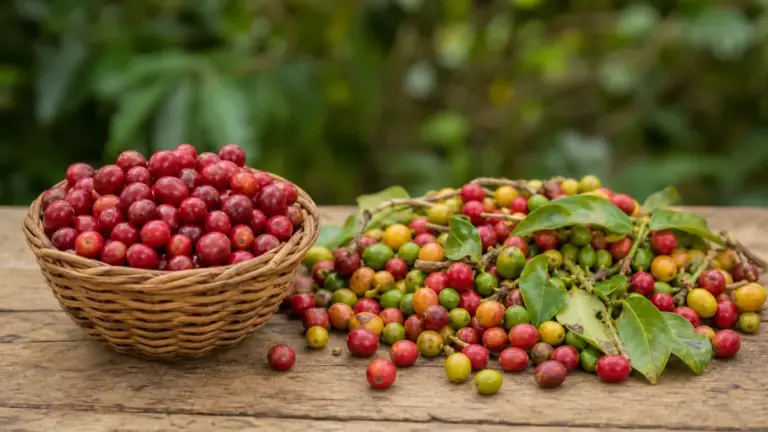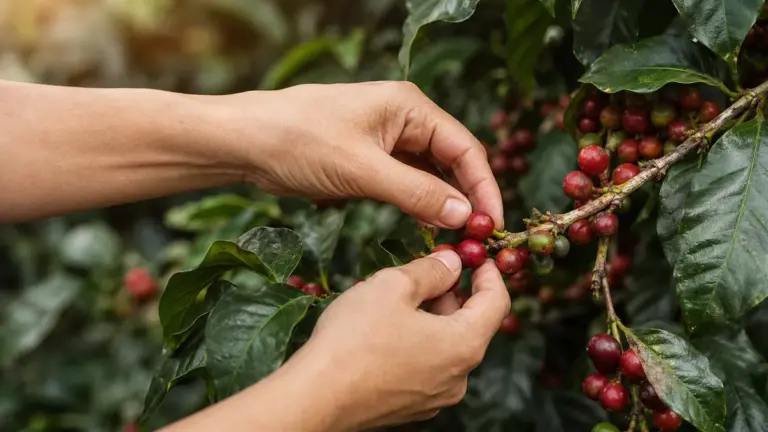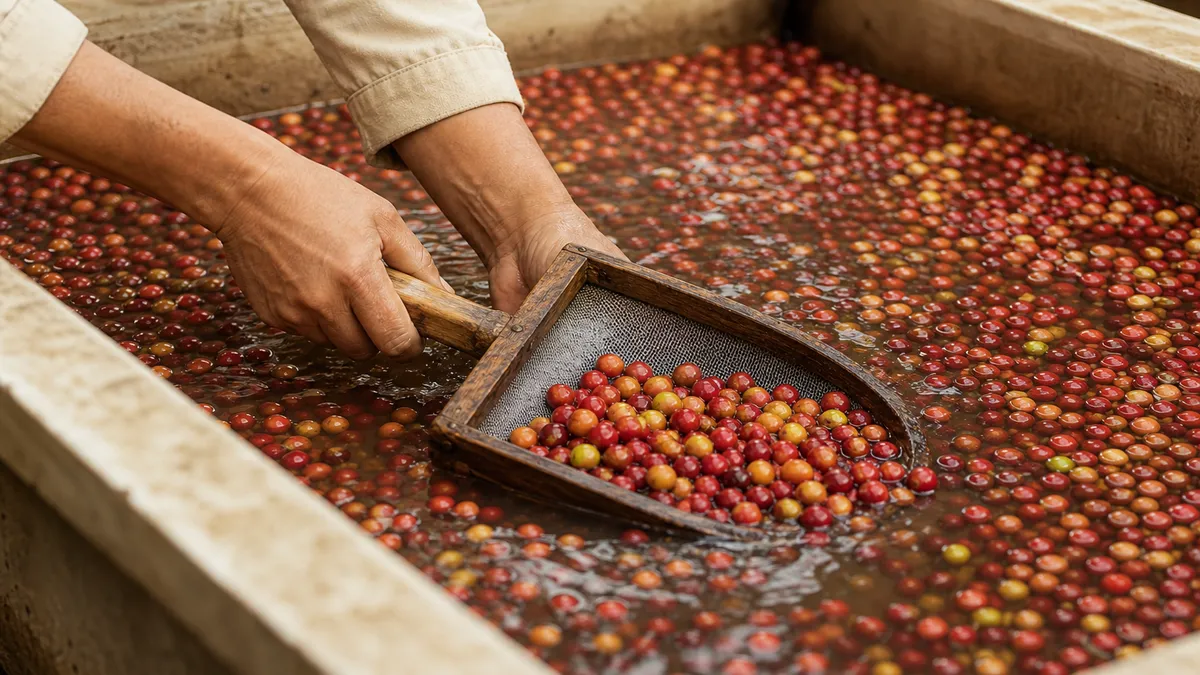
Coffee cherry sorting and floating separate harvested fruit before it moves into processing: people or optical machines check its appearance, while water flotation separates cherries by density. Floating is a preliminary quality-control step, not a definitive test: floaters need further inspection, and sinking does not guarantee that a cherry is ripe or free from defects.
In short
- Hand sorting checks ripeness, visible damage and foreign material.
- Floaters can include dried, poorly filled and insect-damaged cherries, alongside light debris.
- Some unripe cherries remain after flotation, so colour sorting still matters.
- Optical sorters apply selected colour and appearance criteria, rather than tasting or inspecting every seed internally.
- Sorting protects the main lot, but careful processing, drying and later quality checks remain essential.
Where sorting fits after harvest
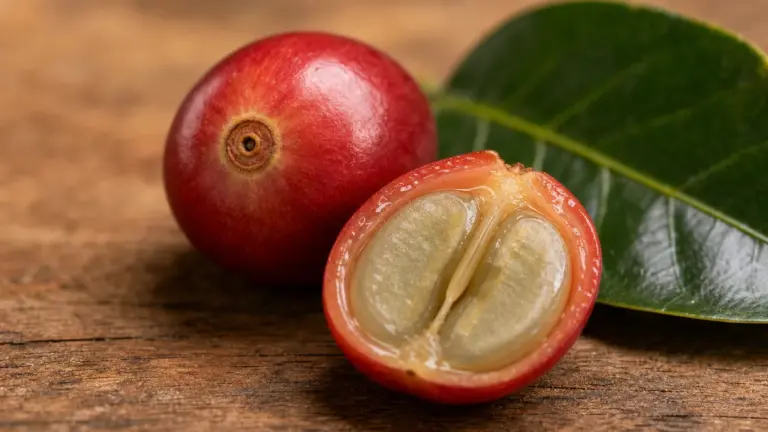
A coffee cherry is the fruit surrounding the seeds we eventually roast as coffee beans. Sorting at this stage therefore examines whole fruit, not the exposed green beans assessed later. Our guide to coffee cherry anatomy explains those layers.
At a receiving point, harvested cherries are inspected and separated before further processing. The immediate jobs are to remove foreign material, identify fruit outside the intended ripeness range and keep questionable material apart from the main lot.
This is one checkpoint within coffee harvesting, not a replacement for careful picking. A well-selected harvest still needs inspection, while sorting cannot reverse deterioration that has already occurred.
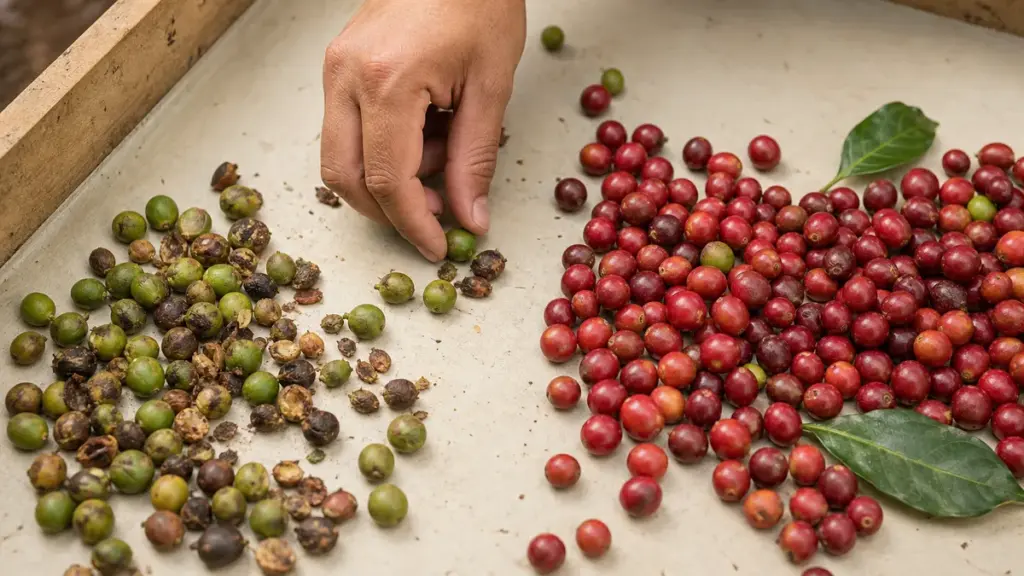
Hand sorting: checking what the eye can see
Workers spread cherries on a clean sheet, table or other suitable sorting surface and remove unwanted material by hand. They look for unripe fruit, visibly damaged or deteriorating cherries, dried fruit and debris.
For a red-fruited coffee, green cherries are an obvious warning that ripeness is uneven. However, “keep the red ones” is not a universal instruction: some coffees ripen yellow. World Coffee Research records both red-fruited and yellow-fruited types of Catuai, for example.
The useful rule is to agree the appropriate ripe appearance for the coffee being handled. A reference sample beside the sorting area helps make that decision explicit, rather than leaving each worker to interpret “ripe” differently.
Hand sorting also provides an opportunity to notice a problem with incoming deliveries. If a batch repeatedly contains substantial immature or damaged fruit, record it and investigate the harvest rather than simply treating the sorting table as the permanent remedy.
Its limitation is straightforward: visual inspection mainly assesses the outside. An apparently sound skin does not prove that the seeds inside are sound.
How flotation tanks separate coffee cherries
Flotation uses the difference between a cherry’s overall density and that of water. Fruit that is less dense than the water floats; denser material sinks.
In a simple batch arrangement, cherries enter a water-filled container and the floating fraction is removed from the surface. Larger hydraulic separators can move sinking cherries onwards through a siphon or a screw conveyor, while separating lighter material.
Cenicafé, Colombia’s national coffee research centre, identifies dried, empty or poorly filled, and insect-damaged fruit among the low-density material encountered in hydraulic separation. Leaves and small pieces of wood may float too.
What a floater actually tells you
“Floater” describes behaviour in water, not one particular defect. A floating cherry might be dried, have poorly developed seeds or contain insect damage. Those are different conditions, so the floating fraction needs inspection rather than a single assumed diagnosis.
Conversely, flotation does not remove every immature cherry. In a Cenicafé equipment study, researchers first removed floaters hydraulically, then manually removed green cherries from the remaining material. That sequence demonstrates why sinking and ripeness must not be treated as equivalent.
The same caution applies to foreign material. Stones and metal can sink, so skimming the surface alone does not make a batch clean. Purpose-designed hydraulic equipment may include a separate trap for heavy objects.
Read the tank as a separation tool, not a verdict on the cup. It identifies material worth separating and examining; it does not measure flavour.
A practical sorting and floating sequence
The following is an illustrative reception workflow, not a fixed specification for every farm or mill. Equipment, incoming fruit and the intended processing method determine the detailed procedure.
- Inspect the delivery. Look at ripeness, visible deterioration and foreign material before mixing it with accepted fruit. Keep the batch identifiable.
- Sort visually. Remove obvious unwanted cherries and debris on a clean surface, using the correct ripe colour for the coffee.
- Float where the process includes it. Use clean water and suitable equipment. Separate surface floaters from sinking fruit rather than sending both fractions onwards together.
- Inspect both fractions. Examine what floated, then check the sinking cherries for remaining immature or visibly damaged fruit. Do not assume either fraction is uniform.
- Keep separated material separate. Record its identity and intended handling. Material retained for another grade needs its own controlled processing, not an unnoticed return to the main lot.
- Continue promptly. Sorting should lead into the planned processing or drying route, rather than create a new holding delay.
Cleanliness matters throughout. Codex guidance calls for clean processing water, while TechnoServe’s washing-station guidance emphasises clean handling and separation of floating cherries. Reusing water is an operational decision requiring control of its cleanliness, not permission to keep using visibly contaminated water.
There is no universal flotation duration in this workflow. A brief separation operation should not be confused with a deliberately designed soaking or fermentation stage.
What optical sorting adds
Optical sorting automates decisions based on detectable appearance. Cherries are presented to an illuminated inspection system, which classifies them against selected acceptance criteria and separates material accordingly.
Manufacturers publish different capabilities. WECO describes full-colour analysis for coffee cherries, including separation of differently coloured and shrivelled fruit. WESORT describes a belt-fed cherry sorter using front and rear cameras to assess visible colour, shape and surface condition. These are manufacturer-described functions, not independent evidence of cup improvement.
The attraction is repeatable application of a chosen visual rule. The limitation is that the rule must be appropriate. A setting intended to reject yellow fruit from a red-fruited lot would be unsuitable for a yellow-fruited coffee.
| Method | Main basis of separation | Useful for | Main limitation |
|---|---|---|---|
| Hand sorting | Visible appearance and human judgement | Ripeness checks, visible damage and debris | Cannot reliably reveal hidden internal defects |
| Flotation | Density relative to water | Separating low-density fruit and light debris | Sinking does not establish ripeness or cup quality |
| Optical sorting | Selected colour and surface signals | Automated separation of appearance categories | Results depend on settings and presentation |
For optical equipment, ask to inspect both accepted and rejected samples. WESORT itself identifies variety, colour boundaries, feeding stability, moisture and contamination as influences on the result. A machine’s presence is less informative than evidence that its settings suit the incoming coffee.
Why defects matter in the cup
Sorting aims to reduce the chance that unsuitable fruit contributes unpleasant flavours or undermines the consistency of the lot. The relationship is real, but it is not a simple rule that every rejected cherry produces the same taste.
Immature fruit is one concern. Cenicafé’s ripening research found lower cup quality from green fruit than from the more developed stages examined. The associated physical and chemical changes mean ripeness is more than a cosmetic difference in skin colour.
Deterioration is another concern. Cenicafé’s quality-risk guidance links failures in cherry reception, cleanliness and processing control with defects described as fermented, vinegary, dirty or otherwise tainted. These descriptions concern faults, not simply the desirable acidity or fruit character of a well-processed coffee.
Importantly, darker or more mature fruit is not automatically defective. In a study of the Colombia variety, Cenicafé obtained its best-rated cups from turning, ripe and overripe stages, while green and tree-dried fruit rated poorly. This was a specific study, not a universal acceptance rule, but it cautions against equating every overripe cherry with rot.
Sorting therefore needs a defined purpose: exclude deterioration and unsuitable material while selecting the ripeness range intended for that lot. Water behaviour alone cannot make that judgement.
How to judge the quality control behind a lot
For a buyer, “hand sorted”, “floated” or “optically sorted” describes an operation. It does not, by itself, establish how carefully that operation was performed or how the finished coffee tastes.
Ask what was separated, how the accepted fruit was checked and what happened to the rejected fraction. These questions reveal more than a list of machines.
Check the process after the sorting point
Flotation can precede more than one processing route. Natural coffee is dried within the fruit, while wet processing removes the pulp before drying. Early sorting does not remove the need to manage those later operations properly.
FAO guidance describes additional separation after pulping, and TechnoServe’s guidance includes further opportunities to remove visible defects during processing. Quality control is a sequence of checks, not one successful pass through a tank.
For the wider route from fruit to dried coffee, see picking and processing.
Keep physical grading and sensory assessment distinct
Later examination concerns the dried seeds rather than whole cherries. Our guide to green coffee grading covers that separate stage.
The sensible assessment combines processing records, examination of the resulting beans and tasting. For a useful comparison, request separately identified samples handled through comparable downstream conditions, rather than assuming a difference in flotation status explains every difference in flavour.
Coffee cherry sorting and floating are most useful when their limits are understood: each check removes particular risks, and the next check tests what remains.
FAQ
Does floating cherries make a natural coffee a washed coffee?
No. An initial water separation does not by itself make a coffee washed. Natural processing dries the whole cherry, whereas wet processing removes the pulp before drying the seeds. A producer can therefore float cherries to separate material and then continue with a natural processing route.
Must all floaters be thrown away?
Not necessarily, but they should not automatically return to the main lot. TechnoServe’s guidance calls for floating coffee to be prepared separately, and Codex requires specific controls for secondary coffee. Inspection and subsequent quality and safety assessment determine whether material is suitable for another use or must be rejected.
Should a UK buyer ask for the percentage of floaters removed?
It can be a useful question, provided the figure is explained. Ask whether the percentage was measured by count or mass, which batch it describes and what the separated material contained. Treat it as process information, not a quality score: it does not replace assessment of the finished coffee.
Where to go next
Start with Coffee Harvesting for the wider sequence, then read Picking and Processing to follow the fruit into its processing route. Coffee Cherry Anatomy explains what is being inspected, while Green Coffee Grading, Screen Sizes and Defects covers the later checks on dried beans.
Sources
- S1. TechnoServe, Quality and Sustainability Guidelines for Coffee Washing Stations, Rwanda Ikawa Nziza Cyane project, September 2023. Reception, initial sorting, flotation and separate handling.
URL: https://www.technoserve.org/wp-content/uploads/2024/08/EN_Rwanda-INC_Minimum-Quality-and-Sustainbility-Guidelines.pdf - S2. Cenicafé, Oliveros-Tascón and colleagues, Separador hidráulico de tolva y tornillo sinfín, Avances Técnicos 360, June 2007. Hydraulic separation, low-density fruit and heavy-object traps.
URL: https://biblioteca.cenicafe.org/jspui/bitstream/10778/4252/1/avt0360.pdf - S3. Cenicafé, Oliveros-Tascón and colleagues, Separación de frutos de café verdes por medios mecánicos, Cenicafé 61(3), 262 to 271, 2010. Experimental preparation showing green cherries remaining after floater removal.
URL: - S4. World Coffee Research, Arabica Varieties Catalogue: Catuai, undated live entry, checked November 2026. Red-fruited and yellow-fruited types.
URL: https://varieties.worldcoffeeresearch.org/varieties/catuai - S5. WECO, Coffee Cherry Sorting, undated manufacturer page, checked November 2026. Manufacturer-described colour-sorting functions.
URL: https://www.wecotek.com/equipment/coffee-cherry-sorting/ - S6. WESORT, AI Coffee Cherry Color Sorter Machine, undated manufacturer page, checked November 2026. Camera arrangement, visible inspection criteria and operational limitations.
URL: https://www.wesortcolorsorter.com/product/coffee-cherry-color-sorter - S7. Cenicafé, Marín-López and colleagues, Cambios físicos y químicos durante la maduración del fruto de café Coffea arabica L. var. Colombia, Cenicafé 54(3), 208 to 225, 2003. Experimental ripening and cup-quality findings.
URL: https://biblioteca.cenicafe.org/handle/10778/265 - S8. Cenicafé, Puerta-Quintero, Riesgos para la calidad por la comercialización de café pergamino húmedo, Avances Técnicos 373, July 2008. Reception, hygiene and processing risks affecting flavour.
URL: https://www.cenicafe.org/es/publications/avt0373.pdf - S9. Codex Alimentarius Commission, FAO/WHO, Code of Practice for the Prevention and Reduction of Ochratoxin A Contamination in Coffee, CXC 69-2009, adopted 2009; retrieved edition labelled CAC/RCP 69-2009. Flotation definition, clean water and secondary-coffee controls.
URL: https://www.fao.org/input/download/standards/11250/CXP_069e.pdf - S10. Australian Centre for International Agricultural Research, Curry, Tilden and Aroga, Smallholder Coffee Production: Farmer Training Guide, Unit 3, Module 1: Coffee Harvesting and Processing, Monograph 220, 2025. Harvest inspection and sorting context.
URL: https://www.aciar.gov.au/sites/default/files/2025-04/FTG_Unit3-M1-PDF_harvest-%26-process.pdf - S11. FAO, Quality and Safety Improvement through Prevention of Mould Formation in Coffee: Introduction, 2000. Cherry anatomy, processing routes and subsequent separation.
URL: https://www.fao.org/4/x6939e/X6939e01.htm
This article was researched from national coffee research publications, agricultural training guidance, Codex recommendations and manufacturers’ descriptions, distinguishing experimental findings from equipment claims and practical interpretation.
Last checked: November 2026