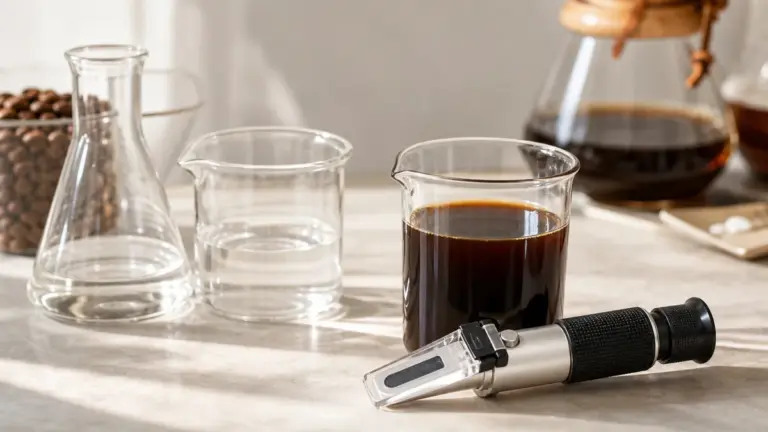
Recent coffee research is improving our understanding of health associations, crop genetics and the physics of brewing, but these fields answer different questions. As checked in November 2026, promising health findings still need careful interpretation, while genomic and extraction studies are producing more specific explanations of how coffee plants and brewing systems work.
In short
- An association is not a treatment recommendation. Observational coffee studies cannot, by themselves, establish that coffee prevents disease.
- Recent reviews do not all agree. Two cardiovascular reviews published in 2026 reached different conclusions about coffee and heart failure, using different comparisons.
- Excelsa classification has changed. A 2025 genomic study supported recognising Coffea dewevrei separately from Coffea liberica.
- Brewing research is becoming more structural. A 2026 study used three-dimensional imaging and fluid simulations to investigate water flow through packed grounds.
- Check the evidence behind the headline. Study design, uncertainty and relevance matter more than an impressive participant count alone.
Recent Scientific Discoveries
The useful question is not simply “What is new?” It is “What does this finding allow us to understand more reliably?” This selection covers research published in 2025 and 2026, rather than attempting to catalogue every coffee paper.
For the broader framework, start with coffee and science. Here, the emphasis is on dated findings, their limitations and what deserves watching next.
August 2025: genomic evidence separates excelsa from liberica
Davis and colleagues published research in Nature Plants supporting three distinct species within coffee previously grouped under a broad interpretation of liberica: Coffea liberica, Coffea dewevrei, commonly called excelsa, and Coffea klainei. Their analysis brought together genomic evidence, plant characteristics and geographical information.
This article follows that treatment. Older references may still call excelsa Coffea liberica var. dewevrei. The distinction matters because grouping different species can conceal useful differences when researchers assess breeding material and climate adaptation. However, the authors explicitly call for field trials: a plant’s natural distribution does not establish its performance on farms elsewhere.
2026: breeding priorities move beyond finding a promising gene
World Coffee Research’s Coffee Research Priorities to Support Breeding and Variety Development, 2026 identifies disease resistance, climate resilience and improved screening methods as priorities. It calls for genetic markers, recognisable stretches of DNA associated with useful traits, and better assessment of plants under combined stresses such as heat, drought and disease pressure.
This is a research agenda, not evidence that a finished, universally resilient variety has arrived. Its value is in identifying what breeders still need to establish. A useful question for future announcements is therefore: has the plant merely been identified as promising, or has its performance been evaluated under the conditions in which farmers would grow it?
April 2026: seeing the spaces through which espresso water moves
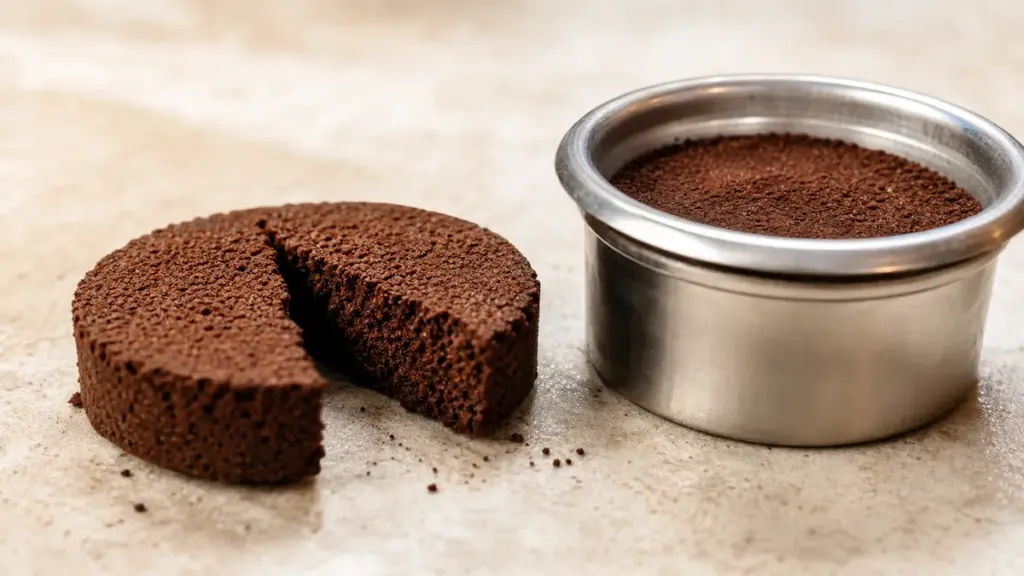
Wadsworth and colleagues published a model of coffee-puck permeability in Royal Society Open Science. Permeability means how readily water passes through the packed bed of grounds. They tested theoretical predictions against fluid-flow simulations using three-dimensional structures obtained by X-ray imaging of real packed coffee.
The model connects flow with the connected spaces between particles and the surface area exposed to liquid. It helps explain why grind and packing must be considered together. It is not a universal recipe for better-tasting espresso: agreement between a structural model and simulated flow is different from demonstrating consumer preference.
For the underlying compounds rather than this research update, see coffee chemistry.
Studies on Coffee Health Benefits
Health research requires particular care because an encouraging result can quickly become an instruction to drink more coffee. The reviews below illustrate why the evidence needs to be read with its qualifications intact.
March 2026: a possible heart-failure association, with low certainty
A systematic review in the Journal of Health, Population and Nutrition reported that moderate coffee consumption was associated with a lower rate of newly diagnosed heart failure. Its main pooled comparison used seven independent cohorts, groups followed over time, and defined moderate intake as 2 to 4 cups daily.
The reported hazard ratio was 0.925, with a 95% confidence interval of 0.882 to 0.971. This is a relative measure over follow-up, not a reduction of 7.5 percentage points in an individual’s risk. Crucially, the authors rated the evidence low certainty and did not consider it grounds for changing clinical recommendations. The cup category is not a prescribed dose.
May 2026: a broader review gives a different answer
A review in BMC Cardiovascular Disorders found no clear association with heart failure when comparing the highest and lowest coffee-consumption categories. It also reported differing findings across cardiovascular outcomes, rather than a uniformly beneficial pattern.
The two reviews do not make identical comparisons: moderate intake versus low or no intake is not the same question as highest versus lowest intake. Our interpretation is that these results should not be collapsed into a single “coffee protects the heart” message. The disagreement is a reason to examine methods and exposure categories, not choose whichever headline is more appealing.
October 2026: randomised caffeine evidence adds a caution
A review published in Frontiers in Nutrition on 29 October 2026 combined 15 randomised controlled trials involving 668 participants. It found no clear overall improvement in depressive symptoms; anxiety scores were higher on average after caffeine exposure, but results varied substantially and certainty was rated very low for both outcomes.
This concerns caffeine administered through different preparations, not simply habitual coffee drinking. Most trials assessed relatively short-term exposure. It neither establishes coffee as a depression treatment nor shows that everyone will experience the same anxiety response. Randomisation improves a study’s ability to investigate causation, but does not remove problems caused by small, varied or imperfect trials.
What should readers do with these findings?
Do not start drinking coffee, or increase your intake, solely to pursue an observational health benefit. That is an editorial recommendation based on the uncertainty above, rather than a claim that coffee has no potential benefits.
Keep caffeine guidance separate from benefit claims. EFSA’s 2015 assessment found no safety concerns for healthy, non-pregnant adults at habitual intakes up to 400 mg daily, spread through the day, or single doses up to 200 mg. These are population benchmarks, not targets; 100 mg near bedtime can affect sleep in some adults.
The NHS advises no more than 200 mg daily from all sources during pregnancy. For advice involving symptoms, medicines, existing conditions or pregnancy, speak to a GP, pharmacist or midwife rather than applying a population study to yourself.
How to Read Coffee Research and Studies
Begin with the question the researchers actually investigated. “Coffee and health” is too broad: a study might examine caffeine exposure, diagnosed disease, a short-term symptom score or water movement through grounds. Those outcomes cannot substitute for one another.
A systematic review uses an explicit approach to finding and assessing research. A meta-analysis statistically combines compatible results. Neither term guarantees a reliable answer: the quality and relevance of the included evidence still matter.
A practical reading checklist
Use this table before sharing a striking claim or changing a habit.
| Check | What to look for | Why it matters |
|---|---|---|
| Actual exposure | Coffee, isolated caffeine, decaf or another preparation | Findings may not transfer between them |
| Study design | Observation, randomised intervention or laboratory experiment | Different designs answer different questions |
| Comparison | Moderate versus none, or highest versus lowest | Different comparisons can produce different conclusions |
| Outcome | Disease, symptoms, chemical measurement or flow | A useful measurement is not automatically a health or taste benefit |
| Certainty | Bias assessment, confidence intervals and consistency | A precise-looking estimate can still have important limitations |
This checklist draws on the distinctions in the selected studies and established guidance on interpreting evidence.
Next, look for confounding: another factor that can distort the relationship being studied. Researchers may adjust for measured differences between groups, but a coffee association can remain uncertain if relevant differences were missed or measured poorly.
Read the confidence interval alongside the central estimate. It describes uncertainty around that estimate; it should not be replaced by a simple “works” or “does not work” label. Cochrane specifically advises against relying on statistical-significance thresholds alone.
Finally, check funding, declared interests and the authors’ own limitations. Treat these as prompts for scrutiny, not shortcuts to accepting or rejecting a paper. Ask whether the conclusion stays within the evidence, especially when a proposed mechanism is presented as though a practical benefit has already been demonstrated.
Keep chemistry and sensory conclusions separate
For brewing research, ask what was actually measured. A study of flow can explain the extraction system without deciding which drink people prefer. Likewise, a paper’s chemical measurements need to be distinguished from evidence about perceived aroma or flavour. Read the science of coffee aroma and flavour for that separate ground.
Keeping This Research Guide Current
This is a selected research briefing, not a clinical guideline or an exhaustive systematic review. Its update policy is to prioritise findings that change an explanation, challenge an earlier conclusion or improve the quality of available evidence.
At each review, the editorial checks should include publication dates, corrections or retractions, newer evidence syntheses and current official caffeine advice. An update should record whether a finding has been strengthened, weakened or remains unresolved, rather than merely adding another recent paper.
Next scheduled review: November 2027, or sooner if relevant guidance changes or a cited paper is corrected. For readers following coffee research and studies between updates, the most useful habit is to retain the date and the qualification alongside the finding.
FAQ
Does decaffeinated coffee have the same potential health benefits?
It is not established that decaf reproduces every association reported for caffeinated coffee. The March 2026 heart-failure review described similar associations within cohorts for caffeinated and decaffeinated coffee, but this was not proof that either prevents disease. Check whether a paper actually analysed decaf separately before extending its conclusion to it.
Is a very large study automatically convincing?
No. Large samples can improve precision, but they do not automatically remove bias, confounding or poorly measured exposure. A narrow confidence interval can surround an estimate that still has methodological limitations. Study design, relevance and certainty assessment should therefore accompany the participant count when judging how much confidence to place in a result.
Can a preprint be treated like a published research paper?
Not without distinguishing its status. A preprint should be labelled as such rather than presented as peer-reviewed evidence. For this guide, the editorial policy is to prioritise peer-reviewed papers and official guidance, then check for corrections and later versions at review. Publication status is one check, not a complete quality assessment.
Where to go next
Read Coffee and Science for the wider subject map, then Coffee Chemistry for the compounds behind brewing research. The Science of Coffee Aroma and Flavour is the next read when you want to connect chemical investigation with sensory experience.
Sources
-
Springer Nature, Journal of Health, Population and Nutrition. Biswas and colleagues, Habitual coffee consumption and risk of incident heart failure: an updated systematic review and dose-response meta-analysis of prospective cohort studies, 17 March 2026.
https://link.springer.com/article/10.1186/s41043-026-01295-w -
Springer Nature, BMC Cardiovascular Disorders. Shaban and colleagues, Coffee, caffeine, and cardiovascular health: navigating risks and benefits, an updated systematic review and meta-analysis, 7 May 2026. Title punctuation normalised.
https://link.springer.com/article/10.1186/s12872-026-05693-0 -
Frontiers in Nutrition. Zhang and colleagues, Effects of caffeine intake on depressive and anxiety symptoms: a systematic review and meta-analysis of randomized controlled trials, 29 October 2026.
https://www.frontiersin.org/journals/nutrition/articles/10.3389/fnut.2026.1950050/full -
Nature Plants. Davis and colleagues, Genomic data define species delimitation in Liberica coffee with implications for crop development and conservation, 8 August 2025.
https://www.nature.com/articles/s41477-025-02073-y.pdf -
World Coffee Research. Coffee Research Priorities to Support Breeding and Variety Development, 2026, 2026.
https://worldcoffeeresearch.org/index.php/actions/wcr/downloads/download?assetUid=4ac51b63-742d-4226-9105-90e4b1d016d1 -
Royal Society Open Science. Wadsworth and colleagues, A model for the permeability of coffee pucks validated using X-ray computed micro-tomography, 2026, volume 13, article 252031. Author manuscript retrieved from the University of Strathclyde repository.
https://strathprints.strath.ac.uk/95930/1/Wadsworth-etal-RSOS-2026-A-model-for-the-permeability-of-coffee-pucks-validated.pdf -
European Food Safety Authority. Caffeine, current topic page explaining the 2015 scientific assessment, retrieved November 2026.
https://www.efsa.europa.eu/en/topics/topic/caffeine -
NHS. Foods to avoid in pregnancy, current guidance retrieved November 2026.
https://www.nhs.uk/pregnancy/keeping-well/foods-to-avoid/ -
Cochrane. Cochrane Handbook for Systematic Reviews of Interventions, version 6.5, 2024, Chapter 15, Interpreting results and drawing conclusions, chapter updated August 2023.
https://www.cochrane.org/authors/handbooks-and-manuals/handbook/current/chapter-15 -
National Institute for Health and Care Research. NIHR Evidence Glossary, undated, current version retrieved November 2026.
https://evidence.nihr.ac.uk/glossary/
Research combined live searches of recent peer-reviewed studies, retrieved research papers and current official guidance, with observational associations kept separate from causal conclusions.
Last checked: November 2026