Coffee contains organic acids, natural oils and sugars that roasting and brewing transform into the drink’s brightness, texture and flavour. Citric and malic acids help explain its acidity, oils form part of its physical structure, and sugars are important roasting ingredients, but a sweet-tasting coffee does not necessarily contain much sugar.
In short
- Chlorogenic acids are a family of compounds, not a single ingredient that simply makes coffee sour.
- Roasting changes the acid balance: some acids decline while others form or become more abundant.
- Arabica generally contains more oil than robusta, but bean composition alone cannot predict smoothness or crema stability.
- Caramelisation and the Maillard reaction are different processes, both involving sugars during roasting.
- Paper filtration retains much of coffee’s oil-associated material. A metal mesh is not an equivalent filter.
What coffee acids, oils and sugars actually do
Think of these compounds as overlapping contributors rather than separate controls marked “brightness”, “body” and “sweetness”. Roasting changes their chemistry, brewing determines what reaches the cup, and our senses interpret the resulting mixture.
Acids can contribute sourness, but some also act as precursors to bitter compounds. Oils occur as tiny dispersed droplets in espresso, while sugars help generate acids, aromas and brown roasting products.
| Compound or group | What happens during roasting and brewing | What it helps explain |
|---|---|---|
| Citric and malic acids | Already present in green beans; generally decline with greater roast development | Part of coffee’s acidity, without providing a complete explanation of fruity flavour |
| Chlorogenic acids | Undergo several reactions, including breakdown and lactone formation | Changes in bitterness and other sensory properties |
| Quinic acid | Can increase as chlorogenic acids break down | A changing acid balance, not simply “more brightness” |
| Oils and other lipids | Some enter the brew as dispersed material; filtration affects their passage | Oiliness, emulsion structure and interactions with foam |
| Sugars | Much is consumed or transformed during roasting | Precursors to flavour, rather than a reliable measure of brewed sweetness |
This article concentrates on those relationships. For the wider picture, including other bean constituents and extraction, start with coffee chemistry.
Organic acids: brightness is not a single ingredient
“Acidity” has several meanings. A chemist can measure pH, which describes hydrogen-ion activity, while a taster describes the intensity and character of sourness. Those measurements and perceptions are related, but they are not interchangeable.
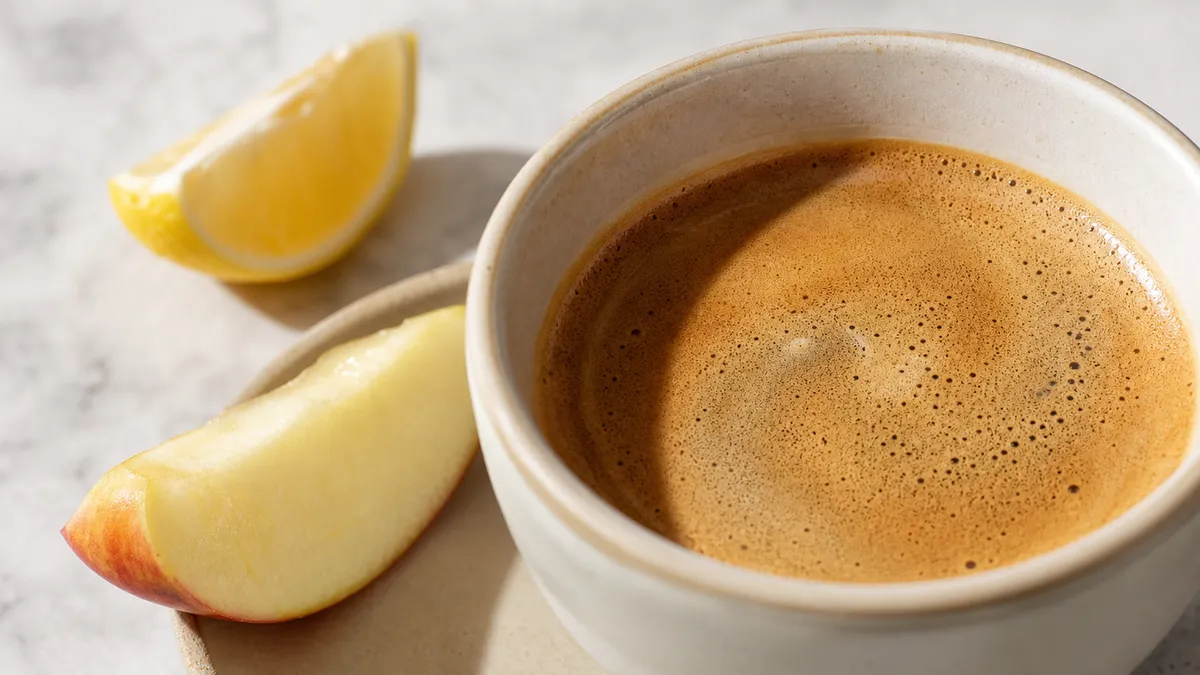
A lively coffee might suggest lemon or apple without tasting like either fruit’s juice. Its acids are being experienced alongside aromas, bitterness and other dissolved compounds.
Citric and malic acids
Citric and malic acids are present before roasting. Lemon-like and apple-like are useful sensory comparisons, but they should not become a chemical diagnosis of the cup.
In a controlled study of brewed specialty coffees, increasing roast degree reduced both acids. However, sensory tests found that individual acids were not necessarily detectable at their naturally occurring concentrations, and coffee experts could not reliably identify the acids added to the brew.
The practical lesson is modest but useful: a tasting note cannot tell you how much of a particular acid your coffee contains. “Apple acidity” is a description of an experience, not a laboratory result.
Chlorogenic acids are a family
The plural matters. Chlorogenic acids include several related compounds, notably caffeoylquinic acids, in which caffeic acid and quinic acid are chemically joined.
Their sensory role cannot be reduced to sourness. During roasting they undergo several competing transformations, changing both their concentration and the compounds derived from them.
Cleavage of caffeoylquinic acids can release quinic acid and caffeic acid. However, “darker roast means more of both” is too simple: the products can react further. A study comparing roast levels found more quinic acid in darker-roasted beverages, but more caffeic acid in the lighter-roasted ones.
Quinic acid, bitterness and astringency
Quinic acid is already present in green coffee and can also arise through chlorogenic-acid breakdown. Its increasing concentration does not mean that dark coffee must taste brighter or more sharply sour.
Nor should all dark-roast bitterness or mouth-drying astringency be assigned to quinic and caffeic acids. Controlled roasting research identified bitter chlorogenic-acid lactones, also called quinides, and harsher bitter products formed under more severe roasting conditions.
These pathways help explain why acidity can become less prominent while bitterness changes character. They do not support a simple chain of “chlorogenic acid breaks down, therefore quinic acid causes every unpleasant taste”.
Coffee oils: more than a shiny surface
Coffee oil belongs to a broader group called lipids, which includes fats and related compounds. Much of the oil consists of triacylglycerols, the same broad class of molecules that makes up many familiar food oils.
Coffee’s lipid fraction also contains compounds such as cafestol and kahweol, known as diterpenes. These are chemically distinct from the main fats, even though they occur within coffee’s oil-associated material.
Does arabica contain more oil than robusta?
Generally, yes. A lipid-characterisation paper reports commonly cited green-bean contents of approximately 15 to 17% of dry weight for arabica, compared with 7 to 10% for robusta.
The often-repeated claim that arabica contains “about 60% more oil” is an illustrative comparison, not a fixed species rule. Comparing 16% with 10% gives:
Relative difference = (16 − 10) ÷ 10 × 100 = 60%.
Those figures concern dry green beans, not the percentage of oil in your drink. Brewing and filtration intervene between bean composition and cup composition.
Does more oil mean a smoother drink?
Oil droplets are part of espresso’s structure, but “more oil equals smoother coffee” is not a dependable prediction. Concentration, suspended particles and other extracted material also matter.
Laboratory research into espresso’s foam-forming material demonstrates interactions involving polysaccharides, protein-like material, brown roasting products and lipids. Treat body as a property of the whole beverage, not a direct reading of the bean’s fat content.
Crema is foam, not a floating layer of oil
Crema is the foam on an espresso, rather than a cap of pure coffee oil. The drink underneath contains an emulsion, meaning tiny oil droplets dispersed through a water-based liquid.
Roasting generates carbon dioxide that remains within the beans and is released during brewing. That gas is central to crema formation. Coffee-derived surface-active material helps form the films around bubbles.
Experimental work with isolated coffee fractions found that polysaccharides influenced film formation, while the protein and melanoidin fraction produced particularly strong elastic properties at the interface. Melanoidins are a complex group of brown products associated with roasting reactions.
Does robusta make longer-lasting crema?
It can produce more crema, but greater volume and greater stability are different findings.
One controlled brewing study found that robusta produced a larger crema volume, whereas arabica produced more stable crema under the tested conditions. Basket size and freshness also affected the results.
This conflicts with the blanket explanation that robusta’s lower lipid content necessarily creates stiffer, longer-lasting bubbles. Oils can affect foam, but the outcome depends on how they interact with the rest of the system. The study does not establish that arabica always wins either.
Use crema as something to observe, not as a substitute for tasting. Its volume alone cannot establish which coffee you will prefer.
Sugars: green beans, roasting and perceived sweetness
Three different questions often get bundled together: how much sugar the raw bean contains, what happens to it during roasting, and why the finished drink tastes sweet.
Sugars in green coffee
Sucrose is a major soluble sugar in green coffee, with smaller amounts of other sugars also present. It is part of the raw material from which roasting develops flavour.
That starting composition matters, but it does not pass unchanged into the cup. A green-bean sugar measurement is not a measurement of sweetness in brewed coffee.
Caramelisation is not the Maillard reaction
Caramelisation is the heat-driven transformation of sugars. The Maillard reaction involves reducing sugars reacting with amino compounds, including those derived from amino acids.
During roasting, sucrose can break down into glucose and fructose. Sugar-derived compounds then participate in further reactions that generate flavour substances, acids and brown material.
Both processes belong in an explanation of roasted coffee, but they are not interchangeable names for browning. Nor does a darker bean simply contain more sweet caramel: continued roasting consumes and transforms sugars.
Controlled roast-profile research found that changing development time shifted perceived sweetness and other sensory characteristics. That is evidence that the roasting process changes the experience, not proof that sweeter coffee contains more residual sugar.
Why unsweetened coffee can taste sweet
The amount of sugar remaining in brewed coffee is often too low to explain its perceived sweetness through sugar taste alone.
Research reported by the Specialty Coffee Association found that blocking aroma with nose clips reduced sweetness ratings but did not eliminate all differences between coffees. Measured sugars were below established detection thresholds in the samples tested.
This supports a combined explanation involving aroma and non-volatile compounds, rather than aroma alone or sugar alone. The complete mechanism remains unresolved. For the distinction between smell and taste, see aroma and flavour science.
Filters change which material reaches the cup
A paper filter does more than stop visible grounds. It retains much of the oil-associated material that would otherwise enter the drink.
A metal mesh separates grounds differently and should not be assumed to remove the same compounds. Controlled studies comparing unfiltered coffee with the same coffee passed through paper demonstrate that filtration can substantially change the passage of lipid-soluble material.
This also explains a specific health distinction. Randomised trials found higher blood cholesterol during consumption of unfiltered boiled or cafetière coffee than during consumption of paper-filtered coffee. Separate experiments implicate cafestol particularly strongly.
These are controlled intervention findings, not merely observational associations. They do not establish a universal safe quantity of unfiltered coffee or predict an individual’s response. If you are managing raised cholesterol, discuss your usual coffee preparation with your GP or another clinician.
For a practical comparison, split one cafetière brew and pass one portion through a suitable paper coffee filter. Taste both at a similar temperature, noting surface appearance, texture and sediment. This is a demonstration of filtration’s combined effects, not an experiment that isolates oil alone.
Reading the chemistry without over-reading the cup
The most useful distinction is between composition, transformation and perception.
Composition describes what a bean or beverage contains. Transformation describes what roasting and brewing do to that material. Perception describes what a person notices.
A percentage measured in dry beans cannot be transferred directly to a brewed drink. Likewise, detecting a compound analytically does not prove that it exceeds its sensory threshold, the concentration at which people can notice it in that particular mixture.
When comparing research, check whether the sample was green coffee, roasted grounds, a laboratory extract or a drink. Then check the roast, brewing method and measurement basis before treating two results as contradictory.
Use sensory science and the flavour wheel to describe the cup precisely. Coffee acids, oils and sugars explain important parts of that experience, but none provides a complete tasting verdict on its own.
FAQ
Does paper filtration remove coffee’s acidity?
Paper filtration does not make coffee acid-free. Dissolved acids can remain in the liquid while the paper retains other material, including much oil-associated material. Its effect is therefore different from chemically neutralising acids. A filtered coffee can still taste bright, and its sensory character cannot be predicted from oil removal alone.
Does a caramel tasting note mean sugar has been added?
No, a caramel tasting note does not establish that sugar has been added. Sugar transformations during roasting help generate flavour compounds, while aroma contributes to perceived sweetness. The description concerns the sensory impression of the drink. It is not a declaration of ingredients or a measurement of its residual sugar.
Are coffee oils and coffee aromas the same thing?
No, coffee oils and aromas are different, although they interact. Oils are part of the lipid fraction and may occur as dispersed droplets in the beverage. Aroma depends on volatile compounds that can reach the nose. Calling all flavour “the oils” overlooks both those volatile compounds and the dissolved substances responsible for taste.
Where to go next
Read Coffee Chemistry for the wider network of bean constituents and reactions, then The Science of Coffee Aroma and Flavour for how smell and taste combine. Coffee Sensory Science and the Flavour Wheel helps turn those impressions into clear descriptions, while the coffee science hub provides the broader reading route.
Sources
-
University of Southern Denmark, Rune and colleagues. Acids in brewed coffees: Chemical composition and sensory threshold. Current Research in Food Science, 2023.
https://pmc.ncbi.nlm.nih.gov/articles/PMC10074501/ -
Foods, primary experimental research. Alterations in pH of Coffee Bean Extract and Properties of Chlorogenic Acid Based on the Roasting Degree, 2024.
https://www.mdpi.com/2304-8158/13/11/1757 -
University of Turku, Ollennu-Chuasam and colleagues. Effect of the Roast Level on Lipophilic and Hydrophilic Compounds in Pot and Filter Coffee Beverages. ACS Food Science & Technology, 2025.
https://pubs.acs.org/doi/10.1021/acsfoodscitech.5c00066 -
Technical University of Munich, Blumberg, Frank and Hofmann. Quantitative studies on the influence of the bean roasting parameters and hot water percolation on the concentrations of bitter compounds in coffee brew. Journal of Agricultural and Food Chemistry, 2010.
https://pubmed.ncbi.nlm.nih.gov/20180507/ -
Journal of Food Composition and Analysis, primary lipid-characterisation research. Lipid characterization of arabica and robusta coffee beans by liquid chromatography-ion mobility-mass spectrometry, 2022.
https://www.sciencedirect.com/science/article/pii/S0889157522002058 -
University of Guelph, Wang and colleagues. Investigation of the factors that affect the volume and stability of espresso crema. Food Research International, 2019.
https://pubmed.ncbi.nlm.nih.gov/30716994/ -
Piazza, Gigli and Bulbarello. Interfacial rheology study of espresso coffee foam structure and properties. Journal of Food Engineering, 2008.
https://www.sciencedirect.com/science/article/abs/pii/S0260877407003330 -
Food Chemistry, primary roasting research. Characterizing the formation of process contaminants during coffee roasting by multivariate statistical analysis, 2023.
https://www.sciencedirect.com/science/article/pii/S0308814623012736 -
CoffeeMind and University of Copenhagen, Alstrup and colleagues. The Effect of Roast Development Time Modulations on the Sensory Profile and Chemical Composition of the Coffee Brew as Measured by NMR and DHS-GC-MS. Beverages, 2020.
https://www.mdpi.com/2306-5710/6/4/70/pdf -
Specialty Coffee Association, reporting original Coffee Science Foundation research. How Sweet Coffee Tastes: Towards an Understanding of Coffee Sweetness, 25 Magazine, Issue 22, undated webpage. Preliminary research report, not a substitute for a full peer-reviewed paper.
https://sca.coffee/sca-news/25/issue-22/understanding-coffee-sweetness-324dy?rq=coffee+aromas -
National Public Health Institute, Finland, Ahola, Jauhiainen and Aro. The hypercholesterolaemic factor in boiled coffee is retained by a paper filter. Journal of Internal Medicine, 1991.
https://pubmed.ncbi.nlm.nih.gov/1919421/ -
BMJ, randomised controlled trial. Comparison of effect of cafetiere and filtered coffee on serum concentrations of liver aminotransferases and lipids: six month randomised controlled trial, 1996.
https://www.bmj.com/content/313/7069/1362.full -
American Journal of Clinical Nutrition, randomised crossover study. Separate effects of the coffee diterpenes cafestol and kahweol on serum lipids and liver aminotransferases, 1997.
https://ajcn.nutrition.org/article/S0002-9165%2823%2917604-0/fulltext
The piece was researched through live searches of primary chemistry and sensory studies, controlled filtration trials and an explicitly identified preliminary research report, with conflicting crema findings retained rather than simplified.
Last checked: November 2026