Coffee chemistry explains how compounds already present in green beans are transformed by roasting and transferred into a drink by brewing. More than 1,000 volatile compounds have been reported in roasted coffee, alongside non-volatile substances such as caffeine, chlorogenic acids, oils and brown melanoidins, although that does not mean every coffee contains the same thousand compounds.
In short
- Green-bean percentages describe the bean’s composition, not the concentration in your finished drink.
- Arabica generally contains more oil and sucrose than robusta; robusta generally contains more caffeine.
- Roasting consumes much of the original sucrose and changes chlorogenic acids and trigonelline, while caffeine is comparatively heat-stable.
- Melanoidins are a varied group of brown roasting products, not one substance with a single chemical formula.
- The amount of a compound matters, but so do its sensory threshold and its interactions with other coffee constituents.
Analyzing Coffee’s Chemical Composition
The simplest way to understand coffee is to separate what the green bean contains, what roasting changes, and what brewing extracts. These are different chemical pictures, and confusing them leads to misleading claims about sweetness, caffeine and antioxidants.
Green coffee contains structural carbohydrates, proteins, oils, sugars, acids, alkaloids and minerals. An alkaloid is a nitrogen-containing organic compound; caffeine and trigonelline are important examples in coffee. For the wider scientific context, start with coffee science.
How much of each substance is present?
The following figures are illustrative reference averages reproduced in the International Agency for Research on Cancer’s coffee monograph. They are percentages of green-bean dry matter, meaning water is excluded, and are not specifications for every harvest.
| Constituent | Arabica reference average | Robusta reference average | Main significance |
|---|---|---|---|
| Caffeine | 1.2% | 2.2% | Stimulant and bitter-tasting compound |
| Total chlorogenic acids | 6.5% | 10.0% | Important precursors of roasting products |
| Coffee oil | 16.0% | 10.0% | Lipid fraction containing several compound classes |
| Sucrose | 8.0% | 4.0% | Major starting material for roasting chemistry |
| Trigonelline | 1.0% | 0.7% | Precursor of volatile and non-volatile roasting products |
These figures need context. In a primary study of wild coffee accessions, average caffeine contents were 1.22% in arabica and 2.54% in robusta, while chlorogenic acid averages were 4.1% and 11.3%, respectively. Such results show why commonly quoted composition ranges should not be treated as fixed boundaries.
Likewise, “6 to 9% sucrose” is a useful approximation for some green arabicas, not for all coffee. Published composition summaries commonly place green arabica oil around 15 to 17% and robusta around 7 to 10%, so a single “10 to 16% lipids” range conceals meaningful species differences.
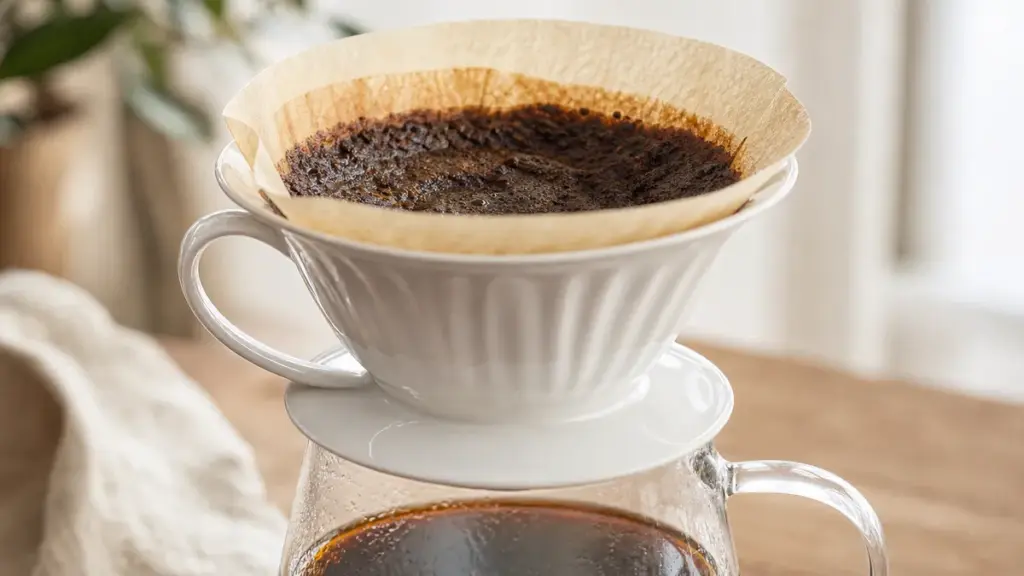
Green versus roasted coffee chemistry
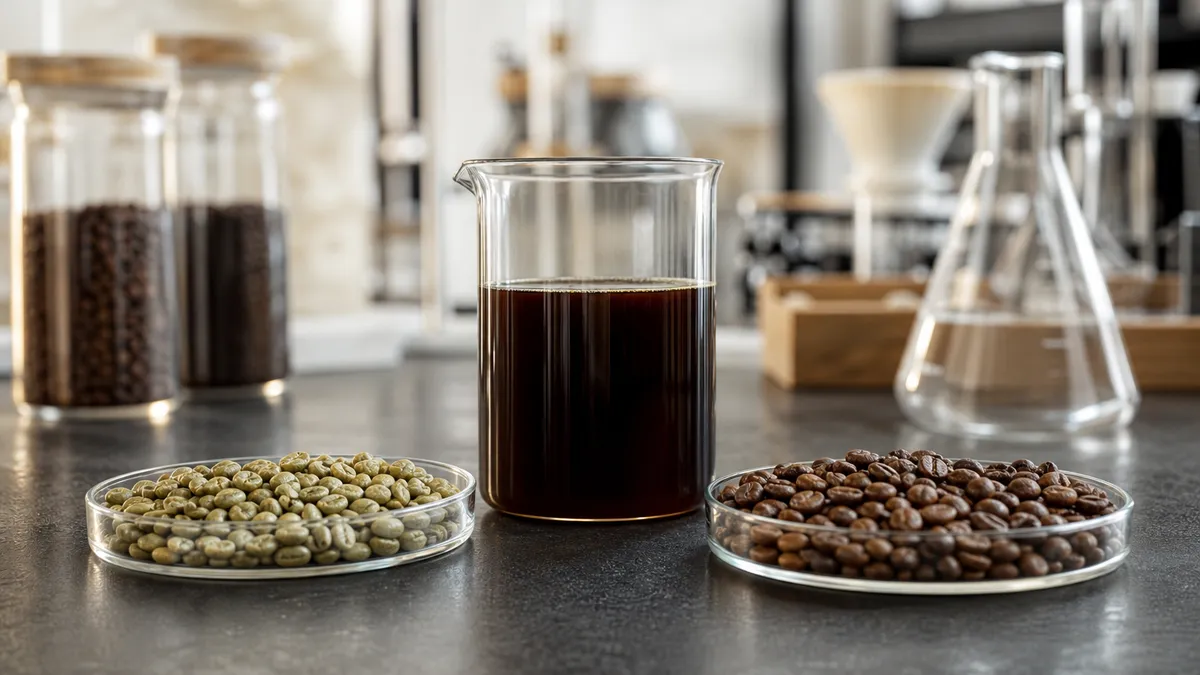
A green bean contains both finished plant compounds and precursors, substances from which other molecules can form. Roasting does not simply release a ready-made coffee aroma. It creates a substantially different mixture.
Several overlapping pathways are involved:
- Maillard reactions: reducing sugars react with amino groups from amino acids and proteins, beginning a network of reactions that produces aroma compounds and brown material.
- Strecker degradation: linked reactions involving amino acids and reactive carbonyl compounds generate aldehydes and other products that contribute to aroma.
- Sugar breakdown and caramelisation: heat changes sugars through pathways that do not all require amino compounds.
- Transformation of existing compounds: chlorogenic acids and trigonelline break down or become incorporated into other material.
These are not neatly separated stages. Their products can become ingredients in further reactions, so a roasting bean is better understood as a changing reaction network than a row of independent chemical switches.
Research comparing green and roasted specialty coffees found that roast level strongly influenced the measured volatile profile. The familiar nutty, malty and roasted character therefore reflects both the starting bean and the treatment it receives.
Caffeine behaves differently from many flavour precursors. Controlled roasting experiments found only a slight decrease in caffeine while trigonelline loss depended strongly on roast degree. A percentage can also rise when other material is lost, without any new caffeine being created.
What the main coffee compounds do
Caffeine: stimulation, with some bitterness
Caffeine is a heat-stable methylxanthine, a particular class of alkaloid. It has a stimulating effect and a distinctly bitter taste, but it is not a chemical measure of how bitter a whole coffee will taste.
Its contribution must be considered alongside other bitter compounds and the surrounding mixture. Consequently, “more bitter” does not reliably mean “more caffeine”, and a dark colour does not tell you the caffeine content of a serving.
Chlorogenic acids: a family of precursors
Chlorogenic acids, often abbreviated to CGAs, are a family rather than one molecule. Important members include caffeoylquinic acids, in which a caffeic acid component is joined to quinic acid.
Roasting changes this family substantially. Some products are chlorogenic acid lactones, also called quinides, which can contribute bitterness. Sensory-guided chemical research has identified several of these as important bitter constituents of coffee.
Not all coffee acidity comes from CGAs. Citric, malic, acetic and other acids also belong in the discussion, and their presence alone does not establish how strongly a person will perceive them. The individual families are explored in coffee acids, oils and sugars.
Lipids: more than a surface sheen
Lipids are coffee’s fat-related compounds. Much of the oil consists of triacylglycerols, the main storage fats also found in many other foods, with additional constituents including diterpene esters and sterols.
The bean’s oil content is not the drink’s oil content. Comparative brewing research found that paper-filtered coffee contained much less lipid than several unfiltered preparations. Most of the bean’s oil did not reach the beverage.
This distinction matters whenever a composition chart is used to describe a cup: a bean containing substantial oil does not produce a drink with the same fat percentage.
Sugars: ingredients for transformation
Sucrose is an important soluble sugar in green coffee, particularly arabica. During roasting, it becomes a starting material for reactions that generate other compounds, including aroma substances and acids.
That does not mean a coffee described as caramel-like contains a large amount of caramelised sugar dissolved in the cup. Research on brewed coffee notes that remaining sugars are generally too scarce to explain perceived sweetness on their own. Smelling something sweet and tasting dissolved sugar are different experiences.
Trigonelline: a source of new roasting products
Trigonelline is another nitrogen-containing compound present in green beans. Its importance lies partly in what it becomes.
During roasting, some trigonelline decomposes into volatile pyridines and non-volatile products including N-methylpyridinium and nicotinic acid, a form of vitamin B3. The extent of conversion depends on roasting conditions; it is not a complete, one-directional conversion of all trigonelline into a vitamin.
Melanoidins: coffee’s brown, chemically varied fraction
Melanoidins are brown, relatively high-molecular-weight products associated with Maillard chemistry. They are not a single pigment that can be represented by one tidy molecular structure.
Research using nuclear magnetic resonance spectroscopy has found evidence of protein and polysaccharide components, together with chlorogenic acids linked into melanoidin material. This helps explain why “sugars”, “proteins” and “phenolics” become less cleanly separated categories after roasting.
Laboratory studies also find antioxidant activity in isolated coffee melanoidins. That describes behaviour under the conditions of a chemical assay, not proof that drinking a particular roast prevents disease.
From roasted bean to brewed coffee
Brewing produces another change in composition: it transfers some substances from the grounds into water, while much of the original material remains behind.
Think of the process in three parts:
- Extraction: water takes up soluble constituents, including caffeine and various acids.
- Transfer of dispersed material: some oil and fine material can enter the drink rather than dissolving in the same way as small soluble molecules.
- Separation: the brewing method and filter influence what reaches the cup.
A bean analysis therefore cannot be converted directly into a serving analysis without knowing the coffee dose, beverage quantity and extraction conditions. Nor should an espresso’s concentrated appearance be confused with the total amount of a compound in the whole serving.
The detailed connection between molecules and smell belongs in coffee aroma and flavour, rather than in a longer catalogue of compounds here.
Why a chemical inventory cannot fully predict flavour
The most interesting question is not merely “What is present?” but “What does it do in this mixture?”
A sensory threshold is the concentration at which a substance becomes detectable under specified conditions. A compound can be measurable by an instrument yet contribute little individually to what someone tastes. Conversely, a potent odorant can matter at a very low concentration.
Interactions complicate the picture further. In a 2026 laboratory and sensory study, caffeine combined with chlorogenic acid and a high-molecular-weight coffee fraction produced substantially less bitterness than caffeine in water at the same concentration. The result supports a role for the surrounding coffee mixture, but it is not a universal prediction for every brew.
Scientists therefore combine chemical measurements with sensory work. Gas chromatography coupled with mass spectrometry helps investigate volatile compounds; liquid chromatography is used for constituents such as caffeine and trigonelline. Neither method, by itself, measures enjoyment.
When reading coffee research, check whether the investigators analysed green beans, roasted grounds, a laboratory extract or a drink. Coffee chemistry becomes much clearer once the sample, measurement basis and limits of the experiment are kept together.
FAQ
Does decaffeinated coffee still contain other coffee compounds?
Yes, decaffeinated coffee still contains many other constituents. Research has identified important bitter quinides in decaffeinated brewed coffee, demonstrating that caffeine is not necessary for all coffee bitterness. Removing caffeine should therefore not be confused with removing the entire chemical mixture responsible for the drink’s colour, aroma and taste.
Can a coffee’s sweetness tell me how much sugar it contains?
No, perceived sweetness is not a reliable sugar measurement. Roasting uses sucrose to form other substances, and the small quantities of sugars remaining in brewed coffee do not straightforwardly explain its sensory sweetness. A sweet-smelling aroma and the balance of the whole drink should not be mistaken for a laboratory sugar result.
Does stronger antioxidant activity mean a healthier coffee?
Not necessarily. An antioxidant assay measures a particular reaction under laboratory conditions, and different assays can give different rankings. Research on coffee melanoidins found that increasing roast intensity affected different antioxidant tests differently. Demonstrating a health benefit requires appropriate human evidence, not simply a favourable result from an isolated coffee fraction.
Where to go next
Read Coffee Acids, Oils and Sugars for a closer look at the main non-volatile families, then The Science of Coffee Aroma and Flavour for the compounds behind coffee’s smell. Coffee Research and Studies helps you judge the evidence behind coffee chemistry claims, while Coffee and Science places those findings in their wider context.
Sources
-
Vezzulli et al., Foods, 2023. “Volatile Compounds in Green and Roasted Arabica Specialty Coffee: Discrimination of Origins, Post-Harvesting Processes, and Roasting Level.” Source for the reported compound count and the comparison of roast effects.
https://pmc.ncbi.nlm.nih.gov/articles/PMC9914344/ -
International Agency for Research on Cancer, 1991. “Coffee”, in Coffee, Tea, Mate, Methylxanthines and Methylglyoxal, IARC Monographs, Volume 51, particularly Tables 15 and 16. Source for illustrative dry-basis composition averages and extraction distinctions.
https://www.ncbi.nlm.nih.gov/books/NBK507020/?report=printable -
Ky et al., Food Chemistry, 2001. “Caffeine, trigonelline, chlorogenic acids and sucrose diversity in wild Coffea arabica L. and C. canephora P. accessions.” Primary measurements used to qualify reference averages.
https://electronicsandbooks.com/edt/manual/Magazine/F/Food%20Chemistry/2001/Vol.75/223_230.pdf -
Caporaso, Whitworth and Fisk, Food Research International, 2018. “Non-destructive analysis of sucrose, caffeine and trigonelline on single green coffee beans by hyperspectral imaging.” Source for compositional variability, published lipid and sucrose ranges, and analytical methods.
https://pmc.ncbi.nlm.nih.gov/articles/PMC5886291/ -
Elsevier, Food and Humanity, 2023. “Maillard reaction precursors and arabica coffee (Coffea arabica L.) beverage quality.” Source for sugar and protein precursors and linked aroma-forming reactions.
https://www.sciencedirect.com/science/article/pii/S2949824423000022 -
Casal, Oliveira and Ferreira, Food Chemistry, 2000. “HPLC/diode-array applied to the thermal degradation of trigonelline, nicotinic acid and caffeine in coffee.” Controlled roasting study of compound stability.
https://www.sciencedirect.com/science/article/pii/S0308814699002289 -
Lang and Hofmann, Czech Academy of Agricultural Sciences, 2009. “On the Generation of Bioactive Trigonelline Degradation Products upon Coffee Roasting and their Bioappearance after Coffee Consumption.” Source for trigonelline’s roasting products.
https://cjfs.agriculturejournals.cz/artkey/cjf-200910-0069_on-the-generation-of-bioactive-trigonelline-degradation-products-upon-coffee-roasting-and-their-bioappearance-a.php -
Frank, Zehentbauer and Hofmann, Developments in Food Science, 2006. “Screening and identification of bitter compounds in roasted coffee brew by taste dilution analysis.” Institutional publication record describing sensory-guided identification of bitter quinides.
https://portal.fis.tum.de/en/publications/screening-and-identification-of-bitter-compounds-in-roasted-coffe/ -
Borrelli et al., American Chemical Society, 2002. “Chemical Characterization and Antioxidant Properties of Coffee Melanoidins.” Primary chemical characterisation and antioxidant-assay research.
https://pubmed.ncbi.nlm.nih.gov/12381145/ -
Ripper, Kaiser and Perrone, Journal of Food Composition and Analysis, 2020. “Use of NMR techniques to investigate the changes on the chemical composition of coffee melanoidins.” Source for melanoidin structure and incorporated chlorogenic acids.
https://www.sciencedirect.com/science/article/pii/S0889157519312517 -
Ratnayake et al., Food and Chemical Toxicology, 1993. “Lipid content and composition of coffee brews prepared by different methods.” Comparative analysis of lipid transfer and filtration.
https://pubmed.ncbi.nlm.nih.gov/8477916/ -
Gigl, Kreissl and Frank, American Chemical Society, 2026. “Impact of Interactions between Melanoidins and Caffeine on the Bitter Taste of Coffee Beverages.” Primary NMR and sensory research on mixture effects.
https://pmc.ncbi.nlm.nih.gov/articles/PMC13281520/ -
Birke Rune et al., Current Research in Food Science, 2023. “Acids in brewed coffees: Chemical composition and sensory threshold.” Source for acids, residual sugars and the distinction between measured composition and perception.
https://doi.org/10.1016/j.crfs.2023.100485
This article was researched through retrieved scientific papers and an authoritative composition monograph, distinguishing reference averages, experimental measurements and sensory findings.
Last checked: November 2026