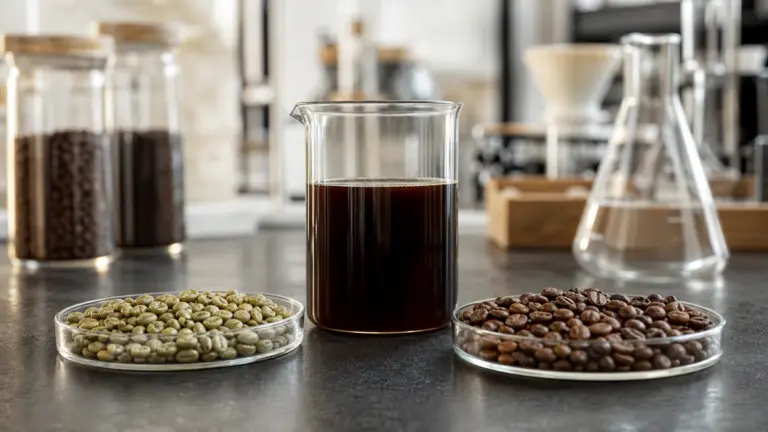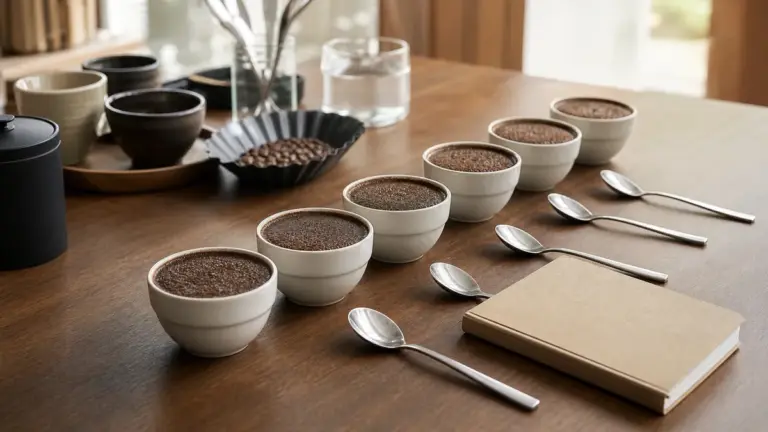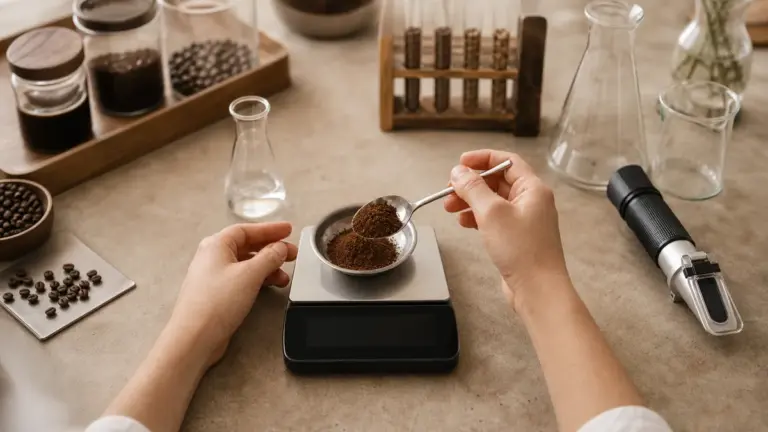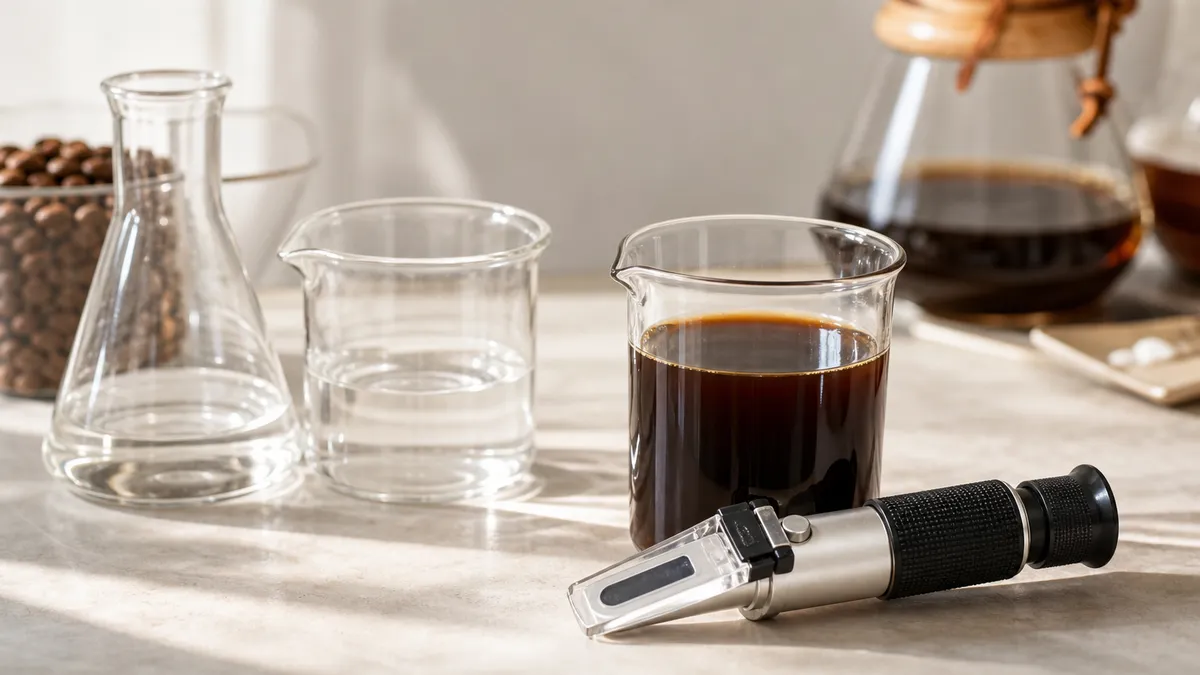
Coffee science is the study of the coffee plant, the changes that turn its seeds into a drink, and the drink’s effects on our senses and bodies. It brings together botany, chemistry, physics, sensory science and health research to answer questions ranging from which trees farmers should grow to why changing a grinder setting changes the cup.
In short
- Start with the question: plant breeding, brewing performance and human health need different kinds of evidence.
- Coffee strength measures concentration; extraction yield measures how much material has been removed from the grounds.
- Sensory science separates what a coffee tastes like from how much someone likes it.
- A laboratory result can explain a mechanism without proving a health benefit in people.
- For practical comparisons, change one variable, record the conditions and repeat before drawing conclusions.
What does coffee science cover?
Coffee science is not one subject with one laboratory method. A plant breeder studies inherited characteristics, a chemist measures molecules, and a sensory researcher studies human perception. Their findings become more useful when connected rather than treated as competing explanations.
The same cup can therefore support several different questions:
| Field | Main question | Example of evidence |
|---|---|---|
| Botany and genetics | Which plants perform well in particular conditions? | Variety descriptions and field trials |
| Chemistry | What substances are present, formed or lost? | Chemical analysis of beans and brewed coffee |
| Physics | How do water and dissolved material move? | Flow measurements and extraction models |
| Sensory science | What do people perceive and prefer? | Structured tasting and consumer assessment |
| Health research | What happens after people consume coffee? | Controlled trials and observational studies |
A useful starting habit is to name the outcome you care about. “Better coffee” might mean a healthier crop, more repeatable brewing, a preferred flavour or fewer sleep problems. Those are different outcomes, and no single measurement answers them all.
Botany: coffee begins as a living plant
A coffee bean is a seed inside a fruit commonly called a coffee cherry. Botany studies the plant itself, while genetics examines inherited differences that help explain how plants grow and respond to their surroundings.
Two widely cultivated species are Coffea arabica, usually called arabica, and Coffea canephora, traded as robusta. A species is not the same thing as a variety: varieties are distinct groups within a species, while cultivars are cultivated selections maintained for particular characteristics.
World Coffee Research’s varieties catalogue describes characteristics such as yield potential, disease resistance and suitability for growing conditions. Its field programmes test plants across locations because performance in one environment does not settle performance elsewhere.
For the reader, the practical lesson is to keep categories separate. A species name identifies the plant at one level; a variety name gives more specific information. Neither should be treated as a complete description of the finished drink.
Chemistry: roasting changes the raw material
Coffee chemistry asks what the beans and drink contain, and how processing changes that composition. Roasting is a useful example because it does more than darken the seed: chemical reactions create, transform and remove substances.
Among these are Maillard reactions, in which reducing sugars react with amino compounds. They contribute to the development of roasted aromas. Research comparing different roast profiles has measured changes in volatile compounds, meaning substances that can enter the air and contribute to smell.
Chemists can investigate these using gas chromatography coupled with mass spectrometry. This separates substances in a sample and helps identify them through their chemical signatures.
However, a list of detected compounds is not a tasting verdict. Chemical analysis answers what is present; sensory assessment investigates what people perceive. Our guide to coffee chemistry examines the molecules and reactions in more detail.
Physics: how extraction turns grounds into a drink
Extraction is the transfer of soluble material from coffee grounds into water. It involves dissolution and movement through and around the particles, not simply the washing of flavour from their surfaces.
Brewing arrangements matter. In immersion brewing, grounds steep in the surrounding liquid. In espresso, pressurised water passes through a packed bed of grounds, so resistance and the distribution of flow become central questions.
Smaller particles can make soluble material more accessible, but finer grinding is not an unlimited route to greater extraction. An experimental and mathematical study of espresso found extraction yield fell at very fine settings, with the results suggesting uneven flow through the coffee bed.
That finding illustrates why mechanisms need testing. “Finer means more extraction” may be a useful starting expectation, but it is not a universal rule. The outcome depends on the brewing system and the other conditions held constant.
Sensory science: measuring the experience
Sensory science uses people as assessors, but gives the assessment a defined method. Its purpose is not to make everyone enjoy the same coffee.
Flavour combines taste with smell. Some aromatic molecules reach the nose from the back of the mouth during drinking, a route called retronasal smell. Mouthfeel adds tactile information, including thickness, texture and mouth-drying sensations.
A particularly useful distinction is between description and preference. “Strong citrus character and a drying finish” describes a sample; “I would choose this coffee again” expresses a preference. The Specialty Coffee Association’s Coffee Value Assessment separates descriptive assessment from affective assessment, which records an impression of quality.
For learners, this suggests a better way to take tasting notes: first write what you notice, then write whether you enjoy it. Keeping those judgements separate makes comparisons clearer without pretending that personal preference is a mistake.
Health research: mechanisms are not medical outcomes
Health research asks both what coffee does in the body and whether drinking it is associated with particular outcomes. These questions require different study designs.
A controlled trial assigns an intervention, such as a drink, under specified conditions. An observational study records people’s habits and outcomes without assigning their coffee consumption. Observational findings can be affected by other differences between participants, including smoking and existing health.
An umbrella review brings together findings from systematic reviews and meta-analyses. A widely cited BMJ umbrella review found coffee consumption was associated with several favourable health outcomes, but called for robust randomised trials to establish whether those associations were causal. It is not evidence that someone should begin drinking coffee to prevent disease.
Caffeine guidance is a separate question
EFSA’s 2015 safety assessment found that caffeine intakes up to 400 mg a day, spread across the day, raise no safety concerns for healthy non-pregnant adults. Single doses up to 200 mg raise no concerns for the general healthy adult population; 100 mg near bedtime may disturb sleep in some adults.
The NHS advises no more than 200 mg a day from all sources during pregnancy. These are population guidance figures, not intake targets or guarantees of individual tolerance.
Coffee research should therefore distinguish the beverage from caffeine alone. For questions involving symptoms, medicines, pregnancy or individual sensitivity, speak to a GP, pharmacist or midwife rather than applying a study average to yourself.
Where does coffee research happen?
Coffee research takes place in fields, laboratories, tasting facilities and health research settings.
World Coffee Research works with national and international partners to create, test and distribute improved varieties. Its international trials connect research with the conditions farmers face, rather than relying entirely on plants grown under controlled laboratory conditions.
Universities bring disciplines together. The University of California, Davis Coffee Center lists research interests including genetics, fermentation microbiology, roasting reactions, brewing efficiency, sensory science and nutrition. UK contributions include work by University of Nottingham researchers on chemical markers of roast defects.
Standards organisations have a different role. The Specialty Coffee Association publishes methods that help assessors describe coffee consistently. EFSA evaluates food-safety evidence, while the NHS communicates practical health guidance.
When reading coffee research and studies, check who conducted the work, what they measured and whether the conclusions match the method.
What coffee measurements can and cannot tell you
A measurement is useful when its meaning is clear. Two brewing measurements are particularly easy to confuse:
- Total dissolved solids, or TDS: the concentration of dissolved material in the drink, commonly called brew strength.
- Extraction yield: the proportion of the starting coffee mass transferred into the beverage.
A coffee refractometer estimates concentration from how the sample bends light. It does not directly measure flavour quality, caffeine or liking.
For an espresso example, assume 18 g of dry coffee, 36 g of beverage and 10% TDS:
Extraction yield = beverage mass × TDS percentage ÷ dry coffee mass
36 g × 10 ÷ 18 g = 20%
These are illustrative assumptions, not measurements from testing. The calculation describes material transfer; it does not establish that the espresso tastes good. A concentration reading and a sensory judgement answer different questions.
How to use coffee science without a laboratory
For everyday learning, borrow the discipline of an experiment rather than trying to reproduce a research laboratory.
- Ask a narrow question. For example: “Do I prefer this coffee with a slightly coarser grind?”
- Write down the conditions. Record the coffee, dose, water mass, grinder setting, brewing method, temperature and time where you can measure them.
- Change one deliberate variable. Avoid changing grind, dose and brewing time together if your aim is to understand grind.
- Compare without identifying the samples if possible. Ask someone else to conceal which is which, and note sensory differences before choosing a favourite.
- Repeat the comparison. Treat the first result as a lead to investigate, not a rule for every coffee.
This is a practical learning exercise, not a validated sensory protocol. Its value is that it makes your reasoning visible: what changed, what stayed similar and what you actually noticed.
The same approach helps at an office tea point. Record the machine setting and coffee used before making adjustments, and distinguish a repeated preference from a single enthusiastic reaction. Coffee and science work well together when the question is precise and the conclusion stays within the evidence.
FAQ
Do I need specialist equipment to understand coffee science?
No, you can begin by asking clear questions and recording repeatable observations. A scale, timer and notebook can make a brewing comparison easier to interpret, but specialist equipment is not a requirement for learning. Use more advanced instruments only when you have a specific measurement question they can answer.
Can a refractometer tell me how much caffeine is in coffee?
No, a coffee refractometer does not specifically measure caffeine. It estimates dissolved-solids concentration from the sample’s optical behaviour. Caffeine assessment is a different analytical task, so a stronger TDS reading should not be converted into a caffeine figure or used to decide whether a drink fits personal health guidance.
Does a scientific study override my taste preference?
No, a study can describe patterns without determining what you must enjoy. Sensory description and preference are different forms of assessment. Research may help explain a difference or suggest something worth trying, but your preferred coffee does not need to match a panel average to be a valid personal choice.
Where to go next
Read Coffee Chemistry for a closer explanation of the substances and reactions behind the drink. For help interpreting experiments, reviews and health headlines, continue with Coffee Research and Studies, the next step from this overview of coffee and science.
Sources
-
Royal Botanic Gardens, Kew. Arabica coffee, undated reference page.
URL: https://www.kew.org/plants/arabica-coffee -
World Coffee Research. Coffee Varieties Catalog: What’s included, undated reference page.
URL: https://varieties.worldcoffeeresearch.org/about-the-catalog/whats-included -
World Coffee Research. Coffee varieties catalog, undated resource page.
URL: https://worldcoffeeresearch.org/resources/coffee-varieties-catalog -
World Coffee Research. Our Work, current programme overview, undated.
URL: https://worldcoffeeresearch.org/work -
Yang and colleagues, Food Chemistry. Determination of volatile marker compounds of common coffee roast defects, 2016. Original experimental research.
URL: https://pmc.ncbi.nlm.nih.gov/articles/PMC4914823/ -
Cameron and colleagues, Matter. Systematically Improving Espresso: Insights from Mathematical Modeling and Experiment, 2020. Original modelling and experimental research, accessible manuscript.
URL: https://www.osti.gov/pages/servlets/purl/1973594 -
Liang, Chan and Ristenpart, Scientific Reports. An equilibrium desorption model for the strength and extraction yield of full immersion brewed coffee, 2021. Original modelling and experimental research.
URL: https://www.nature.com/articles/s41598-021-85787-1.pdf -
Specialty Coffee Association. Coffee Value Assessment: Descriptive Assessment, SCA Standard 103-2024, 2024 edition.
URL: https://sca.coffee/s/AW_SCA-103_Descriptive-Assessment_Sept2024_Secured.pdf -
Specialty Coffee Association. Coffee Value Assessment, current framework overview, undated.
URL: https://sca.coffee/value-assessment -
Poole and colleagues, BMJ. Coffee consumption and health: umbrella review of meta-analyses of multiple health outcomes, 2017.
URL: https://www.bmj.com/content/bmj/359/bmj.j5024.full.pdf -
European Food Safety Authority. Caffeine, current topic page summarising the 2015 Scientific Opinion on the safety of caffeine.
URL: https://www.efsa.europa.eu/en/topics/topic/caffeine -
NHS. Foods to avoid in pregnancy, reviewed 15 June 2026.
URL: https://www.nhs.uk/pregnancy/keeping-well/foods-to-avoid/ -
University of California, Davis Coffee Center. Faculty and Research, current institutional overview, undated.
URL: https://coffeecenter.ucdavis.edu/faculty-research
This overview was researched using botanical references, original brewing and chemistry studies, sensory standards, a health evidence review and current official caffeine guidance; no first-hand testing is claimed.
Last checked: November 2026