Eco-friendly coffee packaging protects the coffee while reducing unnecessary material use and providing a disposal route people can actually use. “Recyclable”, “compostable” and “biodegradable” describe different properties, so the useful question is not simply what the bag is made from, but where the whole package can go afterwards.
In short
- Home-recyclable means accepted in household recycling collections, not something you recycle yourself at home.
- A recyclable plastic pouch needs a compatible collection and processing route. A material identification number alone does not establish that.
- Industrially compostable packaging is not automatically suitable for a garden compost heap or council food waste bin.
- Check the complete bag, including its valve, zip, labels and lining, rather than just its main material.
- England’s household collection requirement for plastic films and bags starts on 31 March 2027. Until then, do not assume your kerbside collection accepts them.
Sustainable Packaging
Sustainable packaging is best understood as a design objective, not a single material. For coffee, that means protecting the product, avoiding unnecessary packaging and choosing a credible route for reuse, recycling or composting.
Protection matters because a coffee bag is more than a carrying container. Its barrier layers restrict oxygen and water vapour, helping preserve the contents. Removing material without checking that protection can exchange an obvious packaging reduction for less obvious product deterioration.
Start with these questions:
- Does it protect the coffee adequately? Ask suppliers for evidence supporting the intended storage conditions and shelf life.
- Is every component necessary? Consider the outer carton, decorative sleeve and individual portions as well as the pouch.
- What happens after use? Identify the actual collection service and treatment route, rather than relying on a symbol.
A life cycle assessment, or LCA, estimates environmental impacts across defined stages of a product’s life. It can reveal trade-offs that are invisible when looking at an empty bag.
For example, a peer-reviewed coffee-packaging LCA published in 2026 compared a mixed-material structure with polyethylene and polypropylene alternatives using an Italian waste-management baseline. The alternatives performed better in many assessed categories, but not every category. This was a modelled comparison of particular packages, developed with packaging manufacturer Goglio, not proof that every mono-material bag is preferable everywhere.
Reusable tins and refill arrangements should face the same questions: how often is the container reused, what packaging delivers the refill, and how are cleaning and transport handled? Treat reuse as a system to examine, not an automatic environmental verdict.
For the wider context beyond packaging, see our guide to coffee and the environment.
What the main packaging claims mean
| Claim | What it tells you | What you must still check |
|---|---|---|
| Home-recyclable | Intended for household recycling collections | Whether your council accepts that exact packaging format |
| Commercially recyclable | Refers to a recycling route outside, or associated with, business collections | The named collector, accepted specification and processing destination |
| Industrially compostable | Meets requirements for controlled industrial composting | Whether an accessible service accepts the finished bag |
| Home-compostable | Assessed for lower-temperature home composting | Certification scope and the supplier’s composting instructions |
| Biodegradable | Describes biological breakdown under particular conditions | The environment, timescale and evidence; it does not identify a bin |
“Commercially recyclable” is particularly worth questioning. It should not be confused with industrial composting, and it should not be taken to mean that an ordinary office recycling contractor accepts the item.
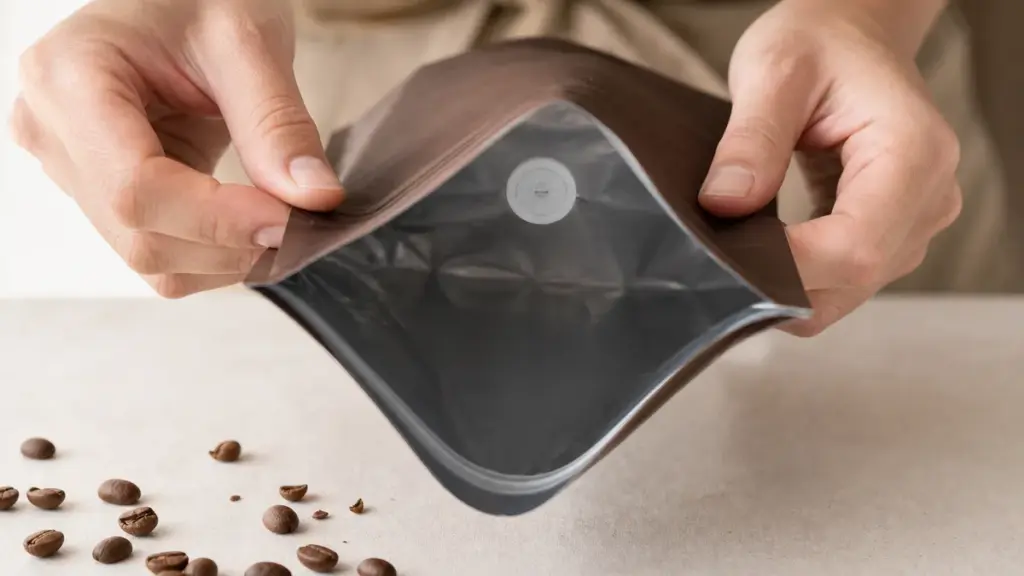
Biodegradable Coffee Bags
Biodegradable coffee bags are not necessarily compostable coffee bags. Biodegradation concerns breakdown through biological activity; without a specified environment and timescale, the word gives little practical disposal guidance.
Compostability is more specific. Certification schemes assess breakdown under defined conditions, including whether the material disintegrates and whether the resulting compost adversely affects plant growth.
A brown paper appearance is not a certificate. Nor does certification of the film alone establish that the finished pouch, with its attachments, meets the same requirements.
Home composting and industrial composting are different
EN 13432:2000 is the packaging standard underlying established industrial compostability certification. The assessment covers biodegradation, disintegration, effects on plants and material characteristics, including restricted substances.
That is not a home-composting claim. A product assessed only for industrial composting should not be assumed to break down successfully in a garden heap.
TÜV AUSTRIA’s OK compost HOME is a separate certification scheme. Its published test specification assesses biodegradation at 20 to 30 degrees Celsius, with a maximum test period of 12 months. These are controlled test conditions, not a promise that a bag disappears within a particular season in every British garden.
Home-compostability certification also does not establish suitability for littering, burial in soil or disposal in water. Those are different environments.
Ask whether certification covers the finished bag and follow any instructions about removing components. A statement such as “compostable pouch, remove valve” requires a separate destination for that valve.
The UK collection reality
A compostability certificate does not give permission to use a council food or garden waste bin.
In England, Defra’s household guidance excludes compostable and biodegradable plastic packaging from the materials councils are required to collect. Food caddy liners are treated separately. For workplaces, Defra explicitly says compostable or biodegradable packaging should go into non-recyclable waste or a dedicated collection, not ordinary food waste.
Collection instructions elsewhere must also be checked locally. Edinburgh, for example, accepts specified liners for its food collection but excludes food packaging. An accepted caddy liner is therefore not evidence that a coffee pouch belongs in the same bin.
If there is no suitable home-composting arrangement or confirmed specialist collection, follow local residual-waste instructions. Do not substitute the plastics recycling bin.
Coffee grounds and their packaging need separate decisions. See reusing coffee grounds and cascara for the organic material itself.
Recyclable Coffee Packaging
Recyclable coffee packaging needs both suitable design and a functioning collection route. Neither one alone guarantees that a particular empty bag will be recycled.
PE and PP mono-material pouches
Polyethylene, or PE, and polypropylene, or PP, are plastic families used in flexible packaging. A mono-material pouch is designed predominantly around one polymer family, rather than combining substantial layers of incompatible materials.
The identification codes need care: 4 identifies low-density polyethylene, LDPE, not every form of PE; 5 identifies polypropylene, PP. These codes identify material, not local collection acceptance.
Mono-material does not necessarily mean one physical layer. A pouch can contain several layers designed around the same polymer family, while still needing assessment of its barrier coatings, inks and adhesives.
RecyClass publishes separate design guidance for PE and PP flexible films. Its assessments consider the main film and attachments, including closure systems, seals, valves and labels. Consequently, “PE bag” is a starting description, not sufficient evidence for a whole-pack recycling claim.
Foil laminates and paper-looking bags
Traditional mixed-material coffee packs can combine plastic and aluminium foil in bonded layers. These provide useful protection, but separating the materials creates recycling difficulties.
Do not put such a pouch into metal recycling simply because its inside looks metallic. Defra’s English household guidance specifically excludes laminated foil coffee pouches from the metal packaging councils are required to collect.
A paper exterior is equally inconclusive. Ask for the complete material structure and disposal instructions before putting a lined pouch into paper recycling.
Conversely, appearance alone cannot establish that a silver-looking film contains a substantial aluminium foil layer. Use the supplier’s specification rather than a visual guess.
Where can you take an empty pouch?
WRAP’s Recycle Now lists coffee pouches among items accepted through relevant plastic-bag and wrapping collection points. It advises that packaging should be clean and free of food. Check the individual collection point and the pack’s instructions, particularly where its material structure is unclear.
As checked in November 2026, England’s requirement to collect household plastic films and bags begins on 31 March 2027. That future requirement is not evidence of current acceptance by every council.
In Scotland, Wales and Northern Ireland, consult the relevant local service rather than applying England’s timetable.
For offices, obtain written confirmation from the waste contractor for the actual pouch specification. Ask whether the receiving processor accepts it and whether any retailer or return scheme accepts business-generated packaging.
Capsules involve different materials and collection arrangements, covered in coffee pods and the environment.
One-way valves: useful, but part of the claim
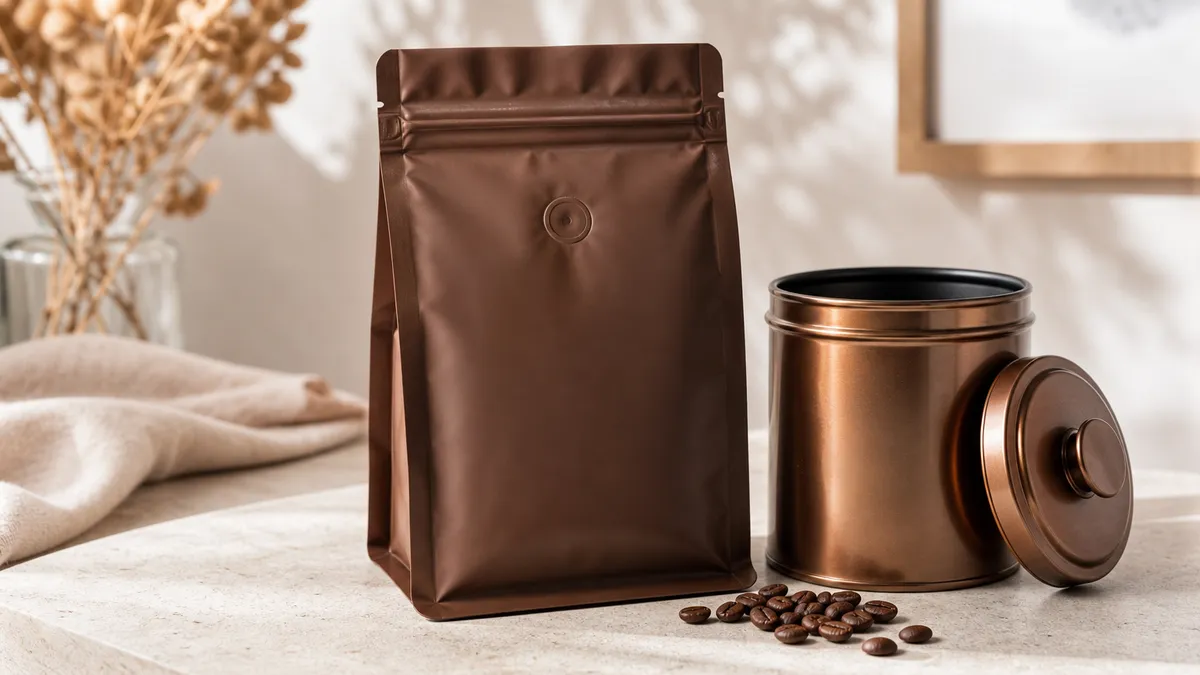
The small disc fitted to many coffee bags is a one-way degassing valve. Roasted coffee releases carbon dioxide; the valve allows gas to escape while restricting outside air entering through that opening.
This helps manage pressure without leaving an open hole in the package. However, the valve must be considered alongside the rest of the bag when assessing recycling or compostability.
Goglio advertises mono-material valves for recyclable packaging. That is a manufacturer’s design claim, not confirmation that a particular UK collection accepts every pouch fitted with one.
Ask the coffee supplier whether the valve is compatible with the pouch’s intended recycling stream. For compostable packaging, ask whether it falls within the finished product’s certification.
Do not automatically cut valves out. Follow the instructions for the actual package and collection route; unnecessary separation can create small loose components without improving the recycling outcome.
Green claims rules
The CMA’s Green Claims Code explains how UK consumer protection law applies to environmental claims. Its principles require claims to be truthful, clear, complete, fairly compared, supported by evidence and considered in the context of the product’s life cycle.
For coffee packaging, a specific statement about an accepted disposal route is more useful than an unqualified “planet-friendly” badge. Essential qualifications should explain whether the claim covers the whole bag and whether specialist processing is required.
The Digital Markets, Competition and Consumers Act 2024 introduced the CMA’s direct consumer enforcement regime from 6 April 2025. For relevant consumer-law infringements, the CMA can impose fines reaching 10% of worldwide turnover. These are enforcement powers under the law, not an automatic penalty for every disputed phrase.
On 22 January 2026, the CMA published additional supply-chain guidance. Retailers and brands cannot simply assume that repeating a supplier’s environmental claim removes their responsibility to verify it.
The guidance also says important qualifications should appear close to the claim. A requirement to return packaging for specialist composting should not be hidden behind a QR code.
A practical check before choosing a bag
- Read the disposal claim literally. Identify whether it concerns recycling, industrial composting or home composting.
- Request whole-pack evidence. Include the lining, valve, zip, labels, inks and adhesives.
- Confirm the destination. Check with the council, collection point or workplace contractor.
- Ask about processing. A collection box alone does not explain what happens to the material afterwards.
- Make the instructions usable. At work, place clear sorting guidance beside the bins and review it when packaging changes.
For eco-friendly packaging, prefer a specific, verifiable arrangement over a broad promise. Keep the supplier’s evidence and disposal instructions together so that the decision remains understandable after the empty bags reach the tea point.
FAQ
Can I put a biodegradable coffee bag in plastic recycling?
No, not simply because it looks or feels like plastic. Recycle Now warns that biodegradable and compostable bags can cause quality problems in conventional plastics recycling. Check the stated disposal route instead. If the only claim is “biodegradable”, ask the supplier for the conditions and evidence behind it before choosing a bin.
Does a recycling triangle mean my council accepts the bag?
No. A recycling symbol does not establish acceptance in every collection system, and a resin identification number primarily identifies the plastic. Check the packaging format as well as its material: an accepted rigid PP tub does not establish acceptance of a flexible PP coffee pouch. Use your council’s current instructions or the named collection scheme’s rules.
Should I buy the largest available coffee bag to reduce packaging?
Not automatically. Compare packaging use against how reliably you will finish and protect the coffee. Ask the supplier about suitable pack sizes, storage and refill arrangements rather than treating size alone as an environmental measure. A meaningful comparison considers the complete packaging system and product protection, not just the number of empty bags.
Where to go next
Read Coffee and Climate Change and Deforestation and Coffee to understand environmental questions beyond the package. Reusing Coffee Grounds and Cascara explains the separate opportunities and limitations involved in using coffee’s organic leftovers.
Sources
- Cigada, M., Barrale, R. and Dotelli, G., From multimaterial to monomaterial: An LCA of flexible coffee packaging, Sustainable Materials and Technologies, 2026. Publisher’s article.
- TÜV AUSTRIA, OK compost HOME: Initial acceptance tests, OK02-e, edition D, application date 1 March 2012. Certification specification.
- TÜV AUSTRIA, OK compost INDUSTRIAL Certification Scheme, OK 01, edition F, 1 January 2022, referencing EN 13432:2000. Certification specification.
- WRAP, Recycle Now, Plastic bags and wrapping and Recycling symbols: what do they mean?, undated, accessed 2026. Collection guidance; symbol guidance.
- Defra, Simpler recycling: household recycling in England and Simpler recycling: workplace recycling in England, current guidance accessed 2026. Household guidance; workplace guidance.
- City of Edinburgh Council, Individual kerbside collections, undated, accessed 2026. Local collection instructions.
- RecyClass, Design for Recycling Guidelines: Coloured PE Flexible Films and Coloured PP Flexible Films, 2026 documents. PE guidance; PP guidance.
- Plitek, What is a coffee valve?, and Goglio, Valves, undated manufacturer information, accessed 2026. Valve operation; manufacturer’s valve designs.
- Competition and Markets Authority, Making environmental claims on goods and services, 2021, and Making green claims: Getting it right, across the supply chain, 22 January 2026. Green Claims Code; supply-chain guidance.
- Competition and Markets Authority, Direct consumer enforcement guidance, CMA200, March 2025. Enforcement guidance.
Researched through official collection guidance, certification specifications, recycling design documents, manufacturer explanations and a peer-reviewed packaging life cycle assessment; no first-hand packaging tests were undertaken.
Last checked: November 2026