The key players in the coffee industry are growers and co-operatives, green coffee traders, roasters, retailers and the institutions shaping research and standards. Control is divided between them: farmers produce the crop, traders connect supply with buyers, and roasters and retailers control much of its access to consumers.
In short
- Major green coffee trade houses include Neumann Kaffee Gruppe, Louis Dreyfus Company, ECOM, Volcafe, Sucafina and ofi.
- The Coffee Barometer 2026 estimates that the ten largest roasters collectively purchase 35% to 40% of global green coffee production.
- Co-operatives can strengthen growers’ negotiating position by combining coffee, services and access to buyers.
- Brand names do not necessarily identify independent businesses. Ownership, licensing and manufacturing arrangements can differ.
- The ICO brings governments together, the SCA develops industry knowledge and standards, and World Coffee Research works on agricultural innovation.
Who controls each stage of coffee?
Coffee moves through a value chain, meaning the activities that take it from cultivation to the finished product. A useful starting point is to distinguish control of the coffee itself from control of its route to market.
A grower can influence cultivation and harvesting but may depend on another business for processing, finance or export. A retailer might never handle an unroasted bean yet still decide which coffees reach its customers.
| Player | Main role | Principal source of influence |
|---|---|---|
| Growers and co-operatives | Produce coffee and organise its sale | Supply, quality and collective organisation |
| Traders and exporters | Assemble, process and move green coffee | Finance, logistics and buyer networks |
| Roasters and brand owners | Turn green coffee into finished products | Purchasing scale, product development and brands |
| Retailers and foodservice operators | Sell packaged coffee or prepared drinks | Customer relationships and distribution |
| Institutions | Develop data, research and shared frameworks | Knowledge, convening power and standards |
These categories overlap. A co-operative can export, a trader can manufacture instant coffee, and a roaster can operate shops. This is vertical integration: participation in several stages of the same supply chain.
For the wider structure behind these relationships, start with the coffee industry hub. The focus here is who exercises influence, rather than the full journey of every shipment.
Growers and co-operatives: the foundation of supply
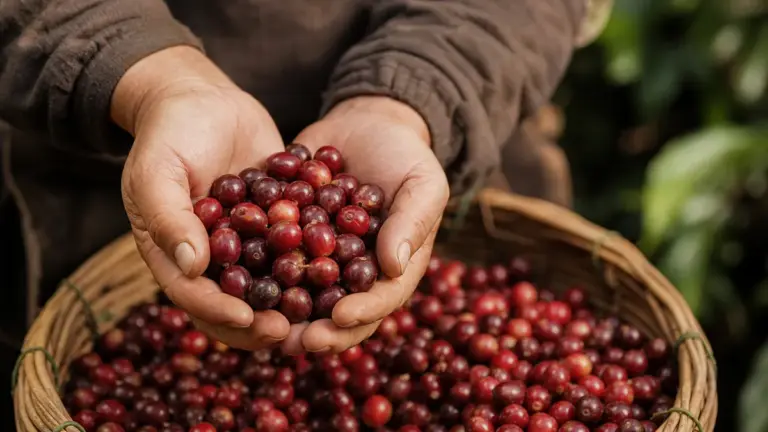
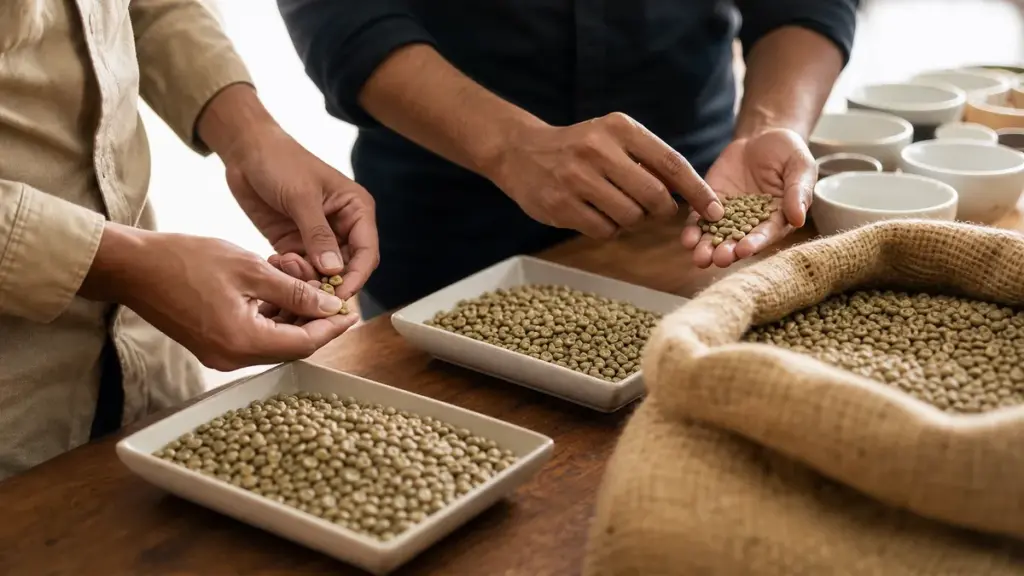
Growers make the production decisions on which every other business depends. However, producing something essential does not automatically give an individual farmer strong bargaining power. Access to information, technical support, finance and alternative buyers affects the terms available.
A co-operative is a jointly owned organisation through which members can organise activities together. In coffee, this can include combining harvests, providing agricultural advice, arranging storage and reaching buyers that would be difficult to serve individually.
Cooxupé in Brazil shows why co-operatives should not be treated simply as small local buying groups. Its published information describes activities spanning coffee handling, roasting, specialist coffees and export, supported by warehouses and technical departments. Producer organisation can therefore extend well beyond collecting beans.
Fairtrade International identifies stronger collective negotiation and access to markets as benefits of small producer organisations. It also provides for co-operatives to decide democratically how to use the Fairtrade Premium, an additional payment attached to qualifying sales.
The practical question is not merely whether a co-operative exists. Ask what it enables members to do: compare buyers, understand contracts, improve quality or sell through an additional channel. Those capabilities are more revealing than a membership badge alone.
Green coffee traders: connecting origins with roasters
Green coffee means beans that have not yet been roasted. Trade houses connect producing regions with customers that need particular qualities, volumes and delivery schedules.
Their work can include purchasing, processing, quality control, storage, transport and finance. These are substantial commercial functions, not simply introductions between a farmer and a roaster.
Major trade houses to recognise
- Neumann Kaffee Gruppe, or NKG: a coffee-focused group whose published activities include export and milling, importing, logistics, warehousing, financing and farm management.
- Louis Dreyfus Company, or LDC: sources arabica and robusta coffee, purchases from farmers, co-operatives and local traders, and processes and transports coffee. Its activities also extend into soluble coffee manufacturing.
- ECOM Agroindustrial: operates coffee sourcing, processing, warehousing and sales businesses. Its published network includes origin operations and specialist import businesses.
- Volcafe: a major green coffee merchant within ED&F Man Commodities. Its ownership history needs updating in older industry summaries: Hartree Partners acquired ED&F Man Commodities’ core businesses, including Volcafe, in 2025.
- Sucafina: a coffee-focused business connecting producers and roasters through sourcing and trading operations. Its activities also include soluble coffee and private-label products.
- ofi, Olam Food Ingredients: supplies coffee within a wider food ingredients business. Coffee industry references to “Olam” should identify the relevant business rather than assume that every Olam-branded activity belongs to the same operating division.
This is a list of significant participants, not a verified ranking by market share. Company descriptions establish what these businesses do; they do not independently establish comparative performance or sustainability outcomes.
To understand a trader’s influence, follow the services as well as the beans. Who finances the stock? Who has the warehouse capacity? Who can assemble the required coffee and deliver it consistently? These questions explain why a business unfamiliar to drinkers can be important to their daily cup.
Roasters and brand owners: purchasing power and product identity
Roasters transform green coffee into products sold as beans, ground coffee, instant coffee or other formats. Large businesses combine purchasing with manufacturing, marketing and distribution.
Recognisable participants include Nestlé, JDE Peet’s, Starbucks, Lavazza, Tchibo, Melitta and UCC. Their businesses are not identical, and a list of familiar names should not be mistaken for a single global ranking.
Nestlé’s coffee portfolio includes Nescafé and Nespresso. Its relationship with Starbucks illustrates another distinction: Nestlé’s agreement covers specified Starbucks packaged coffee and foodservice products outside Starbucks coffee shops. That licensing arrangement is not ownership of the Starbucks café business.
Ownership also changes. Keurig Dr Pepper announced the acquisition of a controlling shareholding in JDE Peet’s on 1 April 2026. Older diagrams presenting them as wholly separate ownership groups therefore need revision.
Independent roasters matter for a different reason. Their relevance is not necessarily the quantity they buy, but the sourcing relationships and products they choose to build. When assessing one, ask for evidence about its actual suppliers and purchasing practices rather than assuming that smaller automatically means more accountable.
The separate guide to major coffee companies examines corporate groups in more detail.
Retailers: controlling the route to the customer
Retailers determine what customers can readily find. Supermarkets select packaged products, while coffee shop operators shape the drinks, service and brand experience offered in their outlets.
Starbucks and Costa Coffee are recognisable examples of businesses reaching consumers through coffee shops. Costa forms part of The Coca-Cola Company. The corporate owner, café operator, roaster and supplier are therefore not necessarily interchangeable identities.
Retail influence also exists without a prominent café brand. Own-label coffee is sold under the retailer’s name rather than the manufacturer’s. For a buyer investigating such a product, the useful questions concern who roasted it, who supplied it and what information follows it through the chain.
For UK workplace procurement, apply the same distinction. Establish whether the company proposing the coffee is its roaster, a distributor or an equipment and service provider. Ask it to identify the other parties rather than treating the name on the proposal as the whole supply chain.
Institutions: influence without owning the coffee
Three organisations are especially useful to distinguish.
International Coffee Organization: government dialogue and data
The International Coffee Organization, or ICO, brings exporting and importing governments together. It compiles official statistics on production, trade and consumption, provides a forum for dialogue and supports development work and partnerships.
Its role is institutional rather than commercial. Use it to understand the sector and its policy discussions, not as a supplier directory or a body deciding the terms of an individual purchase.
Specialty Coffee Association: shared knowledge and standards
The Specialty Coffee Association, or SCA, is a trade association working through research, standards, education and events.
Its standards help establish common terminology and methods for activities such as coffee assessment and equipment testing. That gives it influence over how professionals describe, evaluate and learn about coffee, a different kind of power from purchasing a harvest.
World Coffee Research: agricultural innovation
World Coffee Research, or WCR, is a non-profit research organisation funded through collaborative industry investment. It works with producing-country institutions and other partners on coffee variety development and the systems needed to make improved planting material available.
Its influence concerns future production: the plants available to growers and the research supporting them. WCR describes its industry members as helping shape research priorities, so its funding and governance are relevant context.
Certification organisations have another role. Fairtrade, for example, sets requirements for participating supply chains. Certification should be assessed against its particular scope, not treated as a substitute for identifying the businesses involved.
How concentrated is the coffee industry?
The Coffee Barometer 2026 estimates that the ten largest coffee roasters collectively purchase 35% to 40% of global green coffee production, citing earlier Barometer work. This is a buying-volume estimate, not their share of retail revenue or café drinks sold.
That distinction corrects the frequently repeated shorthand that ten companies “control 35% of coffee”. The denominator matters: production, exports, purchases, retail volume and retail value describe different markets.
Concentration can also vary by product. The report identifies particularly strong concentration in single-serve capsules and pods, while describing stronger competition in traditional packaged roast-and-ground coffee.
Buying scale helps explain influence, but it is not proof that companies act together or control every transaction. The more useful test is who has alternatives. Can the producer change buyer, can the roaster change supplier, and can the customer choose a genuinely different ownership group?
A checklist for understanding who holds power
Use these questions when examining a coffee brand or workplace supplier:
- Identify the parties. Name the producer organisation, exporter or importer, roaster, brand owner and seller wherever possible.
- Separate ownership from partnership. Establish whether a relationship is ownership, licensing, distribution or contract manufacturing.
- Follow the decisions. Ask who specifies quality, accepts deliveries and agrees purchasing terms.
- Look for producer participation. Ask how growers or their organisations influence the relationship, not simply whether they appear in marketing.
- Request evidence. Seek sourcing records and clearly scoped certification or verification information rather than broad assurances.
This is an analytical checklist, not a certification test. Its purpose is to turn a vague claim about “supporting farmers” or “direct sourcing” into questions that can be answered.
Understanding the key players means looking beyond the most visible logo. Follow ownership, services and decision-making, and the distribution of power becomes much clearer.
FAQ
Does direct trade mean no importer is involved?
No, a sourcing relationship described as direct can still involve an importer or other service provider. Buying relationships and physical logistics are different matters. Ask who agrees the purchase, who exports and imports the coffee, and who provides finance or storage. A useful description names those roles rather than relying on “direct” alone.
Is a trader unnecessary if a roaster knows the farmer?
Not necessarily. Knowing the producer does not remove the need for processing, export arrangements, transport, storage or finance. A roaster and producer may choose to use another business for some of these tasks. Assess what the intermediary does and how accountable the arrangement is, rather than treating its presence as automatically good or bad.
Is market share the same as the share of value received?
No. Market share measures participation in a defined market, while value distribution concerns how returns are divided along the chain. A purchasing-volume percentage cannot tell you what an individual farmer received. Any comparison needs a stated product, market, period and method before it can support a meaningful conclusion.
Where to go next
Read The Global Coffee Industry for the broader structure of production and consumption, then Coffee Industry Giants for a closer look at corporate groups. Specialty Coffee Roasters explores the businesses whose influence rests more on sourcing and product choices than global scale.
Sources
-
International Coffee Organization, Coffee Development Report 2020: The Value of Coffee, Sustainability, Inclusiveness, and Resilience of the Coffee Global Value Chain, 2020.
https://www.ico.org/wp-content/uploads/2022/11/CDR2020.pdf
Value-chain structure, integration, producer constraints and commercial relationships. -
Conservation International, Ethos Agriculture, Solidaridad and VOCAL, Coffee Barometer 2026, 2026, especially printed pages 54 to 56.
https://coffeebarometer.org/wp-content/uploads/2026/06/Coffee-Barometer-2026.pdf
Roaster purchasing concentration, product-market distinctions and major participants. -
Neumann Kaffee Gruppe, We’re all about coffee, undated, retrieved November 2026.
https://www.nkg.net/
Published description of group activities. -
Louis Dreyfus Company, Coffee, undated, retrieved November 2026.
https://www.ldc.com/who-we-are/about-us/our-business-lines/coffee/
Sourcing, processing, transport and soluble coffee activities. -
ECOM, ECOM Coffee: Sustainable Coffee Sourcing and Supply Chain Solutions, undated, retrieved November 2026.
https://ecomgroup.com/products-services/coffee/
Published operating network and services. -
Volcafe, History and values, undated, includes 2025 ownership update, retrieved November 2026.
https://www.volcafe.com/pages/history-values
Hartree acquisition of ED&F Man Commodities businesses. -
Sucafina, About Sucafina and FAQ, undated, retrieved November 2026.
https://group.sucafina.com/about/
https://group.sucafina.com/faq
Coffee focus, trading and product activities. -
ofi, Global leaders in food and beverage ingredients and solutions, undated, retrieved November 2026.
https://www.ofi.com/en-us/about
Business identity and coffee platform. -
Cooxupé, Quem Somos, undated, retrieved November 2026.
https://www.cooxupe.com.br/quem-somos/
Co-operative identity and activities. -
Fairtrade International, Coffee, undated, retrieved November 2026.
https://www.fairtrade.net/en/products/Fairtrade_products/coffee.html
Producer organisations, collective negotiation and Premium decisions. -
Nestlé, Explore our coffee brands, undated; Nestlé and Starbucks close deal for the perpetual global license of Starbucks consumer packaged goods and foodservice products, 2018.
https://www.nestle.com/brands/coffee
https://www.nestle.com/media/pressreleases/allpressreleases/nestle-starbucks-close-deal-consumer-packaged-goods-foodservice-products
Portfolio and licensing distinction. -
Keurig Dr Pepper, Keurig Dr Pepper Acquires JDE Peet’s and Announces Rafael Oliveira as CEO of Future Global Coffee Co., 1 April 2026.
https://www.keurigdrpepper.com/keurig-dr-pepper-acquires-jde-peets-and-announces-rafael-oliveira-as-ceo-of-future-global-coffee-co/
Completed controlling-shareholding acquisition. -
The Coca-Cola Company, Costa Coffee, undated, retrieved November 2026.
https://www.coca-colacompany.com/brands/coffee-tea/costa-coffee
Costa’s place within the company. -
International Coffee Organization, About Us, undated, retrieved November 2026.
https://ico.org/about-us/
Institutional mandate and activities. -
Specialty Coffee Association, About the SCA and SCA Standards, undated, retrieved November 2026.
https://sca.coffee/about
https://sca.coffee/research/coffee-standards
Association activities and the purpose of its standards. -
World Coffee Research, About Us and Our Work, undated, retrieved November 2026.
https://worldcoffeeresearch.org/about
https://worldcoffeeresearch.org/work
Research role, funding, governance and planting-material systems.
This article was researched using institutional publications, an independent sector assessment and companies’ published descriptions, with ownership changes checked against corporate announcements.
Last checked: November 2026