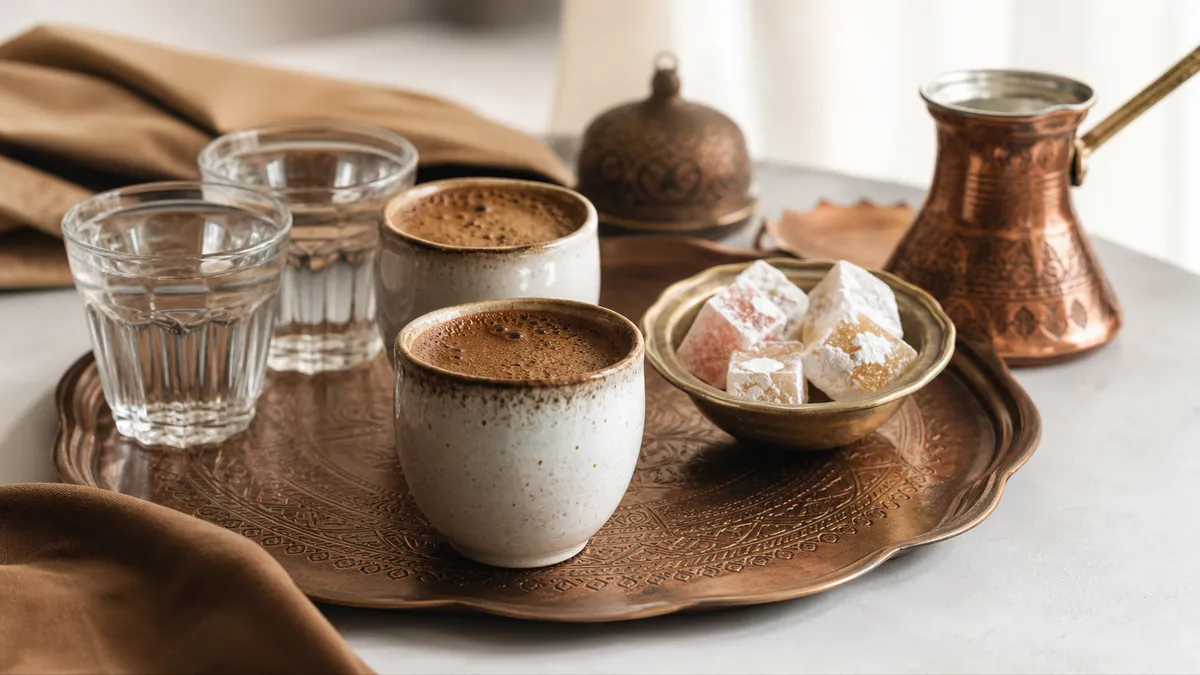
Turkish coffee rituals turn preparing and sharing a small cup of coffee into an act of hospitality: sweetness is agreed before brewing, foam is carefully preserved, and coffee arrives with water and often something sweet. Conversation is central, while fortune reading and marriage customs give the drink further ceremonial meaning. UNESCO inscribed Turkish coffee culture and tradition on its Representative List of the Intangible Cultural Heritage of Humanity in 2013.
In short
- Ask for your preferred sweetness before brewing: sade, az şekerli, orta or şekerli.
- The cezve is the brewing pot; the fincan is the small serving cup.
- Foam is part of the presentation, and the coffee is served unfiltered.
- Water traditionally comes before the coffee to refresh the palate; Turkish delight is a familiar accompaniment.
- Fortune reading is a cultural pastime, while salted bridal coffee has different meanings in different accounts.
What makes Turkish coffee a ritual?
The ceremony begins with attention to the guest rather than with elaborate equipment. Asking how someone likes their coffee, preparing it accordingly and sitting down together make the drink an occasion for companionship.
Türkiye’s Ministry of Culture and Tourism describes coffee as an invitation to intimate conversation and the sharing of everyday concerns. It also records the use of more elaborate cups for special guests, showing how the serving vessel can express regard for the person receiving it.
“Ritual” need not mean a formal performance with a fixed script. Here it describes familiar actions that carry meaning: asking, preparing, offering and making time. A quiet conversation at home belongs to the tradition as much as a ceremonial family visit.
The most useful approach for a visitor is therefore curiosity rather than anxiety about etiquette. Notice what your host does, explain your preferences when asked and let the occasion develop without trying to demonstrate perfect knowledge.
For the wider context, our coffee culture guide explores how drinking habits acquire meanings beyond refreshment.
Preparation: asking before brewing
Turkish coffee is prepared with coffee ground to a fine powder, water and, when wanted, sugar. These are combined in a cezve, a small, long-handled pot, and heated slowly so that foam develops.
The coffee is not filtered before serving. Grounds accompany the liquid into the cup and settle, which is why drinking it differs from finishing a mug of filter coffee. Leave the sediment rather than treating the last mouthful as something that must be swallowed.
Choose the sweetness first
Sugar traditionally goes into the pot during preparation, not into the finished cup. Stirring it in afterwards would disturb both the settled grounds and the foam.
| Request | Meaning | Useful distinction |
|---|---|---|
| Sade | Without sugar | Plain does not mean weak |
| Az şekerli | Lightly sweetened | A little sugar |
| Orta, or orta şekerli | Medium sweetness | Between lightly sweetened and sweet |
| Şekerli, also çok şekerli for very sweet | Sweet or very sweet | Clarify if you have a particular preference |
Treat these as sweetness descriptions rather than universally fixed recipes. Official preparation guides give differing sugar quantities, so the words are more useful to a guest than memorising a supposedly exact dose.
For hosting, ask everyone before beginning. If preferences differ, plan separate preparations rather than sweetening a shared batch and hoping it suits everybody. This small act of consideration is more faithful to the ceremony than an impressive tray prepared without asking.
Why the foam matters
Foam is a deliberate part of Turkish coffee’s appearance and presentation. UNESCO’s description specifically includes slow brewing to produce it, rather than treating it as an incidental by-product.
GoTürkiye’s preparation guide describes stirring before heating, using low heat, lifting the pot as the coffee rises and sharing foam between the cups before completing the pour. The aim is a carefully presented serving, not an aggressively bubbling pot.
For a beginner, the useful distinction is between watching the coffee rise and leaving it unattended to boil. Stay beside the pot and respond to what you can see.
If you are serving several guests, give each cup attention. Distributing the foam is a practical expression of that care. There is little value in creating a beautifully foamed first cup if the remaining guests receive visibly neglected servings.
The small cup should not be mistaken for espresso merely because the serving looks compact. For that separate tradition, see Italian espresso customs.
Serving water and sweets
A small glass of water and a piece of lokum, or Turkish delight, are familiar companions to Turkish coffee. GoTürkiye describes drinking the water first to cleanse the palate before tasting the coffee.
The sweet provides a contrasting flavour alongside the concentrated drink. It is an accompaniment, not evidence that every cup must itself contain sugar: someone choosing sade may still enjoy Turkish delight beside it.
Other offerings are documented too. The Ministry of Culture and Tourism lists chocolate and confectionery among the things served to guests with coffee. Lokum is recognisable, but it is not the only possible expression of hospitality.
As a guest, begin with the water if you want to follow the conventional sequence, then take your time with the coffee. As a host, put the water within easy reach and make the accompaniment easy to share.
Avoid turning the tray into an etiquette examination. The useful lesson is that serving coffee involves considering the whole experience, including what the guest tastes before and alongside it.
For another hospitality tradition with its own conventions, read Arabic coffee traditions separately rather than assuming that all small-cup coffee services follow the same rules.
Fortune reading: telve and fal
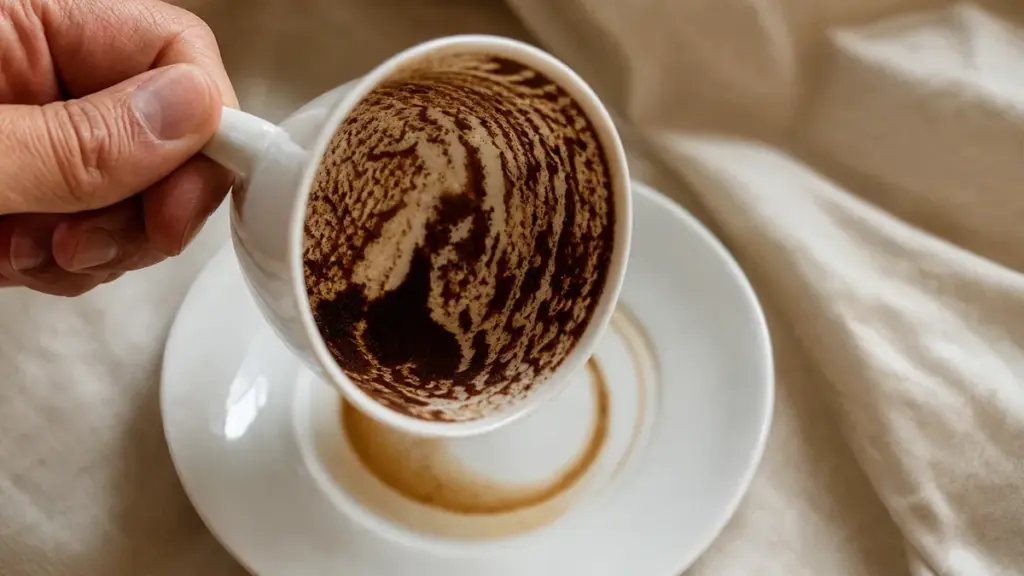
Telve means the coffee grounds left behind; fal means fortune-telling. In coffee reading, the shapes made by those grounds become material for interpretation.
Türkiye’s periodic report to UNESCO describes a sequence in which the drinker finishes the coffee, makes a wish, turns the cup upside down onto its saucer and leaves it to cool. The resulting marks are then interpreted as entertainment.
That framing matters. Present fortune reading as folklore and a social pastime, not as a verified way to predict events or make consequential decisions. You can appreciate its imaginative storytelling without accepting its predictions.
The Ministry’s cultural history describes an established vocabulary of images, but also the reader’s freedom to find new figures and meanings. It is therefore misleading to treat every mark as though it belonged to one authoritative decoding chart.
If someone offers to read your cup, ask them to explain what they see. That is a better introduction than trying to memorise symbols in advance. If you would rather not participate, a courteous refusal leaves plenty of room to enjoy the coffee and conversation.
Weddings, proposals and salted coffee
Coffee has a recognised place in engagement and marriage-related gatherings. GoTürkiye describes the bride-to-be preparing and serving coffee to the prospective groom and his elders during a visit before the wedding.
This distinction is worth keeping: the well-known family coffee ritual is not necessarily an event at the wedding reception itself. When describing a particular occasion, follow the family’s account rather than applying one label to every marriage custom.
What does salt in the groom’s coffee mean?
Accounts differ. Beşir Ayvazoğlu’s Ministry-published Turkish Coffee Culture describes salt replacing sugar as a way for a woman to signal unwillingness to marry the prospective groom.
A contemporary participant interviewed by SBS describes a different interpretation: drinking the salted coffee without complaint demonstrates acceptance and willingness to endure difficulty. His own account also shows that a bride may choose not to serve an unpleasant drink despite relatives encouraging the custom.
These are different meanings attached to a practice, not grounds for declaring one universal explanation. Historical accounts and present-day participants can describe different intentions.
For visitors, the sensible rule is not to introduce salt as a surprise joke. Let the people involved explain whether the custom belongs in their celebration. Respecting their choice matters more than reproducing something seen online.
What UNESCO recognised in 2013
The inscription’s exact name is “Turkish coffee culture and tradition”, reference 00645. Türkiye’s element was inscribed in 2013 on UNESCO’s Representative List of the Intangible Cultural Heritage of Humanity.
Its scope extends beyond the beverage. UNESCO’s description brings together preparation, hospitality, friendship, social occasions, fortune reading and the informal transmission of knowledge within families.
This is recognition of a living cultural practice, not simply a cup design or a recipe. The distinction helps explain why an article about Turkish coffee rituals needs to discuss the relationship between host and guest as well as the pot.
The Ministry also describes learning through observation and participation at home, alongside professional transmission in coffeehouses. Watching someone make coffee and gradually taking part is itself part of how the tradition continues.
For a different ceremonial structure, explore the Ethiopian coffee ceremony without treating it as interchangeable with Turkish service.
A thoughtful hosting checklist
Use this as a practical approach, not a claim that every household follows identical rules.
- Ask first. Establish who wants coffee and how sweet each person would like it.
- Prepare the setting. Put out small cups, saucers, drinking water and an optional sweet accompaniment before heating the coffee.
- Give preparation your attention. Keep the pot under observation and preserve the foam rather than rushing to serve.
- Make room for conversation. Arrange the occasion so guests can sit comfortably rather than feeling expected to finish and leave.
- Explain unfamiliar details lightly. Mention the grounds if someone is new to the drink, without turning the invitation into a lecture.
- Keep additional customs optional. Offer fortune reading only if it interests those present, and leave marriage-related practices to the people concerned.
For Turkish coffee rituals at home, prioritise attentive hospitality over elaborate staging. A considerate invitation is a better starting point than trying to reproduce every custom at once.
FAQ
Must Turkish coffee be made over hot sand?
No, hot sand is not required for the preparation described by UNESCO. Its account specifies slow brewing on a stove, and GoTürkiye also gives a direct-heat method. If you are introducing the tradition at home, concentrate on careful preparation and serving rather than assuming that a sand-heating display is essential.
Is there a fixed number of times the coffee must rise?
The official guides consulted do not give one identical sequence. GoTürkiye describes two rises, while a Ministry recipe includes further reheating. Follow a coherent preparation method rather than treating a particular count as a universal cultural requirement. For this ceremony, attentive handling and thoughtful serving are the more useful lessons.
Does everyone have their fortune read after coffee?
No, fortune reading should not be treated as a compulsory final stage. UNESCO recognises it as part of the wider tradition, and Türkiye’s periodic report describes it as entertainment. Enjoying the coffee without having the grounds interpreted is entirely compatible with approaching the occasion respectfully.
Where to go next
Read Arabic Coffee Traditions and Ethiopian Coffee Ceremony to explore other forms of ceremonial hospitality in their own contexts. Asian Coffee Traditions offers a broader next step, while Coffee Culture brings the related guides together.
Sources
-
UNESCO, Turkish coffee culture and tradition, inscription 2013, nomination file 00645.
https://ich.unesco.org/en/RL/-00645
Official listing, inscription year and description of the cultural practice. -
Türkiye Ministry of Culture and Tourism, Turkish Coffee Culture and Tradition, undated web page.
https://yakegm.ktb.gov.tr/TR-345121/turkish-coffee-culture-and-tradition.html-0
Hospitality, special serving cups and transmission through families and coffeehouses. -
Türkiye Ministry of Culture and Tourism, Turkish Coffee, undated web page.
https://www.ktb.gov.tr/EN-98850/turkish-coffee.html
Sweetness terminology, preparation sequence and confectionery accompaniments. -
GoTürkiye, Turkish Coffee, İstanbul guide, undated web page.
https://goturkiye.com/istanbul/turkish-coffee
Utensils, foam handling, water and pre-wedding coffee service. -
GoTürkiye, Google Arts & Culture, How Do You Like Your Turkish Coffee?, undated exhibition.
https://artsandculture.google.com/story/how-do-you-like-your-turkish-coffee-turkey-tourism-promotion-and-development-agency/FwWx6miQWc95BQ
Unfiltered preparation, sugar added during brewing, water and lokum. -
Beşir Ayvazoğlu, Republic of Turkey Ministry of Culture and Tourism, Turkish Coffee Culture, first edition, 2011.
https://teda.ktb.gov.tr/Eklenti/6594%2Cturkishcoffeeculturepdf.pdf
Marriage customs, telve and the interpretation of coffee-ground patterns. -
Türkiye, submitted to UNESCO, Periodic Report (Convention), section C00645, undated report containing developments through 2021.
https://ich.unesco.org/doc/src/Signed%20periodic%20report%20-%20Periodic%20report-53872.pdf
Cup inversion, wishing, cooling and fortune reading as entertainment. -
SBS Food, Lee Tran Lam, This TikTok coffee trend is also a Turkish wedding custom, updated 14 December 2023.
https://www.sbs.com.au/food/article/this-tiktok-coffee-trend-is-also-a-turkish-wedding-custom/eycy8jvio
First-person testimony about salted coffee and a family choosing not to serve it.
Research combined UNESCO documentation, official Turkish cultural and tourism material, a Ministry-published cultural history and first-person testimony, distinguishing documented customs from suggested hosting etiquette.
Last checked: November 2026