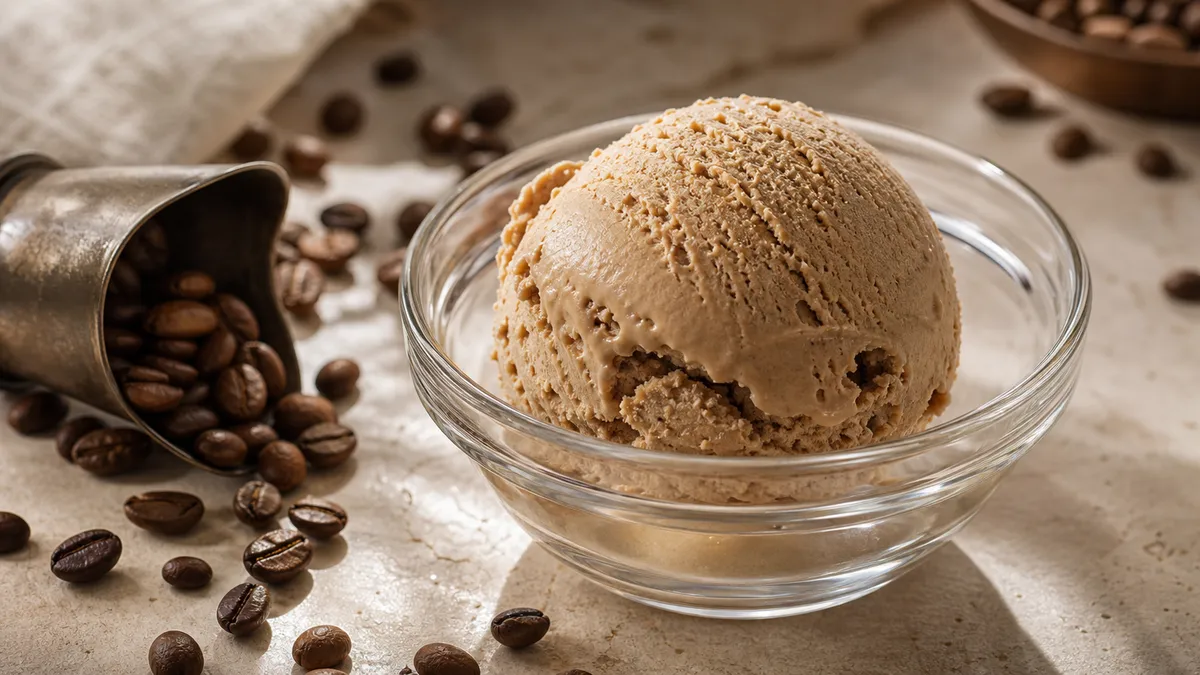
Make coffee ice cream by flavouring a milk-and-cream custard, cooling it quickly, then churning and freezing it. Instant coffee is the simplest starting point, while espresso and whole-bean infusion offer alternatives; the keys to smoothness are a thoroughly chilled base, controlled water content and prompt freezing.
In short
- Use soluble instant coffee or instant espresso powder, not ground espresso coffee, for the recipe below.
- Heat the egg custard to at least 75°C for 30 seconds, checking with a clean thermometer, then cool it promptly.
- Refrigerate the cooled base for at least 4 hours, preferably overnight, before churning.
- Sugar affects softness as well as sweetness, so reducing it substantially changes the texture.
- No machine? Use a whipped-cream and condensed-milk base rather than simply freezing unchurned custard.
Homemade Coffee Ice Cream
A custard base combines milk, cream, sugar and egg yolks. Gentle heating thickens the mixture, while yolk emulsifiers help control the relationship between fat and water; freezing and churning then create the ice crystals and air bubbles that give ice cream its structure.
For a first batch, soluble coffee removes the need to strain beans or account for a substantial addition of brewed liquid. The recipe below uses that approach, followed by instructions for adapting it to espresso or whole beans. For other ways to use coffee in puddings, browse coffee desserts.
Recipe card: churned coffee custard ice cream
Serves: 8
Preparation and cooking: allow approximately 30 minutes
Chilling: at least 4 hours, preferably overnight
Churning: according to your machine’s instructions
Final freezing: allow approximately 4 hours, or until scoopable
Allergens: milk and egg
The quantities and preparation allowances below are this article’s suggested formulation. The custard, chilling and churning methods draw on published ice-cream-making guidance; this is not a report of first-hand kitchen testing.
Ingredients
- 350 g pasteurised whole milk
- 300 g pasteurised double cream
- 130 g caster sugar
- 80 g egg yolks, weighed without whites
- 8 g soluble instant coffee or instant espresso powder
- 1 g fine salt
- Ice and cold water, for cooling
Equipment: digital scales, saucepan, heatproof spatula, whisk, clean probe thermometer, fine sieve, two bowls for an ice bath, ice-cream machine and a shallow freezer-safe container with a lid.
Approximate caffeine: 25 to 45 mg per serving, specifically if using Nescafé Original or Gold at the manufacturer’s published range of 50 to 90 mg per 2 g. The calculation is 8 g ÷ 2 g × 50 to 90 mg = 200 to 360 mg in the batch, divided into eight equal portions. Other coffees need their own manufacturer’s figures.
Pregnancy and sensitivity note: this estimate is not a measured result. The NHS advises no more than 200 mg caffeine daily from all sources during pregnancy. Individual sensitivity varies; speak to a GP, pharmacist or midwife about personal concerns.
Method
-
Prepare the equipment. If your machine has a removable freezer bowl, freeze it according to its instructions. Set a clean bowl inside a larger bowl containing ice and cold water, keeping the water below the inner bowl’s rim.
-
Warm the dairy. Put the milk, cream, coffee and salt into the saucepan. Heat gently, stirring until the coffee dissolves and the mixture is steaming, without boiling.
-
Combine the yolks and sugar. Whisk them together in a separate bowl. Gradually pour in the hot dairy while whisking, then return everything to the saucepan. This gradual mixing, called tempering, helps avoid localised overheating of the yolks.
-
Cook safely. Stir continuously over gentle heat, scraping the bottom and corners. Bring the whole mixture to 75°C and maintain it at or above that temperature for 30 seconds, checking with a clean probe without touching the pan’s base. Continue gently if necessary until the custard lightly coats the spatula, but do not boil it. Spoon-coating alone is not a safety check.
-
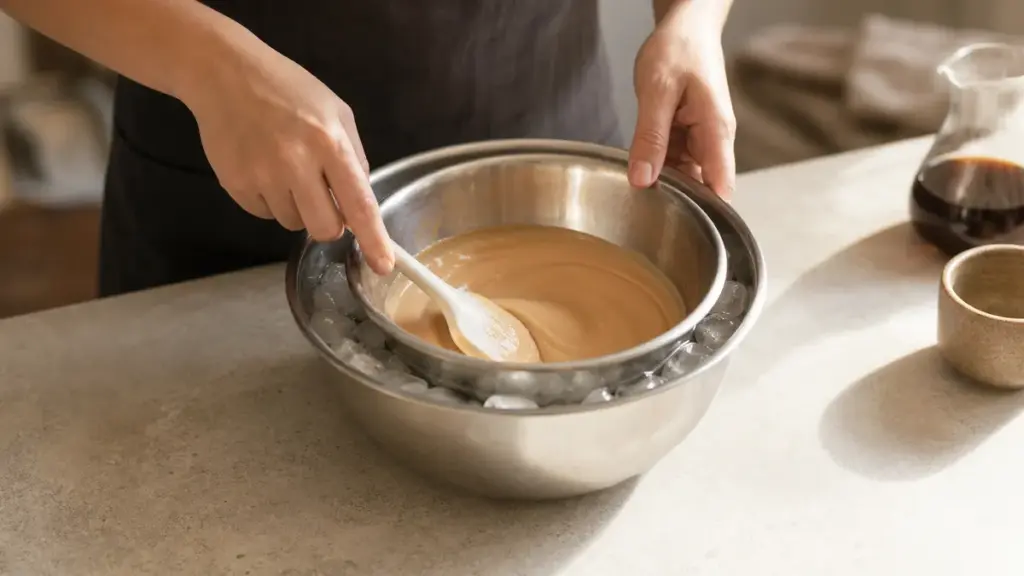
Strain and cool promptly. Pour through the sieve into the bowl over ice. Stir with a clean utensil, replenish the ice as needed and prevent bath water entering the custard. Once cooled, cover and refrigerate promptly, within one to two hours of finishing cooking. Do not leave the saucepan out to cool overnight.
-
Chill thoroughly. Keep the base in a fridge operating between 0 and 5°C for at least four hours, preferably overnight. It should be cold throughout before entering the machine.
-
Churn. Follow the machine’s instructions and maximum fill line. Stop when the mixture resembles thick soft-serve ice cream rather than waiting for a firm, freezer-ready scoop. Churning freezes part of the water while incorporating air.
-
Harden. Transfer immediately to the shallow container, cover and freeze until firm enough to scoop. Keep the freezer around minus 18°C. Fast hardening and steady cold storage help limit further ice-crystal growth.
Infusing beans versus adding espresso
These methods are alternatives, not additions to the instant coffee. Changing the coffee source also changes the caffeine estimate, so do not carry the recipe card’s figure across to either variation.
| Method | Main advantage | Main limitation | Best suited to |
|---|---|---|---|
| Soluble instant coffee | Dissolves without straining or much added water | Flavour depends on the product | A straightforward first batch |
| Whole-bean infusion | Flavours the dairy without adding brewed water | Needs steeping and straining | Exploring a particular coffee |
| Espresso | Uses freshly brewed coffee | Adds water and varies between shots | Someone with an espresso machine |
Published recipes support all three approaches, but they are not directly interchangeable by weight. Whole beans must be removed, while brewed espresso introduces liquid that can make the finished ice cream icier if added without adjustment.
Whole-bean infusion
As a suggested starting variation, omit the instant coffee and warm 60 g whole roasted beans with the recipe’s milk and cream. Remove from the heat, cover and steep for 30 minutes, then strain before proceeding with the custard.
Weigh the strained dairy and replace what the beans retained with fresh milk, bringing it back to 650 g. Reheat it, then continue with the yolks and sugar. These quantities are an editorial starting point, not a claim that every roast extracts identically; whole-bean infusion is a published ice-cream technique.
Whole beans are convenient to strain. Ground coffee is another established approach, but fine particles can remain in the custard and give a less smooth finish. Do not grind the beans simply because you would grind them for brewing a drink.
Espresso
For a suggested espresso variation, omit the instant coffee, use 290 g milk instead of 350 g and add 60 g freshly brewed espresso to the dairy before making the custard. Keep the cream, sugar and yolks unchanged.
Replacing some milk is preferable to pouring an unrestricted quantity of coffee into the finished base. It keeps the overall batch weight similar, although espresso does not replace milk’s fat, protein and other solids, so the two versions will not have identical texture.
Do not use the instant-coffee caffeine estimate for this version. Unless your coffee supplier provides a suitable figure for the prepared espresso, a precise serving estimate would be misleading.
Churning or no-churn: which should you choose?
Choose the custard recipe if you have an ice-cream machine and want a traditional churned result. For equipment-free preparation, whipped cream and sweetened condensed milk provide a different structure: the air is incorporated before freezing rather than during it.
A simple no-churn alternative
For a suggested alcohol-free adaptation, use:
- 300 g cold double cream
- 175 g sweetened condensed milk
- 8 g soluble instant coffee
- 10 ml hot water
Dissolve the coffee in the water and cool it completely. Mix it into the condensed milk. Whip the cream to soft peaks, fold in the coffee mixture, transfer to a lidded container and freeze for at least 6 hours, preferably overnight. This adapts Nigella Lawson’s published cream-and-condensed-milk method, omitting its coffee liqueur; allow brief softening before serving if necessary.
Divide into six portions. With the same Nescafé products used for the earlier calculation, estimated caffeine is approximately 33 to 60 mg per portion. The same pregnancy and sensitivity note applies.
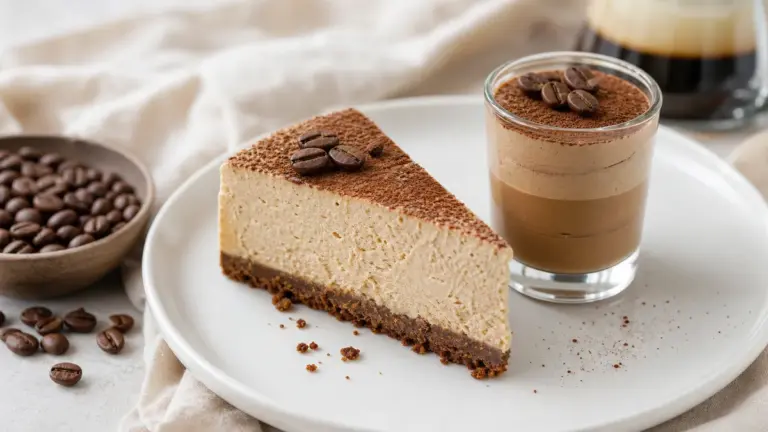
Simply freezing the liquid custard is not equivalent to this no-churn method: it lacks both the machine’s freezing action and the whipped base’s pre-incorporated air. For another chilled dessert, see coffee cheesecake and mousse.
Texture tips and troubleshooting
Smooth ice cream is a balance of ice, unfrozen liquid, fat and air. Small ice crystals are less noticeable on the tongue, while dissolved sugar allows some water to remain unfrozen at freezer temperatures. This is established food-science teaching, rather than evidence that one domestic recipe is uniquely best.
Keep the sugar proportion intact for your first attempt. Removing a large amount may make the flavour less sweet, but it also allows more water to freeze and produces a harder result. Changing sweeteners is a formulation change, not a neutral substitution.
Start cold and finish quickly. Thorough chilling prepares the base for freezing, while prompt transfer to a cold freezer limits crystal growth after churning. Avoid repeatedly softening the whole container and putting it back: partial melting and refreezing encourage coarser crystals.
| Symptom | Likely cause | Fix |
|---|---|---|
| Hard, difficult-to-scoop ice cream | Low serving temperature or substantially reduced sugar | Let the portion soften briefly; retain the stated sugar next time |
| Coarse or icy texture | Slow freezing, excess brewed coffee or temperature cycling | Chill thoroughly, control coffee additions and freeze promptly |
| Eggy lumps in the custard | Local overheating or inadequate stirring | Use gentle heat and scrape continuously; strain immediately |
| Greasy or buttery particles | Excessive whipping or churning | Stop at soft peaks for no-churn, or soft-serve consistency when churning |
These are diagnostic possibilities, not proof of a single cause. Sugar, freezing conditions, custard handling and fat destabilisation can each affect the result.
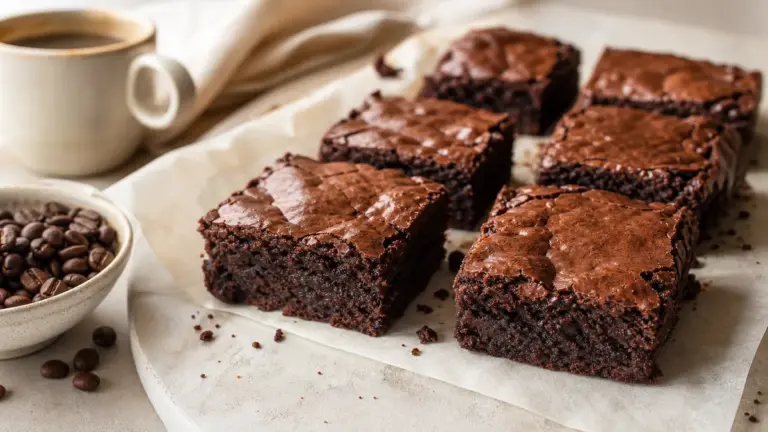
For serving, pair a small scoop with espresso brownies, keeping the brownie recipe separate from the ice-cream base.
FAQ
Can I make it with decaffeinated coffee?
Yes, use a soluble decaffeinated coffee in place of the regular instant coffee. Check that it dissolves rather than leaving grounds behind. Do not describe the result as caffeine-free or reuse the regular-coffee estimate: obtain a figure for the decaffeinated product if caffeine content matters to the person eating it.
How far ahead can I make the custard?
Make it the day before churning and refrigerate it promptly after rapid cooling. Overnight chilling is a published recommendation for ice-cream bases. Keep the fridge between 0 and 5°C, respect ingredient use-by dates and avoid extending storage unnecessarily; the FSA’s general advice is to eat refrigerated leftovers within two days or freeze them.
Can I leave out the eggs?
Not as a direct substitution in this custard recipe. The yolks contribute thickening and emulsification, so removing them changes the base rather than merely removing an ingredient. Use the egg-free no-churn alternative above instead, or follow a separately formulated egg-free churned recipe. The no-churn version still contains milk.
Where to go next
Read Coffee Desserts to choose your next pudding, or Espresso Brownies for a baked accompaniment to coffee ice cream. Tiramisu offers another approach to a chilled coffee dessert, while Coffee Cheesecake and Mousse explores alternatives that do not need churning.
Sources
-
Food Standards Agency, Cooking your food, 2017, current online guidance. Safe cooking temperature and holding-time combinations.
https://www.gov.uk/government/publications/cooking-your-food/cooking-your-food -
Food Standards Agency, How to chill, freeze and defrost food safely, 2017, current online guidance. Cooling, refrigeration, freezing and storage advice.
https://www.gov.uk/government/publications/how-to-chill-freeze-and-defrost-food-safely/how-to-chill-freeze-and-defrost-food-safely -
David Lebovitz, Coffee Cajeta Ice Cream, 2017. Coffee infusion, custard preparation, chilling and discussion of espresso substitution.
https://www.davidlebovitz.com/coffee-cajeta-chocolate-chip-ice-cream-recipe/ -
Nigella Lawson, One-Step No-Churn Coffee Ice Cream, from Nigellissima, 2012. Cream, condensed milk and soluble-coffee method.
https://www.nigella.com/recipes/one-step-no-churn-coffee-ice-cream -
University of Guelph, H. Douglas Goff, Ice Cream Technology e-Book, undated online edition. Chapters consulted: “Freezing/Whipping of Ice Cream”, “Sweeteners”, “Emulsifiers” and “Hardening”.
https://books.lib.uoguelph.ca/icecreamtechnologyebook/chapter/freezing-whipping-of-ice-cream/
https://books.lib.uoguelph.ca/icecreamtechnologyebook/chapter/sweeteners/
https://books.lib.uoguelph.ca/icecreamtechnologyebook/chapter/emulsifiers/
https://books.lib.uoguelph.ca/icecreamtechnologyebook/chapter/hardening/ -
University of Guelph, H. Douglas Goff, Finding Science in Ice Cream, undated. Ice crystals, sugar, fat structure and temperature cycling.
https://foodscience.uoguelph.ca/sites/default/files/FindingScienceInIceCream.pdf -
Nescafé UK and Ireland, General FAQs, undated current manufacturer guidance. Published caffeine range for Original and Gold instant coffees.
https://www.nescafe.com/gb/faqs -
NHS, Foods to avoid in pregnancy, reviewed 15 June 2026. Pregnancy caffeine guidance.
https://www.nhs.uk/pregnancy/keeping-well/foods-to-avoid/ -
European Food Safety Authority, Caffeine, current topic page summarising its 2015 scientific opinion. Caffeine sensitivity and the scope of its safety assessment.
https://www.efsa.europa.eu/en/topics/topic/caffeine
This article was researched from official food-safety guidance, university food-science teaching, published recipes and manufacturer caffeine information; its suggested formulations were not independently kitchen-tested.
Last checked: November 2026