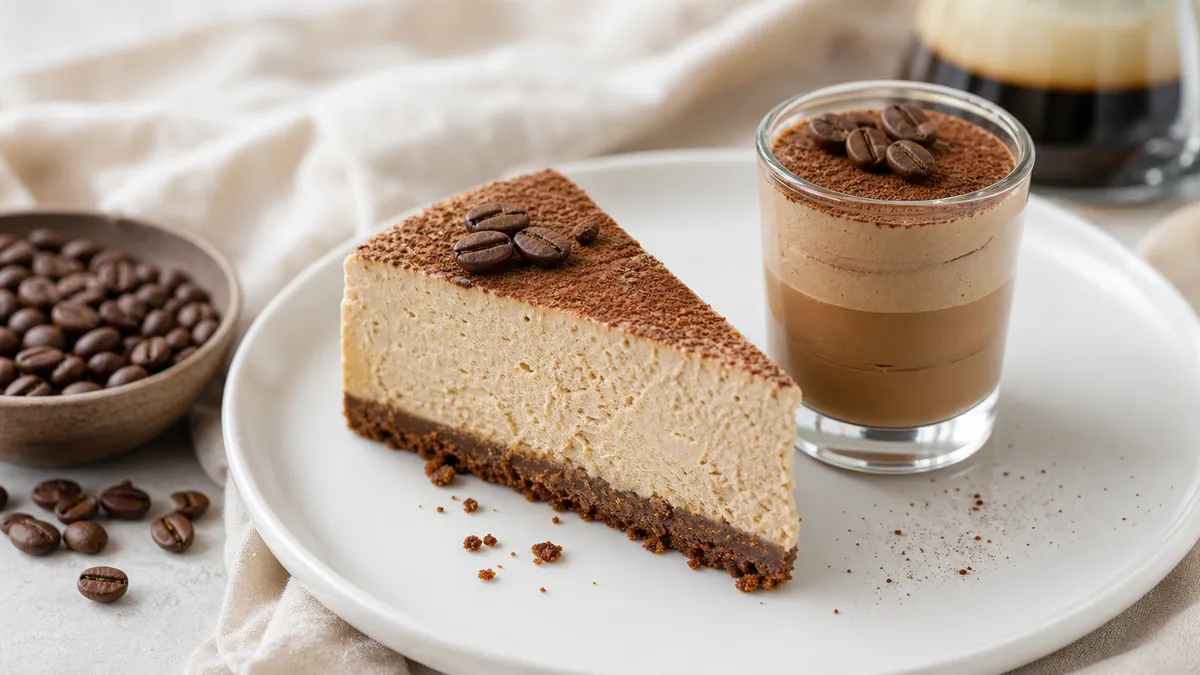
Coffee cheesecake and mousse need concentrated coffee flavour without enough extra water to loosen the filling. These two chilled recipes use dissolved instant coffee: a no-bake cheesecake that sets overnight and an egg-free mascarpone mousse ready after at least two hours in the fridge.
In short
- Use full-fat cream cheese and double cream for the cheesecake; reduced-fat substitutions are not a direct swap.
- Dissolve the coffee first, then cool it completely before adding it to either filling.
- Allow an overnight chill for the cheesecake and at least two hours for the mousse.
- Both fillings contain no eggs and need no gelatine, but they still require careful refrigeration.
- Keep the desserts covered at 0 to 5°C and, as a cautious household rule, finish them within 48 hours of making them, or sooner if an ingredient’s instructions require it.
Getting the coffee strength right
For these recipes, instant coffee is a practical choice rather than a compromise: it delivers coffee flavour in a small, measured quantity of water. Use plain soluble coffee, not ground espresso beans or a sweetened instant latte mixture.
The cheesecake uses 8 g instant coffee dissolved in 25 ml hot water. The mousse uses 4 g dissolved in 15 ml hot water. These are recipe concentrates, not drinks or standard brewing ratios.
Stir until no granules remain, then leave the concentrate to cool completely. A shallow heatproof dish helps you spread it out rather than leaving a hot pool at the bottom of a mug.
Do not replace these concentrates with a mug of filter coffee. That would change the amount of liquid substantially. Espresso can flavour chilled desserts, but it is not an exact substitute here because its concentration varies; use a recipe formulated for brewed espresso rather than simply adding extra shots.
For other ways to build a pudding around coffee, start with the coffee desserts guide.
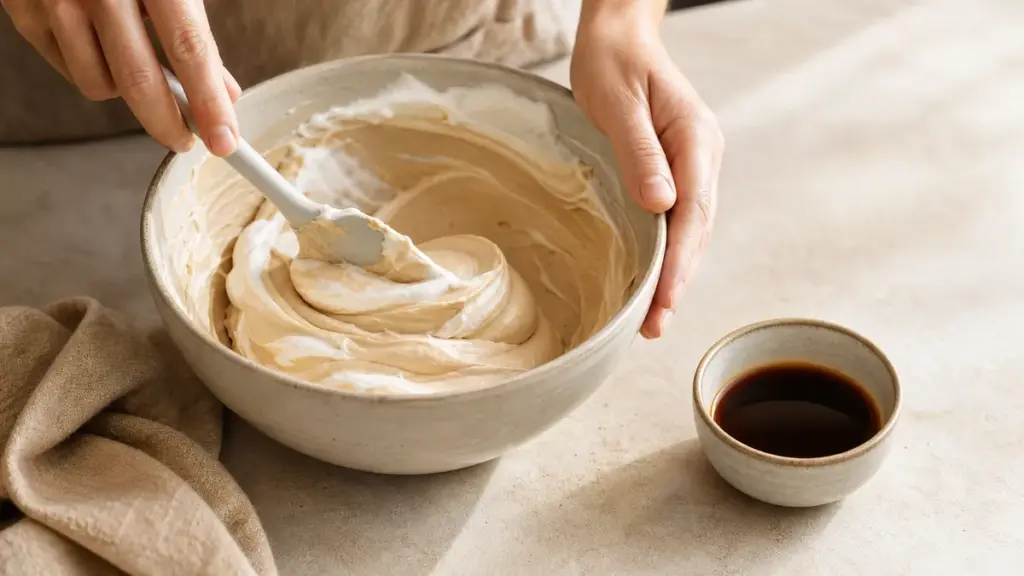
No-bake coffee cheesecake recipe
This is a softly creamy, sliceable cheesecake with a digestive biscuit base. It sets in the fridge rather than the oven, so plan to make it the day before serving.
Recipe card
Serves: 12
Equipment: 23 cm springform tin, baking parchment, scales, measuring jug, mixing bowls, electric whisk, spatula and a food processor or rolling pin
Preparation: approximately 25 minutes
Chilling: one hour for the base, then overnight for the assembled cheesecake
Cooking: none, apart from melting the butter
Ingredients
For the base
- 250 g digestive biscuits
- 100 g unsalted butter, melted
For the filling
- 600 g full-fat plain cream cheese
- 100 g icing sugar, sifted
- 300 ml double cream, chilled
- 8 g plain instant coffee
- 25 ml hot water
Use pasteurised dairy products. Check the biscuit ingredients for allergens and any dietary requirements.
Method
- Prepare the tin. Line the base with baking parchment. Leave enough clear space in the fridge for the tin to sit level.
- Make the biscuit base. Crush the digestives into fine crumbs. Mix thoroughly with the melted butter, press evenly into the tin and refrigerate for one hour. Aim for a level, compact base rather than crushing it into a very hard slab.
- Prepare the coffee. Dissolve the 8 g instant coffee in 25 ml hot water. Stir thoroughly and cool completely before continuing.
- Mix the cheese filling. Briefly beat the cream cheese and icing sugar until smooth. Mix in the cooled coffee concentrate, scraping around the bowl so the colour is even.
- Thicken with cream. Add the cold double cream and whisk on a moderate setting until the mixture is thick and holds its shape. Stop to check frequently. It should mound on a spoon rather than pour in a ribbon.
- Fill and chill. Spoon onto the cold biscuit base, pressing gently into the edges. Smooth the surface, cover without touching the filling and refrigerate overnight.
- Unmould and serve. Check that the centre holds its shape before releasing the tin. Loosen the edge carefully and transfer to a serving plate. For neater slices, wipe the knife clean between cuts.
Approximate caffeine: about 17 to 30 mg per slice, when cut into 12 equal portions and made with an instant coffee matching the manufacturer’s published range of 50 to 90 mg per 2 g. Calculation: 8 g ÷ 2 g × 50 to 90 mg ÷ 12. Other products may differ. Include dessert in your daily caffeine intake; in pregnancy, the NHS advises no more than 200 mg daily from all sources. Individual sensitivity varies.
What a properly set cheesecake looks like
The filling should remain upright when the ring is removed, with a creamy cut surface rather than a rubbery texture. This recipe has neither gelatine nor a baked egg structure, so do not expect the dense firmness of a baked cheesecake.
Keep the ingredient proportions intact on the first attempt. More coffee liquid, a different cream product or reduced-fat cheese changes the formulation, not just the flavour.
If the cheesecake is still too soft to cut after its overnight chill, spoon it into dishes rather than repeatedly attempting to unmould it. That rescues the presentation, provided it has remained safely refrigerated; it does not correct unsafe storage.
Egg-free coffee mousse recipe
This is a mascarpone and whipped-cream mousse, not a raw-egg or cooked-egg mousse. Mascarpone gives it body, while whipped cream supplies the air, so the finished texture is rich and spoonable rather than sharply sliceable.
Recipe card
Serves: 4
Equipment: scales, measuring jug, two mixing bowls, electric or hand whisk, spatula and four small serving glasses
Preparation: approximately 15 minutes, plus cooling the coffee
Chilling: at least two hours
Cooking: none
Ingredients
- 250 g mascarpone
- 200 ml double cream, chilled
- 40 g icing sugar, sifted
- 4 g plain instant coffee
- 15 ml hot water
Use pasteurised mascarpone and cream.
Method
- Dissolve the coffee. Mix the instant coffee with the hot water until smooth. Leave to cool completely.
- Prepare the mascarpone. Stir it briefly with the icing sugar and cooled coffee until evenly combined. Avoid prolonged beating.
- Whip the cream separately. Whisk until it forms soft peaks: when you lift the whisk, the cream makes a peak whose tip bends over.
- Lighten the mixture. Stir a spoonful of whipped cream into the mascarpone. Fold in the remainder gently with a spatula, lifting mixture from the bottom and turning the bowl until no pale streaks remain.
- Portion and chill. Divide between four glasses, cover and refrigerate for at least two hours. Serve directly from the glasses.
Approximate caffeine: about 25 to 45 mg per serving, using an instant coffee matching the published range of 50 to 90 mg per 2 g. Calculation: 4 g ÷ 2 g × 50 to 90 mg ÷ 4. This is an estimate, not an analysis of the finished dessert. In pregnancy, count it towards the NHS limit of 200 mg daily from all sources; people sensitive to caffeine should take their usual precautions.
For a contrasting texture alongside a small mousse portion, see espresso brownies, rather than adding dense brownie pieces to the mousse itself.
Why the fillings set, and what can go wrong
Whipped cream is a foam: air pockets are supported by a structure involving milk fat. Whisking creates that structure, but excessive whisking can break it down, producing a grainy mixture and eventually separating butterfat from liquid.
This explains why “whisk for longer” is not a universal fix. Watch the texture rather than relying on a fixed mixing time, because the equipment, cream temperature and quantity all affect how quickly it thickens.
The cheesecake needs a mixture thick enough to support a slice. The mousse needs enough structure to hold air in a glass, but not enough to stand unsupported. Neither should be treated like a gelatine-set dessert.
| Symptom | Likely cause | What to do |
|---|---|---|
| Cheesecake filling pours before chilling | Mixture is insufficiently thickened, or the ingredients have been changed | If the specified ingredients were used, whisk briefly and reassess; do not keep beating once graininess appears |
| Cheesecake slumps when unmoulded | Insufficient chilling or an overly loose filling | Leave overnight before checking; serve in dishes if it still cannot support a slice |
| Cream becomes grainy while whipping separately | Overwhipping | Stop immediately; slightly overwhipped cream can sometimes be recovered by gently adding cold liquid cream |
| Mousse tastes uneven, with bitter specks | Coffee was not fully dissolved | Dissolve the coffee thoroughly before combining; do not sprinkle extra granules into the finished mousse |
| Mousse is dense rather than airy | Cream was insufficiently aerated or much of the air was lost during mixing | Whip separately to soft peaks and fold gently rather than beating the combined mixture |
Chilling, egg safety and serving
Both fillings are egg-free as written. That avoids handling raw eggs, but it does not make the desserts safe to leave unrefrigerated: cream cheese, mascarpone and cream still need chilled storage.
Keep them covered in a fridge operating at 0 to 5°C, following the dairy products’ storage and use-by instructions. For these household recipes, use a cautious 48-hour maximum from preparation, including the setting time, and shorten that if an ingredient requires it. Bring out only the portions you intend to serve, rather than leaving the whole cheesecake or all the mousse glasses on the table.
If you choose a different mousse recipe containing raw or lightly cooked eggs, UK guidance needs more care. FSA advice for England, Wales and Northern Ireland permits British Lion or Laid in Britain hen eggs for vulnerable consumers, including pregnant people, young children and older adults. Without that assurance, use pasteurised egg products or cook the eggs thoroughly. People who are severely immunocompromised and follow a medically supervised diet need individual medical advice.
Serve the cheesecake with its biscuit base exposed and the mousse in small glasses. My preference is to keep toppings restrained so the coffee remains distinct. For a frozen alternative, follow the separate coffee ice cream recipe, rather than assuming that freezing this mousse produces the same result.
FAQ
Can I make these desserts with decaffeinated coffee?
Yes, plain decaffeinated instant coffee is the simplest substitution because you can keep the coffee and water quantities unchanged. Do not apply the regular-coffee caffeine estimates to it: those calculations use a particular manufacturer’s published range. If caffeine content matters medically, check the specific product and ask a pharmacist or GP for personal advice.
Can I make them without an electric whisk?
Yes, you can whip the cream by hand, although it takes more effort. Use a balloon whisk and judge the texture rather than trying to match an electric mixer’s timing. For the cheesecake, make sure the filling genuinely holds its shape before transferring it to the tin; chilling alone is not a substitute for adequate thickening.
Are these recipes suitable for vegetarians or people with allergies?
The fillings contain no gelatine, but check every ingredient before describing the desserts as suitable for a particular diet. Both recipes contain milk, and standard digestive biscuits commonly contain wheat. An egg-free filling is not an allergy guarantee: biscuits, other ingredients and preparation equipment also need checking for the person you are serving.
Where to go next
Read Coffee Desserts to choose your next recipe by texture and preparation method. Coffee Ice Cream takes coffee flavour into a frozen dessert, while Espresso Brownies provides a baked contrast to these chilled coffee cheesecake and mousse recipes.
Sources
-
Good Food, “How to make strawberry cheesecake”, undated. Base reference for the biscuit, cream cheese, sugar and double-cream proportions and overnight setting method.
https://www.bbcgoodfood.com/videos/hacks/how-make-strawberry-cheesecake-video -
Jane’s Patisserie, “No-Bake Mocha Cheesecake”, 2018, updated July 2026. Coffee concentrate, full-fat cheese, filling consistency and chilling guidance.
https://www.janespatisserie.com/2018/01/29/no-bake-mocha-cheesecake/ -
Un petit Oiseau dans la Cuisine, “Coffee mascarpone mousse”, 2015. Reference for the egg-free mascarpone and whipped-cream method.
https://www.unpetitoiseaudanslacuisine.com/mousse-mascarpone-au-cafe-coffee-mascarpone-mousse/ -
King Arthur Baking, “How to fix whipped cream”, 2019. Whipping stages, foam breakdown and recovery of slightly overwhipped cream.
https://www.kingarthurbaking.com/blog/2019/06/04/fix-whipped-cream -
Food Standards Agency, “How to chill, freeze and defrost food safely”, 2017, current retrieved guidance. Refrigeration, dairy storage and leftover guidance.
https://www.gov.uk/government/publications/how-to-chill-freeze-and-defrost-food-safely/how-to-chill-freeze-and-defrost-food-safely -
Food Standards Agency, “Advice on safe storage, handling and use of eggs for catering”, updated August 2026. Egg assurance schemes, pasteurised eggs and vulnerable consumers.
https://www.gov.uk/guidance/advice-on-safe-storage-handling-and-use-of-eggs-for-catering -
NHS, “Foods to avoid in pregnancy”, reviewed June 2026. Pasteurised dairy and pregnancy caffeine guidance.
https://www.nhs.uk/pregnancy/keeping-well/foods-to-avoid/ -
Nestlé, “NESCAFÉ Original Instant Coffee”, undated, current UK product page. Manufacturer’s caffeine range for Original and Gold instant coffees.
https://www.nescafe.com/gb/coffees/original
The recipes are editorial adaptations of published methods, not claimed first-hand tests; food-safety advice and caffeine calculations were checked against the official sources above.
Last checked: November 2026