The best coffee desserts give coffee a clear job: the main flavour in tiramisu or ice cream, a roasted contrast to sweet buttercream, or a supporting note in chocolate brownies. For baking, soluble espresso powder is usually the easiest way to increase coffee flavour without adding much liquid; brewed coffee works best where the recipe already allows for it.
In short
- Choose by texture: brewed coffee for soaking, soluble powder for concentrated flavour, and recipe-led quantities for custards and frozen desserts.
- Espresso powder means a soluble baking ingredient, not finely ground beans intended for an espresso machine.
- Stronger coffee means a higher concentration of dissolved coffee, not simply a darker roast or longer brewing.
- Do not replace milk freely with black coffee: milk contributes more than water.
- Keep dairy-rich desserts refrigerated at 0 to 5°C, and follow appropriate egg-safety guidance for uncooked fillings.
Which coffee dessert should you make?
Choose the eating experience first, then the coffee ingredient. A coffee-soaked sponge needs liquid; a buttercream needs concentrated flavour without becoming loose.
The suggestions below are editorial choices based on those practical differences, not a ranking of objectively superior desserts.
| Dessert | Why choose it? | Useful coffee format | Main point to control |
|---|---|---|---|
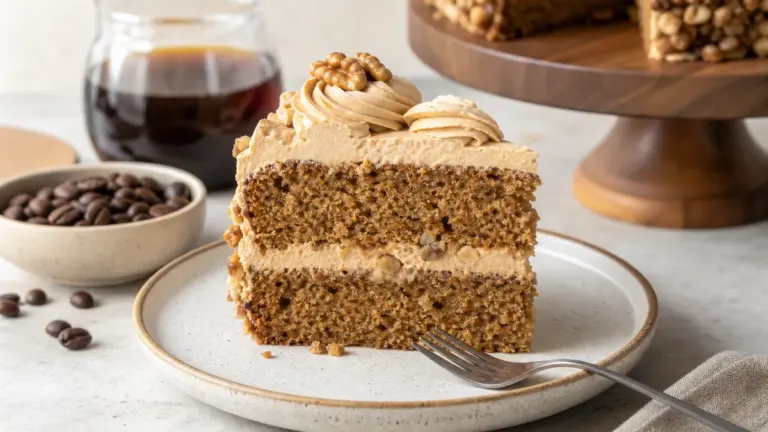
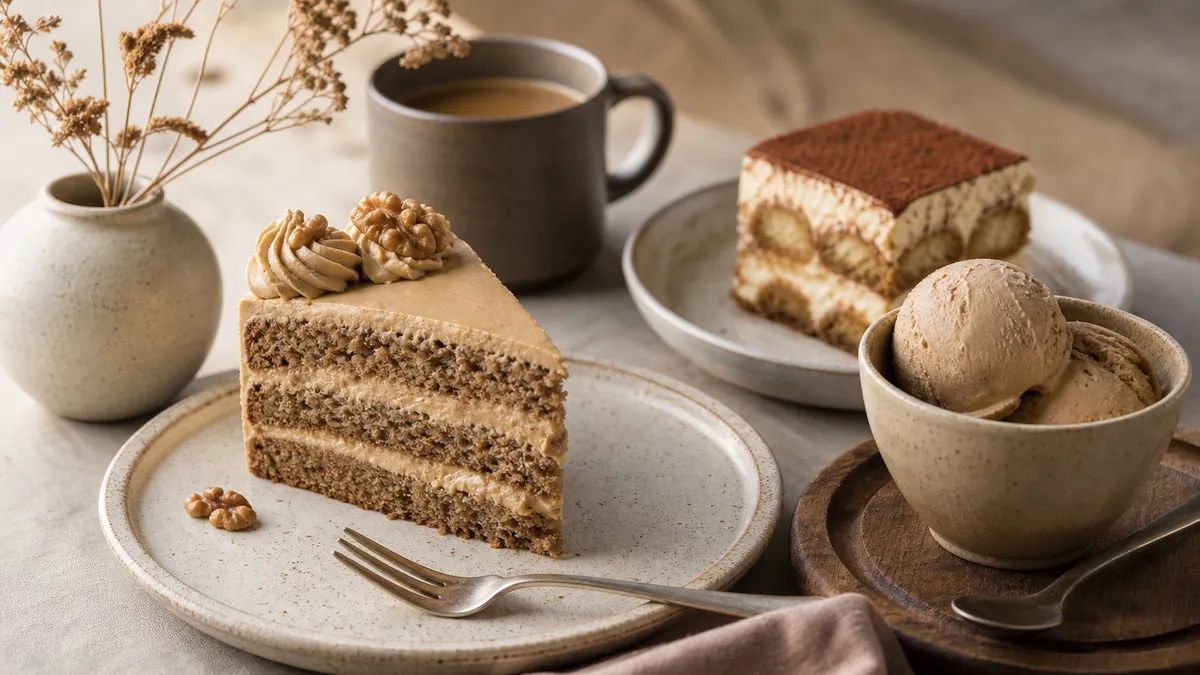
| Coffee cake | A sliceable bake with coffee in the sponge, icing or both | Soluble powder, sometimes alongside brewed coffee | Flavour without excessive liquid |
| Tiramisu | Soft coffee-soaked layers against creamy mascarpone | Brewed coffee or a dissolved espresso-powder soak | Even soaking without waterlogging |
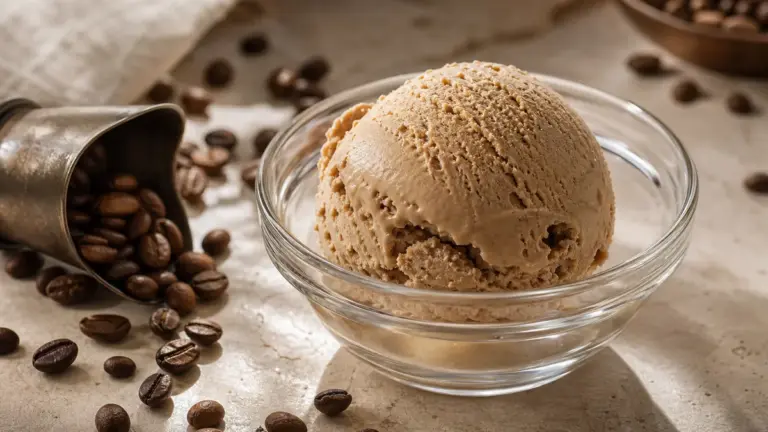
| Coffee ice cream | Coffee flavour throughout a creamy frozen dessert | Soluble powder incorporated into the base | Follow the base’s liquid and sugar balance |
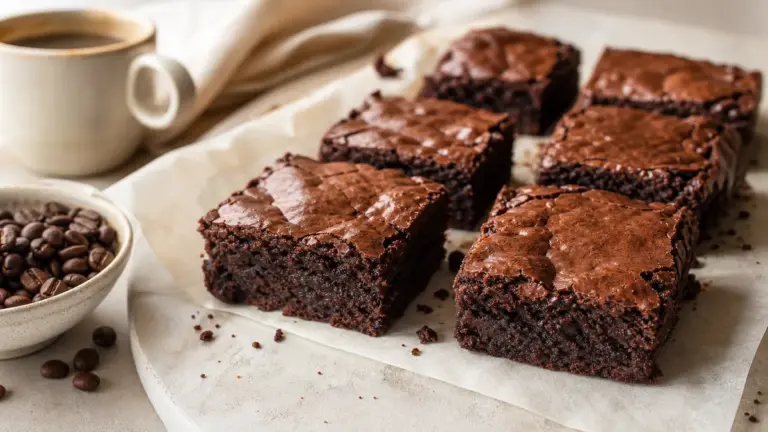
| Espresso brownies | Chocolate first, or a more obvious mocha flavour | Soluble espresso powder | Whether coffee supports or leads |
| Coffee cheesecake or mousse | A creamy dessert with concentrated coffee flavour | Usually a recipe specifying soluble coffee or espresso | Preserve the intended filling consistency |
For a first bake, my recommendation is coffee cake: you can judge the sponge and icing separately and learn where you prefer the strongest coffee note. For a make-ahead pudding, choose tiramisu, provided you have refrigerator space.
Browse the wider coffee desserts collection for individual methods. This guide explains how to choose and handle the ingredient rather than reproducing those recipes.
How coffee flavours desserts
Coffee contributes both aroma, the fragrant compounds reaching your nose, and taste, including bitterness and acidity. Roasting develops the characteristic coffee aroma through chemical reactions in the beans. Analytical research measures these volatile compounds, meaning substances that can pass into the air, rather than treating “coffee flavour” as a single ingredient.
That distinction matters in a dessert. Increasing the coffee quantity changes a whole mixture of flavour compounds, not just one pleasant roasted note. More coffee is therefore not automatically better.
Coffee as the main flavour
In coffee cake, ice cream or a coffee filling, the aim is recognisable coffee flavour in the finished portion. Judge the complete dessert, not just the coffee before it goes in.
Published cake recipes illustrate why a drinkable brew may not be enough. Sally’s Baking uses both brewed coffee and espresso powder in its espresso chocolate chip cake, explaining that brewed coffee alone did not provide sufficient flavour in that particular formulation. This is recipe-development evidence, not a universal dosage rule.
For a straightforward sponge-and-icing approach, use the dedicated coffee cake guide.
Coffee as a supporting ingredient
A small addition of espresso powder can make a chocolate dessert taste more intensely chocolatey without making coffee the obvious flavour. King Arthur Baking recommends this approach for brownies and chocolate cakes.
Treat that as a culinary technique rather than a precisely established sensory threshold. The point at which chocolate becomes mocha depends on the recipe and coffee product. If you want a clear coffee dessert, choose a formula designed for that result rather than assuming a small optional addition will do it.
For flavour combinations, my starting choices are chocolate for a roasted, bittersweet direction, or vanilla and cream when I want the coffee easier to distinguish. These are preferences, not rules about which ingredients belong together.
Espresso powder versus brewed coffee
Soluble espresso powder
Baking espresso powder is made from brewed coffee that has been dried into a soluble ingredient. It is not the same thing as ground espresso coffee.
Its main advantage is control: you can introduce concentrated coffee flavour with little additional water. Manufacturers’ directions differ, so check that the product is soluble and intended for the use described in your recipe.
Where the method calls for dissolving it, use liquid already included in the recipe. King Arthur’s product guidance recommends dissolving its powder before adding it to buttercream to avoid visible flecks. Other recipes deliberately mix powder into butter, so follow the method rather than applying one technique to every bake.
Ordinary instant coffee
Ordinary instant coffee is another practical option, but it is not a guaranteed equal-strength substitute. King Arthur and Sally’s Baking describe their baking espresso powder as more concentrated than ordinary instant coffee.
That does not establish a conversion for every jar sold under either name. Start with a recipe that specifies instant coffee, or follow the recipe writer’s substitution advice. Weighing your chosen product makes later batches easier to repeat.
Brewed coffee and espresso
Brewed coffee is useful when liquid has a structural purpose, particularly in a sponge soak. Espresso also supplies coffee flavour in a relatively small beverage quantity, but a shot is not interchangeable with a spoonful of powder.
For repeatability, record the amount of brewed coffee used rather than writing “one coffee” in your notes. Espresso recipes can also record dose and yield separately: for example, 18 g of ground coffee producing 36 g of beverage describes a 1:2 dose-to-yield ratio.
Ground coffee beans
Ground beans are particles from the roasted seed, not a soluble extract. Do not substitute them directly for instant or espresso powder and expect a smooth filling.
Use grounds only where a recipe deliberately specifies them, including any required straining. For an evenly flavoured buttercream or smooth custard, a specified soluble ingredient is the simpler starting point.
Getting the strength right without changing the texture
The most useful distinction is between strength and extraction.
Strength describes the concentration of dissolved coffee in the drink. Extraction describes how much material has been removed from the grounds during brewing. A controlled drip-coffee study by Batali and colleagues found that both strength and extraction affected the sensory profile.
For dessert-making, the practical inference is simple: “brew it longer” is not a reliable instruction for better coffee flavour. Establish a coffee preparation you like, then control how much goes into the recipe.
Keep the liquid allowance under control
If a recipe specifies brewed coffee, use its stated quantity. Do not add a large extra serving to rescue weak flavour.
For an adaptation, identify which liquid you are replacing. An illustrative substitution of 30 ml coffee for 30 ml water keeps the nominal liquid volume unchanged, but does not prove that the revised recipe will bake identically.
Milk is a more complicated replacement because it also contributes fat, protein and other solids. Sally’s Baking specifically warns that replacing more milk with espresso in its cake changes the texture. Soluble powder can be a better route when you need more coffee flavour but want to preserve the original dairy quantity.
Water matters, but dessert is not a water-standard test
The SCA’s discussion of brewing water explains how alkalinity, water’s capacity to neutralise acid, influences coffee acidity. It also distinguishes this from hardness.
For dessert work, the useful lesson is consistency rather than chasing a particular mineral figure. Use the same suitable brewing water when comparing batches. Do not assume that a brewing-water recommendation establishes the correct coffee dose for a cake or custard.
Build flavour into more than one component
A useful recipe-design option is coffee in the cake and its icing, rather than forcing all the flavour into the sponge. Similarly, tiramisu keeps the coffee largely in the soaked layers.
This lets you adjust the balance component by component. It also explains why tasting only the filling or only the sponge can give a misleading impression of the finished dessert.
A practical checklist for adapting a coffee dessert
Use a published recipe as your starting point, then change one variable at a time.
- Choose coffee’s role. Decide whether you want a chocolate dessert with background coffee, an obvious mocha flavour, or coffee as the main attraction.
- Identify the required format. Check whether the recipe means soluble powder, brewed coffee, espresso or grounds. These are not interchangeable instructions.
- Record quantities precisely. Note powder in grams, brewed coffee in millilitres or grams, and the product used. Keep brewing details consistent.
- Follow the specified temperature and mixing order. Some methods need hot liquid to dissolve ingredients; others require cooled coffee. Sally’s cake method, for example, calls for room-temperature coffee.
- Evaluate the finished portion. Taste cake with icing, or the fully assembled chilled dessert. Write down the change you would make next time instead of correcting several ingredients at once.
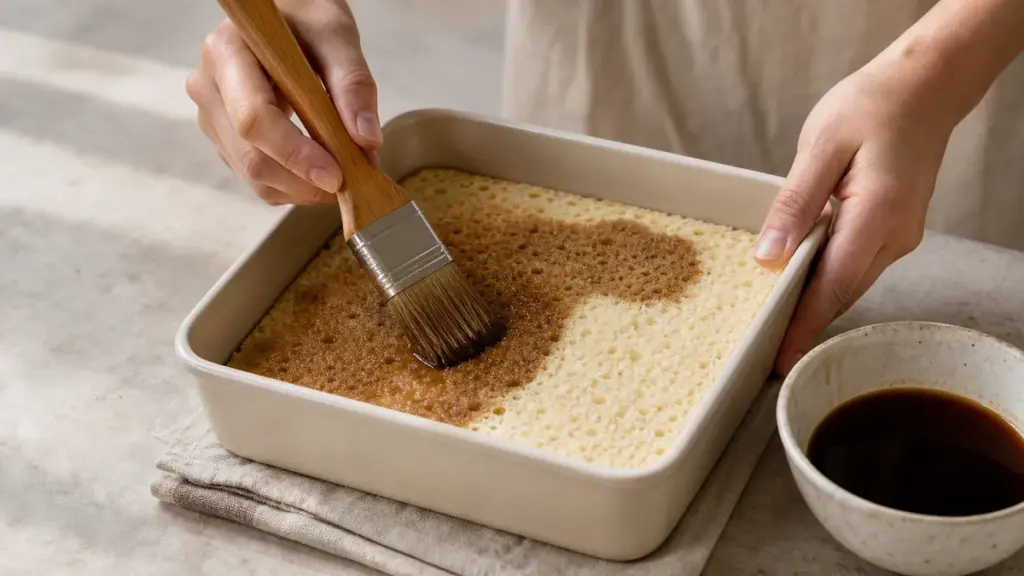
For tiramisu, the soaking method deserves particular attention. King Arthur’s recipe distinguishes brushing sponge cake from quickly dipping ladyfingers. Follow the method for your chosen base rather than giving every sponge the same immersion time. Our tiramisu guide covers the dessert in detail.
| Symptom | Likely cause | Fix for the next batch |
|---|---|---|
| Coffee flavour is faint | The coffee addition is too modest for that recipe | Use a coffee-led formula or its approved stronger variation |
| Buttercream becomes loose | Too much brewed coffee has been added | Choose a powder-based buttercream recipe |
| Filling has unwanted coffee flecks | The soluble powder has not dispersed as intended | Follow the product’s dissolving instructions |
| Tiramisu layers are waterlogged | The soaking method does not suit the sponge | Use the recipe’s dipping or brushing method |
| Cake texture changes after substitution | Coffee has displaced too much milk or added extra liquid | Restore the original liquid balance |
Chilled desserts, eggs and serving safely
Tiramisu, mousse, cheesecake and ice cream need attention to their dairy and egg ingredients, not special treatment because they contain coffee.
FSA household guidance recommends a refrigerator temperature of 0 to 5°C. Cool cooked food promptly and refrigerate it within one to two hours; divide large quantities into smaller containers where helpful. Its general advice is to eat refrigerated leftovers within 48 hours or freeze them, while also following ingredient storage instructions and use-by dates.
For raw or lightly cooked hen-egg desserts, check the eggs’ assurance scheme. FSA guidance for England, Wales and Northern Ireland, and Food Standards Scotland advice, recognise British Lion and Laid in Britain eggs for vulnerable consumers. Where that assurance cannot be verified, use a thoroughly cooked preparation or suitable pasteurised egg product.
People who are severely immunocompromised and require medically supervised diets are an exception: follow their clinical team’s advice. A recipe described as traditional does not override those precautions.
FAQ
Do I need an espresso machine to make coffee desserts?
No, many coffee desserts can be made with soluble espresso powder or ordinary instant coffee specified by the recipe. Published tiramisu and ice-cream recipes use espresso powder rather than requiring machine-brewed espresso. Choose the recipe first, then obtain the ingredient it actually names, rather than buying equipment for the word “espresso”.
Can I use decaffeinated coffee?
Yes, decaffeinated coffee is an option when you want to reduce caffeine, provided you use the format required by the recipe. Decaf still contains some caffeine, so it is not equivalent to caffeine-free. For a medically required restriction, check the product information and ask a GP or pharmacist rather than relying on flavour intensity.
Can I estimate caffeine from how strongly the dessert tastes of coffee?
No, flavour intensity is not a reliable caffeine measurement. The coffee product, preparation, amount used and portion size all matter. Where a manufacturer supplies caffeine information, use that as the basis for an estimate and account for other ingredients, such as chocolate. Without suitable data, avoid attaching a precise caffeine figure to each slice.
Where to go next
Read Coffee Cake for a focused bake, or Tiramisu for assembling coffee-soaked layers and a creamy filling. Return to Coffee Desserts to choose another format, using the ingredient and liquid-control principles here to compare recipes.
Sources
-
King Arthur Baking, “Baking with espresso powder” (2017), and “Espresso Powder” product guidance (undated). Soluble powder, chocolate applications and manufacturer-specific handling advice.
https://www.kingarthurbaking.com/blog/2017/01/16/baking-with-espresso-powder
https://shop.kingarthurbaking.com/items/espresso-powder -
Sally’s Baking, “Espresso Chocolate Chip Cake” (2022). Recipe-development observations on combining powder and brewed coffee, preserving milk quantity, buttercream and ingredient temperature.
https://sallysbakingaddiction.com/espresso-chocolate-chip-cake/ -
King Arthur Baking, “Tiramisu” (undated). Coffee soak, mascarpone filling, sponge brushing and ladyfinger dipping.
https://www.kingarthurbaking.com/recipes/tiramisu-recipe -
King Arthur Baking, “Coffee Chocolate Chunk Ice Cream” (updated 2022). Soluble espresso powder incorporated into a dairy custard base.
https://www.kingarthurbaking.com/recipes/coffee-chocolate-chunk-ice-cream-recipe -
Caporaso, Whitworth and Fisk, “Prediction of coffee aroma from single roasted coffee beans by hyperspectral imaging”, Food Chemistry (2022). Primary analytical study; the retrieved publisher preview describes roasting and measurement of volatile aroma compounds.
https://doi.org/10.1016/j.foodchem.2021.131159 -
Batali, Ristenpart and Guinard, “Brew temperature, at fixed brew strength and extraction, has little impact on the sensory profile of drip brew coffee”, Scientific Reports (2020). Primary controlled brewing and sensory study, retrieved through PubMed.
https://pubmed.ncbi.nlm.nih.gov/33020560/ -
Specialty Coffee Association, “Water and Coffee Acidity: How to Adapt Your Water for Different Extraction Methods”, 25 Magazine, issue 9 (undated web edition). Expert explanation of alkalinity, hardness and brewing ratios; not presented here as a dessert standard.
https://sca.coffee/sca-news/25/issue-9/english/water-and-coffee-acidity-how-to-adapt-your-water-for-different-extraction-methods-25-magazine-issue-9-pxjby -
Food Standards Agency, “How to chill, freeze and defrost food safely” (2017, current retrieved web text). Household refrigeration, cooling and leftover-storage guidance.
https://www.gov.uk/government/publications/how-to-chill-freeze-and-defrost-food-safely/how-to-chill-freeze-and-defrost-food-safely -
Food Standards Agency, “Advice on safe storage, handling and use of eggs for catering” (updated 20 August 2026). Assured eggs, pasteurised alternatives and vulnerable-consumer exceptions; applies to England, Northern Ireland and Wales.
https://www.gov.uk/guidance/advice-on-safe-storage-handling-and-use-of-eggs-for-catering -
Food Standards Scotland, “Update of FSS advice on the consumption of raw/lightly cooked eggs”, FSS-ENF-21-005 (2021), Annex B. Scottish consumer guidance and the medically supervised diet exception.
https://www.foodstandards.gov.scot/downloads/FSS-ENF-21-005_-_Update_of_FSS_advice_on_the_consumption_of_raw-lightly_cooked_eggs.pdf -
US Food and Drug Administration, “Spilling the Beans: How Much Caffeine is Too Much?” (2024). Variable caffeine content, counting dietary sources and residual caffeine in decaf.
https://www.fda.gov/consumers/consumer-updates/spilling-beans-how-much-caffeine-too-much
This guide was researched using retrieved primary studies, recipe developers’ published methods, manufacturer guidance and official food-safety advice; no first-hand recipe testing is claimed.
Last checked: November 2026