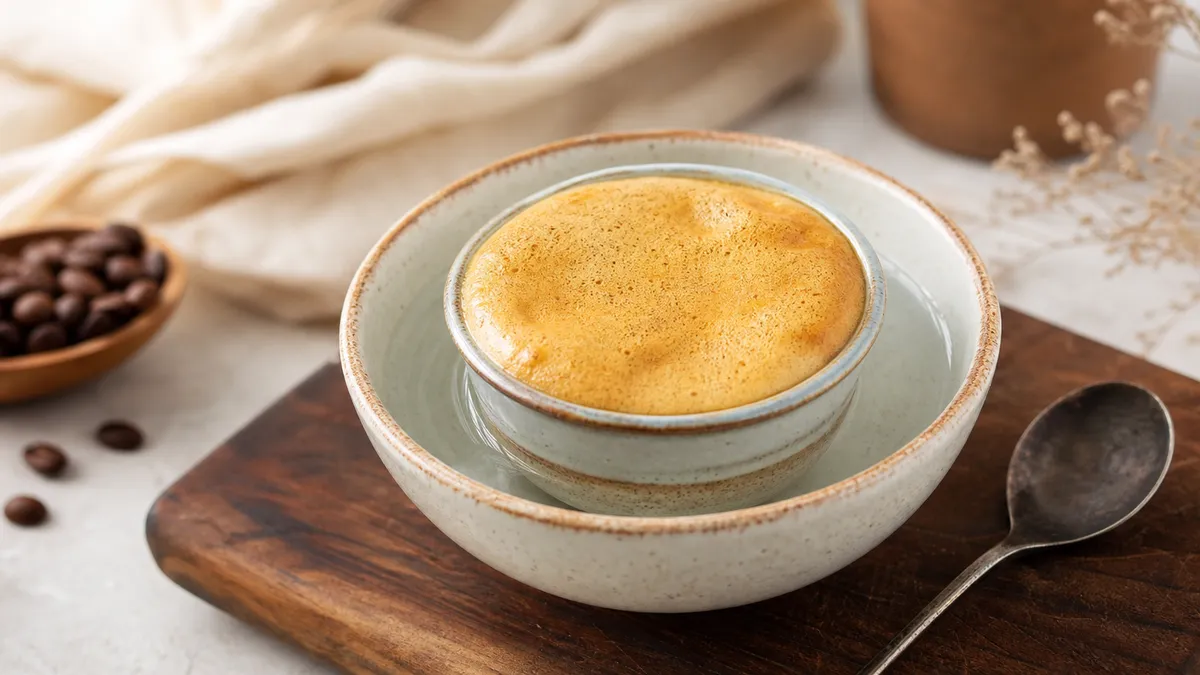
Vietnamese egg coffee, or cà phê trứng, is hot, strong coffee topped with egg yolk whipped into a thick, sweet cream with condensed milk. Make the topping separately, spoon it gently over the coffee and serve the cup in a shallow bowl of hot water to keep it warm.
In short
- Use egg yolk, not a whole egg, for the golden topping.
- Whisk until thick and airy, using the texture rather than the clock as your guide.
- Choose British Lion or Laid in Britain assured hen eggs, or pasteurised yolk suitable for uncooked dishes.
- The hot coffee and serving bowl are not a validated cooking or pasteurisation step.
- Assemble just before drinking and serve immediately.
What is Vietnamese egg coffee?
This Hanoi speciality puts a pale, custard-like topping above a small serving of dark coffee. The contrast is the attraction: sweet, creamy egg foam followed by the coffee underneath. Robusta coffee is used in the Metropole Hotel’s published version, although home recipes also allow espresso.
A phin, the small Vietnamese metal drip filter, is a suitable way to prepare the base. Espresso is a practical alternative if that is the equipment you already have. Unlike the grounds-in-the-cup method explained in Turkish coffee, the coffee is brewed before the topping is added.
This recipe belongs with our coffee recipes, but the egg handling deserves particular attention before you begin.
A brief Hanoi history
The familiar origin story credits Nguyễn Văn Giảng, a bartender at Hanoi’s Metropole Hotel, now Sofitel Legend Metropole Hanoi. In the hotel’s account, reported by Michelin, scarce fresh milk prompted him to experiment with an egg-yolk topping. Treat this as an attributed origin account rather than a surviving contemporary recipe record.
The dates need a small qualification:
- 1946: Michelin dates the drink’s beginnings at the Metropole to this year.
- 1946: Café Giảng’s own website also identifies its heritage as beginning in this year.
- 1960s: Michelin’s account places Giảng’s opening of his own café in this later decade.
The sources therefore agree on the drink’s association with Hanoi and Giảng, but not on the café’s opening date. The milk-shortage explanation is supported; a precise claim that the recipe was created because of the First Indochina War is not established by these sources.
Choose the eggs safely
This method leaves the yolk raw or lightly warmed. Do not assume that pouring hot coffee underneath it makes it thoroughly cooked.
For England, Wales and Northern Ireland, current Food Standards Agency guidance permits raw or lightly cooked hen eggs carrying the British Lion mark or produced under the Laid in Britain assurance scheme for pregnant people, young children, older adults and people with certain underlying health conditions. Food Standards Scotland gives equivalent advice for these assured eggs. This is population food-safety guidance based on assessed risk, not a guarantee that an individual egg is free from Salmonella.
The assurance controls include sourcing from Salmonella-vaccinated flocks. Look for the actual assurance mark or scheme confirmation: “free-range”, “organic” or simply “British” is not the same check.
For this recipe:
- Use verified British Lion or Laid in Britain assured hen eggs, or pasteurised egg yolk labelled as suitable for uncooked preparations.
- If eggs are imported, unverified or outside those schemes, choose pasteurised yolk instead, or use a thoroughly cooked alternative.
- People who are severely immunocompromised and require a medically supervised diet should follow their clinical team’s advice. The general permission for assured raw eggs does not apply to them.
Keep eggs refrigerated until needed, reject damaged shells, wash hands and utensils after handling raw egg, and prepare the drink immediately before serving.
Vietnamese egg coffee recipe
This is a simple home adaptation of the published whipped-yolk method, not a claim to reproduce Café Giảng’s own formula. The quantities below are working recipe proportions; the preparation time is an estimate.
Recipe card
Serves: 1
Preparation and assembly: about 10 minutes, depending on brewing equipment
Allergens: egg and milk
Ingredients
- 18 g hen egg yolk, separated from an appropriately assured egg, or 18 g pasteurised yolk suitable for uncooked use
- 20 g sweetened condensed milk
- 60 ml freshly brewed, strong phin coffee or espresso
- Hot water for warming the cup and filling the serving bowl
Equipment
- Small, deep mixing bowl
- Electric hand whisk
- Kitchen scales and measuring jug
- Phin or espresso equipment
- Heatproof cup, wider heatproof bowl and teaspoon
Approximate caffeine: about 80 mg if made with 60 ml espresso, using EFSA’s illustrative espresso figure. This is not a measurement of this recipe, and actual espresso varies. It must not be applied to the phin version, whose caffeine content cannot be reliably inferred from drink volume alone. During pregnancy, the NHS advises no more than 200 mg daily from all sources; individual sensitivity also varies.
Method
- Prepare the serving cup. Warm the heatproof cup with hot water, then empty it. Place it in the wider bowl on a stable surface.
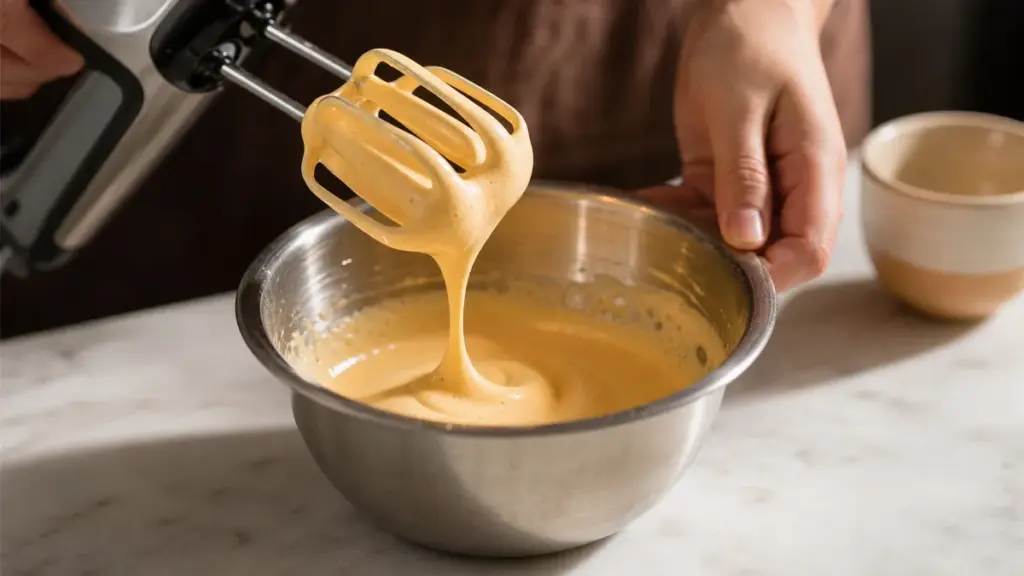
- Start the topping. Put the yolk and condensed milk into the small mixing bowl. Whisk for about 5 minutes, stopping to check the texture. It should become pale, thick and frothy rather than remain a loose yellow liquid. Nini Nguyen’s published recipe uses this whisking time as a guide.
- Check the foam. Drop a small spoonful onto water in a separate glass. If it floats, the topping is ready to layer. If it immediately disperses, whisk further and check again.
- Brew the coffee. Prepare your phin coffee or espresso using the equipment’s usual method. Measure 60 ml into the warmed cup.
- Add the cream. Spoon the whipped mixture gently onto the coffee rather than pouring it forcefully into the centre. Aim for a distinct golden cap.
- Serve warm. Carefully pour hot water into the outer bowl, keeping it below the cup’s rim. Serve immediately with a teaspoon. The water bath is for warmth, not egg safety.
Getting the topping and serving right
Look for thick froth, not the stiff peaks associated with an egg-white meringue. The published readiness test is useful because it checks whether the topping can sit above a liquid, rather than asking you to trust a fixed whisking time.
Keep the coffee and topping separate until you are ready to serve. The bowl of hot water maintains warmth without needing to put the assembled drink back on the hob.
| Symptom | Likely cause | Fix |
|---|---|---|
| Topping immediately mixes into the coffee | Insufficiently whipped topping | Continue whisking and repeat the float test |
| No distinct golden layer | Topping added too forcefully | Spoon it gently across the surface |
| Coffee is cool by serving time | Coffee brewed too early | Finish the topping first, then brew and assemble |
These are practical troubleshooting suggestions based on the published whipping, layering and warm-serving methods, rather than results from comparative testing.
Do not confuse this warm drink with Vietnamese iced coffee. That is the useful next recipe when you want coffee and condensed milk without the egg topping.
FAQ
Can I use evaporated milk instead of condensed milk?
Not as a direct replacement in this recipe. The published recipes specify sweetened condensed milk, so substituting evaporated milk changes both the sweetness and the mixture being whipped. Use the specified ingredient for your first attempt rather than trying to correct a different milk with an improvised amount of sugar.
Do I need to add vodka?
No. Although the Metropole’s published version includes vodka, Nini Nguyen’s recipe does not. This home adaptation leaves it out. Choose the eggs according to the safety guidance above, not according to whether alcohol is included in the mixture.
Can I prepare a batch of topping ahead?
For home preparation, make only what you intend to serve immediately. If eggs are cracked ahead, FSA guidance says to keep the liquid egg refrigerated, take out small amounts as needed and use it on the same day. Do not leave a bowl of raw-egg topping standing warm while preparing later drinks.
Where to go next
For another condensed-milk drink, read Vietnamese Iced Coffee; for a different filter preparation, continue to Indian Filter Coffee. Coffee Recipes brings the methods together when you want to choose what to make after Vietnamese egg coffee.
Sources
-
Café Giảng, Café Giảng: Since 1946, undated website, retrieved November 2026.
https://cafegiang.vn/ -
Michelin Guide, Craig Sauers, How to Make Vietnam’s Iconic Egg Coffee the MICHELIN Way, 22 April 2025. Includes the Metropole’s account and published recipe.
https://guide.michelin.com/sg/en/article/dining-in/how-to-make-vietnam-egg-coffee-the-michelin-way -
Nini Nguyen / Imbibe, Vietnamese Egg Coffee (Cà Phê Trứng), 27 September 2024. Recipe reproduced with permission from Đặc Biệt: An Extra Special Vietnamese Cookbook.
https://imbibemagazine.com/recipe/vietnamese-egg-coffee-ca-phe-trung/ -
Food Standards Agency, Home food fact checker, updated 21 August 2026. Applies to England, Northern Ireland and Wales.
https://www.gov.uk/government/publications/home-food-fact-checker/home-food-fact-checker -
Food Standards Agency, Advice on safe storage, handling and use of eggs for catering, updated 20 August 2026. Applies to England, Northern Ireland and Wales.
https://www.gov.uk/guidance/advice-on-safe-storage-handling-and-use-of-eggs-for-catering -
Food Standards Scotland, Update of FSS advice on the consumption of raw / lightly cooked eggs, FSS-ENF-21-005, 29 July 2021.
https://www.foodstandards.gov.scot/downloads/FSS-ENF-21-005_-_Update_of_FSS_advice_on_the_consumption_of_raw-lightly_cooked_eggs.pdf -
European Food Safety Authority, Caffeine, topic page incorporating its 2015 scientific opinion, retrieved November 2026.
https://www.efsa.europa.eu/en/topics/topic/caffeine -
NHS, Foods to avoid in pregnancy, current page retrieved November 2026.
https://www.nhs.uk/pregnancy/keeping-well/foods-to-avoid/
Research combined published recipe instructions, an attributed hotel origin account, the café’s own heritage statement and official food-safety and caffeine guidance; no first-hand testing is claimed.
Last checked: November 2026