Under-extraction means too little of the coffee’s soluble material has been extracted for a balanced cup; over-extraction means extraction has gone further than tastes pleasant. Under-extracted coffee often tastes sharply sour and unfinished, while over-extracted coffee can taste harsh, bitter and drying, but neither flavour alone proves the diagnosis.
In short
- The traditional Golden Cup reference is 18% to 22% extraction yield, not a universal boundary between good and bad coffee.
- Extraction yield describes how much of the dry coffee dissolves. Brew strength describes how concentrated the finished drink is.
- The heritage SCAA Golden Cup filter-strength range is 1.15% to 1.35% total dissolved solids, not 1.15% to 1.45%.
- Change one brewing setting at a time, then compare sweetness, acidity, bitterness and finish.
- Coffee that tastes both sour and harsh may be extracting unevenly. Grinding finer can make that worse.
What extraction means
Extraction is the transfer of soluble material from ground coffee into brewing water. Extraction yield expresses that material as a percentage of the original dry coffee dose: a 20% yield means dissolved coffee material amounts to one-fifth of the dose.
The useful distinction is between a measurement and a judgement. Extraction yield is measurable; calling a drink under-extracted or over-extracted also involves deciding whether its flavour is balanced and enjoyable.
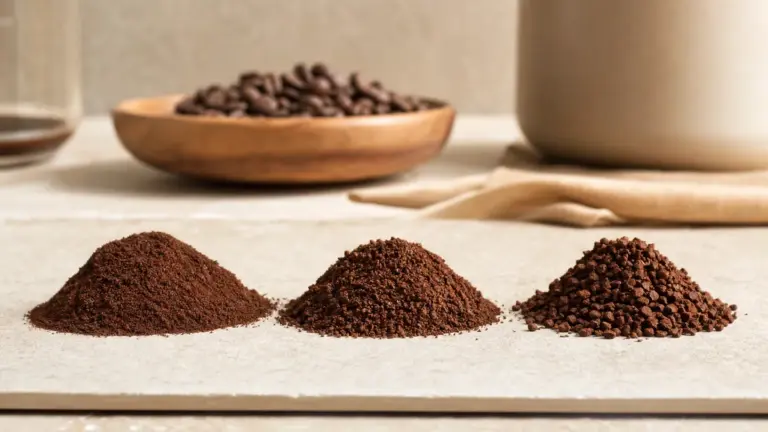
Water must wet the grounds, dissolve soluble compounds and carry them into the drink. Grind size affects both the speed of this process and, in brewers where water flows through a coffee bed, how readily water passes through it. Our grind size and extraction hub explains those connections more broadly.
Extraction is not the same as strength
Total dissolved solids, usually shortened to TDS, describes the concentration of dissolved material in the finished coffee. In brewing discussions, it is the usual measure of strength.
A concentrated coffee can still be under-extracted. Equally, a dilute coffee can contain the flavours associated with excessive extraction. Adding water after brewing lowers strength without undoing the extraction that has already happened.
Coffee-to-water ratio is a main control for strength, while grind, contact time and temperature help control extraction. These are connected controls, not separate switches: changing the amount of brewing water can alter both. See brewing ratios and temperature for the wider recipe relationships.
What the SCA extraction ranges actually mean
The traditional brewing-control framework, associated with Lockhart’s work and subsequently used by coffee associations, places the familiar extraction reference at 18% to 22%. The heritage SCAA Golden Cup Standard, revised on 23 December 2015, pairs this with 1.15% to 1.35% TDS for filter coffee.
You may encounter 1.15% to 1.45% presented as one SCA filter range. That combines different historical recommendations: the 2012 World Brewers Cup rules record 1.15% to 1.35% for SCAA and 1.20% to 1.45% for SCAE, with both using 18% to 22% extraction.
Espresso is much more concentrated. An SCA-hosted technical presentation gives approximately 8% to 12% TDS for speciality competition-style espresso, but this is a descriptive range, not a universal espresso quality requirement.
Treat these figures as reference points. A peer-reviewed synthesis of controlled sensory and consumer studies found that flavour and liking follow more complicated patterns than the traditional chart suggests. Coffee outside its central box is not automatically defective.
Professional cupping has also moved to the SCA’s Coffee Value Assessment, which separates different aspects of coffee evaluation. That development does not turn extraction measurements into obsolete tools: cupping assessment and brewing control answer different questions.
How under-extraction and over-extraction taste
Taste the coffee black while diagnosing it. Use the descriptions below as clues to compare, rather than labels to attach after one sip.
Signs that extraction may be too low
Look for sharp sourness that dominates the cup, little apparent sweetness and an unfinished flavour. Instead of fruit-like acidity supported by sweetness, the coffee may seem piercing, hollow or abruptly short.
However, sourness is not proof of under-extraction. Controlled sensory research shows that roast and concentration also influence the sensory profile. The useful test is whether a controlled change towards greater extraction improves the cup.
Signs that extraction may have gone too far
Look for persistent, harsh bitterness and a drying finish. Astringency is the puckering or rough sensation that can accompany the bitterness, rather than another name for bitter taste.
Ordinary bitterness is not necessarily a fault. The question is whether bitterness overwhelms the other flavours, and whether reducing extraction improves the balance. Roast character and excessive concentration can also make coffee seem more bitter.
Water complicates the diagnosis too. Its alkalinity, meaning its acid-buffering capacity, changes how coffee acidity is expressed. If normal brewing adjustments keep producing puzzling results, investigate water hardness, alkalinity and TDS rather than endlessly changing the grinder.
Symptom, likely cause and first fix
These are starting hypotheses. Keep the coffee, dose and recipe otherwise unchanged when testing them.
| Symptom | Likely cause to investigate | First fix |
|---|---|---|
| Sharply sour espresso with unusually fast flow | Insufficient extraction, possibly from an overly coarse grind | Grind slightly finer |
| Harsh espresso with very restricted flow | Excessive resistance and possibly uneven extraction | Try a slightly coarser grind |
| Sour, unfinished filter coffee with rapid drainage | Insufficient extraction | Try a slightly finer grind |
| Harsh filter coffee with unusually slow drainage | Grind too fine for the brewing conditions | Try a slightly coarser grind |
| Sourness and harshness together | Uneven extraction, particularly in espresso | Improve evenness before pushing extraction further |
Do not interpret the table as “fast always means under-extracted” or “slow always means over-extracted”. Flow and time are diagnostic evidence, not verdicts.
A controlled tasting method
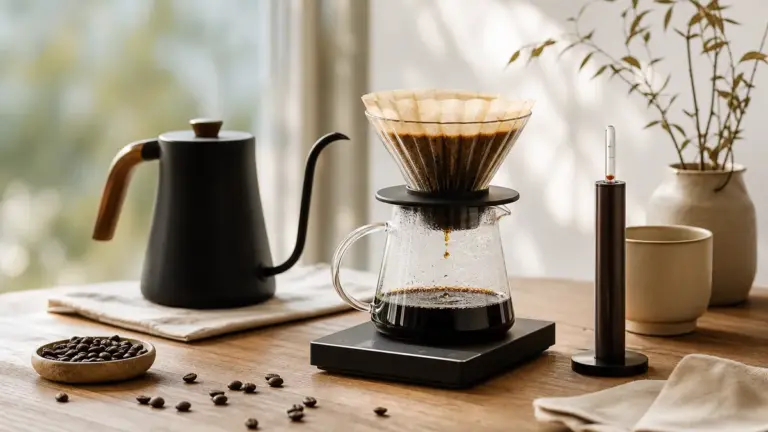
The quickest way to learn the difference is to compare neighbouring settings using the same coffee. This is a suggested diagnostic exercise based on Hario’s published V60 recipe, not a claim of first-hand testing.
- Establish a baseline. Use 15 g coffee and 250 g water, approximately 250 ml, at 93 degrees Celsius. This is a coffee-to-water ratio of about 1:16.7 by weight.
- Brew consistently. Rinse the filter and discard the rinse water. Wet the grounds with 45 g water, wait 30 to 45 seconds, then add the remaining water in stages.
- Record the result. Hario’s recipe suggests roughly 2 minutes 30 seconds to 3 minutes overall. Record your actual time without treating it as a pass-or-fail target.
- Change only the grind. Make the next brew slightly finer if the baseline is sharply sour and unfinished, or slightly coarser if it is harsh and drying.
- Compare deliberately. Taste at comparable temperatures. Record whether sweetness, balance and the finish improved, not merely whether the brew took longer.
Repeat in the direction that improves the coffee. If adjustment stops helping, return to the best setting before testing another variable.
Fixes by brewing method
Pour-over and batch filter
Start with grind and even wetting. A finer grind can increase extraction, but it also changes resistance to flow; the relationship becomes less helpful if water cannot pass evenly through the bed.
For a sour, unfinished cup, test a slightly finer grind while preserving your pouring pattern. For harsh coffee with slow drainage, test a coarser setting. Keep agitation, meaning stirring or swirling, consistent so you can interpret the result.
A longer brew is not automatically a better-extracted brew. Read extraction time and grind size when the clock and the taste appear to disagree.
Espresso
Keep the dry dose and beverage yield fixed while making the first grind adjustment. For example, record an espresso recipe as 18 g in, 36 g out, a 1:2 dose-to-yield ratio, rather than judging its volume through the crema.
A fast, sour shot often benefits from a finer grind. A restricted, harsh shot may benefit from a coarser one. If grinding finer produces less consistent shots, stop pursuing slowness and investigate uneven flow.
Do not automatically alter grind, dose, temperature and shot length together. You may improve the drink, but you will not know which change helped.
Cafetière and other immersion brewers
Immersion means the grounds steep in the brewing water rather than having fresh water continuously pass through them. If the coffee seems insufficiently extracted, test a longer steep or finer grind separately.
However, extraction does not increase at the same rate indefinitely. Controlled immersion experiments found that brews approached a steady concentration, so leaving coffee longer is not equivalent to driving a flowing espresso shot ever further.
If an immersion brew is overwhelming rather than sharply unbalanced, investigate strength as well as extraction. Changing the coffee-to-water ratio may be more useful than repeatedly shortening the steep.
Why the same extraction yield can taste different
Extraction yield is a bulk measurement. It cannot reveal how evenly every part of the coffee bed contributed to the drink.
In espresso experiments supported by mathematical modelling, researchers found that extraction yield eventually fell when grinding became excessively fine. They attributed this to uneven flow and partially inaccessible regions of the bed, rather than to a lack of available surface area.
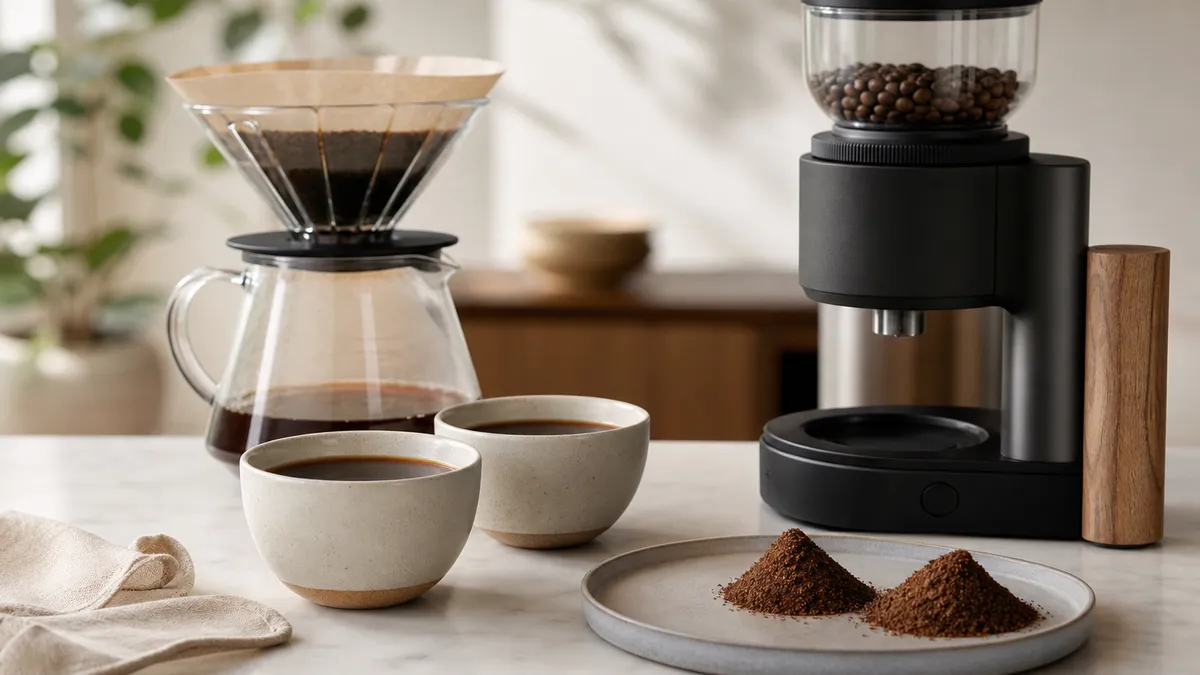
That explains why “grind finer” has limits. A cup can combine flavours associated with insufficient extraction and harsh extraction because different regions have contributed differently. For the grinding side of that problem, see grind consistency and taste.
Strength is another reason to be cautious. Controlled sensory research found that attributes including sourness, bitterness, thickness and perceived sweetness varied with strength, extraction and roast. The familiar sour-versus-bitter shorthand is useful, but incomplete.
For measured comparisons, the conventional beverage-based calculation is:
Extraction yield (%) = beverage mass (g) × TDS (%) ÷ dry dose (g)
For an illustrative filter brew with a 20 g dose, 300 g collected beverage and a measured TDS of 1.30%, the result is 19.5%. Use collected beverage mass, not the initial brewing-water mass; immersion calculations require additional care over dissolved material retained with the grounds.
Use the measurement to understand a change, then taste whether it was worthwhile.
FAQ
Can adding water rescue over-extracted coffee?
Adding water can make an unpleasantly concentrated coffee easier to drink, but it cannot reverse extraction. Dilution lowers the concentration of everything already in the cup, including desirable flavours and unwanted ones. If dilution improves balance substantially, strength was at least part of the problem; test extraction separately on the next brew.
Can coffee taste good above 22% extraction?
Yes, 22% is not a universal sensory ceiling. The traditional reference window does not capture every coffee, brewing method or preference, and controlled consumer research challenges the idea of one ideal combination of strength and extraction. A high reading alone is not a reason to reject a sweet, balanced cup.
Do I need a refractometer to diagnose extraction?
No, a controlled tasting comparison is enough to guide everyday adjustments. A coffee refractometer helps estimate TDS and calculate extraction yield, making it useful for repeatability and investigation. It does not identify individual flavour compounds or show whether extraction was even, so it cannot replace tasting.
Where to go next
Extraction Time and Grind Size explains how to interpret changing brew times, while Grind Consistency and Taste explores why an apparently suitable grind can still produce an uneven cup. For the recipe controls behind over-extraction vs under-extraction, continue with Brewing Ratios and Temperature.
Sources
- SCAA, Golden Cup Standard, version 23 December 2015. Primary standard, retrieved from a third-party-hosted copy. Establishes the heritage extraction and filter-strength ranges. Retrieved PDF.
- World Coffee Events, 2012 World Brewers Cup Rules and Regulations, version 9 September 2012, section 24.1. Records the separate SCAA and SCAE strength recommendations. Retrieved PDF.
- Marco Wellinger, Zurich University of Applied Sciences, Tracking and Tweaking Your Extraction, undated SCA-hosted presentation. Provides espresso TDS context and distinguishes beverage-based from total-extract approaches. Retrieved PDF.
- Guinard and colleagues, A New Coffee Brewing Control Chart Relating Sensory Properties and Consumer Liking to Brew Strength, Extraction Yield, and Brew Ratio, Journal of Food Science, 2023. Peer-reviewed synthesis of controlled sensory and consumer studies. Retrieved paper.
- Frost, Ristenpart and Guinard, Effects of Brew Strength, Brew Yield, and Roast on the Sensory Quality of Drip Brewed Coffee, Journal of Food Science, 2020. Controlled sensory study supporting the distinction between extraction, strength and flavour. Retrieved article.
- Hario UK, How to Brew Coffee with Hario V60 Coffee Dripper, 16 September 2026. Manufacturer recipe used as the baseline for the suggested comparison exercise. Retrieved guide.
- Hario UK, Expert V60 Brew Guide, undated. Manufacturer guidance on wetting, grind adjustment and slow drainage. Retrieved guide.
- Breville, How to Find the Best Grind Size for Espresso, undated. Manufacturer troubleshooting guidance for sour, harsh and restricted-flow espresso. Retrieved guide.
- Cameron and colleagues, Systematically Improving Espresso: Insights from Mathematical Modeling and Experiment, Matter, 2020. Peer-reviewed experiments and modelling concerning uneven flow, fine grinding and extraction measurement. Retrieved paper.
- Liang, Chan and Ristenpart, An Equilibrium Desorption Model for the Strength and Extraction Yield of Full Immersion Brewed Coffee, Scientific Reports, 2021. Controlled brewing experiments and modelling concerning immersion equilibrium and retained liquid. Retrieved paper.
- SCAE, The SCAE Water Chart, undated retrieved edition. Primary technical report distinguishing alkalinity from hardness and explaining acid buffering. Retrieved report.
- SCA, Coffee Value Assessment, current online overview, undated. Official description of the assessment framework and its separate assessment types. Retrieved overview.
Research combined retrieved association documents, peer-reviewed brewing studies and manufacturer instructions; the tasting exercise is an editorial adaptation, not a report of first-hand testing.
Last checked: November 2026