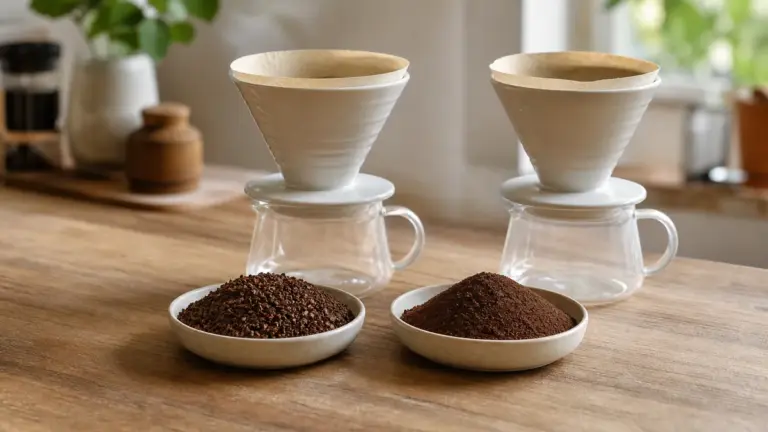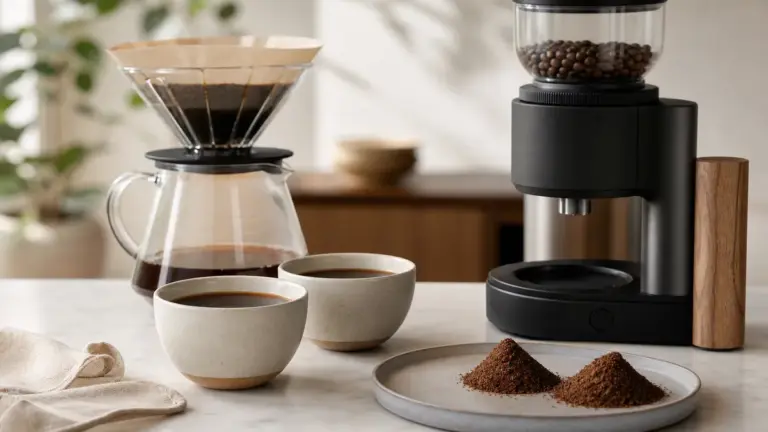
Coffee grind size and consistency control both how readily water extracts soluble material and how easily it moves through the grounds. Finer grinding generally makes extraction faster at particle level, but a bed of very fine or uneven grounds can restrict flow and extract unevenly, so the finest setting is not necessarily the tastiest.
In short
- Think about the whole spread of particle sizes, not just whether the grounds look fine or coarse.
- Fines are the smallest fragments. Their effect on water flow can matter as much as their exposed surface area.
- A burr grinder offers more deliberate size adjustment than a blade grinder, but it does not produce identical particles.
- Keep the coffee dose, water quantity and brewing technique steady while testing grind changes.
- Use flavour alongside flow and brewing time: a slow brew is a clue, not a diagnosis.
Why coffee grind size changes extraction
Extraction is the transfer of soluble material from roasted coffee into water. Grinding breaks the bean into smaller pieces, exposing more surface and shortening the distance dissolved compounds must travel from inside a particle.
A simple geometric model helps explain the surface-area effect. If a solid cube is divided into eight equal smaller cubes, its total volume stays the same but its combined external surface area doubles. Coffee fragments are porous and irregular rather than neat cubes, but the example shows why breaking material into smaller pieces exposes more of it.
Water movement adds another layer. In a pour-over or espresso basket, the grounds form a bed through which water must pass. Changing the grind changes the spaces between particles and therefore the bed’s permeability, meaning how easily water can flow through it.
These effects work together. Finer grinding may make soluble material more accessible while also slowing the water carrying it into the cup. The grind size and extraction hub places this relationship alongside the other brewing variables.
Immersion and flowing-water methods behave differently
In immersion brewing, such as a cafetière, coffee and water steep together before separation. Grind still affects extraction, but it does not govern a continuous drawdown through the grounds in the same way.
In percolation brewing, where water flows through a coffee bed, extraction and flow are tightly connected. This is why “grind finer” can improve one brew yet make another stall. It also explains why copying a grind setting without copying the recipe is unreliable.
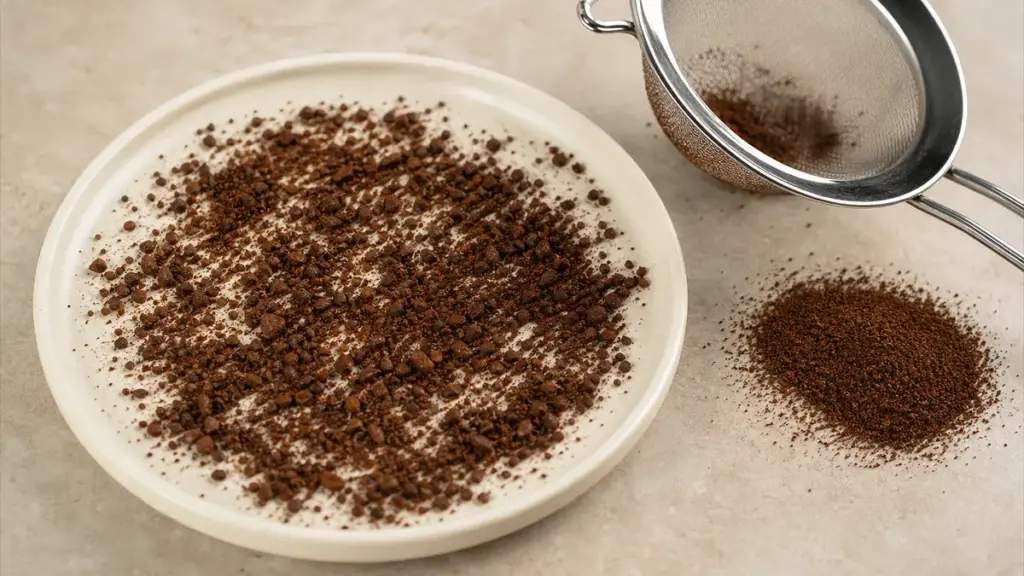
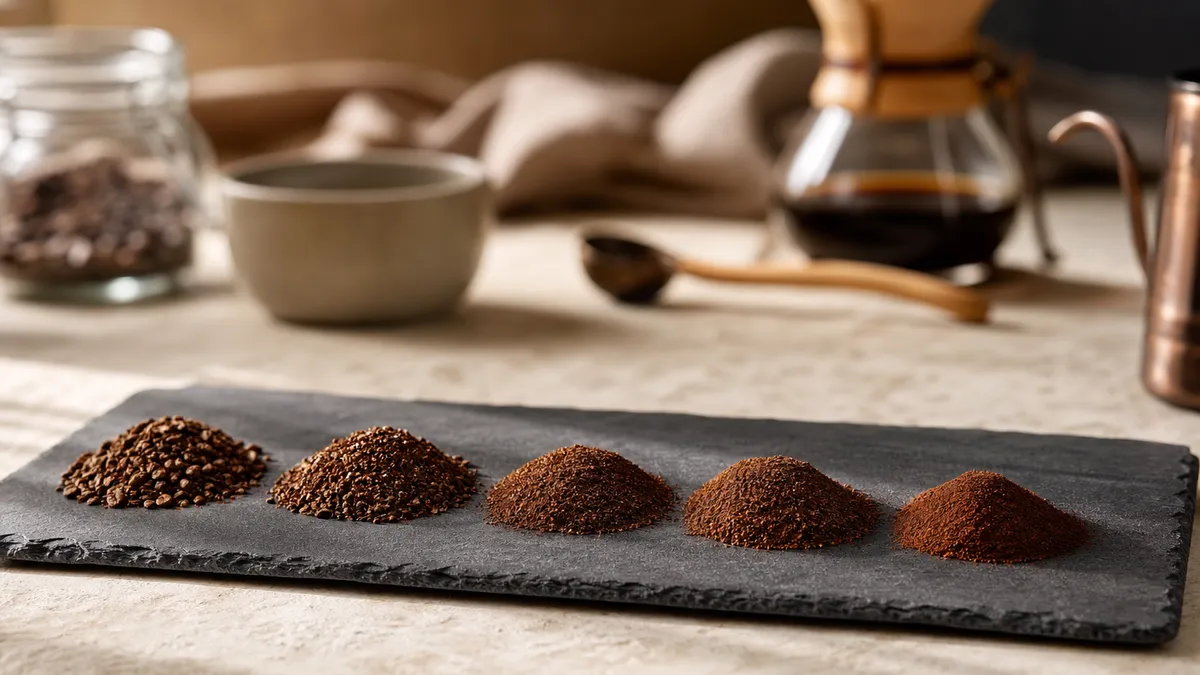
Grind sizes by brewing method
Use these descriptions as starting directions, not fixed specifications. “Medium” is a practical label, not a measurement that every grinder manufacturer defines identically.
| Method | Starting grind direction | What matters when adjusting |
|---|---|---|
| Cafetière | Coarse | Follow the brewer’s instructions and assess sediment as well as flavour |
| Cold-brew immersion | Coarse | Judge within a fixed steeping and filtration method |
| Automatic drip filter | Medium | Keep batch size and the machine’s brewing cycle consistent |
| V60-style pour-over | Medium-fine | Watch flavour and drawdown together |
| Moka pot | Finer than pour-over, coarser than espresso | Use a moka-suitable grind and do not tamp |
| Espresso | Fine | Small adjustments affect resistance and the time needed to reach the chosen yield |
The table deliberately avoids universal grinder clicks and particle diameters. For a fuller visual reference, use the coffee grind size chart.
Manufacturer guides also vary in their terminology. Hario calls its espresso category “extra fine”, for example, while other guides simply call espresso grounds “fine”. The useful information is the intended brewing method and the result in your cup, not the adjective alone.
Consistency means a predictable distribution
A grinder does not produce one particle size. It produces a particle-size distribution, the spread of sizes within the ground coffee.
That distribution includes the main body of grounds, smaller fragments called fines, and larger pieces sometimes called boulders. Two samples can have a similar average size while containing different proportions of these fragments.
Consequently, “more consistent” needs some care. A narrower spread can be useful, but a repeatable distribution suited to the brewing method is a better practical goal than expecting every particle to match.
Fines are not simply a grinding defect
In a controlled espresso experiment published in Scientific Reports in 2024, researchers added separated fines to ground coffee. Increasing their share reduced bed permeability, slowed flow and lengthened extraction time.
The study defined fines as particles smaller than 100 micrometres, or 0.1 mm. Treat that as the study’s operational definition, not a universal boundary for every grinder or brewing method.
Its findings also qualify a common explanation: fines matter not only because small particles expose more surface. In that experiment, their principal influence was on flow, while the additional effect on extraction efficiency was marginal.
The practical lesson is not to remove every fine particle. It is to recognise that changing their proportion can change how a brew behaves, even when the larger grounds look much the same.
Burr versus blade grinders
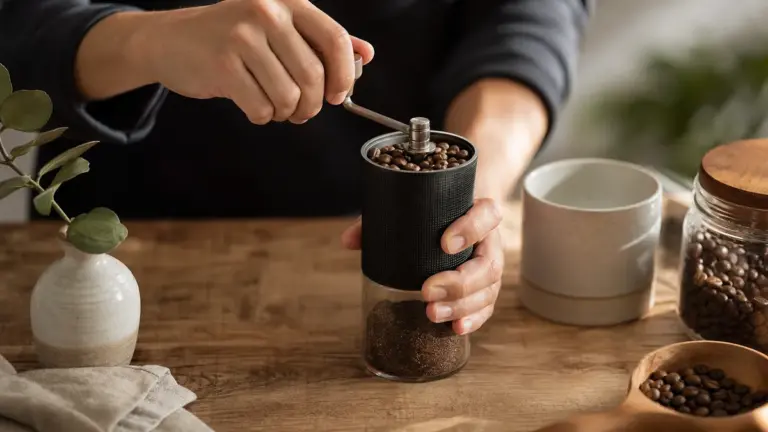
A blade grinder chops beans with a rotating blade. Running it longer generally makes the grounds finer, but this does not give the same deliberate size control as adjusting the gap between burrs.
A burr grinder breaks coffee between grinding surfaces. Adjusting their separation changes the resulting distribution, making it the more useful design when you want to make a controlled change and return to a previous setting.
The distinction is control, not perfection. Burr grinders still produce a mixture of sizes, and a “burr grinder” label alone does not establish how well a particular machine performs.
Before choosing one, assess whether it:
- Covers your intended brewing method.
- Allows sufficiently small adjustments.
- Returns predictably to previous settings.
- Can be cleaned and maintained according to its instructions.
Both manual and electric burr grinders can be considered against those criteria. Likewise, flat or conical burr geometry should not be treated as a complete performance verdict: the relevant question is what the particular grinder produces.
For operating steps rather than the underlying science, see how to grind coffee.
Adjusting grind size by taste
Start with a known recipe and change the grind alone. Otherwise, an improvement might come from a different dose, hotter water or a changed pouring pattern rather than the adjustment you intended to test.
For espresso, keep both the dry dose and the target beverage yield steady. Reaching the same yield in a different time tells you more than stopping every shot at the same time and comparing different quantities of drink.
A controlled pour-over comparison
This exercise adapts Hario’s V60 guidance. It is a comparison method, not a requirement that every coffee should finish at precisely the same time.
- Set the recipe. Use 15 g coffee and 250 g brewing water, a coffee-to-water ratio of approximately 1:16.7 by weight. This is roughly 250 ml water, but use the scales to control the brew.
- Prepare the brewer. Rinse the paper filter with separate hot water and discard the rinse water.
- Brew a baseline. Start medium-fine. Use water at 92 to 96 degrees Celsius, wet the grounds evenly, wait about 30 seconds, then continue pouring slowly in circles.
- Record the result. Note the setting, pouring pattern, total brewing time and flavour. Hario’s guide gives roughly 2 minutes 30 seconds as its reference.
- Change one thing. Move the grinder a small amount finer or coarser, following its adjustment instructions. Repeat the same recipe.
- Compare. Look for a more pleasing balance of sweetness, acidity and finish rather than a particular timer reading. Repeat the preferred setting to check that the result is reproducible.
Use the following as testable starting points, not automatic diagnoses.
| Symptom | Possible cause | First controlled test |
|---|---|---|
| Thin, sharply sour brew with unusually fast flow | Grind too coarse for the recipe | Try slightly finer |
| Harsh, bitter brew with unusually slow flow | Excessive resistance from the grind | Try slightly coarser |
| Espresso flow varies markedly between repetitions | Uneven preparation or flow through the bed | Standardise distribution and tamping before changing grind |
| Finer grinding makes espresso less repeatable | Excessively restricted or uneven flow | Step back coarser while keeping dose and yield fixed |
Flavour and flow should support the same explanation before you commit to it. If the adjustment does not help, return to the baseline instead of continuing indefinitely in the same direction.
Why finer is not always better
The most useful advanced distinction is between extracting an individual particle and extracting an entire bed of particles. Making fragments smaller can help the first process while disrupting the second.
In research published in Matter in 2020, espresso experiments did not show extraction increasing indefinitely as grinding became finer. Extraction yield peaked, then fell at the finest settings tested. The authors interpreted this as evidence of uneven water flow.
Extraction yield is the proportion of the dry coffee’s mass dissolved into the drink. It is different from strength, which describes the concentration of dissolved coffee material in the beverage.
Water can favour easier routes through the bed, a behaviour commonly called channelling. Some grounds then receive more flowing water than others. A setting that increases resistance is therefore not guaranteed to increase useful, even extraction.
Nor does one average measurement fully describe the bed. An extraction-yield figure summarises what reached the cup; it does not prove that every region of the grounds extracted equally.
What grind measurements can tell you
When comparing laboratory results, check how particle size was measured and reported. A particle-count distribution and a volume-weighted distribution emphasise different parts of the sample: numerous tiny fragments can dominate the count without dominating its volume.
The SCA’s Home Coffee Grinders: Specifications and Test Methods, SCA-320:2021, uses sieve-based particle-distribution testing and separately assesses repeatability of performance. Its stated context is grinders for compatible home filter brewers, not a universal espresso specification.
That distinction matters when reading claims about “uniformity”. Ask whether the claim concerns a narrow spread, repeatability between doses, or suitability for a particular brewer.
For everyday brewing, use those ideas without needing laboratory equipment. Choose a sensible starting grind, hold the recipe steady and record what changes. Useful coffee grind size and consistency are ultimately about making the next adjustment more predictable.
FAQ
Why does the same coffee sometimes need a different setting?
The same coffee can need adjustment as it ages or its conditions change. Baratza’s manufacturer guidance identifies ageing and environmental conditions among the reasons settings may shift. Keep the recipe steady and make small corrections based on repeatable changes in flavour and flow, rather than assuming the original setting must remain right.
Can I put grounds through the grinder again to make them finer?
Do not regrind coffee unless your grinder’s manufacturer explicitly permits it. Baratza warns that feeding already-ground coffee back through its grinders can cause clumping, compacting and clogs. Adjust the setting and grind a fresh dose instead. Follow the instructions for your own model rather than assuming that advice transfers unchanged between designs.
Do I need a sieve to improve grind consistency?
You do not need a sieve to follow the adjustment method in this guide. Sieving can separate size fractions for experiments, but removing fines changes the material you brew, including its flow behaviour. If you experiment, weigh the coffee remaining after separation and treat it as a new recipe, not simply a corrected version of the original.
Where to go next
Read Grind Size and Extraction for the wider brewing framework, then How to Grind Coffee for the practical workflow. Keep Coffee Grind Size Chart beside your grinder when you need a quick method-by-method starting reference.
Sources
- Specialty Coffee Association, Home Coffee Grinders: Specifications and Test Methods, SCA-320:2021, 2021. Standard PDF.
- Uman and colleagues, The effect of bean origin and temperature on grinding roasted coffee, Scientific Reports, 2016. Research paper PDF.
- Smrke, Eiermann and Yeretzian, The role of fines in espresso extraction dynamics, Scientific Reports, 2024. Research paper PDF.
- Cameron and colleagues, Systematically Improving Espresso: Insights from Mathematical Modeling and Experiment, Matter, 2020. Author-hosted research paper.
- Starbucks Coffee at Home, Ways to Grind Coffee Beans, undated. Grinding guide.
- Hario UK, Find Your Perfect Grind: A Hario Coffee Grinder Guide, undated. Grinder guide.
- Hario UK, Expert V60 Brew Guide, undated. Brewing guide.
- Blue Bottle Coffee, How to Make Moka Pot Coffee, undated. Moka brewing guide.
- Baratza, Dialing in Espresso: Burr Types, Adjustments, and Troubleshooting, undated. Espresso adjustment guide.
- Baratza, Common Grinding Myths, undated. Manufacturer guidance.
This article was researched using retrieved peer-reviewed experiments, an SCA equipment standard and manufacturer brewing guidance; the comparison exercise is an editorial adaptation, not first-hand testing.
Last checked: November 2026