A roast date tells you when coffee was roasted; a best-before date tells you how long the producer expects it to retain its quality under the stated storage conditions. Use the roast date to plan brewing and the best-before date as a shelf-life guide, not as a guarantee of peak flavour or an automatic safety cut-off.
In short
- Ordinary prepacked roasted coffee generally needs a best-before date; a roast date is voluntary.
- A packing date is not necessarily a roast date.
- Filter and espresso can benefit from different resting periods after roasting.
- There is no universal peak-freshness window: roast style, packaging, storage and brewing all matter.
- Coffee past its best-before date is not automatically unsafe, but damaged, contaminated or mouldy coffee should not be used.
What roast dates and best-before dates actually tell you
Roast date: the starting point for brewing age
The roast date records when the beans were roasted. It lets you calculate their age and follow the roaster’s advice about resting, meaning allowing freshly roasted coffee time to release some of its trapped gas before brewing.
It does not tell you how well the coffee has been stored since then. Two bags with the same roast date can develop differently if their packaging, temperature or exposure to oxygen differs. Treat it as useful information, not a quality certificate.
A packing date records a different event. Unless the producer confirms that roasting and packing happened on the same day, do not substitute one for the other. Likewise, you cannot reliably work backwards from a best-before date without knowing the producer’s shelf-life policy.
For the other information surrounding those dates, see reading a coffee bag.
Best before: the producer’s quality assessment
A best-before date is a date of minimum durability: it concerns the food retaining its expected properties when stored correctly. The responsible food business sets the date for its product. It is not a promise that the coffee will taste freshly roasted throughout that period.
There is no single statutory shelf-life period for roasted coffee in the labelling rules discussed below. Do not assume every producer adds the same number of months to its roast date. A distant best-before date therefore tells you little about when a bag was roasted.
Once you open the bag, follow any after-opening instructions too. The printed date should not replace attention to storage and the condition of the contents. The broader buying and storing guide explains how to bring these decisions together.
What UK labelling rules require
For ordinary prepacked roasted beans and ground coffee sold to consumers, a best-before date is generally mandatory. Coffee is not among the listed exemptions from durability marking. A roast date is not part of the general mandatory information and does not replace the required best-before marking.
The underlying framework is Regulation (EU) No 1169/2011 on food information to consumers. In Great Britain, its domestic version is now described as assimilated law, rather than retained EU law. EU food-information law applies in Northern Ireland. The Food Information Regulations 2014 provide enforcement provisions in England, with separate legislation for Wales, Scotland and Northern Ireland.
The wording depends on the date format:
- “Best before” accompanies a date that includes the day.
- “Best before end” accompanies a date without the day, such as a month and year.
- The wording may direct you elsewhere on the packaging, for example to the base.
These general prepacked-food requirements should not be confused with the rules for loose coffee or coffee packed for direct sale on the premises. Those categories have different labelling requirements.
When coffee tastes best for filter and espresso
Freshly roasted coffee contains trapped carbon dioxide. Its gradual release is called degassing. Brewing very early can make extraction, the movement of soluble flavour compounds into water, less predictable. With espresso, this can contribute to excessive crema and uneven water flow through the grounds.
Resting is therefore useful, but it competes with ageing. Aroma compounds are lost or change over time, while oxygen, moisture and heat affect freshness. Grinding accelerates gas loss, so a whole-bean resting schedule should not be treated as advice to leave ground coffee sitting around.
The following are roaster guidance, not scientifically guaranteed peak windows. Partners Coffee publishes these starting points:
| Brewing method | Suggested rest after roasting | How to use the guidance |
|---|---|---|
| Filter brewing | At least 5 to 7 days | Begin comparing cups around this point, unless your roaster advises differently |
| Espresso, including bean-to-cup espresso | At least 7 to 10 days | Assess flavour and brewing consistency rather than chasing the largest crema |
Source: Partners Coffee, A Guide to Resting Coffee. Its advice is a practical starting point, not a universal standard.
There is no reliable calendar date on which every coffee reaches its best and then becomes stale. Roast degree and roast speed affect degassing, and storage conditions affect ageing. A light roast may release gas more slowly than a darker roast, so the same waiting period will not suit every bag.
The distinction between evidence types matters here. Laboratory measurements establish that degassing changes over time and varies with roasting. A roaster’s recommended drinking window adds practical brewing judgement. Neither establishes a universal sensory peak for every coffee and every drinker.
How to use the dates on your next bag
- Identify each date. Distinguish “roasted on”, “packed on” and “best before” rather than treating any printed date as the roast date.
- Ask for coffee-specific advice. If only a best-before date appears, ask the seller when it was roasted and what resting period the producer recommends.
- Compare like with like. Keep your brewing recipe consistent while comparing the coffee at different ages.
- Record your preference. A short note on aroma, sweetness and finish is more useful than assuming another coffee’s schedule will apply.
- Protect the opened bag. Reseal it and keep it away from heat, light and moisture, following the producer’s instructions.
Use coffee storage tips for the storage details. The useful distinction is simple: roast dates help you organise tasting; best-before dates do not measure your preferred flavour peak.
Can you use coffee after its best-before date?
Yes, passing a best-before date does not automatically make coffee unsafe. UK guidance allows food bearing best-before dates to be sold after those dates if it remains of suitable quality and fit for consumption. That is different from selling food after a safety-based use-by date, which is prohibited.
For a household bag, consider whether it has been stored correctly and shows signs of spoilage. Do not use mouldy coffee or taste it to decide whether mould is acceptable. A best-before date is not permission to ignore contamination, just as an unexpired date does not make visibly spoiled food suitable to eat.
Sound but older coffee may simply be less enjoyable: its aroma can fade and unwanted flavours can develop. Decide whether you still enjoy it, rather than discarding it solely because a quality date has passed.
FAQ
Does a missing roast date mean the coffee is poor quality?
No, a missing roast date alone does not establish poor quality. Roast-date labelling is voluntary, while storage and packaging also affect freshness. However, if you want to compare coffee at particular ages, its absence makes that harder. Ask the seller for the roasting information and recommended drinking window rather than guessing from the best-before date.
Does a large filter bloom prove the coffee tastes better?
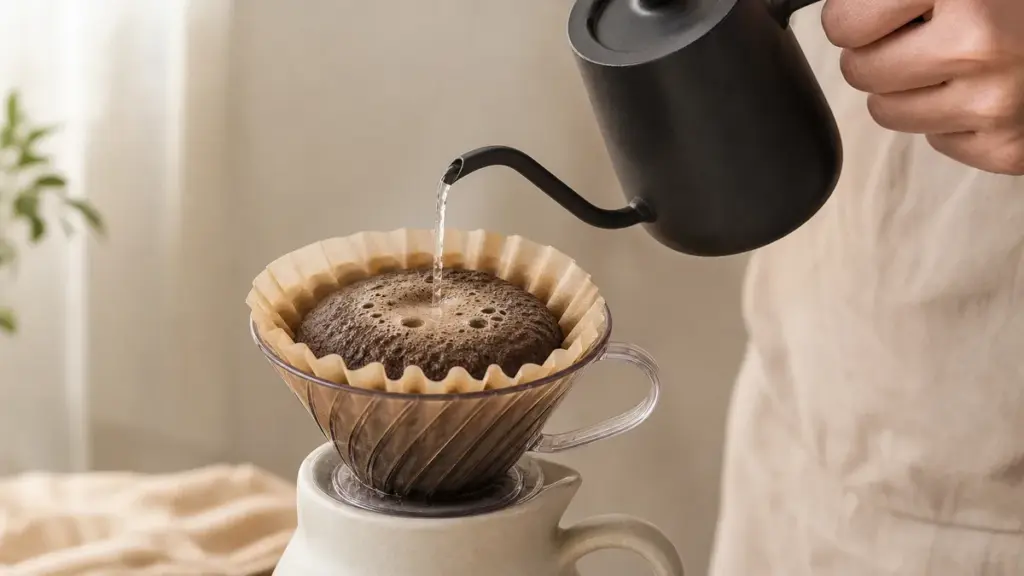
No, a large bloom mainly indicates gas being released when water meets the grounds. Fresh coffee can produce a stronger bloom, but that does not establish its flavour quality or your preferred drinking age. Use bloom as an observation alongside aroma and taste, not as a freshness score that overrides the cup.
Should I open a new bag to help it rest?
You do not need to leave coffee exposed to air to follow a resting recommendation. Keep it in its intended packaging and follow the roaster’s instructions. Oxygen exposure contributes to staling, so deliberately airing the beans is not a substitute for waiting. Once opened, reseal the bag between uses.
Where to go next
Read How to Read a Coffee Bag to interpret the rest of the label, then Finding Specialty Coffee Retailers for help choosing where to ask about roast dates and drinking windows. Coffee Storage Tips covers everyday handling, while Freezing Coffee addresses longer-term storage.
Sources
-
Department for Environment, Food & Rural Affairs and Food Standards Agency. Food labelling: giving food information to consumers. Updated 2022, current page checked November 2026.
https://www.gov.uk/guidance/food-labelling-giving-food-information-to-consumers
Mandatory prepacked-food information and durability-marking exemptions. -
Food Standards Agency. Packaging and labelling. Current guidance checked 2026.
https://www.gov.uk/government/publications/packaging-and-labelling/packaging-and-labelling
Food-information legislation and territorial application. -
Department for Environment, Food & Rural Affairs. Consultation on the Bread and Flour Regulations 1998 and the Bread and Flour Regulations (Northern Ireland) 1998. 2022, legislative background.
https://consult.defra.gov.uk/food-compositional-standards/bread-and-flour-consultation-2022/supporting_documents/Consultation%20Document.pdf
Separate food-information enforcement legislation in each UK nation. -
Chartered Trading Standards Institute, Business Companion. Date and lot marking of prepacked food. Undated, current guidance checked 2026.
https://www.businesscompanion.info/en/quick-guides/food-and-drink/date-and-lot-marking-of-prepacked-food
Date formats, prepacked-food scope and sale after best-before dates. -
Food Standards Agency. Home food fact checker. Current guidance checked 2026.
https://www.gov.uk/government/publications/home-food-fact-checker/home-food-fact-checker
Quality versus safety dates, sensory checks and mould advice. -
Specialty Coffee Association. Coffee Decoded: What is “freshly roasted” coffee? Publication year not displayed in retrieved text, checked 2026.
https://sca.coffee/sca-news/coffee-decoded-9-fresh-coffee
Degassing, grinding and freshness, summarising published experimental research. -
Specialty Coffee Association. Preserving Freshness: A Race Against Time, 25 Magazine, issue 4. Publication year not displayed in retrieved text, checked 2026.
https://sca.coffee/sca-news/25-magazine/issue-4/preserving-freshness-race-time-25-magazine-issue-4-2spkp
Effects of roasting, oxygen, moisture and temperature on ageing. -
Partners Coffee. A Guide to Resting Coffee. Undated, checked 2026.
https://www.partnerscoffee.com/blogs/education/a-guide-to-resting-coffee
First-party roaster guidance on filter and espresso resting periods.
Researched using live official food-labelling guidance, SCA explanations of freshness research and first-party roaster advice; resting recommendations are distinguished from experimental findings.
Last checked: November 2026