Choose single-origin coffee if you want to explore a particular place or producer; choose a blend if you want a flavour profile designed from several coffees, often with everyday consistency in mind. Neither label guarantees better coffee: roast style, freshness, brewing and your taste matter more than the category alone.
In short
- “Single-origin” can mean one country, region, co-operative or farm. Check how precisely the roaster identifies it.
- A blend can be fruity and lightly roasted; a single-origin can be chocolatey and medium-roasted.
- For milk drinks, choose beans that taste good with your usual milk, rather than assuming blends always win.
- For an office bean-to-cup machine with limited adjustment, start by trialling a medium roast, whether blended or single-origin.
- Compare traceability, roast suitability and the finished drink. The origin label alone does not establish quality or value.
Single-origin vs blends: what are you actually buying?
Single-origin coffee comes from one identified geographical source, but the size of that source varies. A country-labelled coffee may bring together production from many farms; a more specific offering might identify a co-operative, washing station or individual producer.
A blend combines separately identified coffees into a deliberate recipe. Those components need not come from different countries. The useful distinction is between presenting an identifiable source and combining components to achieve an intended result.
The categories therefore overlap at their edges. Ask “single origin at what level?” rather than assuming the phrase means one farm, one variety or one small harvest lot. Our beans and blends guide explains the wider terminology.
For this comparison, single-origin means coffee sold principally around its identifiable source, while blend means coffee sold principally around its combined recipe. That is a buying distinction, not a quality ranking.
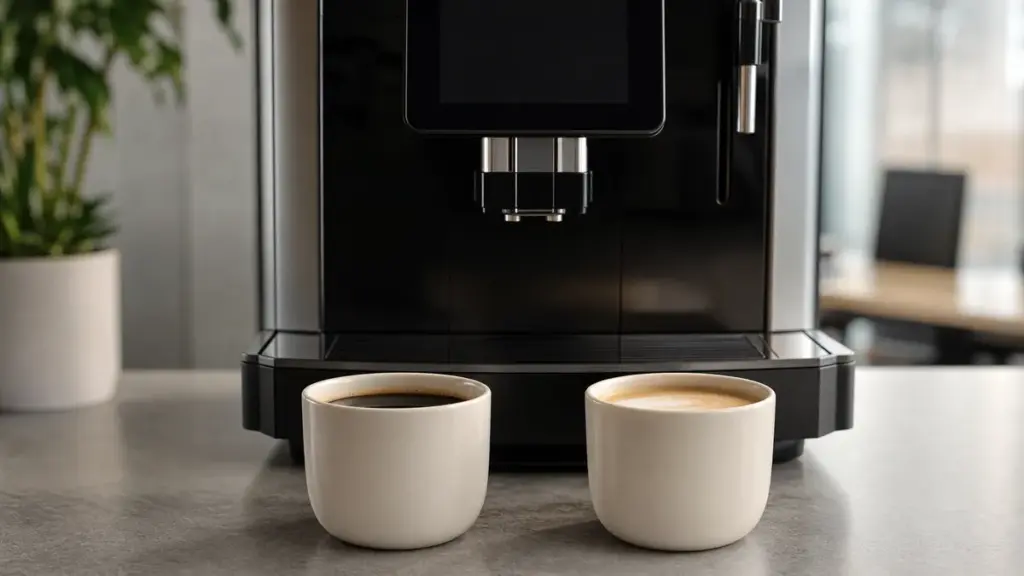
The comparison at a glance
The criteria below are flavour intention, repeatability, traceability, brewing fit and buying suitability. They describe common approaches, not rules that every roaster follows.
| Criterion | Single-origin | Blend | Who it suits |
|---|---|---|---|
| Flavour intention | Presents the character of an identified source | Combines components for a chosen profile | Exploration: single-origin; a particular house style: either |
| Consistency | A particular lot is finite; replacements may taste different | Components can change to maintain a recognisable profile | Routine drinkers often favour a maintained blend |
| Traceability | Can identify a country, community, farm or lot | Can identify every component, if the roaster publishes them | Readers who want detail should inspect either label |
| Brew-method fit | Depends on roast and recipe, not origin status | Also depends on roast and recipe | Match the beans to your equipment |
| Milk drinks | Can work well when the profile suits the drink | Can be designed specifically for milk drinks | Taste with your usual milk before deciding |
| Seasonality | Offers an opportunity to follow particular harvests | May change its recipe with the seasons | Explorers may welcome rotation; routine buyers may prefer continuity |
| Buying decision | Look for useful source information and a suitable roast | Look for component information and a clear flavour aim | Choose the drink you enjoy, not the more impressive description |
Flavour: distinctive does not necessarily mean better
A single-origin is useful when you want to investigate how coffees differ between sources. However, its flavour is not a simple geographical fingerprint: variety, growing conditions and processing also contribute.
A blend gives the roaster another tool. Instead of asking one component to deliver everything, the recipe can combine characteristics into a chosen balance. How that recipe is developed belongs in our guide to coffee blending.
Avoid comparing “single-origin flavour” with “blend flavour” as though each were one recognisable taste. World Coffee Research’s sensory lexicon includes fruity, floral, nutty, cocoa, roasted and sour attributes. These are descriptive tools, not categories reserved for particular sourcing labels.
Roast style cuts across the comparison. Franke’s introductory coffee guidance associates lighter roasting with brighter acidity and fruity or floral flavours, medium roasting with caramelised flavours, and darker roasting with smoky or roasted flavours. These are broad tendencies, not promises about every bag.
Here, acidity means the bright or tangy impression in the drink, not a medical claim. If you dislike sharp coffee, ask for a rounded, less tangy profile rather than rejecting all single-origins.
Consistency and seasonality: a stable flavour can have a changing recipe
Blending allows a roaster to adjust components while pursuing a recognisable finished cup. The International Trade Centre describes this flexibility as a way to maintain a preset profile and compensate for seasonal changes or shortages.
Counter Culture provides a practical example: its year-round coffees retain intended flavour profiles while the coffees inside the bag change. Some formulations use one source; others use several.
That distinction matters. A consistent product name does not necessarily mean an unchanged recipe, and an unchanged recipe is not the only route to consistency.
Single-origin buying offers a different pleasure: following a particular source and accepting that the next available coffee may not be identical. A named lot will eventually sell out, even if the roaster later buys from the same producer.
For a household that enjoys discovery, this is part of the appeal. For a workplace trying to keep a familiar drink available, ask the supplier what happens when the current coffee runs out and whether a replacement needs different machine settings.
Which works with your brew method?
Treat brewing recommendations as a separate question from origin.
For filter coffee or a cafetière, either category is a reasonable candidate. My recommendation is to choose a single-origin when learning about source differences, or a blend when you want to investigate how a roaster builds a particular flavour profile.
For manual espresso, ask whether the roaster recommends the coffee for espresso and can supply a starting recipe. Extraction, the movement of soluble material from grounds into water, depends partly on the physical properties of the roasted coffee. Experimental research has shown that roast degree changes properties including density, porosity and measured solubility.
That does not establish one universal recipe for light or dark coffee. It explains why changing beans can require more than replacing the contents of the hopper.
The useful buying question is: “Can I make the drink I want with the adjustments my equipment allows?” A well-matched single-origin is preferable to an unsuitable blend, and the reverse is equally true.
Milk drinks: test the complete drink
For a chocolatey flat white or familiar latte, my starting recommendation is a medium-roasted coffee described as cocoa-like, nutty or caramel-like. That might be a blend or a single-origin.
Milk changes what you perceive. In a controlled sensory and aroma-release study published in 2025, adding cow’s milk or oat drink to medium- and dark-roasted arabica reduced the perception of coffee-related flavours and introduced characteristics of the milk itself. The experiment did not establish that blends outperform single-origins.
The practical lesson is to test the drink you actually order. A coffee that seems striking as a black espresso may not be your favourite once milk is added.
Keep the coffee recipe and milk quantity consistent during comparison. If your workplace mainly serves milk drinks, do not select its beans solely through a black-coffee tasting.
Office bean-to-cup machines: roast suitability comes first
For an office machine with fixed or restricted temperature, dose and grind settings, a medium-roasted blend is a sensible first trial, especially when you want a familiar profile maintained across deliveries. A suitable medium-roasted single-origin can work just as well.
There is direct manufacturer support for caution with very light roasts. Franke’s A800 manual identifies a roast that is too light, temperature that is too low and grinding that is too coarse as possible causes of sour coffee. Its remedies include a darker roast, higher temperature or finer grinding.
The implication for an office is practical: if the machine cannot make the adjustments a particular coffee needs, changing the coffee may be more effective than repeatedly changing the drink volume. This is an inference from manufacturer troubleshooting, not evidence that every automatic machine struggles with light roasts.
A rounded Brazilian or Colombian single-origin is worth including in a trial if the roaster confirms its profile and suitability. Do not treat either country name as a guarantee of low acidity. The Colombian growers’ federation, for example, describes its recognised national profile as relatively high in acidity.
Before approving a regular supply:
- Ask for beans suited to the exact machine and its available settings.
- Trial the normal black and milk drinks.
- Have an authorised operator make permitted adjustments.
- Record the successful settings and ask how replacement coffees will be introduced.
The advantage comes from a suitable roast, recipe and supply arrangement, not from blending itself.
What determines the price?
There is no useful universal rule that single-origin is expensive and blends are inexpensive. The category does not reveal the full production or supply chain.
The International Trade Centre identifies rarity, quality, production scale, labour, processing and supply-chain structure among the factors influencing coffee pricing. Keeping a small lot separate also involves different handling and marketing requirements from supplying a bulk coffee.
For home buying, compare equal quantities and ask what additional information or characteristics you are receiving. More precise traceability may matter to you, but it does not automatically make the drink more enjoyable.
For workplace buying, request itemised written quotations covering beans, delivery arrangements, minimum orders, technical support and any machine or service commitments included. To compare your own consumption, multiply the measured coffee dose by expected drinks, then account for coffee used during adjustment and discarded drinks.
Keep that calculation separate from the tasting decision. The better choice is the one that meets your workplace’s drinking preferences and operational requirements.
How to make your decision
Use a small, structured comparison rather than buying by reputation alone:
- Choose comparable candidates. Start with a single-origin and a blend recommended for the same brewing method and a similar roast style.
- Establish a suitable recipe for each. Follow the roaster’s guidance and your equipment’s instructions. An unsuitable shared setting is not a fair test.
- Taste your usual drink. Include the normal milk or plant drink, if used.
- Hide the packaging while choosing. Write down what you enjoy before considering the source description.
- Check repeat availability. Ask whether the next delivery will contain the same coffee or a replacement.
My recommendation: choose single-origin for source-led exploration, a maintained blend for a recurring house profile, and either when it makes the better drink. In single-origin vs blends, buying well means knowing what you want to repeat and what you are happy to change.
FAQ
Can a single-origin contain coffee from several farms?
Yes, depending on how broadly the source is defined. A coffee identified by country, region or co-operative can include production from several farms while still being sold as single-origin. If you specifically want coffee from one estate or a separately identified lot, look for that information rather than relying on the headline phrase.
Is single-origin the same as micro-lot?
No, single-origin does not necessarily mean micro-lot. Single-origin describes geographical sourcing at a stated level, which may be quite broad. Micro-lot describes a separately identified lot rather than guaranteeing a particular flavour. Ask what was kept separate and why; a more elaborate description is useful only when the seller explains what it means.
Does the World Coffee Research lexicon rank single-origins above blends?
No, the lexicon is a tool for describing and measuring sensory attributes, not a ranking of sourcing categories. It provides shared references for characteristics such as aroma, flavour and texture. Use that language to describe what you perceive, while keeping the separate question of whether you enjoy the coffee firmly in view.
Where to go next
Read Coffee Beans and Blends for the wider buying vocabulary, then Micro-Lot and Single Estate Coffee to understand more precise source claims. Coffee Blending explains recipe development, while Green Coffee Beans Explained introduces the unroasted ingredient behind both choices.
Sources
-
Counter Culture Coffee, Coffee Basics: Single-Origin Coffee, undated. Definitions, source specificity, flavour influences and seasonal availability.
URL: https://counterculturecoffee.com/blogs/counter-culture-coffee/coffee-basics-single-origin -
International Trade Centre, The Coffee Guide, fourth edition, 2021. Blending for uniformity and seasonal flexibility; production and supply-chain influences on pricing.
URL: https://www.intracen.org/media/5718 -
World Coffee Research, Sensory Lexicon, version 2.0, October 2017. Shared references for coffee aroma, flavour and texture attributes.
URL: https://worldcoffeeresearch.org/resources/sensory-lexicon -
Counter Culture Coffee, Coffee Basics: Year-Round Coffee, undated. Producer explanation of changing components to maintain intended profiles.
URL: https://counterculturecoffee.com/blogs/counter-culture-coffee/coffee-basics-year-round-coffee -
Franke Coffee Systems, Coffee 101: Coffee Essentials, undated, roast section. Broad manufacturer guidance on roast-associated sensory characteristics.
URL: https://www.franke.com/content/dam/franke/us/en/coffee-systems/documents/coffee-101-download/Franke_Coffee%20101.pdf.coredownload.pdf -
Nakilcioğlu-Taş, E. and Ötleş, S., Physical characterization of Arabica ground coffee with different roasting degrees, Anais da Academia Brasileira de Ciências, 2019. Experimental measurements of roast-dependent physical properties.
URL: https://www.scielo.br/j/aabc/a/F44XMrhpdQtMbjCySbg3pBM/?lang=en -
Cleve, N. and colleagues, Effects of Roasting Level and Milk Addition on In Vivo Aroma Release and Perception of Coffee, Journal of Agricultural and Food Chemistry, 2025. Research abstract retrieved through Friedrich-Alexander-Universität Erlangen-Nürnberg’s institutional publication record.
URL: https://cris.fau.de/publications/343779430/ -
Franke Kaffeemaschinen AG, A800 User Manual, document 20109324, revision 04, 29 August 2024, product-quality troubleshooting section. Manufacturer-authored manual retrieved from a distributor-hosted copy.
URL: https://dslinc.com/wp-content/uploads/2025/01/20109324_User-manual_A800_en.pdf -
Federación Nacional de Cafeteros de Colombia, 2012 FNC Sustainability Report, section “Colombia, origin of the world’s best coffee”. Used only for the federation’s description of Colombian coffee’s recognised acidity profile, not for current statistics.
URL: https://federaciondecafeteros.org/static/files/sostenibilidad-2012-eng.pdf
Research combined trade-reference material, sensory research, roasters’ explanations of their own sourcing practices and manufacturer guidance; buying recommendations and practical inferences are identified as such.
Last checked: November 2026