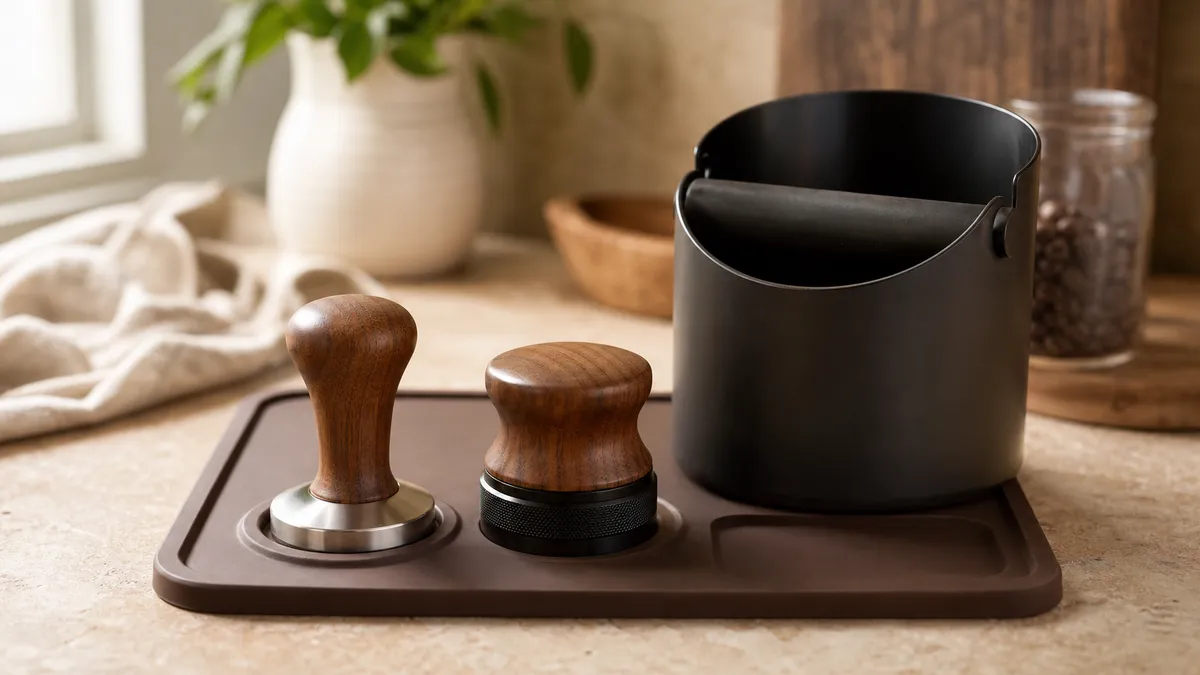
For manually prepared espresso, a correctly fitting tamper matters most; a distribution tool can help make the grounds more even before tamping, while a knock box makes clearing up easier. Choose tampers, distribution tools and knock boxes by basket compatibility, repeatability and ease of cleaning, rather than by how many accessories fit on the worktop.
In short
- Match the tamper to the actual basket, not simply the machine’s advertised portafilter size.
- A self-levelling guide and a calibrated spring do different jobs: one controls alignment, the other helps repeat tamping force.
- WDT, the Weiss Distribution Technique, stirs the grounds with fine needles; a spinning surface leveller is not an equivalent process.
- Prioritise a stable knock box with a removable bar and accessible interior.
- Our buying priority is a suitable tamper and secure tamping surface first, then additional tools only where they solve an identifiable problem.
Which espresso tools really help?
A tamper compresses ground coffee inside the filter basket, the perforated metal insert held by the portafilter. The compressed coffee bed is called the puck. Distribution happens before tamping: its purpose is to make the grounds evenly packed throughout that bed, rather than merely neat on top.
A knock box receives the used puck after brewing. A tamping mat provides a protected working surface. These are useful workflow accessories, but neither directly improves extraction, the process of dissolving flavour compounds from coffee.
Our assessment uses four criteria: compatibility, preparation consistency, practical usefulness and cleaning requirements. These are buying judgements, not rankings from hands-on product testing.
| Tool | Main purpose | Who it suits | Main limitation |
|---|---|---|---|
| Flat manual tamper | Compress the coffee evenly | Anyone comfortable tamping straight by hand | Alignment depends on technique |
| Self-levelling or calibrated tamper | Guide alignment, repeat force, or both | Users seeking a more repeatable action | Features vary; compatibility still matters |
| Fine-needle WDT tool | Redistribute grounds through the bed | Users investigating clumps or inconsistent preparation | Adds a manual step |
| Spinning surface leveller | Smooth the upper coffee layer | Users who specifically want surface grooming | A flat top does not prove even distribution underneath |
| Knock box | Collect spent pucks | Regular manual espresso preparation | Requires space and regular emptying |
| Tamping mat or station | Protect and support the working area | Anyone without a suitable tamping surface | Must suit the portafilter and worktop |
For the wider equipment picture, start with brewing accessories. Buy for the task you actually perform, rather than assembling a matching collection.
Tamper sizes: fit the basket, not the label
Tamper measurements describe the base diameter. Unfortunately, a nominal basket or portafilter size is not always the diameter of the tamper that fits it best.
For example, Normcore lists a 53.3 mm version of its V4 tamper for certain Sage and Breville machines with nominal 54 mm baskets. It also offers both 58 mm and 58.5 mm bases. These are manufacturer compatibility claims, checked in November 2026, not interchangeable choices for every machine.
Basket shape matters as well. Flair states that its standard Flair 58 Low-Flow basket narrows from 58.7 mm to 58.5 mm, recommending a 58.4 mm tamper and treating 58.5 mm as the largest size to consider. That is a useful illustration of why “buy the widest one” is poor advice.
Before ordering:
- Identify your machine and the basket you currently use, including any replacement basket.
- Check the basket maker’s recommended tamper diameter.
- Ask the seller to confirm compatibility where the listing is ambiguous.
- Check that the tamper can reach the coffee without binding against the basket walls.
The aim is a close, free-moving fit, not an interference fit. Pullman offers basket-matching services precisely because nominal machine size does not settle every compatibility question.
For a straightforward first purchase, our preference is a flat base with an undamaged edge and a comfortable handle. Keep it off abrasive surfaces and do not use it to strike the portafilter. Basket choice is covered separately in filters.
Calibrated tampers: force and alignment are different
A calibrated tamper uses a mechanism intended to make tamping force more repeatable. A self-levelling tamper uses a guide, commonly a collar resting on the basket rim, to help keep the base parallel to the basket. A product may combine both features, but one does not automatically imply the other.
Normcore’s V4, for example, is advertised with interchangeable springs and a rim-supported levelling plate. Those are published design features, not independent proof that it will improve your espresso.
The useful question is what problem you need to solve. If your tamp regularly slopes, a levelling guide addresses that directly. If several people share a machine and want the same pressing action, a calibrated mechanism may make training simpler.
Do not make maximum force the objective. Barista Hustle’s teaching demonstrations found little additional puck compression between a comfortable tamp and a much heavier one. Its guidance emphasises entering straight and tamping flat, rather than correcting the angle after compression has begun.
Our recommendation is therefore to choose fit and alignment before elaborate force adjustment. A plain tamper used consistently remains a sensible choice.
Check maintenance instructions too. Normcore specifically advises against putting the V4 in a dishwasher or soaking it. A spring mechanism should not be treated like a solid piece of stainless steel.
Distribution tools and WDT: what is the difference?
Fine-needle WDT tools
WDT means Weiss Distribution Technique: stirring the loose grounds with fine needles before tamping. The action breaks up clumps and redistributes coffee through the bed. A dosing funnel can help contain the grounds while you work.
Look for replaceable needles, a secure holder and safe storage. Fine needles are preferable to improvised thick probes: Barista Hustle reports that tools thicker than 1 mm were counterproductive in its testing.
Work gently across the whole basket rather than repeatedly stirring one patch. Aggressive or uneven stirring can itself create uneven density, so more movement is not necessarily better.
Spinning surface levellers
A spinning leveller has shaped surfaces underneath a puck-shaped body. Turning it smooths the upper layer of grounds, leaving an attractive surface ready for tamping.
That appearance is not proof of even distribution deeper down. Barista Hustle distinguishes surface grooming from whole-bed distribution and reports that these tools have not generally demonstrated improved extraction.
Our buying judgement is to try a simple fine-needle tool before adding a surface leveller when the actual problem is clumped or unevenly distributed grounds. Neither replaces a tamper.
How strong is the evidence?
There is useful experimental evidence for WDT, but not a universal guarantee.
In a June 2020 comparison published by Decent Espresso, Stéphane Ribes obtained the best and most consistent results in the tested setup by combining full-depth WDT using 0.4 mm needles with gentle vertical taps before tamping. The work used a particular machine, grinder and blooming extraction profile, so its findings should not be treated as a promised improvement on every setup.
The practical lesson is to test the process, not collect mechanisms. Compare repeated shots with the same coffee, dose, grind setting and beverage yield, changing only the preparation method. Judge taste and consistency together; the Ribes comparison also found that visually uniform extraction did not always correspond to better taste or extraction yield.
Knock boxes: buy for emptying and cleaning
A knock box provides a bar against which to strike the portafilter so the spent puck falls into a container. Prioritise stability, an easily removed bar and an interior you can reach without awkward corners.
As a concrete size reference, Sage claims its Knock Box 10 holds up to 10 espresso pucks and measures 11.1 cm wide, 12.1 cm deep and 12.1 cm high. It also specifies a removable bar and an anti-slip base. These manufacturer specifications were checked in November 2026.
Treat puck capacity as a guide, not a reason to leave the box full. Our housekeeping recommendation is to empty it at the end of each session and wash and dry it regularly, following its instructions.
Before choosing, consider where your hand and portafilter will move, not just where the box will stand. Leave clearance around the bar and check that removing it for cleaning is straightforward. Ask about replacement bars if you expect frequent use.
Tamping mats and a simple preparation routine
A tamping mat protects the working surface and gives you a defined place to prepare coffee. Rhino’s Double Tamper Mat, for example, has portafilter support recesses and an edge-drop design; the manufacturer describes that particular silicone model as dishwasher-safe.
For a spouted portafilter, check how the body is supported. A mat is not automatically a suitable stand for every shape. Choose a station or support that holds your portafilter securely without rocking.
Use this short routine before adding more accessories:
- Prepare the basket. Start clean and dry, using your established weighed dose.
- Distribute if needed. Work gently through the grounds with WDT, then leave an even surface.
- Support the portafilter. Place it securely on the mat or suitable station.
- Tamp straight. Enter level, press consistently and withdraw carefully without disturbing the puck.
- Brew and clear. Follow the machine’s brewing instructions, then discharge the used puck into the knock box.
This is a preparation sequence, not a brewing recipe; temperature, beverage yield and timing belong to the recipe being used.
| Symptom | Likely cause to investigate | Fix |
|---|---|---|
| Tamper catches against the basket | Unsuitable diameter or basket taper | Recheck the exact basket’s compatibility guidance |
| Coffee is compressed on a slope | Tamper enters at an angle | Establish alignment before pressing; consider a guided tamper |
| Surface looks tidy but preparation remains inconsistent | Surface grooming has not addressed deeper distribution | Compare gentle whole-bed WDT with your existing routine |
| Puck moves when the tamper is removed | Abrupt withdrawal or an excessively close fit | Withdraw slowly and check compatibility |
| Knock box slides during use | Poor stability or contaminated contact surfaces | Clean and dry the base and worktop; reassess placement |
Keep neighbouring tasks separate: milk frothers and milk pitchers addresses milk preparation, not puck preparation. With tampers, distribution tools and knock boxes, retain the tools that make your routine measurably more consistent or simply easier to manage.
FAQ
Can I use WDT after tamping?
No: WDT is intended for loose grounds before tamping. Stirring an already compressed puck disrupts the structure you have just created. If preparation has gone wrong, redistribute and tamp again rather than poking through the compressed bed and brewing it unchanged. The normal sequence is distribution first, tamping afterwards.
Should I twist the tamper to polish the coffee?
A finishing twist is unnecessary as a general rule. Barista Hustle advises against spinning the tamper after tamping and recommends careful withdrawal to avoid disturbing the puck. Follow the instructions for your particular mechanism, however: an operating movement specified by its manufacturer is different from adding a polishing flourish to a completed tamp.
Can all these tools go in the dishwasher?
No: cleaning suitability is product-specific. Rhino describes its Double Tamper Mat as dishwasher-safe, whereas Normcore advises against dishwasher cleaning for its V4 spring-loaded tamper. Check the instructions for each component, including removable bars, handles and mechanisms, rather than assuming that every coffee accessory tolerates the same treatment.
Where to go next
Read Brewing Accessories to place these tools within a complete preparation setup, then Filters for basket-related choices. Milk Frothers and Milk Pitchers covers the next stage for milk drinks, while Coffee Cups, Glassware and Travel Mugs helps you choose suitable serving vessels.
Sources
-
Barista Hustle, B1 1.03: Tamping, undated online lesson, current version retrieved November 2026.
https://www.baristahustle.com/lesson/b1-1-03-tamping/
Supports tamper fit, base care, puck compression and tamping mechanics. -
Pullman Espresso Accessories, Matching Tampers to Baskets, 2017.
https://pullman.coffee/matching-tampers-to-baskets/
Supports checking actual basket compatibility rather than relying on nominal machine size. -
Normcore, Normcore Spring Loaded Tamper V4, undated manufacturer specification, current version retrieved November 2026.
https://www.normcorewares.com/products/normcore-spring-loaded-tamper-v4
Supports published diameters, claimed compatibility, spring and guide features, and care instructions. -
Flair Espresso, What size tamper/accessories work on the Flair 58?, undated manufacturer guidance, current version retrieved November 2026.
https://support.flairespresso.com/knowledge/what-size-tamper/accessories-work-on-the-flair-58
Supports the basket-taper example and recommended tamper diameters. -
Barista Hustle, Weiss Distribution Technique, 2021.
https://www.baristahustle.com/weiss-distribution-technique/
Supports WDT mechanics, needle-thickness caution and careful whole-bed stirring. -
Barista Hustle, Advanced Espresso, lesson 3.04: Distribution Techniques, undated online lesson, current version retrieved November 2026.
https://www.baristahustle.com/lesson/ae-3-04-distribution-techniques/
Supports the distinction between surface grooming and whole-bed distribution. -
Stéphane Ribes, published by Decent Espresso, Puck Preparation Techniques Comparison, June 2020.
https://decentespresso.com/doc/puck_preparation/puck_preparation.pdf
Supports the qualified experimental discussion of WDT, tapping and visual extraction assessment. -
Barista Hustle, Advanced Espresso, lesson 3.06: Tamping and Brewing Technique, undated online lesson, current version retrieved November 2026.
https://www.baristahustle.com/lesson/ae-3-06-tamping-and-brewing-technique/
Supports straight entry, avoiding angle correction, careful withdrawal and avoiding a finishing spin. -
Sage Appliances UK, The Knock Box 10, undated manufacturer specification, current version retrieved November 2026.
https://www.sageappliances.com/en-gb/product/SEA501BSS0ZEU1
Supports claimed capacity, dimensions, removable bar and anti-slip base. -
Rhino Coffee Gear, Rhino Coffee Gear Double Tamper Mat: Black, undated manufacturer specification, retrieved November 2026 through its indexed product-page content.
https://rhinocoffeegear.com/rhino-coffee-gear-double-tamper-mat-black.html
Supports the stated material, support recesses, edge design and dishwasher suitability.
Research combined manufacturer specifications, specialist technical instruction and a published espresso-preparation experiment; buying priorities are editorial judgements, not claims of first-hand testing.
Last checked: November 2026