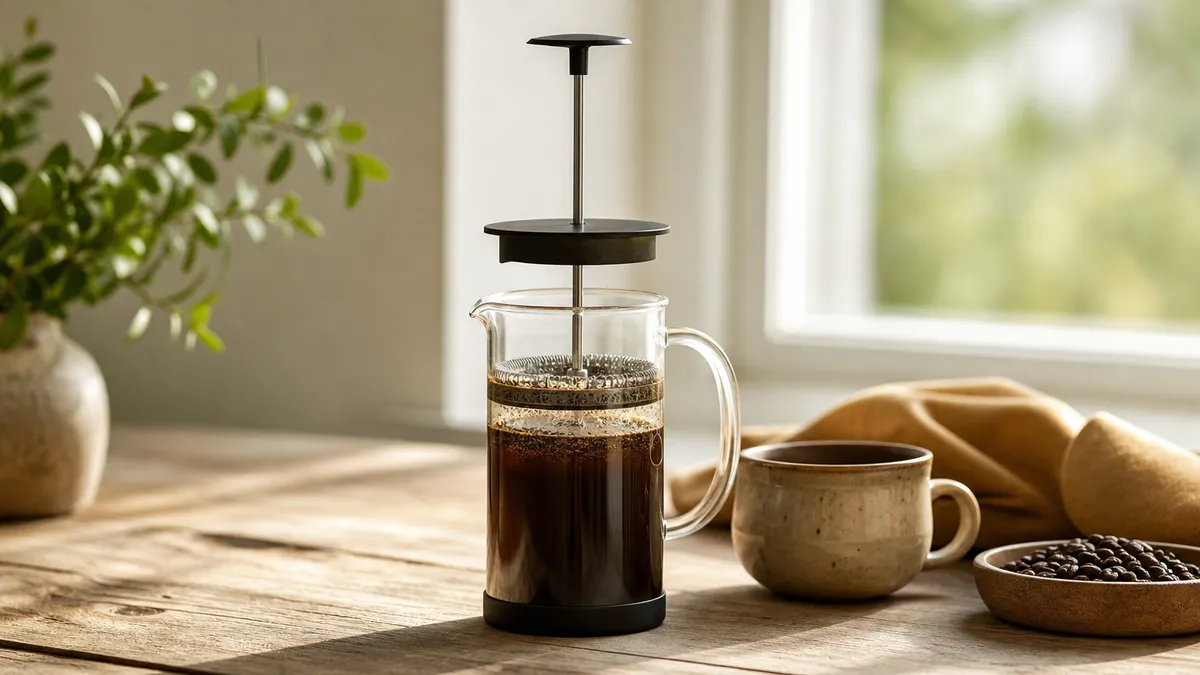
A French press, usually called a cafetière in the UK, is a good coffee maker if you enjoy a full-bodied drink and do not mind measuring, timing and cleaning up yourself. It steeps ground coffee in hot water, then uses a plunger-mounted filter to separate most of the grounds from the drink. Its main buying decisions are capacity, material, filtration and how easily the parts come apart for washing.
In short
- Buy by millilitres, not “cups”. Bodum’s eight-cup Chambord holds 1 litre, not eight full mugs.
- Choose glass for visibility or double-walled steel for insulation. Neither material removes the need for careful handling of hot coffee.
- Check the filter and replacement parts. Conventional screens and finer double-filter systems have different cleaning requirements.
- Use a slow, gentle plunge. A blocked filter is a reason to stop, never to push harder.
- Plan to dismantle the filter after use. Rinsing the assembled plunger is not a substitute for cleaning its separate surfaces.
How a French press works
A cafetière is an immersion brewer: the grounds sit in the brewing water rather than having fresh water continually pass through them. After steeping, the filter moves down through the liquid and holds most of the grounds beneath it. The pressing action separates the drink; it is not an instruction to squeeze the grounds firmly.
The filter helps explain the characteristic texture. A conventional metal screen produces a different drink from paper filtration, while some specialist presses accept an additional paper filter to absorb oils and change the result. ESPRO explicitly describes this difference for its compatible presses.
For buying purposes, distinguish the vessel from the recipe. You can change the coffee dose, water quantity and brewing routine without replacing the brewer. Start with the short method below, then adjust deliberately rather than changing everything together.
If you are still deciding between manual brewing and an appliance, the coffee machines guide is the broader starting point.
Sizes, materials and double-walled versions
Choose capacity around your actual mugs
Manufacturer cup counts are not interchangeable with your kitchen mugs. Bodum’s published Chambord range includes 350 ml, 500 ml, 1 litre and 1.5 litre versions, described respectively as three, four, eight and twelve cups. Hario’s Cafe Press U comes in 300 ml and 600 ml capacities.
Measure the amount you normally serve before choosing. For example, two assumed servings of 250 ml require 500 ml of finished coffee. That arithmetic does not establish that a nominally 500 ml press will supply both: check whether the stated capacity means vessel volume, brewing-water capacity or finished beverage.
Also check minimum batch size. ESPRO publishes minimum brewing quantities for the P7, so the largest model is not automatically the most flexible choice for someone who usually drinks alone.
Compare construction, not appearance alone
The useful criteria are visibility, insulation, breakage considerations and care instructions.
| Construction | Main reason to choose it | Ownership consideration | Who it suits |
|---|---|---|---|
| Single-walled glass | You can see the brew and liquid level | Inspect for damage and check replacement-beaker availability | Someone who serves the batch promptly |
| Double-walled stainless steel | Insulated construction | You cannot judge the contents through the wall | Someone who prioritises heat retention |
| Double-walled glass | Visibility with a double-glass construction | Still requires the care appropriate to glass | Someone who specifically wants this format |
| Glass with decorative wood or plated parts | Preferred appearance and grip | Check care instructions for every component | Someone willing to follow model-specific cleaning directions |
These are construction choices, not a tested performance ranking. Manufacturer examples include Bodum’s glass Chambord and steel Columbia, ESPRO’s insulated P7, and Hario’s double-glass and wood-trimmed presses.
Double-walled does not necessarily mean vacuum-insulated. Bodum describes the Columbia’s insulation as air between its steel walls. Look for an explicit manufacturer statement before treating a double-wall description as a vacuum-flask specification.
My buying preference would be glass for someone who values visibility and serves immediately, or insulated steel where avoiding a glass beaker matters more. That is a suitability judgement, not evidence that either makes better-tasting coffee.
Filter mesh: what to inspect
Look beyond the number of screens. Check that the filter fits the vessel properly, can be dismantled without awkward handling, and is available as a replacement for the exact model.
ESPRO uses two nested filter baskets and a silicone seal. The manufacturer claims finer filtration than a conventional press, but its “grit-free” wording should be treated as a manufacturer claim, not an independently verified result here. More elaborate filtration also means more surfaces to separate and wash.
Replacement compatibility deserves particular attention. A screen that looks approximately right is not sufficient evidence that it fits. Ask the seller to confirm the model reference before ordering a replacement.
Do not confuse a finer filter with permission to use espresso-fine grounds. Bodum warns that fine coffee can clog its filter, while ESPRO also identifies fine particles and residue as causes of difficult plunging. Follow the instructions supplied with your press.
Brands
Compare brands against the same criteria: useful capacity, construction, filter design, cleaning access and replacement support. The examples below use manufacturers’ published descriptions, checked in November 2026; they are not a league table based on first-hand testing.
Bodum
Bodum’s Chambord provides the familiar glass-beaker format, while the Columbia uses double-walled stainless steel. Its published catalogue offers several sizes, making these useful ranges to compare when deciding between visibility and insulation.
Bodum also lists separate Chambord beakers and filter components. That provides a replacement route, but confirm availability and compatibility with a UK seller rather than assuming an overseas parts listing guarantees local stock.
ESPRO
The P7 is an insulated steel press with the company’s double-filter system. It is worth considering if filtration is a priority, provided you are happy to dismantle the baskets and respect the specified minimum brewing quantity.
Its detailed filtration claims do not establish that everyone will prefer the resulting coffee. Treat texture as a preference to explore, not a universal measure of quality.
Hario
Hario’s Cafe Press U uses heatproof glass, a polypropylene holder and stainless-steel filtering components, with published capacities of 300 ml and 600 ml. It offers a straightforward glass option to assess alongside the other brands.
Check the exact product rather than relying on an old photograph or range name. Hario Europe marks the 600 ml Olive Wood press page as discontinued, illustrating why current availability needs checking model by model.
Advantages/Benefits & Disadvantages
Advantages
- A straightforward brewing process. Add coffee and water, steep, then separate the grounds with the plunger.
- Reusable filtration. Conventional presses do not require a fresh paper filter for each batch.
- A choice of serving sizes and construction. Glass and insulated steel versions let you prioritise different ownership needs.
- Potentially replaceable components. Some manufacturers list separate beakers and filter parts rather than requiring replacement of the whole brewer.
Disadvantages
- You manage the process. Weighing, heating water, timing and serving remain manual tasks.
- Filter cleaning is part of every batch. Nested screens or assemblies need separating, not merely swilling.
- Glass requires inspection and careful handling. Bodum instructs users not to use scratched, chipped or cracked beakers.
- Insulation claims need context. A manufacturer’s statement about keeping coffee hot is not a guarantee of a particular serving temperature in your kitchen.
My assessment: a cafetière suits someone who wants involvement without a complicated operating routine. I would not choose it for a workplace where the priority is unattended, repeated drinks preparation and nobody has responsibility for washing the filter.
A practical starting method
This is an ownership-level starting routine, not a substitute for the instructions supplied with your brewer. The SCAA’s French press guidance uses a four-minute brew at 93.5°C; the rounded temperature below and single-pour routine are practical adaptations, not a claim to reproduce that protocol exactly.
- Check the press. Use a stable, heat-resistant surface and inspect a glass beaker for damage.
- Preheat, then empty it. Warm the vessel with hot water before adding the brewing ingredients.
- Weigh 30 g of suitably ground coffee. Follow your manufacturer’s grind guidance.
- Add 500 g of water, approximately 500 ml, at about 94°C. This suggested starting dose is 60 g per litre, or roughly 1:16.7 coffee to water by weight.
- Wet all the grounds gently. Use a utensil permitted by the manufacturer, then fit the lid with the plunger raised.
- At four minutes, plunge slowly and serve. Never force a resistant plunger.
Use a vessel with sufficient working capacity and the required headroom. Bodum’s instructions specify at least 2.5 cm below the top, so do not fill to the rim simply to reach a recipe quantity.
| Symptom | Likely cause to investigate | First action |
|---|---|---|
| Plunger becomes difficult to move | Fine grounds or a clogged filter | Stop applying pressure; follow the maker’s instructions |
| Filter remains dirty after rinsing | Residue between assembled surfaces | Separate the parts and wash individually |
| You run short when serving | Cup count mistaken for mug capacity | Measure your servings and check capacity definitions |
| Replacement component does not fit | Wrong model or part reference | Confirm compatibility before using it |
The first two checks follow manufacturer guidance; the capacity and compatibility checks are practical buying precautions.
Cleaning, water and everyday ownership
Let the contents cool enough to handle safely, then collect the spent grounds before washing. Do not deliberately wash the batch of grounds down the sink: Thames Water includes coffee grounds among the materials that should be kept out of drains.
Separate the filter assembly as directed, wash the exposed surfaces, rinse thoroughly and dry before storage. Dishwasher permission belongs to the particular product and finish, not to cafetières as a category. Hario lists the Cafe Press U as dishwasher-safe, but that does not establish the care requirements of a different press with decorative components.
For water, start with your own supplier’s report rather than a supposed UK-wide hardness figure. Thames Water, for example, provides postcode-based water-quality information and identifies calcium and magnesium as the minerals responsible for hardness.
Keep the receipt and model reference. For UK consumer purchases, GOV.UK explains that statutory rights concerning faulty goods are not replaced by a manufacturer’s warranty or guarantee. An office purchase may require a different assessment, so do not assume consumer guidance applies to every business order.
FAQ
Can I put a cafetière on the hob?
No, not unless its manufacturer expressly permits it. Bodum’s French press instructions prohibit stovetop use, and ESPRO also says not to put the P7 on a hob. Heatproof glass and stainless steel describe materials, not permission to heat the assembled brewer directly. Prepare the water separately and follow the product manual.
Does a cafetière need SCA certification?
SCA certification is not a requirement for choosing a cafetière. The association’s equipment programme involves evaluation of particular products against its standards; it is not blanket approval of a brewing category. This article uses published brewing guidance separately from certification and does not claim certification for any press mentioned here.
Can I add a paper filter to any French press?
Do not assume that you can. ESPRO specifically offers paper filters for its compatible presses and explains that they change the drink by absorbing oils. For another design, check the maker’s instructions before adding material to the filter assembly, particularly if it could affect fit or plunging resistance.
Where to go next
Use Coffee Machines to place the French press alongside other equipment choices. Read Aeropress and Moka Pots when comparing other manual formats, or Percolators if that is another option on your shortlist.
Sources
-
Specialty Coffee Association of America, Guidelines for Brewing with a Three Cup French Press, revised 2 April 2016.
-
Bodum, Catalogue 2026, Chambord, Columbia and related French press entries. Manufacturer-authored catalogue retrieved from a distributor-hosted copy.
https://aksai.co/download/2026/BODUM_Catalogue2026.pdf -
Bodum, French Press Coffee Makers: Instructions for Use, document BE00-022-0000, publication date not stated. Manufacturer-authored manual retrieved from a retailer-hosted copy.
https://essense.coffee/wp-content/uploads/2019/07/BE00-022-0000_manuale_BODUM-CHAMBORD.pdf -
Bodum, Chambord 1928-57, product details, brewing directions and replacement components, undated live page, checked 2026.
https://www.bodum.com/us/en/1928-57-chambord -
ESPRO, P7 French Press Coffee Maker, manufacturer specifications and claims, undated live page, checked 2026.
https://espro.com/products/coffee-french-press-p7 -
ESPRO, Frequently Asked Questions, filtration, cleaning, compatibility and safety guidance, undated live page, checked 2026.
https://espro.com/pages/faq -
Hario USA, Cafe Press “U” Coffee and Tea Press, manufacturer specifications and care information, undated live page, checked 2026.
https://globalhario.com/products/cafe-press-u -
Hario Europe, Coffee Press Olive Wood, product details and discontinued notice, undated live page, checked 2026.
https://www.hario-europe.com/products/coffee-press-olive-wood -
Thames Water, Water Quality and Bin It, local water information and drainage guidance, undated live pages, checked 2026.
https://www.thameswater.co.uk/help/water-and-waste-help/water-quality
https://www.thameswater.co.uk/help/water-and-waste-help/blockages/bin-it -
GOV.UK, Accepting Returns and Giving Refunds: The Law, undated live guidance, checked 2026.
https://www.gov.uk/accepting-returns-and-giving-refunds -
Specialty Coffee Association, Certified Home Equipment, certification programme description, undated live page, checked 2026.
https://sca.coffee/certified-home-brewer
Researched using retrieved manufacturer specifications and instructions, published SCAA brewing guidance, official consumer guidance and water-supplier information; no first-hand equipment testing is claimed.
Last checked: November 2026