For a team of roughly 20 to 100 people, the best starting point is a commercial bean-to-cup machine chosen for actual attendance, daily drinks and the busiest break, not payroll headcount alone. Choose one machine only if it meets your peak queue target; consider two when breaks coincide, staff occupy separate areas or coffee must remain available during a breakdown.
In short
- Calculate demand from people attending, the proportion drinking coffee and drinks per coffee drinker.
- Record the busiest 15 minutes separately from the daily total.
- Treat manufacturers’ daily capacity figures as selection guidance, not guaranteed queue performance.
- Specify the milk system, cleaning responsibilities and installation requirements before comparing quotations.
- Ask for written repair, replacement-machine and lease-exit terms, not simply “full service”.
Size coffee machines for medium-sized offices by attendance
Start with a representative working week, including your busiest office day, visitor meetings and shift handovers. Record drinks made, queues, refills and occasions when staff abandon the queue.
A useful planning calculation is:
Daily coffees = people attending × proportion drinking coffee × coffees per coffee drinker, plus visitor drinks.
The following matrix uses illustrative assumptions, not measured workplace averages: everyone listed attends, 75% drink coffee, and each coffee drinker has two coffees daily. Rounded results help with initial screening, not final specification.
| People attending | Assumed coffee drinkers | Calculated coffees daily | What to investigate |
|---|---|---|---|
| 20 | 15 | 30 | One machine, refill workload and cleaning ownership |
| 40 | 30 | 60 | One machine tested against the busiest break |
| 60 | 45 | 90 | Peak milk-drink output and downtime cover |
| 80 | 60 | 120 | Higher-capacity equipment or two machines |
| 100 | 75 | 150 | Two serving points, concentrated breaks and resilience |
For example, a business employing 100 people but expecting 40 on site should begin with the 40-person attendance scenario. It must still accommodate occasional all-team days.
Use workplace coffee planning for the broader choice of provision. If attendance remains modest even on busy days, the small-office guide covers the neighbouring category.
Test peak demand, not just daily capacity
Daily output and peak throughput answer different questions. One describes the workload the manufacturer recommends; the other concerns how quickly your chosen drinks reach waiting colleagues.
For example, JURA publishes a recommended maximum of 100 cups daily for its X10, alongside separate hourly figures of 80 espressos and 51 cappuccinos under DIN 18873-2 test conditions. Neither figure guarantees your office’s real queue performance.
Run a supplier demonstration using your cup sizes, drink recipes and expected milk-drink mix. Include selecting the drink, positioning the cup, dispensing, collecting it and any intervening rinse or refill.
Set an explicit acceptance target. “Nobody waits more than three minutes during the busiest break” is a possible workplace target, not an industry standard.
Suppose 20 drinks are requested within 15 minutes. That represents an arrival rate equivalent to 80 drinks an hour, but an hourly specification alone cannot show whether the queue will clear. Ask the supplier to reproduce the burst itself.
Record shift changes and meeting finishes separately. A quiet morning followed by one simultaneous break needs a different demonstration from the same number of drinks spread throughout the day.
Decide between one machine and two
Choose one machine when a single tea point is convenient, demonstrated throughput meets demand and temporary loss of coffee service is acceptable.
Choose two when you need parallel serving, separate locations or a practical fallback. Place cups, milk and waste bins so the two queues do not converge at the same narrow space.
Two machines do not automatically provide full resilience. In an illustrative 120-drink day, two machines sharing demand equally make 60 drinks each. If one becomes unavailable, the survivor would need to handle all 120 unless you restrict the menu or introduce another brewing method.
Ask three questions:
- Can the remaining machine support the essential daily demand?
- Can it manage the busiest break without unacceptable queues?
- Will a shared water supply, electrical fault or unavailable milk fridge disable both?
For demand beyond this article’s scope, use the large-office guide. Where several organisations share the equipment, the shared-workspace guide addresses the different management arrangements.
Build a shortlist around stated criteria
Compare machines against daily capacity, demonstrated peak output, drink quality, milk handling, installation fit, cleaning workload and local service arrangements. Reject unsuitable configurations before comparing contract terms.
These are examples to investigate, not tested winners. Specifications below are manufacturers’ published claims, checked in November 2026; confirm the exact UK configuration in writing.
| Candidate or arrangement | Manufacturer’s daily guidance | Who should investigate it | Main qualification |
|---|---|---|---|
| JURA X10 | Recommended maximum 100 cups | Teams whose measured demand fits comfortably within that guidance | Its claimed 51 single cappuccinos hourly makes a milk-heavy peak demonstration particularly important |
| Franke A600 | Up to 150 cups | Busier teams considering a configurable commercial system | Specify the milk, cleaning and water-supply configuration; do not assume every option is included |
| Two appropriately sized commercial machines | Assess each model separately | Split floors, simultaneous breaks or workplaces needing continuity | Test the surviving-machine scenario, not just combined capacity |
Franke’s A600 range includes different milk and cleaning configurations, with FoamMaster and CleanMaster among the available systems. Its suitability therefore depends on the actual specification offered, not the model name alone.
Make the tasting practical: compare the black coffee and milk drink staff will actually choose. Ask the demonstrator to record the coffee dose, drink volume and settings so an attractive demonstration can be reproduced after installation.
Choose a milk system someone will maintain
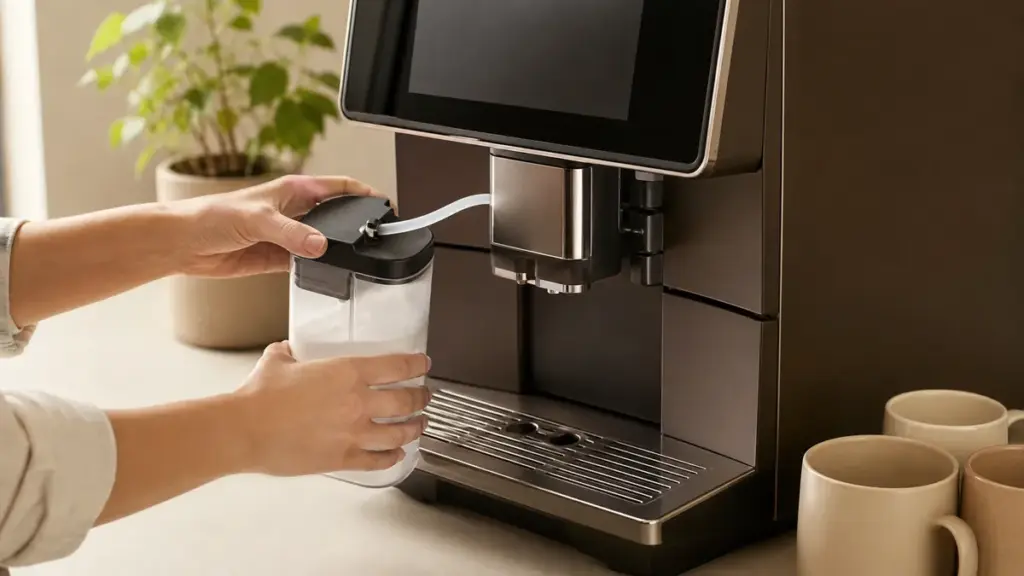
For fresh-milk drinks, specify a compatible refrigerated supply and an agreed procedure for replenishment, cleaning and end-of-day handling. Ask who will perform those tasks when the usual office organiser is absent.
Automatic rinsing is not the same as completing the cleaning procedure. JURA’s X10 instructions require milk-system cleaning daily when milk has been prepared, alongside the relevant dismantling and rinsing tasks.
Ask the supplier to demonstrate the entire routine, including manual work. Have the proposed operator carry it out rather than merely watching a sales demonstration.
If considering powdered milk or topping, compare the finished drink and the actual maintenance procedure. Do not assume it is either maintenance-free or an acceptable taste substitute.
Plant-based drinks also need scrutiny. Ask which products the manufacturer supports and whether dairy and plant-based drinks share tubing or dispensing components. A separate container does not, by itself, demonstrate allergen separation; switching products must not be treated as proof that the next drink is safe for someone with a milk allergy.
Check plumbing, water and usable space
A tank-fed installation may suit a location without an accessible water connection, but assess the work involved in replenishment. A plumbed-in installation should still be assessed for drainage, grounds disposal and cleaning access.
For scale, 60 black coffees containing an assumed 200 ml of dispensing water each require 12 litres for drinks alone. Rinsing and cleaning are additional, so tank capacity cannot simply be divided by cup volume to predict a working day.
Ask the installer to confirm:
- Water supply, isolation, pressure and any required drainage.
- Backflow protection and applicable installation rules.
- Electrical requirements for the machine and refrigerator together.
- Space for opening doors, removing tanks, filling hoppers and servicing.
- Worktop suitability and an accessible, unobstructed approach.
In England and Wales, the Water Supply (Water Fittings) Regulations 1999 require appropriate backflow prevention. Have the installer identify the applicable local requirements rather than assuming that arrangement applies throughout the UK.
Use your water supplier’s local information and the machine’s installation requirements when specifying treatment. Thames Water, for example, provides postcode-based water-quality information; do not substitute a supposed UK-wide hardness figure for the actual supply.
In Great Britain, machines containing steam pressure systems may fall within the Pressure Systems Safety Regulations 2000. Check with the supplier and HSE guidance on pressure systems, including any requirement for a written scheme of examination. A routine service visit should not be assumed to fulfil that requirement.
Provide a grounds bin beside the machine. In England, workplaces with at least 10 full-time-equivalent employees have been required to separate food waste, including coffee grounds, since 31 March 2025. Smaller firms have until 31 March 2027; do not apply England’s timetable elsewhere without checking.
Compare leasing and service as separate decisions
Do not assume a lease includes maintenance or that a maintenance agreement guarantees a replacement machine. Request the finance agreement, service schedule and consumables terms separately.
Before signing, establish:
- The agreement length, ownership position and end-of-term process.
- Early termination, relocation and upgrade conditions.
- Any compulsory ingredient supply or minimum purchasing commitment.
- Which repairs, parts, travel and routine maintenance are included.
- Whether filters, cleaning products and milk-system components are excluded.
Define service levels precisely. “Response” could mean acknowledging a message rather than sending an engineer. Ask for attendance commitments, restoration arrangements, working-day coverage and the conditions for providing a suitable replacement.
Also confirm who handles a failure involving the machine, fridge, filter or installation. One named contact is useful only if responsibility for those boundaries is clear.
Work out your own running requirement
Get itemised written quotations covering equipment, installation, finance where applicable, ingredients, servicing, filters, cleaning products, energy and waste handling.
For a workplace-specific per-drink calculation, total the relevant amounts over one consistent period, then divide by expected drinks actually served during that period. Include staff cleaning time and avoid counting bundled items twice.
State attendance, opening days, dose, milk-drink share, milk quantity, wastage, equipment term and VAT treatment. Coffee and milk supplied as food are generally zero-rated, while hot drinks supplied in the course of catering are standard-rated. Ask for the VAT status of each quotation line and compare all proposals on the same basis.
FAQ
Can we keep our current machine as a backup?
Yes, if its condition, intended use and capacity make it suitable for the backup role. Write down what it must deliver during an outage, which drinks will remain available and who will prepare it for use. A stored machine is not a practical fallback until someone has checked and demonstrated that arrangement.
Should tea users share the coffee machine’s hot-water outlet?
Include tea demand in the demonstration before deciding. Ask the supplier to show whether hot water and coffee can be dispensed simultaneously on the proposed configuration. If tea requests prevent the coffee service from meeting your queue target, evaluate a separate hot-water provision rather than sizing the coffee machine around coffee drinkers alone.
How should we allow for future recruitment?
Ask suppliers to assess a defined future attendance scenario alongside today’s measured demand. Include expected visitors, office days and shift patterns rather than adding an unexplained capacity margin. For coffee machines for medium-sized offices, retain a written trigger for reassessment, such as exceeding the agreed queue target or the manufacturer’s recommended workload.
Where to go next
Start with Coffee for Every Workplace to put the machine within your overall workplace provision. Read Coffee Machines for Small Offices or Coffee Machines for Large Offices if measured demand points outside this category; use Coffee Machines for Shared Workspaces where several organisations share responsibility.
Sources
-
JURA, “X10 Dark Inox (INTB)”, live UK specification page, undated, checked November 2026. Daily guidance and drink-specific hourly output.
URL: https://uk.jura.com/en/professional/machines/x10dark-inox-intb-15781 -
JURA, “X10 (EB/SB/INTB): Instructions for Use”, Type 777, manufacturer’s currently linked manual, checked November 2026. Milk-system maintenance and installation instructions.
URL: https://uk.jura.com/-/media/global/pdf/manuals-global/professional/X10/X10-EB-SB/download_manual_x10_eb_sb.pdf -
Franke Coffee Systems, “A Line” product brochure, undated retrieved edition, checked November 2026. A600 daily guidance and configuration options.
URL: https://www.franke.com/content/dam/franke/language-masters/en/coffee-systems/documents/brochures/en/EN_A_Line_Franke_CS_Brochure.pdf.coredownload.pdf -
Franke Coffee Systems UK, “The Franke A600 coffee machine”, live product page, undated, checked November 2026. Milk and cleaning systems.
URL: https://www.franke.com/gb/en/coffee-systems/products/fully-automatic-coffee-machines/classic-a600-coffee-machine.html -
Food Standards Agency, “Precautionary allergen labelling”, 2023, live guidance checked November 2026. Allergen cross-contamination assessment and controls.
URL: https://www.gov.uk/government/publications/precautionary-allergen-labelling/precautionary-allergen-labelling -
UK legislation, “The Water Supply (Water Fittings) Regulations 1999”, SI 1999/1148, Schedule 2, paragraph 15, checked November 2026. England and Wales backflow requirements.
URL: https://www.legislation.gov.uk/uksi/1999/1148/pdfs/uksi_19991148_en.pdf -
Thames Water, “Water quality”, live customer guidance, undated, checked November 2026. Local postcode-based water-quality information.
URL: https://www.thameswater.co.uk/help/water-and-waste-help/water-quality -
HSE, “Pressure Systems Safety Regulations 2000 (PSSR)”, live guidance, undated, checked November 2026. Relevant fluids, examination arrangements and duties involving leased equipment.
URL: https://www.hse.gov.uk/pressure-systems/pssr.htm -
DEFRA, “Simpler recycling: workplace recycling in England”, 2024, updated 2025, checked November 2026. Commencement dates, employee threshold and coffee grounds.
URL: https://www.gov.uk/guidance/simpler-recycling-workplace-recycling-in-england -
HMRC, “Food products (VAT Notice 701/14)”, 2014, updated June 2026, checked November 2026. Coffee and milk supplied as food.
URL: https://www.gov.uk/guidance/food-products-and-vat-notice-70114 -
HMRC, “Catering, takeaway food (VAT Notice 709/1)”, live notice, checked November 2026. Catering and hot-drink VAT treatment.
URL: https://www.gov.uk/guidance/catering-takeaway-food-and-vat-notice-7091
Research used manufacturer specifications and instructions alongside official UK regulatory guidance; planning scenarios are explicitly assumed calculations, and no first-hand machine testing is claimed.
Last checked: November 2026