Office coffee consumables and supplies include beans, milk, cups, sugar, cleaning products and replacement water filters, plus the small items needed to store and serve everything safely. Build your stock list around the machine’s instructions and actual drink demand, then set reorder points that cover delivery time without filling cupboards with ageing supplies.
In short
- Separate the stock list into ingredients, serving supplies and machine-care products, with an owner for each.
- Calculate beans from drinks and dose, milk from the drinks that actually use it, and cleaning supplies from the prescribed maintenance schedule.
- Keep refrigerated milk at 0 to 5 degrees Celsius, follow carton instructions and record opening dates.
- Rotate beans and milk first-in, first-out, but prioritise an earlier use-by date if deliveries arrive out of sequence.
- Store cleaning chemicals separately from food, cups and serving utensils, not alongside them on an open shelf.
Your office coffee consumables stock list
Start with the checklist below, deleting anything your machine does not use. Record the exact product reference for filters and cleaning chemicals rather than relying on descriptions such as “coffee tablets”.
| Category | What to keep | What to confirm before ordering |
|---|---|---|
| Coffee | Whole beans; decaffeinated coffee if required | Suitable format and approved ingredients for each hopper or chute |
| Milk | Dairy milk and agreed plant-based alternatives | Refrigeration, allergens, opened shelf life and machine suitability |
| Other ingredients | Sugar, sweeteners; chocolate or milk powder where used | Pack sizes, ingredient information and compatibility |
| Drinkware | Reusable mugs or hot-drink cups; matching lids where needed | Cup height, usable capacity and lid fit |
| Serving supplies | Teaspoons or suitable stirrers, napkins | Washing arrangements or disposal route |
| Machine care | Cleaning tablets, milk-system cleaner; descaler if prescribed | Exact product, dose and maintenance instructions |
| Water treatment | Correct replacement cartridge, where fitted | Cartridge reference and replacement requirements |
| Supporting supplies | Dedicated brushes, cloths, cleaning container, suitable bin liners | Hygiene separation and compatibility with the cleaning and waste arrangements |
Do not assume the initial machine delivery includes an ongoing supply of these items. Ask for a written handover list showing what is included, what needs replenishing and who orders it.
Keep this stock plan with your wider installation and maintenance arrangements, so responsibilities survive changes of staff or supplier.
Beans and optional ingredients
Choose the coffee first, then standardise the ordering reference and pack size. For flavour and machine suitability, see choosing office coffee beans, rather than treating this stock list as a bean-buying guide.
Decaffeinated coffee needs its own demand estimate. Before buying it, check whether the machine accepts whole beans in a separate hopper, pre-ground coffee through a designated chute, or neither.
Chocolate and milk powders belong on the list only where the machine is designed for them. Keep their ingredient information available alongside the milk information.
Cups, lids, sugar and stirrers
Reusable mugs need a washing and replenishment plan, not just a cupboard. For disposable cups, order samples first and check clearance beneath the outlet, room for the selected drink and compatibility with the exact lid.
Avoid automatically issuing a lid and stirrer with every drink. Make them available where needed, and measure use separately from total drinks. Sugar sachets and sweetener portions can likewise have their own stock count rather than an assumed one-per-coffee allowance.
Match cleaning products and filters to the machine
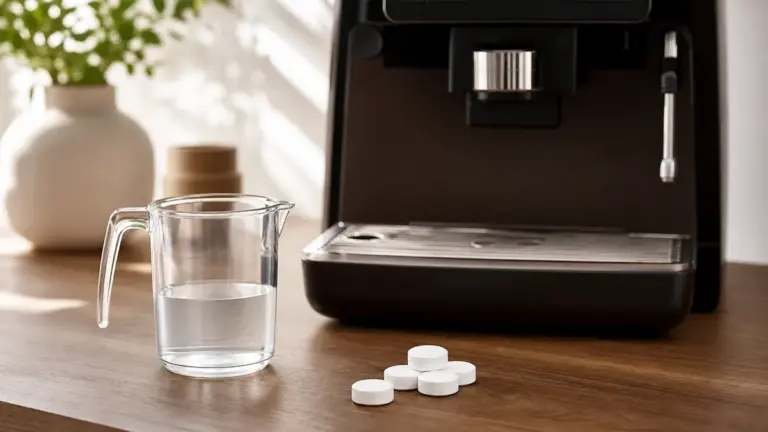
Cleaning tablets, milk-system cleaner and descaler are different supplies, not interchangeable versions of one product. For example, JURA’s WE8 instructions specify separate procedures for coffee-system cleaning, milk-system cleaning and descaling.
Build the replenishment list from your machine’s current manual. Record the approved product, amount used per procedure and expected number of procedures before the next delivery. Do not copy another office’s cleaning schedule simply because its machine looks similar.
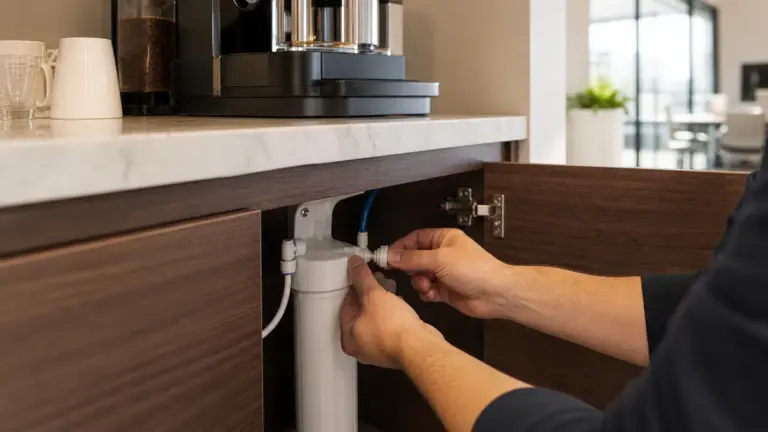
For water treatment, record the cartridge reference, installation date and replacement instructions. Filter requirements can depend on the machine and water-hardness setting: the WE8 manual, for example, links its replacement prompt to that setting. There is no useful universal “one filter per month” rule for this stock list.
Keep a replacement available before the prescribed change is due, where shelf life and supplier instructions permit. Confirm whether your team or the service provider changes it.
If the machine develops a fault, use the breakdowns and repairs guide rather than experimenting with stronger chemicals or improvised cleaning products.
Set stock levels from attendance and actual use
Headcount is a starting point, not a consumption measurement. For initial planning, use expected daily attendance, then replace assumptions with machine-counter readings and stock records.
The following matrix is an illustrative scenario, assuming two coffee drinks per attendee per working day. It is not a consumption benchmark or a machine-capacity recommendation.
| People attending daily | Assumed coffee drinks per person | Planned drinks per day | Planned drinks over five working days |
|---|---|---|---|
| 10 | 2 | 20 | 100 |
| 40 | 2 | 80 | 400 |
| 80 | 2 | 160 | 800 |
Turn drinks into quantities
Suppose your planning assumptions are:
- 40 people attend daily.
- Each takes two coffee drinks.
- Each drink uses 9 g of beans, with no additional coffee dose.
That gives 40 × 2 × 9 g = 720 g of beans per working day, or 3.6 kg over five working days, before any allowance for dialling-in, discarded drinks or other losses. These are example inputs, not recommended settings.
For milk, multiply the number of milk drinks by the actual millilitres dispensed per recipe. Add recorded discarded milk separately. Do not multiply all coffees by the volume of a latte, and do not confuse milk volume with the finished volume of foam.
Count disposable cups from takeaway demand, not total drinks. Estimate cleaning products from prescribed procedures and doses, not from cup numbers alone.
Use a reorder point
A practical starting rule is:
Reorder point = expected use during delivery lead time + safety stock.
Using the example above, a three-working-day delivery lead time and one working day of safety stock gives:
720 g × 3 + 720 g = 2,880 g, or 2.88 kg.
Choose your own safety allowance for supplier reliability and demand variation. With fixed ordering days, also allow for the interval until the next stock review.
Check stock on hand and confirmed incoming deliveries before ordering. Round to pack sizes only after checking storage space and usable shelf life. Milk will usually need a different delivery pattern from cups or cleaning tablets.
Store supplies safely and rotate them properly
Beans and dry ingredients
Keep beans airtight, cool and dark, away from the coffee machine’s heat, sunlight and damp areas. The National Coffee Association identifies air, moisture, heat and light as enemies of freshness.
Use first-in, first-out rotation, abbreviated to FIFO: bring older stock forward and place new deliveries behind it. Record opening dates and retain the product and batch information if ingredients are transferred into suitable containers.
Buy quantities that move through the office rather than treating spare cupboard space as a target. Refill the hopper for expected use instead of using it as long-term storage.
Milk refrigeration and dates
Keep refrigerated milk in a fridge operating at 0 to 5 degrees Celsius, checking the temperature with a suitable thermometer. Check the machine’s milk-cooling arrangement too, rather than assuming that a cool-looking enclosure provides refrigeration.
Follow each carton’s storage and “use within” instructions. Refrigerate shelf-stable milk after opening when the label requires it, and mark when it was opened. Keep milk out of refrigeration for as little time as possible.
A use-by date concerns safety; a best-before date concerns quality. Milk can carry either, so read the actual label. Do not use milk after its use-by date or rely on smell to override it.
Apply FIFO to milk, but use earlier-expiring stock first if delivery dates and expiry dates differ.
Allergens and chemical separation
Keep dairy milk and alternatives clearly identified and separated to prevent spills and mix-ups. Retain ingredient labels, use dedicated utensils or containers where appropriate, and check replacement products before accepting substitutions.
Separate cartons do not make a shared milk circuit allergen-free. Shared equipment is a potential cross-contact route, so assess it and communicate its limitations rather than promising an allergen-free drink.
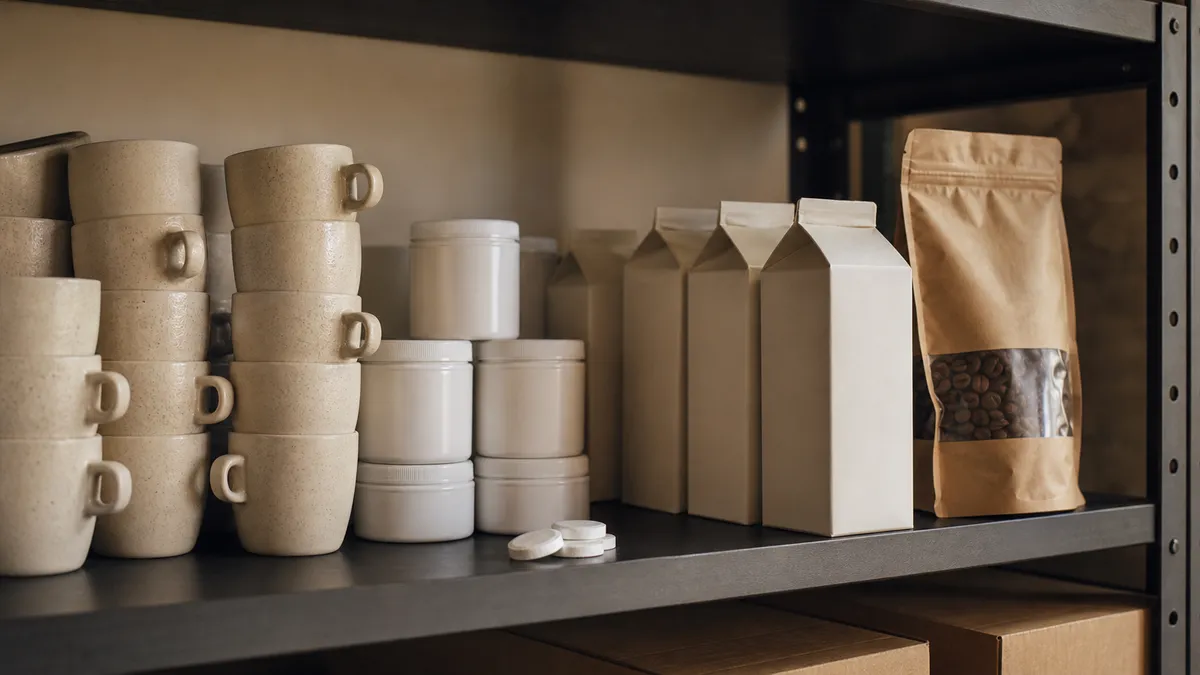
Store cleaning chemicals in a separate designated cupboard, following their labels and storage instructions. Keep them in clearly identified packaging, away from ingredients, cups and utensils. Cleaning tablets should never sit beside sugar or sweeteners.
Ordering and cost control without compromising supplies
Give one person responsibility for the master list and nominate cover. Use a stock sheet containing the product reference, pack size, stock on hand, reorder point, supplier, lead time and storage location.
At receipt, check the product, quantity, condition and dates before putting it away. Agree acceptable substitutions in advance, especially for allergens, cup-and-lid combinations and machine-care products.
For cost control, ask suppliers for itemised written quotations separating ingredients, serving supplies, cleaning products, filters, delivery and any compulsory purchasing commitments. Check which supplies are already included in the machine or service agreement, and ask for the VAT treatment of each line.
To work out your own consumables cost per drink, total the supplies used over a chosen period and divide by drinks actually served. State the period and VAT basis, and include discarded stock. If assessing the whole coffee service, add machine provision, servicing, utilities, washing and waste collections separately.
Do not reduce prescribed cleaning doses or extend filter intervals to control consumption. Instead, investigate over-ordering, expired milk, duplicate supplies and unnecessary disposable items.
Choose supplies that fit the waste arrangements
In England, the relevant bans started on different dates: plastic drinks stirrers were banned from 1 October 2020, while the ban covering single-use expanded and extruded polystyrene cups began on 1 October 2023. These are not blanket bans on every disposable coffee cup.
Choose reusable teaspoons or suitable non-plastic stirrers. Check the rules for the UK nation where the workplace operates rather than treating England’s requirements as UK-wide.
England’s Simpler Recycling workplace requirements began on 31 March 2025, with micro-firms having fewer than 10 full-time-equivalent employees given until 31 March 2027. Coffee grounds count as food waste.
Do not put compostable cups, lids or pods into food waste simply because the packaging says “compostable”. DEFRA says such packaging needs residual disposal or a dedicated collection, rather than ordinary food-waste recycling. Confirm the collection route before ordering office coffee consumables and supplies.
FAQ
Can we buy all our consumables from one supplier?
Yes, provided the supplier can meet the specification for every item. Compare delivery reliability, acceptable substitutions, pack sizes and remaining shelf life, not just the convenience of one order. Keep exact references for cleaning products and filters, and ask whether any agreement restricts where you may buy them.
How much emergency stock should we keep?
Keep enough to cover a realistic delivery delay, subject to shelf life and storage capacity. Set this separately for each item rather than holding the same number of weeks of everything. Review the allowance after stockouts, attendance changes or supplier delays, and avoid solving a milk shortage by creating a fridge full of short-dated cartons.
Should staff be allowed to bring their own milk?
They can, if the workplace has a clear storage and handling arrangement. A practical policy is to require identifiable containers, opening dates where relevant and suitable refrigerated space. Personal milk still needs allergen controls, and putting it through a shared machine does not remove the possibility of cross-contact.
Where to go next
Read Office Coffee Installation and Maintenance to place replenishment within the wider operating plan, and Choosing Coffee Beans for Office Machines to settle the main ingredient specification. Keep Office Coffee Machine Breakdowns and Repairs available for faults that replenishment and routine care cannot resolve.
Sources
-
JURA, WE8 Instructions for Use, undated, manufacturer-hosted manual. Used for machine-specific maintenance-product distinctions and filter instructions.
https://www.jura.com/-/media/global/pdf/manuals-global/professional/WE-8-2019/download_manual_jura_we8_v19.pdf -
National Coffee Association, Storage and shelf life, undated. Used for bean-storage guidance.
https://www.aboutcoffee.org/beans/storage-and-shelf-life/ -
Food Standards Agency, Safe Catering: Your Guide to Making Food Safely, Issue 7, April 2019. Used for ordering, FIFO rotation, delivery checks and chemical separation.
https://assets.publishing.service.gov.uk/media/69b3f32ffdbfc4d58fc8cf2e/safe-catering_0_0.pdf -
Food Standards Agency, How to chill, freeze and defrost food safely, live guidance, accessed November 2026. Used for refrigeration temperature and storage instructions.
https://www.gov.uk/government/publications/how-to-chill-freeze-and-defrost-food-safely/how-to-chill-freeze-and-defrost-food-safely -
Food Standards Scotland, Use-by and best-before dates, undated. Used for date-label distinctions, including milk.
https://www.foodstandards.gov.scot/consumer-advice/food-labels/use-by-and-best-before-dates -
Food Standards Agency, Precautionary allergen labelling, live guidance, accessed November 2026. Used for ingredient segregation and shared-equipment cross-contact.
https://www.gov.uk/government/publications/precautionary-allergen-labelling/precautionary-allergen-labelling -
DEFRA, Single-use plastics bans and restrictions, updated 7 October 2024; Start of ban on plastic straws, stirrers and cotton buds, 1 October 2020; New bans and restrictions on polluting single-use plastics come into force, 29 September 2023. Used for England’s prohibited items and commencement dates.
https://www.gov.uk/guidance/single-use-plastics-bans-and-restrictions
https://www.gov.uk/government/news/start-of-ban-on-plastic-straws-stirrers-and-cotton-buds
https://www.gov.uk/government/news/new-bans-and-restrictions-on-polluting-single-use-plastics-come-into-force -
DEFRA, Simpler recycling: workplace recycling in England, updated 3 October 2025. Used for commencement dates, the micro-firm exemption, coffee grounds and compostable packaging.
https://www.gov.uk/guidance/simpler-recycling-workplace-recycling-in-england
This guide was researched from manufacturer instructions, food-safety authorities and DEFRA guidance; stock calculations are explicitly labelled planning examples, not measured office consumption.
Last checked: November 2026