Commercial boiler safety and PSSR compliance depend on the pressure system inside your coffee machine, not its size or drink menu. In Great Britain, workplace machines incorporating a steam boiler require a written scheme of examination and examination by a competent person, subject to any applicable system-specific exception. Routine servicing does not replace this statutory examination.
In short
- Steam is a relevant fluid at any pressure, with no minimum boiler volume exemption.
- The 250 bar-litres partial exception applies to relevant fluids other than steam, not coffee steam boilers.
- A written scheme of examination sets out what must be examined, how and at what intervals.
- Check the examination report’s deadline, rather than assuming an annual service covers compliance.
- For hired machines, establish responsibilities in writing and obtain the current examination documents.
What is a pressure system?
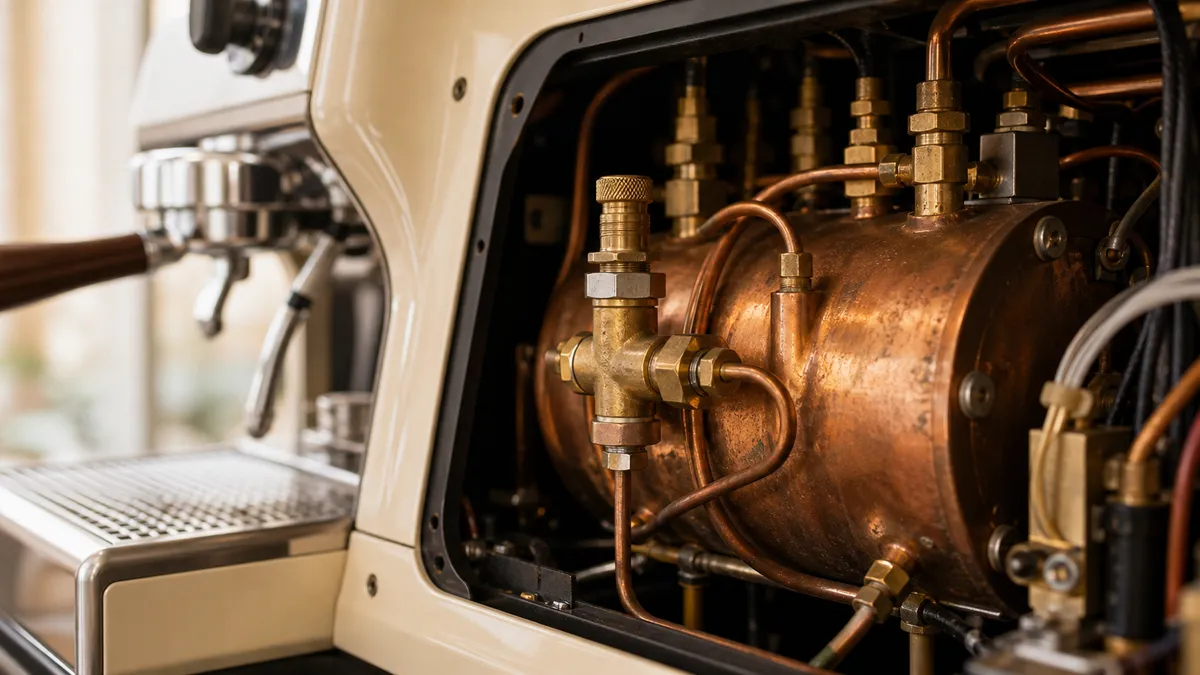
For a boiler-equipped coffee machine, the pressure system comprises the pressure vessel, associated pipework and protective devices. The vessel contains the heated water and steam; protective devices help prevent dangerous operating conditions.
PSSR addresses injury from the unintended release of stored energy when a system fails. Steam also presents a scalding hazard, which the regulations recognise.
A relevant fluid is a fluid covered by the legal definition. It includes steam at any pressure, certain pressurised gases and liquids that meet the specified vapour-pressure conditions. Do not apply the pressure threshold for compressed gases to steam.
This article covers the Pressure Systems Safety Regulations 2000 in England, Scotland and Wales, checked in November 2026. Northern Ireland has separate legislation, the Pressure Systems Safety Regulations (Northern Ireland) 2004. Businesses there should use that legislation and HSENI guidance rather than treating the Great Britain regulations as UK-wide.
For the wider maintenance framework, start with installation and maintenance.
Which coffee machines come under PSSR?
A workplace coffee machine incorporating a steam-generating boiler falls within the pressure-system requirements described by HSE. This includes traditional espresso machines with steam boilers and bean-to-cup models that use them.
However, “traditional”, “automatic” and “bean-to-cup” are not legal classifications. Obtain information about the actual heating system.
Steam boiler or thermoblock?
A thermoblock heats water as it passes through a heated component, rather than necessarily storing it in a steam boiler. A thermoblock-only or flash-heater machine without a qualifying pressure vessel or another qualifying pressure-system arrangement will generally fall outside these boiler examination requirements.
That is a design-based assessment, not a blanket exemption for anything advertised as a thermoblock machine. Ask the manufacturer or supplier for technical documentation, then seek competent advice if the classification remains unclear.
Manufacturer specifications can identify a heating technology. They do not, by themselves, establish the legal position of every connected component or accessory.
Applicability and examination are separate questions
First establish whether PSSR applies. Then establish which provisions apply to that particular system.
Schedule 1 contains both complete and partial exceptions. For certain non-steam systems, the partial exception applies where the pressure multiplied by the internal volume of each pressure vessel is less than 250 bar-litres. It removes specified duties, including the written-scheme and examination requirements, rather than switching off every PSSR duty.
That partial exception expressly excludes steam. A small coffee steam boiler is not excused from examination because its pressure-volume product is below that figure.
Ask for any claimed exception to be identified against the actual system and relevant legal provision. “Too small to need inspection” is not a sufficient explanation.
What the written scheme of examination must do
A written scheme of examination, usually shortened to WSE, is the document that defines the statutory examination programme. It must be drawn up by a competent person or certified as suitable by one.
It is not the machine’s cleaning checklist, service schedule or warranty document. Its purpose is to identify the parts requiring examination to prevent danger and establish the appropriate examination arrangements.
The scheme normally identifies:
- The equipment and relevant parts of the system.
- The examinations required, including checks on protective devices.
- Preparations needed to make examination safe.
- Any examination required before first use.
- Maximum intervals between examinations.
- Critical repairs or modifications requiring examination before reuse.
- The competent person certifying the scheme and the certification date.
Make sure the scheme matches your machine and its configuration. Ask the examiner to resolve missing identification, undocumented alterations or uncertainty about what the scheme covers.
Before putting a qualifying machine into service, have the WSE in place and complete the first-use examination requirements established for that system. Do not assume that being new removes these obligations.
Who checks the boiler?
The statutory examination must be undertaken by a competent person with the knowledge, experience and independence needed for the particular pressure system. Competence includes recognising defects and assessing their significance for continued safe operation.
This may be an independent inspection organisation, a suitable individual or an appropriately organised in-house inspection function. An in-house function needs independence from operation and authority to stop unsafe equipment.
A coffee engineer’s ability to repair a machine does not automatically establish competence to undertake its PSSR examination. Conversely, the organisation certifying the WSE need not be the same one carrying out subsequent examinations.
When appointing an examiner, ask:
- Does your competence cover this type of coffee pressure system?
- Will you examine it against a suitable WSE?
- What preparation must our service engineer undertake?
- Will you provide a written examination report identifying required action and the next deadline?
An examination and routine maintenance serve different purposes. Keep the service programme described in descaling and servicing alongside, not instead of, statutory examination.
How often is examination required?
The system’s WSE determines the examination intervals, and the examination report specifies the date after which operation must not continue without further examination.
Do not treat “every 12 to 14 months” as a universal legal rule. HSE’s Approved Code of Practice, L122, discusses the historical 14-month interval for steam plant as a possible reference point, not a fixed interval for every coffee machine.
The competent person considers condition, history, operating conditions, fluid quality and maintenance when setting an appropriate interval. Different parts may need different examination arrangements.
Arrange the appointment early enough to accommodate preparation and remedial work. If the deadline is approaching and the inspector cannot attend, do not simply carry on: any statutory postponement must meet the regulatory conditions.
Who is responsible when the machine is hired?
For an installed system, the principal operating duties generally fall on its user, meaning the employer or self-employed person controlling its operation. For a mobile system, the corresponding duties generally fall on its owner.
Ownership alone therefore does not settle responsibility for an installed office machine.
Schedule 2 allows a supplier providing an installed system by hire or lease to assume specified user duties through a written agreement. These include particular duties concerning the WSE, examination, operation, maintenance and records.
A general promise that “servicing is included” does not establish that arrangement. Obtain written confirmation of:
- Who arranges the scheme and examinations.
- Which statutory duties the supplier has accepted.
- Who receives reports and organises remedial work.
- Who authorises withdrawal from service.
- How examination deadlines will be tracked.
HSE advises users of hired equipment to ensure that the WSE exists and the examination documentation remains current. Keep accessible copies rather than relying on a supplier’s verbal assurance.
Insurance and examination are different things
Insurance cover, statutory examination and maintenance should be checked separately. An insurance document is not a WSE or examination report.
Engineering inspection services may be provided by an insurer’s inspection business. That does not mean you should assume that buying insurance automatically books the examination or supplies the scheme.
Ask your broker or insurer to confirm in writing:
- Whether the machine and its pressure vessel are covered.
- Which examination and maintenance conditions apply.
- Whether inspection is included or arranged separately.
- What documents and notifications they require.
Also ask the inspection provider exactly what its appointment includes. Obtain itemised written quotations separating scheme preparation, examination, preparation work and any subsequent repairs.
Do not postpone compliance while an insurance question is being resolved.
Daily safe use: a workplace checklist
Daily checks support safe operation but do not replace examination. Base the checklist on the manufacturer’s instructions and your site’s risk assessment.
- Before starting: check for visible damage, unexpected leaks, loose external fittings or an unresolved fault warning. Do not remove panels to investigate.
- Check the water supply: follow the machine’s filling and supply instructions. Do not override a low-water warning.
- Watch normal operation: staff should recognise the machine’s documented normal indications and report departures from them.
- Respect protective devices: never adjust, obstruct or disable safety valves, interlocks or pressure controls.
- Report changes promptly: unexpected steam escaping from the casing, repeated protective-device operation or abnormal pressure indications need investigation.
- Stop safely: follow the site’s shutdown and isolation procedure where safe to do so, prevent further use and contact the responsible person.
Keep clear of escaping steam. Staff should not loosen fittings, remove a safety valve or open a boiler to investigate a fault. Intrusive work requires competent personnel and safe isolation, including control of residual pressure and temperature.
Keep routine daily cleaning and hygiene separate from pressure-system work. For fault escalation, use breakdowns and repairs, not repeated resets.
Keep a usable compliance file
Keep the WSE, examination reports, manufacturer’s instructions and relevant repair information accessible to the people managing the machine. Record required actions and confirm their completion.
A useful workplace record also identifies the responsible manager, service provider, competent person and next examination deadline.
Where an examination identifies imminent danger, the affected system must not operate until the required action has been taken. A machine still producing coffee is not evidence that continued operation is safe.
The practical test of commercial boiler safety and PSSR compliance is straightforward: can you identify the system, demonstrate the applicable examination arrangements and show that required actions are controlled?
FAQ
Does a domestic coffee machine need a WSE if we use it in an office?
Its domestic branding does not decide the answer. A machine incorporating a steam boiler and used at work needs assessment against the applicable pressure-system rules. Also check whether the manufacturer considers it suitable for workplace use. Do not assume that occasional use, a small boiler or ownership by an employee provides an exemption.
Does a CE or UKCA mark replace the boiler examination?
No. Product conformity and examination during workplace use are different matters. Pressure-equipment supply rules concern design, manufacture and conformity assessment, while PSSR establishes relevant operating and examination duties. Keep the supplied conformity documents, but do not treat a marking as a substitute for a suitable WSE and required examination.
Must an examination include a hydraulic pressure test?
Not automatically. The competent person determines the appropriate examination techniques through the WSE and the condition of the system. Examination can include testing where appropriate, but it is not simply another name for a hydraulic test. Ask what will be examined, how protective devices will be assessed and what preparation is necessary.
Where to go next
Read Office Coffee Installation and Maintenance for the wider management framework, then Office Coffee Machine Descaling and Servicing for routine maintenance planning. Office Coffee Machine Breakdowns and Repairs explains fault escalation when a machine needs attention outside its scheduled visits.
Sources
-
HSE, Safety of pressure systems: Pressure Systems Safety Regulations 2000. Approved Code of Practice and guidance, L122, second edition, 2014.
https://www.hse.gov.uk/pubns/priced/l122.pdf -
UK legislation, The Pressure Systems Safety Regulations 2000, SI 2000/128, 2000, particularly regulations 2, 8 to 10 and 14, and Schedules 1 and 2. Original statutory text read alongside current HSE guidance.
https://www.legislation.gov.uk/uksi/2000/128/pdfs/uksi_20000128_en.pdf -
HSE, Pressure Systems Safety Regulations 2000 (PSSR), web guidance, updated 2025.
https://www.hse.gov.uk/pressure-systems/pssr.htm -
HSE, Written schemes of examination, INDG178(rev2), November 2012.
https://www.hse.gov.uk/pubns/indg178.pdf -
HSE, Pressure systems: A brief guide to safety, INDG261(rev2), November 2012.
https://www.hse.gov.uk/pubns/indg261.pdf -
HSE, Using pressure systems, web guidance, undated.
https://www.hse.gov.uk/pressure-systems/user.htm -
Shared Regulatory Services, How safe is your commercial coffee machine?, June 2023.
https://www.srs.wales/en/About-Us/News-and-Updates/June-23/How-Safe-is-Your-Commercial-Coffee-Machine.aspx -
Northern Ireland legislation, Pressure Systems Safety Regulations (Northern Ireland) 2004, SR 2004/222, 2004.
https://www.legislation.gov.uk/nisr/2004/222/pdfs/nisr_20040222_en.pdf -
JURA, Product comparison, manufacturer explanation of thermoblock heating, undated. Used for the heating-technology description, not as a legal exemption statement.
https://uk.jura.com/en/pages/shop/product-comparison?catalog=94A91040C8F04F0C8E7FE7D97F7F54FC&product=749C79BD76C643558D168AE5A59947EA&product=E1977D0861ED413BB503EFEA2B3B287F -
Zurich Engineering, Written Schemes, service and technical information, undated.
https://www.zurich.co.uk/engineering/pressure-systems/written-schemes -
HSE, Pressure Equipment (Safety) Regulations, web guidance, undated.
https://www.hse.gov.uk/pressure-systems/pesr.htm
Research combined statutory text, HSE’s Approved Code of Practice and practical guidance, regulator advice for coffee boilers, and primary descriptions of heating technology and examination services; no first-hand machine testing was undertaken.
Last checked: November 2026