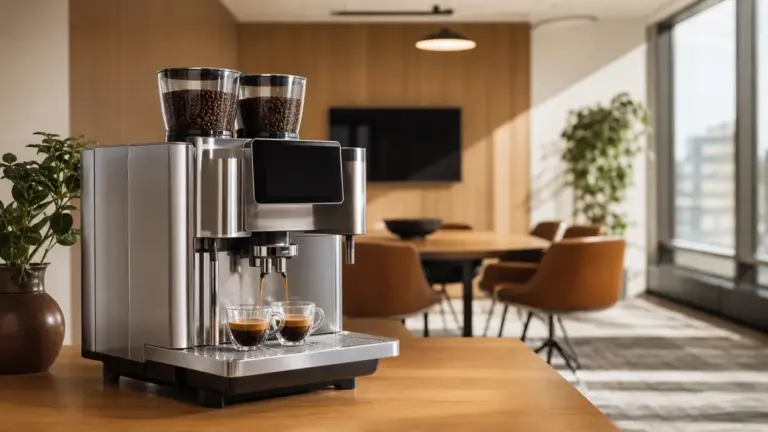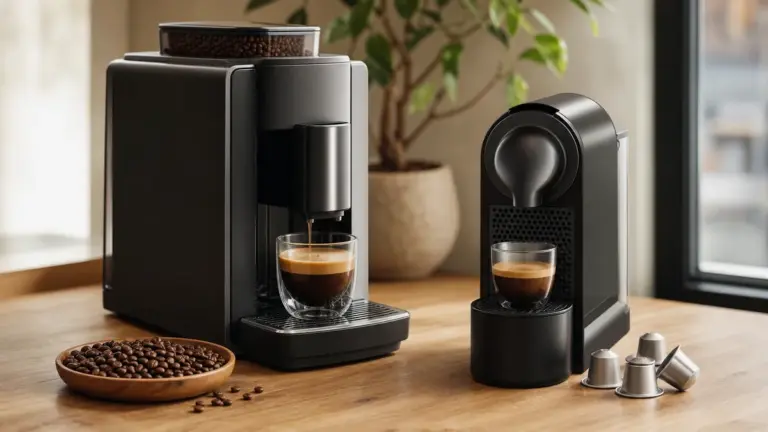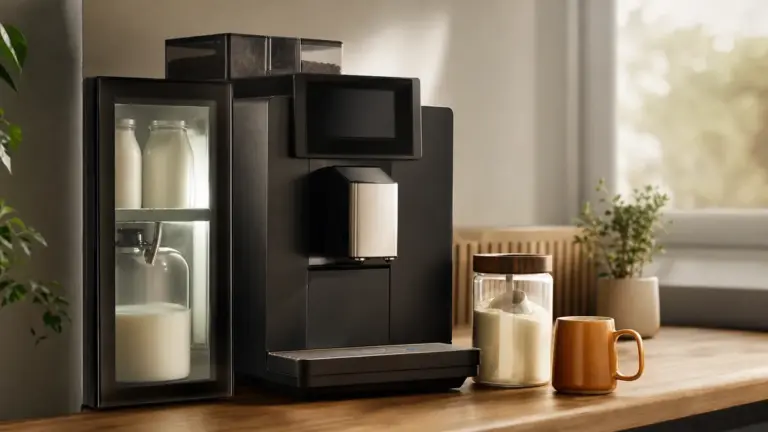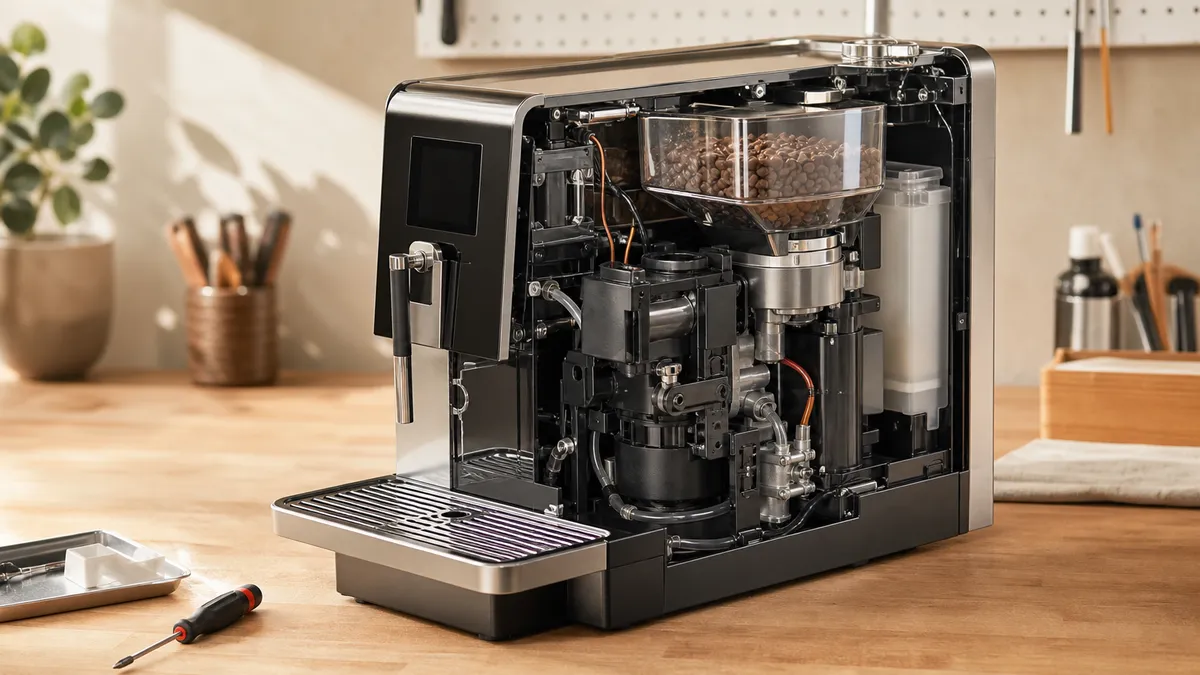
Office bean-to-cup machines grind whole beans, measure a portion of ground coffee, compress it inside a brewing chamber and push heated water through it into your cup. The machine then ejects the used grounds, while a separate milk system prepares milk or foam if the selected drink needs it.
In short
- The grinder setting controls particle size; the dose controls how much ground coffee enters the brewer.
- Automatic compression does the job of tamping, but without a person pressing a tamper into a removable filter basket.
- Water heating, water measurement and pumping are separate jobs, handled by different components.
- Milk systems may use steam suction, a dedicated milk pump or a steam wand. Not every machine contains a milk pump.
- Automatic rinsing does not replace detergent cleaning, emptying waste containers or the maintenance specified in the manual.
How office bean-to-cup machines work, step by step
Think of the machine as several connected systems rather than one mechanism. Coffee, water and milk follow different routes before meeting at the dispensing outlet or in the cup.
A typical brewing sequence is:
- Select: the controller loads the chosen drink recipe.
- Grind and dose: beans pass through the grinder and a measured portion reaches the brew unit.
- Compress: the brewing chamber closes around the grounds.
- Brew: the pump moves heated water through the compressed coffee.
- Add milk: where required, the milk system dispenses milk or foam.
- Reset: the brewer ejects the spent grounds and returns to its starting position.
The precise order varies, particularly for milk drinks. This is the internal tour; our office coffee machines hub covers the wider subject.
The hopper and burr grinder
The hopper is the bean container above the grinder. Beans feed into a pair of burrs, shaped grinding surfaces that break them into smaller particles as one rotates relative to the other.
Burrs can be conical, with a cone sitting inside an outer ring, or flat, with opposing circular grinding surfaces. Their spacing helps determine the grind size.
An office machine does not necessarily have the same grinder arrangement as another machine that looks similar. Saeco’s published Magic specifications, for example, identify steel conical burrs and adjustable grinding.
The hopper is for whole beans, not ground coffee or instant coffee. Follow the model’s instructions when changing the grind setting: some adjustments are intended for trained staff rather than everyday users.
Dosing: deciding how much coffee to brew
Dose means the mass of dry ground coffee used for a brewing cycle. It is separate from the amount of water dispensed.
Machines control dosing in different ways. A controller may run the grinder for a calibrated time, while another design uses a dosing mechanism to portion the grounds. A strength setting can change the dose, but its exact behaviour depends on the recipe and machine.
For a concrete example, Saeco claims a variable brewing chamber accommodating 8.5 to 15 g in its Magic range. That is a model-specific specification, checked in November 2026, not a universal office-machine dose.
The bypass doser
Some machines have a bypass doser, a separate opening for pre-ground coffee, often used for occasional decaf. It sends grounds towards the brewer without passing them through the bean grinder.
Use only the permitted quantity and follow the ground-coffee selection sequence. Do not assume that every opening on top is a bypass doser: a cleaning-tablet funnel may serve a different purpose.
The brew unit: compression, brewing and ejection
The brew unit, also called the brew group or brewing module, is where ground coffee meets pressurised hot water.
In a piston-style brewer, moving components close a chamber around the dose and compress it into a coffee bed, often called a puck. Seals around the moving parts help contain the brewing water rather than letting it escape around the chamber.
This is automatic compression, not conventional hand tamping. A barista normally tamps grounds in a filter basket held in a portafilter, the handled assembly attached to a traditional espresso machine. A bean-to-cup brewer combines filling, compression, brewing and grounds disposal inside its mechanism.
After brewing, the chamber opens and the spent puck is pushed or swept into the grounds container. The unit then returns to its filling position.
For the practical differences between these approaches, see our traditional espresso comparison.
The water circuit: pump, heater, flowmeter and valves
Water comes from a refillable tank or a connected mains supply, depending on the model and installation. It then travels through the machine’s water circuit.
The pump moves water
The pump provides the force needed to move water through the circuit and coffee bed. It does not heat the water or measure the dry coffee dose.
The controller coordinates it with the brewer and valves. Some recipes include pre-infusion, an initial wetting stage before the main delivery of brewing water.
The thermoblock or boiler heats it
A thermoblock heats water as it passes through a heated passage. A boiler heats a contained volume of water.
Some machines have separate heating arrangements for brewing and steam production. Franke’s A600 FCS4043 manual, for example, lists a brew boiler and a hot-water/steam boiler. Other designs use thermoblocks.
The distinction explains why the heater cannot be inferred from the machine’s appearance. It also explains why switching between brewing and steaming can involve a wait on some shared-heater designs.
The flowmeter measures movement
A flowmeter measures water passing through its part of the circuit. In a turbine-style sensor, flowing water turns a small rotor and the electronics generate pulses.
The controller uses those signals to track water delivery. This is not the same as weighing the finished drink: the sensor measures water within the machine, not everything sitting in your cup.
Valves direct and drain water
Valves send water towards the required outlet and manage drainage. A solenoid valve is electrically operated; some drainage arrangements use a three-way valve, while others use mechanically or motor-operated assemblies.
There is no single valve layout shared by every bean-to-cup machine. JURA’s published XJ Office hydraulic drawing, for example, shows a motor-operated drainage valve.
The milk system: moving, heating and frothing
Milk usually follows a separate path from the coffee brewer. There are several ways to move it and introduce air.
- Steam-suction frother: steam passing through a narrow mixing arrangement creates suction that draws in milk and air. This is often described as the Venturi principle. A separate powered milk pump is not essential to this arrangement.
- Pumped milk system: a dedicated pump meters or transports milk. Franke’s A600 published specifications describe milk-pump dosing and configurations offering hot or cold milk and foam.
- Steam wand: steam enters milk in a jug. Air is incorporated at the milk surface, with the operator or an automatic wand system controlling the process.
A milk pump and a water pump therefore have different jobs. Nor does every foam system depend on heating: equipment offering cold foam needs a suitable milk-and-air processing arrangement.
When comparing office bean-to-cup machines, check the actual milk-system configuration rather than assuming that all one-touch cappuccino buttons conceal the same equipment.
Where the used coffee and wastewater go
The grounds drawer collects spent coffee from the brew unit. The drip tray collects liquid, including drips and water released during maintenance or drainage.
Water in the tray is therefore not automatically evidence of a leak. Internal water routes can discharge there even when nobody spills a drink.
Empty and clean both containers according to the manual, rather than treating the full-container warning as the entire cleaning schedule. On some machines, the grounds warning relies on a preparation counter: the container must be removed and emptied under the specified conditions for that counter to reset.
Larger installations may have grounds disposal through the counter or a wastewater connection. Those options change waste handling, not the basic brewing process.
Cleaning cycles: what “automatic” actually means
Automatic cleaning describes a programmed process, not a machine that needs no human attention.
Keep these jobs separate:
- Rinsing flushes the circuit with water.
- Coffee-system cleaning uses the specified cleaning product to remove coffee residues and oils.
- Milk-system cleaning uses the prescribed milk cleaner and procedure.
- Descaling, where required, tackles mineral deposits rather than coffee oils.
The correct products are not interchangeable. Saeco explicitly states that its coffee-oil cleaning treatment does not descale the machine.
Depending on the equipment, staff may still need to add a tablet, connect milk hoses to a cleaning container, dismantle an outlet or empty a tray. Follow the displayed instructions through to completion.
For the workplace, make someone responsible for completing those tasks and recording faults. A cleaning prompt is useful; an assigned person makes it actionable.
Removable and fixed brew groups
This distinction matters because it changes what routine cleaning looks like.
A removable brew group is designed to come out through an access door for the cleaning specified by its manufacturer. Saeco Magic instructions include operator removal and rinsing of the group, alongside separate cleaning and lubrication requirements.
A fixed brew group stays inside during routine user maintenance. JURA’s approach uses integrated cleaning programmes without requiring users to remove the group. “Fixed” does not mean the component can never be removed by a service engineer.
Avoid classifying an entire brand from one example. The Franke A600 FCS4043 manual includes removal of its brewing module in troubleshooting, so “Franke means fixed brew group” would be misleading.
Neither arrangement removes the need for maintenance. Ask to see the exact model’s operator procedure, including which parts staff may remove, which need cleaning chemicals and which require an engineer.
What goes wrong and why
Start with the displayed message and operator manual. A symptom can have several causes, so the table below is a starting point, not a diagnosis.
| Symptom | Likely cause | First action |
|---|---|---|
| Coffee emerges only in drips | Grind too fine or the coffee path restricted | Follow the approved grind-adjustment and cleaning procedure |
| No milk or irregular milk delivery | Dirty outlet, incorrectly fitted parts or a leaking suction connection | Clean and refit the operator-removable milk parts |
| “Empty tray” remains after emptying | Moisture or residue affecting tray detection | Clean and dry the areas identified in the manual |
| Brewer or water-flow error persists | Movement, flow or component fault requiring further investigation | Stop repeated attempts and contact the service provider |
Not every water-flow error means the flowmeter itself has failed. A restricted coffee path can stop water movement and trigger a flow-related message.
Record the error wording, selected drink and whether the fault affects coffee, milk or both. That gives the service provider a more useful starting point than “it sometimes stops”.
Understanding how office bean-to-cup machines work should make routine care clearer, not encourage internal repairs. Stay within the operator instructions and leave casing removal, wiring and pressurised components to qualified service personnel.
FAQ
Can I put instant coffee in the pre-ground opening?
No, a pre-ground coffee opening is not an instant-coffee inlet. Franke’s A600 instructions specifically distinguish ground coffee from instant coffee made from dried extract. Use only the ingredient and quantity permitted by your machine’s manual, and select its ground-coffee mode before adding anything if that is the required sequence.
Why does the machine refuse to brew when there are beans and water?
Beans and water are only part of the readiness checks. The machine may also require a correctly fitted brew group, closed service door, available grounds capacity or completion of a maintenance task. Read the displayed message first: repeatedly pressing the drink button will not resolve a missing component or a locked-out function.
Does an automatic cleaning programme clean the bean hopper too?
No, do not assume that a coffee-circuit cleaning programme cleans the hopper or grinder. JURA’s X8 instructions specify separate cleaning of the bean container with a soft, dry cloth. Treat the hopper, coffee circuit, milk circuit and waste containers as distinct maintenance areas, each with its own instructions.
Where to go next
Read Office Coffee Machines: The Complete UK Guide for workplace planning, and Office Bean-to-Cup Coffee Machines for the machine category in practice. If you are still deciding which brewing approach fits your team, Best Types of Coffee Machine for Offices provides the wider comparison.
Sources
Manufacturer specifications below describe claimed equipment features, not independently tested performance. Undated pages are identified rather than assigned an assumed publication year.
- Baratza, Shop by Burr Type, undated. Burr geometry and grinding arrangements. Manufacturer page.
- Saeco Professional, Magic: Coffee and Style, 2024 brochure. Burr type, adjustable dosing and brewing-chamber capacity. Manufacturer brochure.
- Saeco Professional, Magic: Operation and Maintenance, document H0663EN03, undated edition retrieved. Brew-group removal, maintenance and fault descriptions. Manufacturer manual.
- De’Longhi Group, ECAM310.7X / 8X / 9X Magnifica Plus: Data Sheet and Service Manual, DSDL_23013_A, 28 September 2023. Brewing sequence, timed grinding, hydraulic circuit and drainage. Manufacturer service document.
- USPTO, Brewing Unit for a Coffee Machine, US7481152B2, 2009, reproduced by Google Patents. Piston compression, sealing and grounds ejection. Patent document.
- Ascaso, Thermoblock, undated. Flow-through heating and shared or separate coffee and steam heaters. Manufacturer explanation.
- Digmesa, Consultation and Support: Frequently Asked Questions, undated. Turbine pulses, calibration and causes of measurement problems. Component manufacturer guidance.
- JURA, Fluidsystem: XJ Office, EF518, drawing 0030N033-ds00.00.01, revision 12 May 2011, hosted by JURA Parts. Water routing and motor-operated drainage. Manufacturer hydraulic drawing.
- USPTO, Device for Preparing Milk Froth for Cappuccino, US5335588A, 1994, reproduced by Google Patents. Steam-driven suction, air admission and steam-wand operation. Patent document.
- Franke Coffee Systems, A600 Spec Sheet, undated edition retrieved. Milk-pump dosing, hot and cold milk systems and grounds-disposal options. Manufacturer specification sheet.
- Franke Coffee Systems, A600 FCS4043 User Manual, document 20109362, revision 04, 27 August 2024, hosted by Corporate Coffee. Ground-coffee insertion, boilers, brewing-module access and troubleshooting. Manufacturer manual.
- JURA, Perfect Maintenance at the Touch of a Button, undated. Cleaning in place without routine brew-group removal. Manufacturer maintenance explanation.
- JURA, X8 Instructions for Use, undated edition retrieved. Separate cleaning tasks, grounds-counter reset, bean-container care and troubleshooting. Manufacturer manual.
This article was researched from manufacturer manuals, component documentation and patent descriptions, with model-specific examples kept separate from general operating principles.
Last checked: November 2026