Coffee sensory science uses structured tasting to describe what coffee smells, tastes and feels like, while keeping those observations separate from personal preference. The coffee flavour wheel helps tasters move from broad descriptions, such as fruity, towards more specific ones, such as citrus fruit and orange. It is a shared vocabulary, not a scorecard or a test of how many flavours you can name.
In short
- The SCAA and World Coffee Research rebuilt the Coffee Taster’s Flavor Wheel in 2016, replacing the original 1995 wheel.
- Its foundation, the WCR Sensory Lexicon, defines 110 aroma, flavour and texture attributes and supplies references for assessing intensity.
- Start at the centre and move outwards only as far as your perception supports. “Fruity” is a useful observation without a named fruit.
- The SCA’s Coffee Value Assessment separates sensory description from an evaluator’s impression of quality.
- The verified 103-term canephora wheel was published by Carvalho and colleagues in May 2025, not as a 2026 SCA/WCR release.
What coffee sensory science measures
Sensory science turns an experience into observations that other people can examine and compare. Instead of recording only “I like this coffee”, a taster might describe its citrus aroma, noticeable sourness, smooth texture and lingering roasted aftertaste. The SCA distinguishes descriptive assessment, which characterises the coffee, from affective assessment, which records an impression of quality.
Smell has two routes into the experience. Orthonasal smell is what you perceive through the nose when sniffing grounds or brewed coffee. Retronasal smell comes from aromatic molecules travelling from the mouth towards the nose as you breathe out, contributing to flavour while drinking. Mouthfeel is separate again: the brew’s thickness, texture and other tactile properties, including mouth-drying astringency.
For practice, give those sensations separate lines in your notebook. Try “orange-like aroma; moderately sour; smooth; short finish”, rather than asking the word “orange” to explain everything.
This article concerns description and measurement. For the wider subject, begin with coffee science; the mechanisms behind aromatic impressions belong in aroma and flavour science.
How the flavour wheel and Sensory Lexicon were built
The familiar wheel and the lexicon behind it are related tools, but they do different jobs.
The lexicon is a reference document: it defines attributes and explains how to prepare reference materials. The wheel arranges flavour vocabulary visually, helping a taster navigate related descriptions.
From laboratory vocabulary to a visual tool
The original SCAA wheel was developed by Ted Lingle in 1995. Its 2016 replacement was grounded in the WCR Sensory Lexicon, developed at Kansas State University’s Sensory Analysis Center and validated with Texas A&M University. The lexicon identified 110 attributes spanning flavour, aroma and texture.
Researchers at the University of California, Davis then investigated how to organise the vocabulary. In the study reported by Spencer and colleagues in the Journal of Food Science in 2016, 72 experts sorted 99 flavour attributes into groups online. Crucially, this stage involved sorting words, not tasting coffee.
Two statistical methods shaped the result:
- Hierarchical clustering identified nested groups, providing categories and subcategories.
- Multidimensional scaling helped position those groups around the wheel according to their perceived relationships.
The arrangement therefore reflects patterns in expert judgements about descriptors. It is not a chemical diagram showing which molecules sit next to one another.
Why reference materials matter
A reference gives a word a shared sensory anchor. The WCR lexicon supplies attribute definitions, preparation instructions and intensity references, allowing trained panels to work towards a common interpretation rather than relying entirely on private memories.
Version 2.0, published in October 2017, added globally available references for 24 existing attributes. That is not the same as adding 24 new attributes to the original 110.
For home learning, use familiar foods to explore vocabulary, but call this familiarisation rather than laboratory calibration. Smelling an orange can help you understand your own “citrus” note; reproducing an official reference requires following its preparation instructions.
How to read the coffee flavour wheel
Read from the centre outwards. The inner categories are broad; the outer tiers become more specific. A possible route is fruity → citrus fruit → orange. You can stop at any level, return to the centre and investigate another impression.
Think of the following as a labelled route through the diagram:
Centre: flavour family → middle: subgroup → outside: specific descriptor
Do not begin by searching the outer rim for the most impressive word. As a practice rule, write your first impression before consulting the wheel, then use it to refine rather than replace that observation.
Nor must every useful description appear on the printed diagram. The SCA’s descriptive assessment explicitly allows additional words where they clarify a category or describe a character its checklist does not cover.
The wheel should support communication. For a beginner, “nutty, with a cocoa-like finish” is a sensible destination. Precision means choosing a description you can defend, not making it unusually elaborate.
Sensory testing methods: different questions need different tests
A tasting method should match the question being asked. Describing a coffee, detecting a change and deciding which drink you prefer are not interchangeable tasks. The SCA separates description from quality judgement, while ISO’s triangle-test standard addresses perceptible differences between products.
| Method | Main question | What it provides | What it does not establish |
|---|---|---|---|
| Descriptive analysis | What characteristics are present? | A sensory profile using defined attributes and references | Whether consumers will prefer it |
| CVA descriptive assessment | How intense are the cupping sections, and which descriptions apply? | Section intensity ratings and descriptive selections | An impression-of-quality score |
| Triangle testing | Is there a perceptible difference? | Evidence about difference under the test conditions | Which attribute changed or which product is better |
| Affective assessment | What impression of quality does this coffee give? | An evaluator’s quality judgement | A neutral description of its sensory character |
Sources: WCR Sensory Lexicon; SCA Coffee Value Assessment; ISO 4120:2021.
In a triangle test, the assessor receives three coded samples, two alike and one different, and selects the odd sample. A correct answer in a single home attempt is not sufficient evidence of a reliably detectable difference; formal testing requires an appropriate design and statistical interpretation.
For informal comparisons, adopt a few research-minded habits: conceal the packaging, use matching cups, keep preparation consistent and write independently before discussing. Treat the result as a practice observation, not proof that one coffee or brewing method is universally superior.
Using the flavour wheel at home
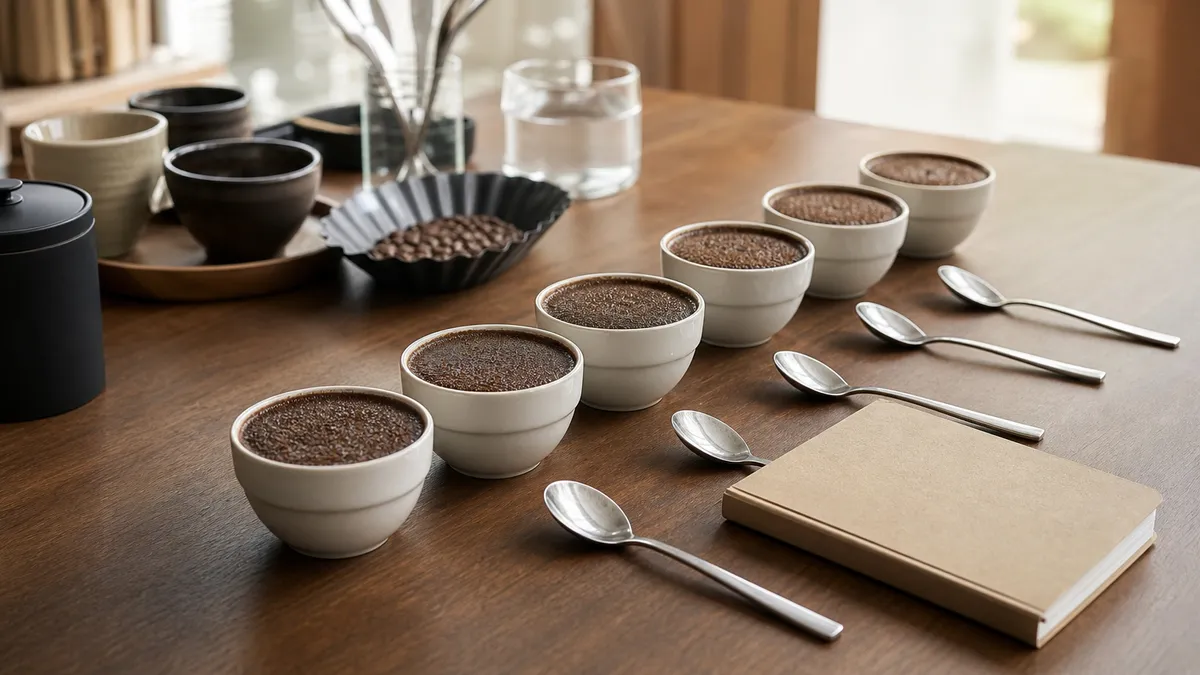
The following is an editorial practice exercise, not the official SCA cupping protocol. It uses a simple immersion preparation so you can concentrate on description.
- Choose two coffees. Use identical heatproof vessels and keep their identities out of sight until you have written notes.
- Prepare matching brews. For each coffee, use 12 g of grounds and 200 g of water, approximately 200 ml. This is a coffee-to-water ratio of about 1:16.7. Use the same grind setting, water at 94 degrees Celsius and a four-minute steep.
- Separate grounds from brew. Filter both coffees in the same way into matching cups. Wait until comfortably drinkable.
- Describe before consulting. Smell, sip and write a plain first impression. Give aroma, taste, texture and aftertaste separate attention.
- Use the wheel. Find the closest broad category, then move outwards only if a more specific term fits.
- Repeat and compare. Taste again as the drinks cool. Finish your individual notes before revealing the coffees or discussing them.
These quantities and timings are repeatable exercise settings, not claims that this recipe is optimal for every coffee.
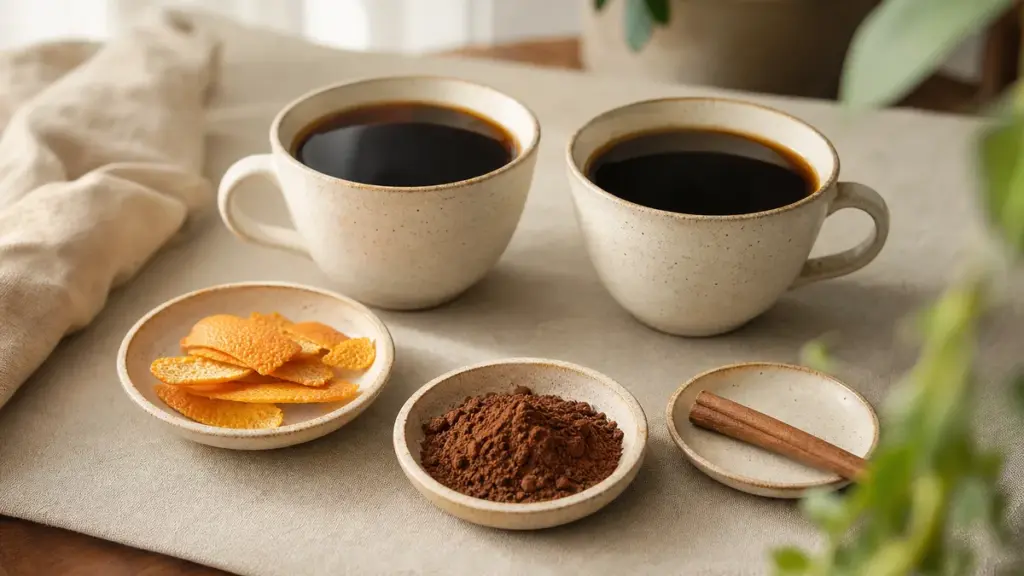
For your next session, try a food-reference exercise instead: smell familiar citrus fruit, cocoa or a spice separately, then write down what distinguishes them. Keep reference foods away from the coffee while recording its aroma. The SCA recommends exploring references and building sensory memory alongside wheel practice.
Where the wheel fits in current SCA assessment
The wheel remains part of the SCA’s Coffee Value Assessment, or CVA, rather than being displaced by it. SCA Standard 103-2024 includes the wheel and uses its inner and middle categories within the descriptive vocabulary.
CVA descriptive assessment combines check-all-that-apply selections with section intensity ratings on a 15-point scale. Importantly, tasters rate a section’s overall intensity, not a separate numerical intensity for every named aroma. “Strong fragrance” and “strong blueberry” are therefore different statements.
The broader CVA framework also includes physical, affective and extrinsic assessments. Its separation of description from quality judgement helps avoid a common confusion: an intense characteristic is not automatically a desirable one.
Canephora, cultural vocabulary and the wheel’s limits
A wheel needs evidence beyond attractive design. Carvalho and colleagues published a separate Coffea canephora wheel in Scientific Reports on 13 May 2025, containing 103 descriptors. Their study involved 49 professional graders assessing 67 samples from 13 countries, using rate-all-that-apply, or RATA, to select descriptors and rate their intensity.
This corrects the suggested description of a “2026 SCA/WCR Canephora Flavor Wheel”. The retrieved primary paper documents a 2025 research publication, not that claimed release.
The study also found differences between exporting and importing graders in descriptor use and assessment. Its findings support treating shared vocabulary as something to establish through practice, not something guaranteed by professional experience alone.
Use the coffee flavour wheel as a disciplined starting point: record what you perceive, choose the clearest words available and remain willing to revise them.
FAQ
Do I need to recognise every flavour on the wheel?
No, using the wheel does not require recognising every descriptor. The SCA’s instructions explicitly allow tasters to stop at a broad category rather than continue to a specific outer-ring term. For practice, choose a small group of familiar descriptions and work carefully with those before expanding your vocabulary.
Is sourness the same as a lemon flavour?
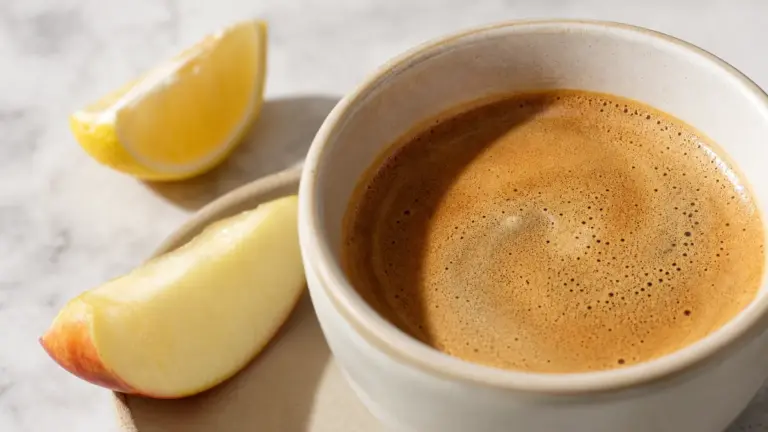
No, sourness describes a taste, while a lemon-like flavour also involves characteristic aromatics. The SCA uses lemon to illustrate how taste and smell combine in flavour. In your notes, distinguish “noticeably sour” from “lemon-like”: you might perceive either, both or neither in a particular coffee.
Can I describe something that is not on the wheel?
Yes, additional descriptions are allowed in the SCA’s CVA descriptive assessment. Use them to clarify a category or capture a distinctive perception, rather than forcing an unsuitable match. For home notes, record your own comparison and, where possible, add a broader shared term that helps another reader understand it.
Where to go next
Read Coffee and Science for the wider research context, then The Science of Coffee Aroma and Flavour for the mechanisms behind sensory impressions. Coffee Acids, Oils and Sugars is the next read for understanding those constituents without confusing a tasting description with a chemical measurement.
Sources
-
World Coffee Research. Sensory Lexicon, resource page, including the October 2017 version 2.0 update.
https://worldcoffeeresearch.org/resources/sensory-lexicon -
World Coffee Research. World Coffee Research Sensory Lexicon, edition 2.0, 2017.
https://worldcoffeeresearch.org/download/bf904452-fc8c-488f-b591-c0b20d9bcab2 -
Spencer, M., Sage, E., Velez, M. and Guinard, J.-X. “Using Single Free Sorting and Multivariate Exploratory Methods to Design a New Coffee Taster’s Flavor Wheel.” Journal of Food Science, 81(12), 2016.
https://pmc.ncbi.nlm.nih.gov/articles/PMC5215420/ -
Specialty Coffee Association. Coffee Value Assessment: Descriptive Assessment, SCA Standard 103-2024, September 2024 revision.
https://sca.coffee/s/AW_SCA-103_Descriptive-Assessment_Sept2024_Secured.pdf -
Specialty Coffee Association. Coffee Value Assessment, current framework page, undated.
https://sca.coffee/value-assessment -
Specialty Coffee Association. How to Use the Coffee Taster’s Flavor Wheel in Eight Steps, undated current webpage.
https://sca.coffee/sca-news/how-to-use-the-flavor-wheel-in-eight-steps-ab2hy -
Carvalho, F. M. and colleagues. “Development of a flavour wheel for Coffea canephora using rate-all-that-apply.” Scientific Reports, 15, article 16643, 13 May 2025.
https://pmc.ncbi.nlm.nih.gov/articles/PMC12075734/ -
International Organization for Standardization. Sensory analysis: Methodology: Triangle test, ISO 4120:2021, edition 3, March 2021, confirmed 2026.
https://www.iso.org/standard/76666.html
Research combined live retrieval of WCR reference materials, SCA guidance and standards, the original wheel-construction study, the canephora study and ISO’s triangle-test summary; the home exercise is an editorial adaptation, not reported testing.
Last checked: November 2026