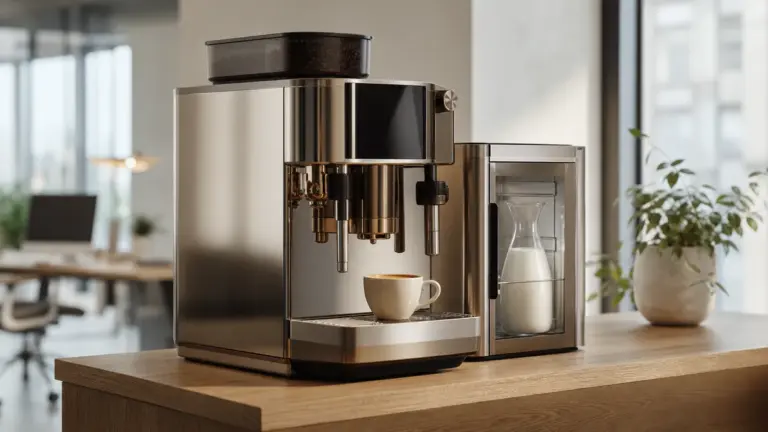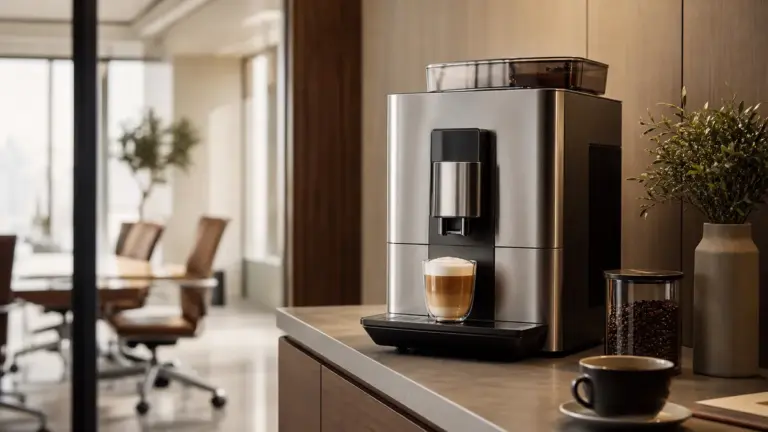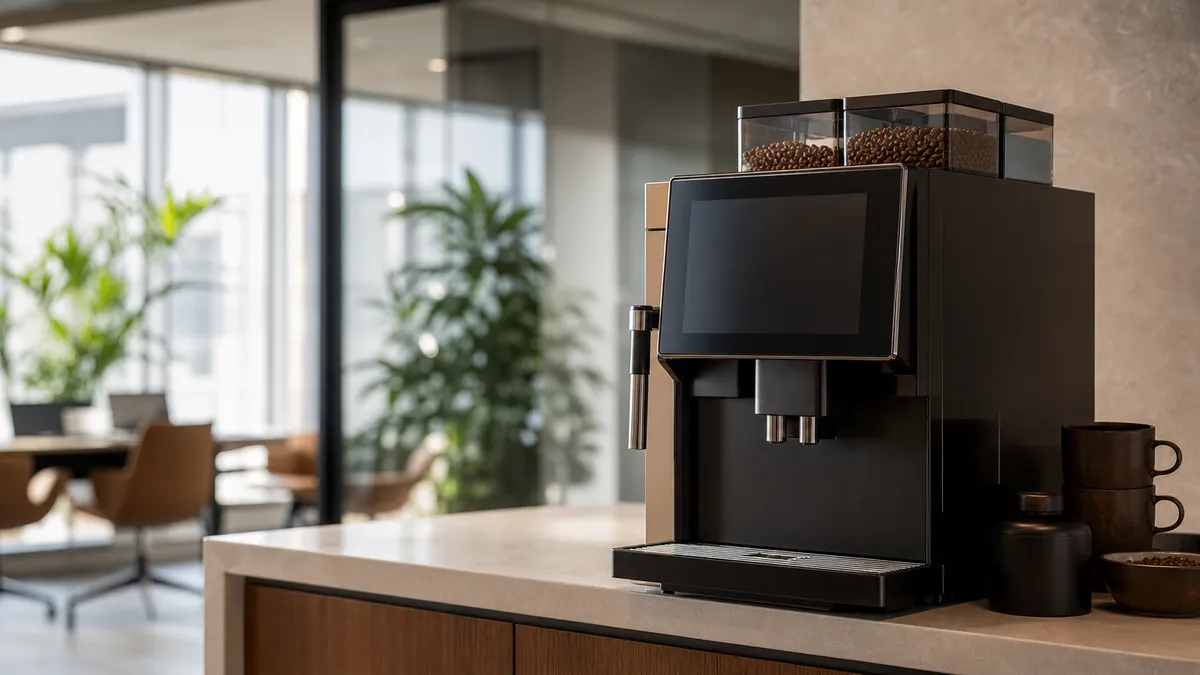
WMF office coffee machines are professional automatic machines built around configurable coffee, milk and cleaning systems, with models for smaller tea points through to busy shared facilities. Choose by daily drinks, peak demand and the exact milk and cleaning package, not by the WMF badge or model number alone.
In short
- WMF Professional Coffee Machines belongs to France’s Groupe SEB, under SEB Professional, alongside Schaerer and Wilbur Curtis.
- WMF’s published recommended daily outputs include 80 cups for the 1100 S, 120 for the 1300 S, 180 for the 1500 S+ and 250 for the 5000 S+.
- The UK website also lists the Elevation 10 and Peak 50. The familiar 1100 S still has a UK product page, but is absent from the main navigation checked in November 2026.
- Basic Milk handles hot milk and hot foam; Easy Milk adds cold milk; Dynamic Milk adds cold foam and a wider choice of foam textures.
- Automated cleaning reduces particular tasks. It does not remove the need for trained staff, replenishment, checks and scheduled maintenance.
Who makes WMF office coffee machines?
WMF Professional Coffee Machines is the commercial coffee-machine business associated with WMF’s German heritage in Geislingen an der Steige. France’s Groupe SEB acquired WMF in 2016, and its SEB Professional organisation includes the WMF, Schaerer and Wilbur Curtis coffee-machine brands.
The distinction matters when searching for support. WMF-branded domestic appliances and WMF Professional hotel equipment, such as tableware, are not the same product business as WMF Professional Coffee Machines. Use the professional coffee-machine support route rather than assuming a consumer-appliance contact will handle an office installation.
Brand fact panel
- Business: WMF Professional Coffee Machines.
- Parent: Groupe SEB, within SEB Professional.
- Heritage and location: Geislingen an der Steige, Germany.
- Main machine classes: fully automatic bean-to-cup, automatic portafilter and filter-coffee machines.
- UK contact organisation: SEB Professional UK Limited, Uxbridge.
Start with our UK office coffee machine brands guide if you are still deciding which manufacturers deserve a demonstration. This profile concentrates on WMF’s equipment and ownership requirements, rather than ranking every competing brand.
The WMF office coffee machine range
A bean-to-cup machine grinds beans and brews the drink automatically. Within WMF’s range, the important differences are recommended workload, beverage options, water supply and the fitted milk and cleaning systems.
The following figures are manufacturer-published specifications checked in November 2026, not independently measured performance. The suggested applications are editorial starting points, conditional on a demonstration.
| Model | Recommended daily output | Water arrangement | Sensible starting application |
|---|---|---|---|
| WMF 1100 S | 80 cups | Approximately 4.5-litre tank or fixed connection | Smaller office tea point |
| WMF 1300 S | 120 cups | Tank and mains-connected configurations | Shared office kitchen with moderate demand |
| WMF 1500 S+ | 180 cups | Approximately 4.5-litre tank or fixed connection | Busier workplace needing more configuration choices |
| WMF 5000 S+ | 250 cups | Fixed water connection | Higher-demand shared facility |
These four familiar models are not the whole current range. The UK website now also lists the WMF Elevation 10, recommended for 50 cups daily, and WMF Peak 50, recommended for 80. Its wider offering includes the 9000 S+, filter machines and the espresso NEXT automatic portafilter machine.
The 1100 S deserves particular care in quotations: its UK product page remains accessible, but it is not listed in the main product navigation checked for this article. That does not establish discontinuation. Ask the supplier to confirm availability, specification and ongoing support for the exact unit offered.
For every model, request a configuration schedule. A quotation saying only “1500 S+” leaves too much unspecified: milk system, cleaning package, grinders, refrigerator and installation arrangements all need identifying.
Capacity: daily cups are only the beginning
WMF’s recommended daily outputs are planning figures, not promises about how quickly your particular drinks will appear. The manufacturer states that performance depends on factors including cup size, quality settings, equipment and rated power.
Estimate demand from people actually attending, rather than total payroll. This illustrative matrix assumes two machine-made coffees per attending person daily, with no visitors or meeting catering included.
| People attending daily | Assumed coffees per person | Calculated daily drinks | Initial models to investigate |
|---|---|---|---|
| 20 | 2 | 40 | Elevation 10; compare the 80-cup machines |
| 40 | 2 | 80 | Peak 50 or 1100 S, with particular attention to spare capacity |
| 60 | 2 | 120 | 1300 S or a larger configuration |
| 90 | 2 | 180 | 1500 S+ or a larger configuration |
| 125 | 2 | 250 | 5000 S+; assess whether several tea points work better |
Calculation: attending people × two coffees = assumed daily demand. These are examples, not measured consumption or staffing recommendations.
Do not treat a machine rated at exactly your expected demand as automatically suitable. Add visitors and meeting drinks, then test the busiest period. Ask the demonstrator to prepare your intended sequence of black coffees and milk drinks in your actual cups, including any interruptions for replenishment.
Two lower-demand tea points may be operationally preferable to one central machine. Treat that as a workplace-layout decision, not a conclusion that follows from adding daily output figures together.
Milk systems: specify the drink, then the equipment
WMF’s milk-system names describe different capabilities, not interchangeable trim levels.
- Basic Milk: hot milk and hot milk foam for drinks such as cappuccino and latte.
- Easy Milk: hot milk, hot foam and cold milk, but not cold milk foam.
- Dynamic Milk: hot and cold milk, with four hot-foam consistencies and three cold-foam variations.
- Smart Milk: a separate system associated with the 1300 S, covering hot and cold milk-based drinks.
WMF lists Easy Milk and Dynamic Milk for the 1500 S+ and 5000 S+. The 1100 S specification lists Basic Milk. Newer compact models introduce further terminology, including Essential Foam on the Peak 50, so older comparison sheets should not be treated as a complete guide to every current model.
For an office mainly serving hot cappuccinos and lattes, begin by demonstrating the simpler appropriate system. Choose additional capabilities because staff will use them, not because the menu can display more drinks.
Have the supplier make your preferred drinks with your intended dairy milk or plant-based alternative. Ask which ingredients are approved for that configuration and how different milk supplies are handled. For competing equipment, our Franke office machines profile provides another useful comparison point.
Cleaning: automation still needs an owner
WMF offers several cleaning arrangements, and the exact package changes the staff routine.
The 1100 S specification lists Click+Clean, a partly automated arrangement that still requires weekly manual cleaning in the relevant Basic Milk configuration. The 1300 S lists Plug+Clean and Basic Clean options; Basic Clean requires daily manual cleaning.
For the 1500 S+ and 5000 S+, published options include Easy Clean, Clean in Place and Auto Clean, subject to configuration. Easy Clean retains weekly manual milk-foamer cleaning. Clean in Place includes automated cleaning of the foamer with Dynamic Milk. Auto Clean automates the configured coffee and milk cleaning process, including chemical dosing.
Those descriptions apply to specific systems, not every surface or accessory around the machine. Assign a named person and a deputy to follow the supplied manual, with responsibility for:
- Completing the required cleaning cycle and any remaining manual tasks.
- Looking after the milk container or refrigerator, drip tray, grounds container and external surfaces as instructed.
- Replenishing approved cleaning products and recording completed care.
- Reporting faults and arranging maintenance rather than bypassing warnings.
Before ordering, ask someone who will actually clean the machine to perform the routine during the demonstration. A sales presentation is not a substitute for checking whether the task fits your office’s staffing arrangements.
UK service and installation
WMF’s UK website identifies SEB Professional UK Limited in Uxbridge as its local organisation. WMF advertises installation, maintenance and repair services, but that does not establish the response time or contractual cover available at your postcode.
Get written answers on engineer coverage, support hours, planned maintenance, included parts, exclusions, escalation and temporary replacement arrangements. Establish whether the contract is with SEB Professional UK or another supplier, and who handles a fault from first report to resolution.
The installation survey should cover the complete equipment arrangement, not just the machine casing:
- Machine, refrigerator and accessory space, including access for filling and maintenance.
- Electrical supply matched to the precise machine variant.
- Water supply, filtration, isolation and drainage.
- Water testing and the filter replacement arrangements.
For example, WMF’s 5000 S+ brochure lists both single-phase and three-phase electrical variants. Do not assume that every machine carrying that name can use the same connection.
In England and Wales, the Water Supply (Water Fittings) Regulations 1999 require appropriate backflow prevention. Confirm the applicable local requirements with the installer rather than assuming that arrangement covers every UK jurisdiction.
In Great Britain, machines incorporating steam systems may fall within the Pressure Systems Safety Regulations 2000. Steam counts as a relevant fluid at any pressure: ask the supplier and a competent person to establish the requirements using HSE guidance.
CoffeeConnect and automatic adjustment
WMF CoffeeConnect is telemetry: a system that sends machine information to a management portal. WMF describes reporting, fleet-status information, cleaning notifications and remote-management functions, with access controlled through user roles.
That is worth investigating for several machines across floors or sites. Ask which hardware, connectivity and functions are included, who receives alerts and who must act on them. A notification about an empty hopper still needs someone nearby to refill it.
Some configurations also offer Dynamic Coffee Assist. WMF says this monitors brewing flow and adjusts grind or coffee quantity to maintain the configured extraction. Dynamic Milk Assist monitors factors including milk temperature and flow.
These are manufacturer-described control systems, not independent proof of superior flavour. Ask the demonstrator to explain which features are fitted, then taste the actual drinks. If you are comparing brands within the same parent group, see our Schaerer office machines profile rather than assuming shared ownership means identical equipment.
Pros, cons and who WMF suits
The following is an editorial assessment based on the documented range, not a hands-on reliability test. The decision criteria are workload, milk capability, cleaning responsibility, installation and support.
Advantages
- Useful range of workloads: the published line-up provides several starting points for different office demand levels.
- Configurable milk provision: buyers can distinguish straightforward hot drinks from cold milk and varied foam requirements.
- Several cleaning approaches: there is scope to match equipment to the staff time and supervision available.
- Fleet-management tools: CoffeeConnect gives multi-machine buyers functions worth examining during procurement.
Limitations
- Configuration takes work: the model name alone does not describe the complete installation.
- Automation is conditional: advanced milk, cleaning and connected functions must be confirmed on the quotation.
- Installation can be substantial: larger configurations need a proper services and space survey.
- Service quality needs local verification: manufacturer specifications cannot prove fault rates, engineer attendance or first-time repair performance.
WMF deserves a shortlist place where the workplace wants configurable commercial equipment and will assign clear responsibility for daily care. It is less convincing as a choice made on brand reputation alone, especially if nobody has agreed to manage cleaning and replenishment.
Request itemised written quotations covering equipment, accessories, installation, filtration, consumables, servicing and connected services. To work out your own operating cost per drink, total those items over a stated ownership period, add beans, milk, cleaning materials, utilities and staff time, then divide by expected drinks over that same period. Keep the VAT basis consistent.
FAQ
Can a WMF machine be used without plumbing?
Yes, some WMF configurations have refillable water tanks. The published 1100 S and 1500 S+ specifications list tank or fixed-water arrangements, whereas the 5000 S+ requires a fixed supply. Confirm the exact configuration and drainage requirements before ordering. Ask the supplier to demonstrate the likely refill and emptying routine at your expected demand.
Can a WMF machine offer both regular and decaffeinated beans?
Yes, a suitable two-grinder configuration can provide separate bean choices. WMF describes two-grinder options within its range, but hopper and powder arrangements vary. Have the supplier demonstrate how each drink selects its beans, and list the agreed hopper allocation on the quotation rather than assuming every machine has the same arrangement.
What should we check when buying a used WMF machine?
Check the exact configuration, service history and support eligibility before committing. Ask for the serial number, recorded drink count, maintenance records, included accessories and a demonstration of cleaning. Have the proposed service provider inspect it and confirm support in writing. An accessible product page alone does not establish the condition or suitability of a particular used machine.
Where to go next
Read UK Office Coffee Machine Brands for the broader shortlist, then JURA Office Coffee Machines to assess another office-machine range. Franke Office Coffee Machines is a useful next read for another commercial equipment comparison, while Schaerer Office Coffee Machines helps distinguish WMF from another brand within SEB Professional.
Sources
All undated manufacturer webpages below were retrieved and checked in November 2026. Published capabilities are treated as manufacturer claims, not independently tested results.
- Groupe SEB, Groupe SEB at SIRHA 2023 with its professional brands, 2023. Ownership, Geislingen and SEB Professional brand structure. Source.
- WMF Professional Coffee Machines, UK website and product navigation, undated. Current listed machine classes and models. Source.
- WMF Professional Coffee Machines, WMF 1100 S: Specifications & downloads, undated. Output, water supply, milk and cleaning options. Source.
- WMF Professional Coffee Machines, WMF 1300 S, and Specifications & Downloads, undated. Output, grinders, milk and cleaning arrangements. Product page; specifications.
- WMF Professional Coffee Machines, WMF 1500 S+: Specifications & downloads, undated. Output, water supply, milk, cleaning and assist systems. Source.
- WMF Professional Coffee Machines, WMF 5000 S+: Specifications & downloads, undated; WMF 5000 S+ brochure, April 2025 artwork revision. Output, connections and performance qualifications. Specifications; brochure.
- WMF Professional Coffee Machines, WMF Elevation 10 and WMF Peak 50, undated. Additional current models and recommended outputs. Elevation 10; Peak 50.
- WMF Professional Coffee Machines, Milk, undated. Milk-system capabilities and model compatibility. Source.
- WMF Professional Coffee Machines, Making hygiene simple and effective, undated. Cleaning-system mechanisms and remaining manual tasks. Source.
- WMF, WMF 1300 S User Manual, English edition, undated retrieved copy, hosted by brüud. Operator responsibilities, installation and care. Source.
- WMF Professional Coffee Machines, Technical service and Support WMF CoffeeConnect, undated. Service offering, UK organisation and telemetry functions. Service; CoffeeConnect.
- UK Government, The Water Supply (Water Fittings) Regulations 1999, SI 1999/1148, Schedule 2, paragraph 15. Backflow prevention requirements. Source.
- Health and Safety Executive, Pressure Systems Safety Regulations 2000 (PSSR), webpage updated December 2025. Relevant fluids, examination and competent-person guidance. Source.
Research combined retrieved manufacturer specifications, operating instructions and corporate information with official UK safety and water-fittings sources; no first-hand machine testing was undertaken.
Last checked: November 2026