Soil composition affects coffee by controlling the water, air and nutrients available to its roots, which influence plant growth and bean development. Volcanic soils can offer excellent growing conditions, but neither volcanic origin nor any single mineral guarantees a particular flavour.
In short
- Judge coffee soil by its drainage, structure, acidity and nutrient availability, not simply its geological origin.
- Coffee generally benefits from acidic soil, but recommended pH targets vary between growing regions and guidance documents.
- Organic matter supports soil organisms, nutrient cycling and a stable, crumbly structure.
- Volcanic ash soils can retain water well while draining freely, yet may hold phosphorus in forms that plants struggle to access.
- Research links soil properties and nutrition with cup quality, but does not establish a universal soil-to-flavour formula.
What soil composition means for coffee
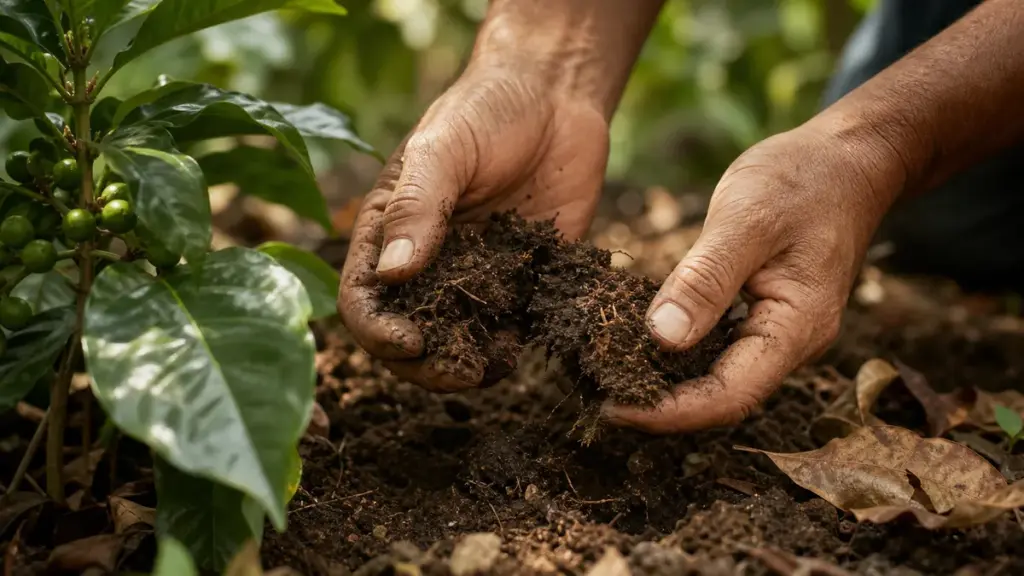
A coffee soil is more than weathered rock. It contains mineral particles, organic matter and living organisms, with spaces between particles holding water and air. Its usefulness to a coffee tree depends on how these components work together.
Two terms help explain the physical side:
- Texture means the proportions of sand, silt and clay.
- Structure means how particles gather into aggregates, the small clusters that give soil its crumbly or blocky character.
These are not interchangeable. Two soils with similar texture can have different structures, so water may move through them differently. A soil description needs to tell us more than whether it is sandy or clay-rich.
Soil is one part of coffee terroir, the combination of growing conditions and human decisions associated with a coffee’s origin. Here, the useful question is what happens around the roots, rather than how an entire region acquires its character.
Why volcanic soils are associated with coffee
Volcanic soils have a sound agricultural reputation, but “volcanic” is not a complete soil specification. The original material, weathering, rainfall and accumulated organic matter all matter.
An important group is Andosols, soils commonly developed from volcanic ash. Many have a porous, friable structure, meaning they crumble readily, with good internal drainage and substantial water-holding capacity. Those qualities can provide a useful combination: moisture remains available without the root zone staying saturated.
There is a chemical complication. Andosols can bind phosphorus strongly, reducing its availability to plants. A soil can therefore contain phosphorus without supplying enough accessible phosphorus to a crop.
The sensible interpretation of “grown in volcanic soil” is that it describes a potentially favourable growing environment. It is not a tasting result, a fertility test or proof that fertiliser is unnecessary. Ask what the producer does to manage that soil, not simply which rock lies beneath it.
Soil pH: acidity changes nutrient availability
pH measures acidity or alkalinity. Coffee generally grows well in acidic soils, but there is no single target that should be applied to every farm.
For example, Cenicafé’s Colombian guidance identifies pH 5.0 to 5.5 as suitable for coffee. The FAO’s Arabica coffee manual for Lao PDR gives a broader preference of 5 to 6 in its site-selection guidance. These recommendations should retain their local context rather than be presented as competing universal rules.
Excessive acidity can increase soluble aluminium and manganese to harmful levels and reduce phosphorus availability. Correcting acidity is therefore about root function and nutrition, not merely making a laboratory number look better.
Lime can raise soil pH, but an application should follow soil analysis and local agronomic advice. The aim is an appropriate correction for that soil, not the assumption that every coffee farm would benefit from more lime.
Organic matter: food, structure and nutrient storage
Soil organic matter includes material derived from plants and other organisms at different stages of decomposition. Leaf litter, roots and properly managed organic amendments contribute to it.
Its value is physical as well as nutritional. Peru’s national agricultural research institute, INIA, describes organic matter as supporting soil structure, feeding soil organisms and helping aggregates resist breakdown under rainfall. Decomposed material also contributes to nutrient storage.
Clay and organic matter can retain positively charged nutrients such as calcium, magnesium and potassium. This property is called cation exchange capacity, essentially the soil’s ability to hold and exchange these nutrient ions rather than lose them readily through leaching.
Organic matter is therefore not simply a slow-release fertiliser. It helps create the conditions in which roots, water and nutrients can interact. Nor does a dark surface remove the need for testing: a soil’s appearance cannot provide a complete account of its fertility.
Drainage: holding water without excluding air
Coffee needs a dependable water supply, but it does not tolerate waterlogging well. Drainage and water retention are different properties, and a useful soil needs an appropriate balance between them.
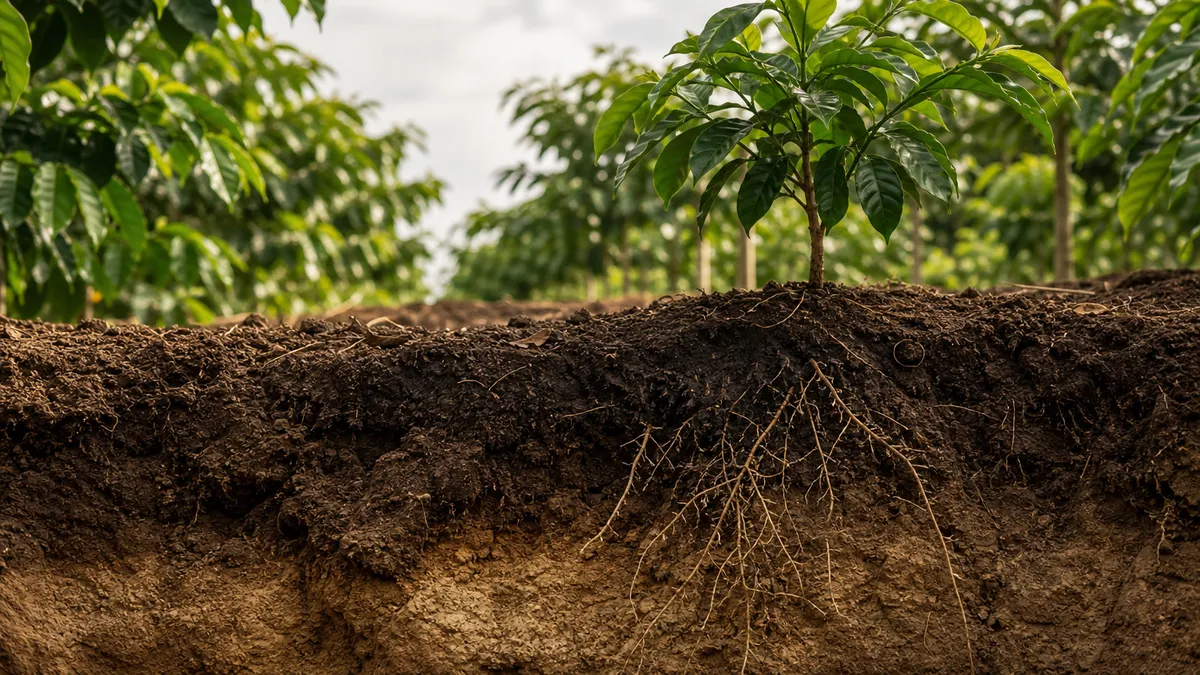
Large pores allow water to drain and air to move through soil. Smaller pores retain water more strongly. Structure determines how these spaces connect, so a compacted layer can restrict the usefulness of otherwise promising soil above it.
The table below is a reading aid, not a ranking of soils from best to worst.
| Soil feature | What it can offer | What needs checking |
|---|---|---|
| Sandy material | Rapid water entry and drainage | Whether enough moisture remains available |
| Clay-rich soil | Nutrient retention and water storage | Structure, aeration and movement of excess water |
| Porous volcanic ash soil | Good drainage alongside water retention | Available phosphorus and local soil chemistry |
| Organic-rich, crumbly topsoil | Biological activity and stable aggregates | Nutrient balance and the condition of deeper layers |
The same soil also behaves differently under different rainfall patterns. A description that sounds favourable during a wet season may reveal little about dry-season water supply. Climate variations explains that wider seasonal context.
For a farm assessment, look below the surface. A loose upper layer cannot tell you whether roots encounter compacted or poorly drained material further down.
Which nutrients matter?
Coffee plants require a balanced supply of nutrients, not a special mineral associated with a desirable tasting note. The FAO’s coffee nutrition guidance identifies several important roles:
- Nitrogen supports growth, proteins, enzymes and photosynthesis.
- Phosphorus is involved in energy compounds, root development and flowering.
- Potassium contributes to water balance and fruit quality.
- Calcium supports cell walls and root and leaf development.
- Magnesium is part of chlorophyll, the green pigment involved in photosynthesis.
- Micronutrients, including boron, zinc and iron, are needed in smaller quantities but still perform essential functions.
Harvesting removes nutrients from the growing system, so maintaining fertility requires their replacement in appropriate forms.
The practical approach is to combine soil analysis, which assesses the growing medium, with leaf analysis, which helps assess plant nutritional status. These answer related but different questions. A nutrient present in soil is not automatically available to the plant in the amount it needs.
Fertiliser recommendations should therefore account for the soil, crop condition and production system, rather than follow a universal recipe.
Soil health and erosion on coffee farms
Soil health concerns how well a soil continues to support roots, organisms, water movement and nutrient cycling. Protecting those functions is especially important where coffee grows on slopes exposed to heavy rain.
Erosion removes surface soil and its associated nutrients. Poor structure and exposed ground can increase the risk of runoff and soil loss. Replacing nutrients alone does not rebuild the physical material washed away.
Coffee guidance from FAO and INIA identifies ground cover, contour planting and suitable vegetation barriers as soil-conservation measures. Leaf fall and prunings from appropriately managed shade trees can also return organic matter and nutrients.
These practices need to suit the site. A useful farm account explains how erosion is controlled and organic material is managed, rather than relying on an unsupported claim that the soil is “naturally rich”.
What does the evidence say about flavour?
The evidence supports soil as an influence on coffee quality, but not a simple translation from soil type to tasting note. Distinguishing observational studies from controlled experiments is essential.
Field associations do not isolate soil
A 2020 observational study by Morales-Ramos and colleagues examined paired coffee and soil samples from 139 plantations in Chiapas, Mexico. Soil properties and bean composition helped explain differences in cup attributes, but plantation altitude and bean moisture were the most important variables in the researchers’ analysis.
Because the study compared existing farms, it did not isolate soil from every other difference between them. Its results support a relationship, not proof that changing one soil property would reproduce a particular flavour elsewhere. Altitude and temperature covers another major part of that growing environment.
Fertiliser experiments provide more direct evidence
A 2023 randomised-block field experiment by Santos and colleagues compared potassium fertiliser sources. Potassium sulphate produced the highest cup-quality score among the tested treatments, while potassium chloride was associated with poorer beverage quality.
That is more direct evidence that a nutrition treatment can affect the cup under particular experimental conditions. It is not evidence that one fertiliser always improves every coffee. The study also received support from fertiliser manufacturer Yara International, alongside public research funders, which is relevant context when weighing the findings.
A flavour description is not a geological diagnosis
The defensible chain is that soil conditions influence plant nutrition and water supply, which can affect bean development and composition. A claim that a particular mineral necessarily creates chocolate, citrus or floral notes goes further than these studies establish.
For the broader sensory picture, see the impact on flavour profiles. When reading about soil composition on a coffee bag, treat it as useful production context and look for supporting farm information, rather than accepting it as a promise of flavour.
FAQ
Is acidic soil the same as acidity in brewed coffee?
No. Soil acidity describes conditions around the roots, while acidity in coffee concerns the chemistry and sensory character of the beverage. Soil pH can influence plant nutrition and has been associated with cup attributes, but the evidence does not justify assuming that a lower soil pH produces a sharper-tasting drink.
Does an earthy flavour mean the coffee tastes of its soil?
No, an earthy descriptor does not establish that the flavour came directly from the growing soil. World Coffee Research’s sensory lexicon uses terms such as musty/earthy to describe perceived aromas, with references for recognising them. A sensory resemblance identifies an impression, not its agricultural cause.
Can I compare two bags to test whether volcanic soil improves coffee?
You can compare your enjoyment of them, but two unrelated bags cannot isolate the effect of volcanic soil. They may differ in variety, growing conditions and handling. Treat the exercise as a preference comparison, not a controlled soil experiment, and record what you taste before reading the growing claims.
Where to go next
Read Coffee Terroir to place soil alongside the other influences associated with origin, then Impact on Flavour Profiles for the connection with sensory character. Coffee Microclimates explains why nearby growing sites can experience different conditions, adding context that a soil description alone cannot provide.
Sources
-
USDA Natural Resources Conservation Service. Soil Quality Indicators: Soil Structure & Macropores, June 2008. Definitions of structure, pore function, compaction and soil-conservation principles.
https://www.nrcs.usda.gov/sites/default/files/2022-10/Soil%20Structure%20and%20Macropores.pdf -
Food and Agriculture Organization of the United Nations. Lecture Notes on the Major Soils of the World, 2001, section on Andosols. Volcanic ash soils, drainage, water retention and phosphorus fixation.
https://www.fao.org/4/y1899e/y1899e06.htm -
Food and Agriculture Organization of the United Nations. Arabica coffee manual for Lao PDR, 2005, Chapter 1: Coffee plant & site selection. Coffee soil suitability, waterlogging and contextual pH guidance.
https://www.fao.org/4/ae939e/ae939e03.htm -
Cenicafé, Federación Nacional de Cafeteros de Colombia. La acidez del suelo, una limitante común para la producción de café, Avances Técnicos 466, April 2016. Soil acidity, nutrient availability, liming and cation exchange.
https://biblioteca.cenicafe.org/bitstream/10778/704/1/avt0466.pdf -
Instituto Nacional de Innovación Agraria, Peru. Circuito tecnológico del café, first edition, July 2012. Organic matter, soil organisms, nutrient storage and erosion management.
https://repositorio.inia.gob.pe/server/api/core/bitstreams/ef28aa9c-5b3f-4bda-b8f3-a37a76fbe962/content -
Food and Agriculture Organization of the United Nations. Arabica coffee manual for Lao PDR, 2005, Chapter 4: Plant nutrition & fertiliser management. Nutrient functions, harvest removal, soil analysis and leaf analysis.
https://www.fao.org/4/ae939e/ae939e06.htm -
Food and Agriculture Organization of the United Nations. Arabica coffee manual for Lao PDR, 2005, Chapter 3: Field management & planting trees. Ground cover, contour planting and shade-tree organic inputs.
https://www.fao.org/4/ae939e/ae939e05.htm -
Colegio de Postgraduados and Universidad Autónoma Chapingo; Morales-Ramos and colleagues. On the soil-bean-cup relationships in Coffea arabica L., Journal of the Science of Food and Agriculture, 2020. Observational soil, bean and cup-quality research.
https://pubmed.ncbi.nlm.nih.gov/32562262/ -
Federal University of Lavras and collaborating institutions; Santos and colleagues. Chloride Applied via Fertilizer Affects Plant Nutrition and Coffee Quality, Plants, 2023. Randomised field experiment and funding disclosure.
https://pmc.ncbi.nlm.nih.gov/articles/PMC9968041/ -
World Coffee Research. Sensory Lexicon, version 2.0, October 2017, official resource page. Sensory descriptors and reference-based assessment.
https://worldcoffeeresearch.org/resources/sensory-lexicon
This article was researched using retrieved agricultural guidance, national coffee and agronomy publications, and original peer-reviewed studies, distinguishing field associations from experimental findings.
Last checked: November 2026