Climate variations affect when coffee flowers, how its fruit develops and whether the harvest can be dried successfully. Rain arriving after a dry spell can trigger flowering, but prolonged drought, frost or persistent harvest rain can damage the crop: timing matters as much as the annual rainfall total.
In short
- A dry spell followed by rain can synchronise flowering, provided the flower buds are ready to respond.
- Developing fruit needs adequate water. Conditions that help initiate flowering can become harmful if dryness continues.
- Drier harvest weather helps sun-drying, but washed coffee still needs drying too.
- El Niño and La Niña change regional rainfall probabilities, not every farm’s weather in the same way.
- Climate projections describe changing growing suitability, not a fixed percentage of coffee destined to disappear.
How climate variations shape the coffee year
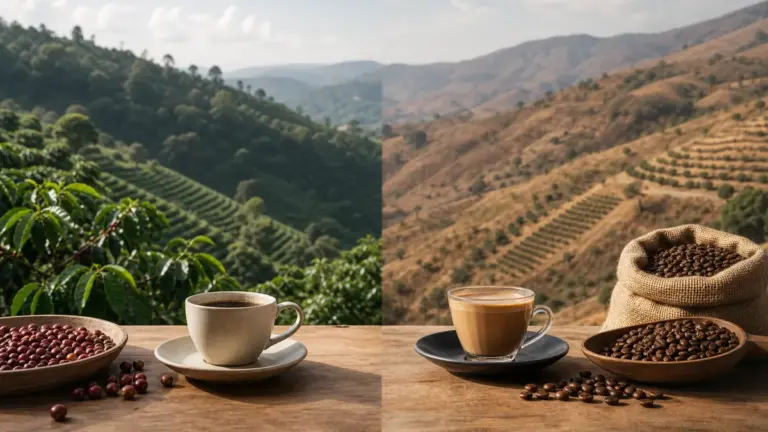
Coffee needs different conditions at different stages. A useful seasonal pattern combines a drier interval before flowering, sufficient water during fruit development and workable drying weather after harvest. That is a pattern, not a universal calendar.
Some growing areas have one main rainy season; others have two rainfall peaks, known as a bimodal pattern. These differences help explain why coffee calendars vary between regions and why a single country may have several harvesting schedules.
To understand a growing season, ask three questions: when did the rain arrive, how long did dry conditions last, and what stage had the crop reached? An annual rainfall total cannot answer those questions on its own.
Climate is one component of coffee terroir, the combination of growing conditions that shapes a coffee’s development. Here, the focus is seasonal water supply and extremes rather than the separate effects of elevation or soil chemistry.
Rainfall patterns and flowering
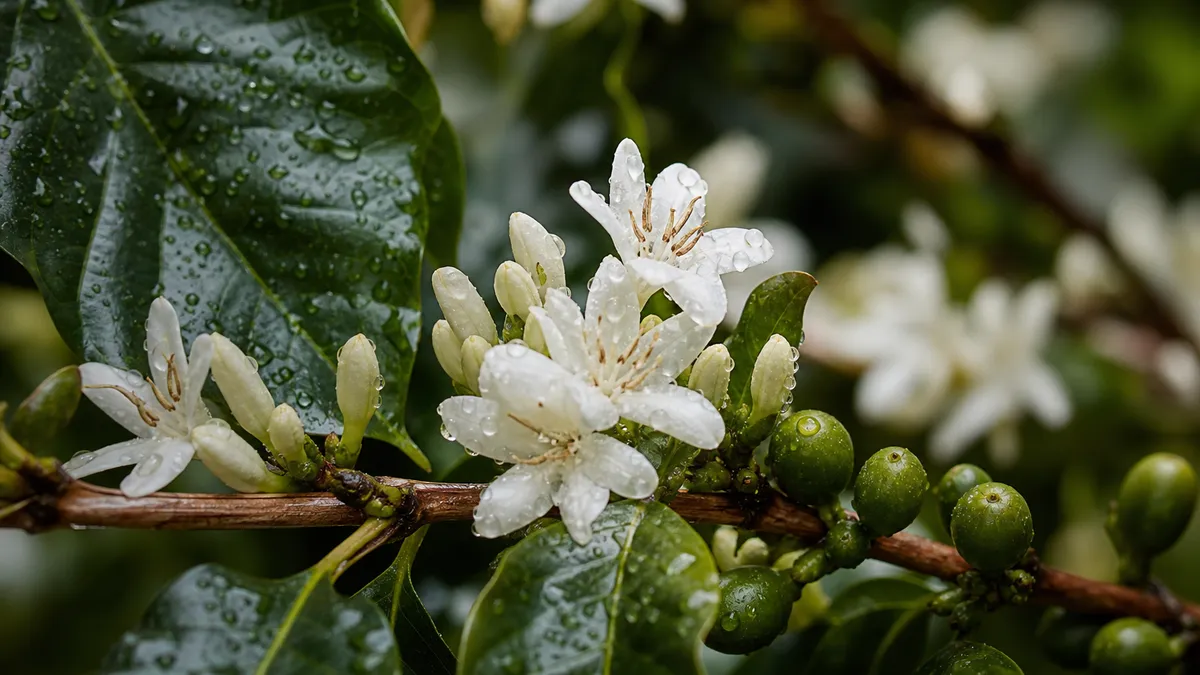
The white blossom following rain is not produced from scratch by that shower. Flower buds have already developed on the branches; sufficiently mature buds can pause before opening.
Experiments with arabica, Coffea arabica, have shown that a period of water deficit followed by rewatering can stimulate flower opening. Crucially, the response depends on bud development. Rain is a trigger for responsive buds, not a switch that makes every bud flower regardless of its condition.
A pronounced dry interval followed by substantial rain can therefore bring many flowers out together. Repeated dry spells and showers can spread flowering across several events. Because fruit develops from those flowers, staggered flowering can also spread the eventual harvest.
There is no single rainfall threshold or prescribed drought duration that works everywhere. Soil moisture, atmospheric dryness and bud maturity all affect the response. Controlled experiments establish the mechanism, but do not provide a universal irrigation instruction for every farm.
Nor is a large flowering display a guarantee of a large harvest. The crop still needs adequate water during fruit expansion. The useful distinction is between a temporary flowering signal and damaging water shortage during subsequent growth.
Why dry seasons matter for processing
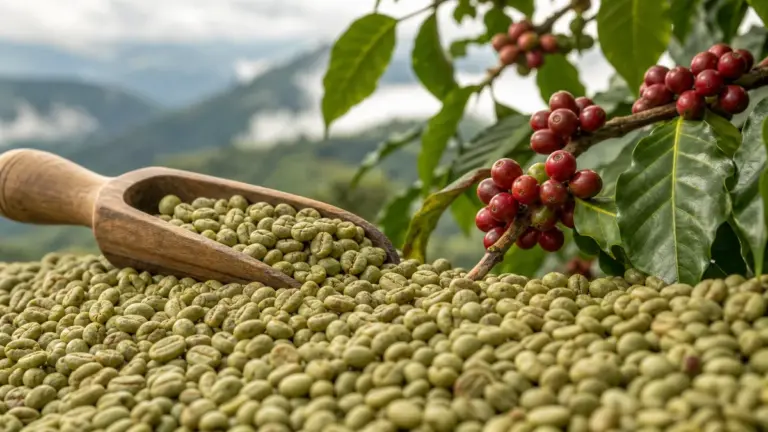
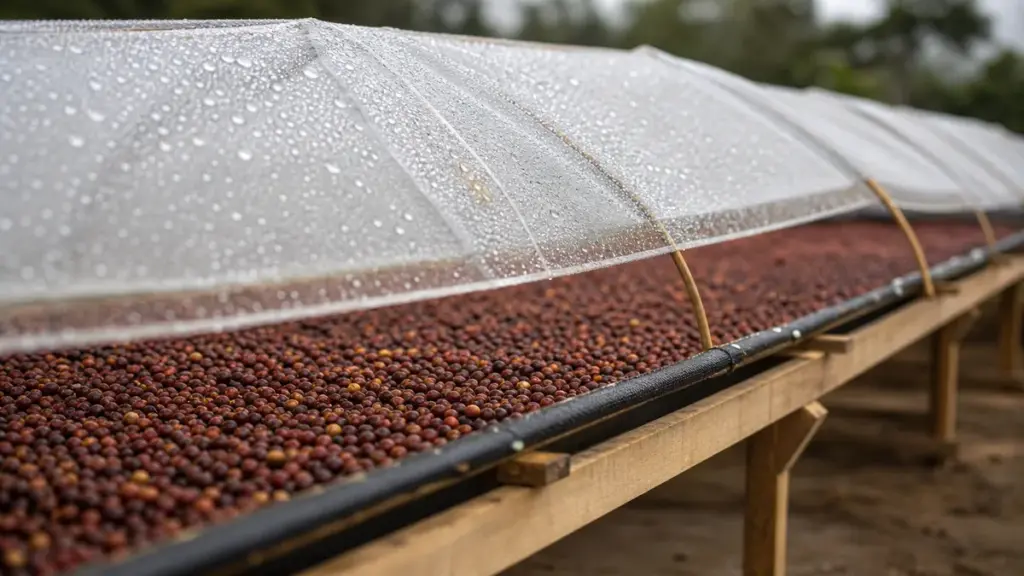
Drier weather can help after picking because harvested coffee must lose moisture before storage. Natural processing dries the whole cherry; washed processing removes the fruit coverings before drying the coffee in its parchment, the protective layer surrounding the seed.
“Washed” therefore does not mean independent of drying weather. Both routes need controlled moisture removal, and rain can interrupt either.
FAO processing guidance identifies rewetting and the storage of partly dried coffee as important problems. Slow or interrupted drying can encourage mould and produce musty or unwanted fermented flavours. A dry harvest period makes this stage easier to manage, but it does not replace careful handling.
Processors can protect drying coffee from rain, use suitable drying surfaces and manage the thickness of the coffee layer. The practical aim is continuous, controlled drying, not simply the strongest possible sunshine.
The distinction matters when reading an origin description: “dry season” may describe favourable processing conditions, while “drought” describes a shortage that harms the living crop.
Reading the seasonal pattern
This table is a guide to the sequence, not a fixed calendar. The same weather can have different consequences depending on when it occurs.
| Climate pattern | Stage most affected | Likely consequence |
|---|---|---|
| Dry interval followed by rain | Mature flower buds | More concentrated flower opening |
| Repeated dry intervals and showers | Flowering | Several flowering events and a more spread-out harvest |
| Water shortage during rapid fruit expansion | Developing cherries | Restricted fruit and seed development |
| Rain interrupting sun-drying | Harvested coffee | Rewetting and greater mould risk |
| Frost | Leaves, branches or stems | Tissue injury, potentially including plant death |
When assessing a weather report, first identify the crop stage. “Rain returned” means something different before flowering, during fruit expansion and when coffee is already spread out to dry.
Drought, heat and frost
Drought is more than a low rainfall total
Plants experience drought when available water cannot meet their needs. Rainfall matters, but so do soil water storage and the drying power of the air.
Coffee can partially close its stomata, the small pores through which leaves exchange gases, to restrict water loss. This also limits carbon dioxide uptake for photosynthesis. Water conservation can help survival while reducing productive growth.
Hot, dry air can intensify the problem even before soil water is exhausted. This helps explain why rainfall alone is an incomplete measure of growing conditions. Soil composition influences the root environment, while altitude and temperature explains the thermal side in more detail.
Frost can damage the tree itself
Frost is a different hazard from slow development in cool weather. It can injure coffee tissues and, when severe, kill trees.
Local terrain matters. FAO guidance warns against planting in depressions where cold air collects. Research on young coffee in southern Brazil has also documented frost injury to exposed stems, illustrating why damage is not confined to leaves or the current fruit crop.
A farm’s average temperature can therefore conceal a serious occasional hazard. The frequency, duration and severity of cold events matter alongside the average.
El Niño and La Niña: different effects in different places
El Niño and La Niña are the warm and cool phases of the El Niño-Southern Oscillation, usually shortened to ENSO. Changes in tropical Pacific ocean temperatures and atmospheric circulation alter rainfall patterns far beyond the ocean itself.
During El Niño, rainfall commonly decreases over Indonesia as tropical rainfall shifts towards the central and eastern Pacific. La Niña commonly strengthens rainfall over Indonesia and the western Pacific. For coffee, those shifts can change the likelihood of water stress or difficult drying conditions.
These are regional tendencies, not guarantees. NOAA stresses that typical ENSO effects are not certain in every event. Season and location must accompany the label.
Colombian coffee research provides a useful reminder that the agricultural outcome is more complicated than “wet is good, dry is bad”. Cenicafé has recorded differences in flowering distribution between ENSO phases and between experimental locations. It has also found that reduced sunshine during La Niña can constrain production in some zones, while cooler, wetter conditions may benefit other, warmer locations.
For a particular crop, use local weather observations and the national coffee institute’s guidance rather than treating an ENSO headline as a harvest forecast.
What climate change projections actually show
Climate projections ask how growing conditions may change over coming decades. They are not forecasts of a particular flowering season.
A peer-reviewed modelling study published by Grüter and colleagues in 2022 assessed arabica suitability using 14 global climate models and three emissions scenarios. By 2050, the global area in its highest suitability class declined by more than 50% under every scenario examined.
That does not mean half of coffee production necessarily disappears. Land can move from a higher suitability class into a lower one, and suitability is not the same measurement as harvested output.
The study did not model management responses such as irrigation, distinguish individual coffee varieties, or incorporate future changes in extreme-weather risks and pest pressure. Its result is a warning about changing biophysical conditions, not a complete prediction of farmers’ responses.
Robusta, Coffea canephora, should not be presented as a climate-proof replacement. A 2026 review led by Royal Botanic Gardens, Kew researchers challenges that assumption, emphasising robusta’s need for dependable soil moisture and weaknesses in some suitability models.
Read any projection by checking the species, geographical area, emissions scenario and outcome measured. “Suitable land”, “yield” and “production” are not interchangeable.
How growers can respond, and what buyers should ask
Adaptation needs to match the local hazard. Shade, mulch and water management can help manage water demand, but no single practice solves every combination of drought, heat, frost and harvest rain.
Variety choice also matters. World Coffee Research’s international field trials examine how varieties perform across contrasting environments, including hot conditions and long dry periods. Their value lies in comparing performance in relevant conditions rather than assuming that a variety successful elsewhere will transfer unchanged.
For growers and technical advisers, a sensible starting sequence is:
- Record the timing: connect rain and dry spells with flowering, fruit development and harvest.
- Identify the recurring constraint: distinguish soil water shortage, atmospheric dryness, frost exposure and drying interruptions.
- Match the response to evidence: use locally relevant variety trials and agronomic advice before changing planting material or management.
For UK buyers, ask suppliers what happened during flowering and fruit development, and how drying was managed. Avoid turning one difficult season into a permanent judgement about an origin.
Neighbouring farms can also experience different conditions. Coffee microclimates explains that smaller scale. Understanding climate variations means following the seasonal sequence, not searching for one ideal annual average.
FAQ
Can coffee grow without a pronounced dry season?
Yes, coffee can grow where rainfall is more evenly distributed, but flowering may be less concentrated. Shorter fluctuations in water availability can still influence flower opening. The result may be several flowering events rather than one dominant bloom, so a pronounced dry season is not a universal requirement for coffee production.
Does irrigation remove the risk of drought?
No, irrigation can supplement rainfall, but its usefulness depends on the local water supply, soil conditions and crop needs. It can also influence flowering timing. A farm with irrigation should not automatically be described as drought-proof: the availability of irrigation water itself needs to be assessed.
Can a weather report tell me whether a coffee will taste good?
No, weather information alone cannot establish cup quality. It can identify risks to fruit development or drying, but those risks are not a tasting result. Ask how the particular lot was harvested, dried and assessed rather than assigning a flavour or quality judgement from a country-level weather headline.
Where to go next
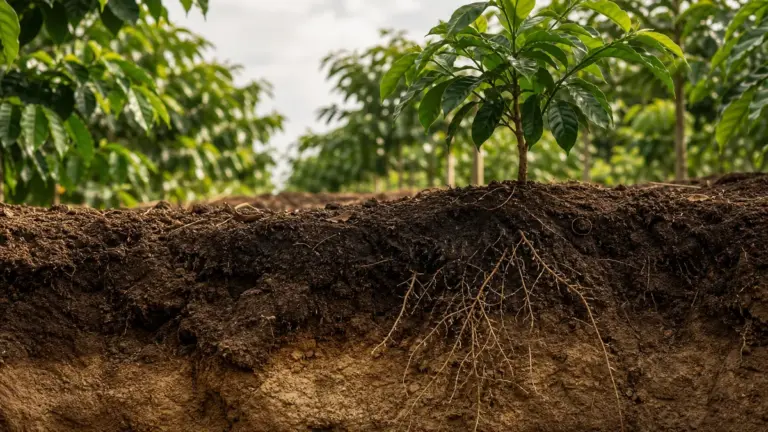
Read Coffee Terroir for the wider relationship between growing conditions, then Altitude and Temperature for the thermal influences kept brief here. Soil Composition explains the root environment, while Coffee Microclimates shows why nearby farms can experience different climate variations.
Sources
-
FAO, Arabica Coffee Manual for Lao-PDR, 2005, chapter “Coffee plant & site selection”.
https://www.fao.org/4/ae939e/ae939e03.htm -
Crisosto, Grantz and Meinzer, Tree Physiology, Effects of water deficit on flower opening in coffee (Coffea arabica L.), 1992.
https://pubmed.ncbi.nlm.nih.gov/14969864/ -
Carr, Experimental Agriculture, The Water Relations and Irrigation Requirements of Coffee, 2001.
https://www.cambridge.org/core/journals/experimental-agriculture/article/abs/water-relations-and-irrigation-requirements-of-coffee/E8FC7E2AF64767A8B98793C463C561BE -
FAO, Arabica Coffee Manual for Lao-PDR, 2005, chapter “Harvesting and processing”.
https://www.fao.org/4/ae939e/ae939e08.htm -
DaMatta and Ramalho, Brazilian Journal of Plant Physiology, Impacts of drought and temperature stress on coffee physiology and production: a review, 2006.
https://www.scielo.br/j/bjpp/a/bDfpJwLr4xLcznSwy4b9zkf/ -
Caramori and Chaves, Pesquisa Agropecuária Brasileira, hosted by Embrapa, Proteção de cafeeiros jovens contra os efeitos de geadas, 1984.
https://apct.sede.embrapa.br/pab/article/download/15736/9768/0 -
NOAA Climate.gov, El Niño and La Niña: Frequently asked questions, 2016, archived reference page.
https://www.climate.gov/news-features/understanding-climate/el-nino-and-la-nina-frequently-asked-questions -
Cenicafé, Registro de la floración del café: Criterio alternativo para el control de la roya del cafeto en Colombia, Avances Técnicos 495, 2018.
https://publicaciones.cenicafe.org/index.php/avances_tecnicos/article/download/4241/4388 -
Cenicafé, El brillo solar en la zona cafetera colombiana, durante los eventos El Niño y La Niña, Avances Técnicos 421, 2012.
https://publicaciones.cenicafe.org/index.php/avances_tecnicos/article/view/496 -
Grüter and colleagues, PLOS ONE, Expected global suitability of coffee, cashew and avocado due to climate change, 2022.
https://journals.plos.org/plosone/article?id=10.1371/journal.pone.0261976 -
Davis, Dashrath and Moat, Sustainable Development, The Sustainability of Robusta Coffee Under Global Change: A Review, 2026.
https://onlinelibrary.wiley.com/doi/10.1002/sd.71568 -
World Coffee Research, International Multilocation Variety Trial, programme page, undated, current version retrieved November 2026.
https://worldcoffeeresearch.org/programs/international-multilocation-variety-trial
Research combined agronomic guidance, experimental flowering research, coffee institute observations and peer-reviewed climate modelling, with seasonal mechanisms distinguished from projections.
Last checked: November 2026