To roast coffee at home, heat green coffee beans while keeping them moving, watch their colour and listen for cracking, then cool them promptly and let them rest before brewing. A purpose-built home roaster offers the clearest starting instructions, but a heavy pan can work if you can manage the heat, smoke and chaff safely.
In short
- Arrange suitable ventilation before starting. Roasting produces airborne emissions, including carbon monoxide, even with electric equipment.
- Never leave a roast unattended, including its cooling cycle.
- Ordinary popcorn makers are not automatically suitable for coffee. Check the manufacturer’s instructions rather than following appliance modifications online.
- For a first batch, aim to finish after first crack has subsided, before the finer snapping of second crack.
- Prepare your cooling equipment first, then rest the cooled beans before judging the result.
Buy green coffee intended for roasting
Buy green, unroasted coffee beans, not roasted beans, coffee seeds sold for planting or products intended as supplements. UK home-roasting suppliers sell green coffee online; Coffee Compass, for example, lists a green-bean option for its coffees. Check the individual listing and availability before ordering.
Look for a supplier that identifies the origin, processing method and intended flavour profile. Ask for a straightforward beginner coffee and roasting guidance for your equipment. Start with one coffee rather than a blend: keeping the raw material unchanged makes your adjustments easier to understand.
A washed coffee is a sensible first choice where the supplier recommends it. Some roaster manuals impose smaller batch limits for natural, or dry-processed, coffees because they shed more chaff, the papery skin released during roasting.
Buy enough to repeat a batch, rather than changing coffee after every attempt. Keep its original identification and supplier notes with your roast records.
For the wider sequence from green bean to finished roast, see our coffee roasting guide.
Make the space safe before switching on
Smoke extraction and carbon monoxide
Roasting needs more than somewhere for the smell to linger. Arrange effective removal of emissions to outdoors and an adequate supply of fresh air, following the roaster manufacturer’s installation instructions. Do not assume that an open window or a recirculating cooker hood makes an otherwise unsuitable space safe.
HSE identifies carbon monoxide as a by-product of coffee processing. Laboratory research has also measured carbon monoxide released by roasted coffee, so an electric heater does not remove every source of it.
Those findings mainly concern occupational settings and controlled emission measurements. They do not establish a universal safe batch size or ventilation rate for a domestic kitchen. The practical precaution is to avoid enclosed, poorly ventilated spaces and obtain advice from the equipment supplier if your extraction arrangements are uncertain.
Keep smoke, heat and carbon monoxide alarms operational. An audible carbon monoxide alarm is an additional safeguard, not proof that ventilation is adequate. If it sounds, evacuate immediately, do not re-enter until advised, and seek urgent medical advice if exposure is suspected.
Fire, hot surfaces and chaff
Set up on a stable, heat-resistant surface with the clearances the appliance requires. Keep children, pets, packaging, curtains and tea towels away. Have dry oven gloves ready and keep air intakes and exhaust paths unobstructed.
Never leave roasting coffee unattended. Chaff can ignite, and accumulated chaff can obstruct airflow. Empty and clean collectors as instructed, but only after the equipment and debris have cooled completely. Do not put hot chaff into a bin.
Know the emergency procedure before starting. For a pan fire, London Fire Brigade advises against tackling it yourself, moving the pan or adding water. Turn off the heat only if safe, leave the room, close the door, warn others and call 999. Do not open an oven containing a fire.
Choose a home-roasting method
The useful comparison is not simply which method gets beans brown. Consider agitation, observation, chaff management and cooling.
| Method | Main advantage | Main limitation | Who it suits |
|---|---|---|---|
| Heavy pan | Clear view of the beans and audible cracking | Continuous stirring; scorching and unevenness are difficult to avoid | An attentive experimenter with suitable extraction |
| Ordinary hot-air popcorn popper | Moving air can agitate the beans | Coffee use may be outside its approved purpose and invalidate its warranty | Only users whose manufacturer explicitly permits coffee roasting |
| Domestic oven | Beans can be spread across a tray | Uneven heating, awkward agitation and chaff near heaters or fans | Experimenters with confirmed equipment suitability |
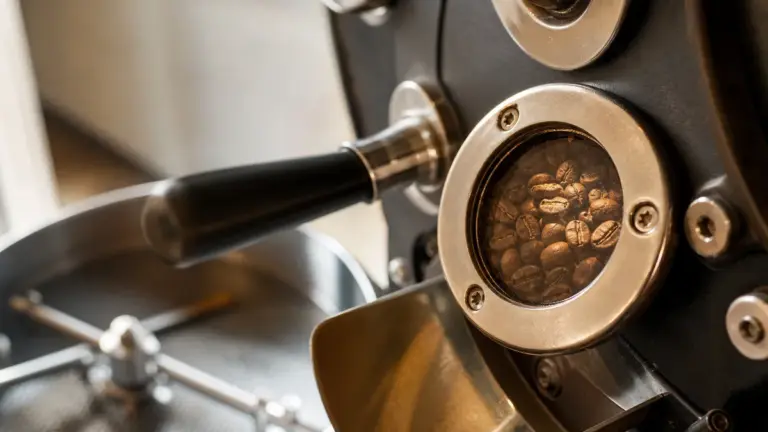
| Purpose-built home roaster | Defined batch limits, controls and operating instructions | Still needs supervision, ventilation and cleaning | Beginners wanting a repeatable procedure |
Pan roasting
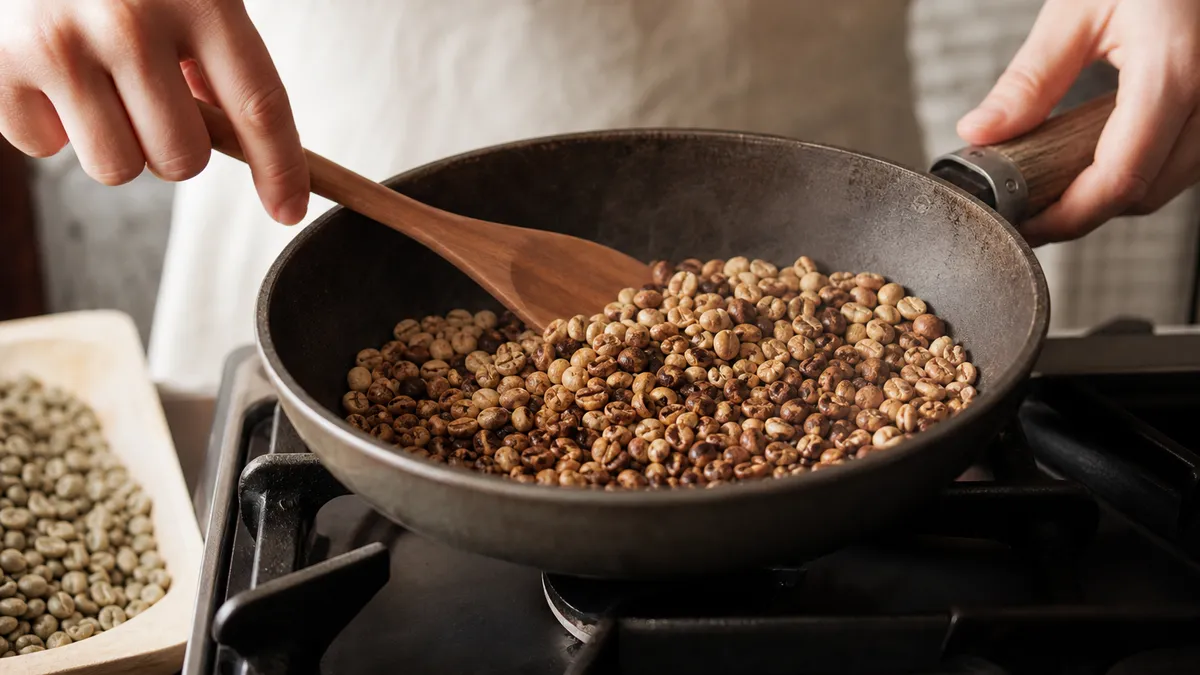
Use a clean, heavy, uncoated pan with good heat distribution and a suitable stirring utensil. Keep the beans moving continuously and add no cooking oil. Expect some unevenness: beans touching the hot base can scorch while others remain pale.
Published stovetop instructions differ substantially in preheating temperature and expected crack timing. They use different pans and heating arrangements, so there is no single reliable hob setting or pan temperature to copy across kitchens. Treat pan roasting as an experiment, not a temperature-controlled recipe.
Popcorn poppers
An ordinary popcorn maker is not the same as a purpose-built coffee roaster with a similar appearance. Coffee roasting may expose it to operating conditions outside its intended use; Sweet Maria’s own popcorn-popper guidance warns of possible hood distortion and warranty invalidation.
Do not bypass thermal cut-outs, block vents or improvise electrical modifications. If the appliance manufacturer does not approve coffee roasting, choose suitable equipment instead.
Oven roasting
Ovens can roast coffee, but stationary beans tend to develop unevenly. Opening the door to stir loses heat, while loose chaff can reach heating elements or fans and ignite.
Do not assume that instructions for one convection toaster oven apply to every oven or air fryer. Check suitability with the manufacturer first. For a first attempt, my preference is a purpose-built roaster rather than an oven: its loading, cooling and cleaning instructions are less ambiguous.
Compare the equipment classes in roasting equipment.
How to roast coffee at home, step by step
This sequence is for a purpose-built home roaster. Its manual takes priority over generic timings, particularly for loading, preheating and cooling.
-
Prepare the whole process. Read the operating and emergency instructions. Arrange ventilation, clear the worktop and prepare any external cooling tray the manufacturer requires. Set out scales, a timer and oven gloves before introducing heat.
-
Weigh and inspect the green beans. Use the manufacturer’s recommended beginner batch, not automatically its maximum capacity. For context, the Gene Cafe CBR-101 manual claims a maximum of 250 g, but limits dry-processed and peaberry coffees to 200 g. Remove stones and other foreign material.
-
Load and select the specified programme. Add 0 ml of water: this is dry roasting. Fit the chamber, collector and safety covers correctly. Do not assume preheating is required; the CBR-101 manual specifically warns against preheating that model without beans.
-
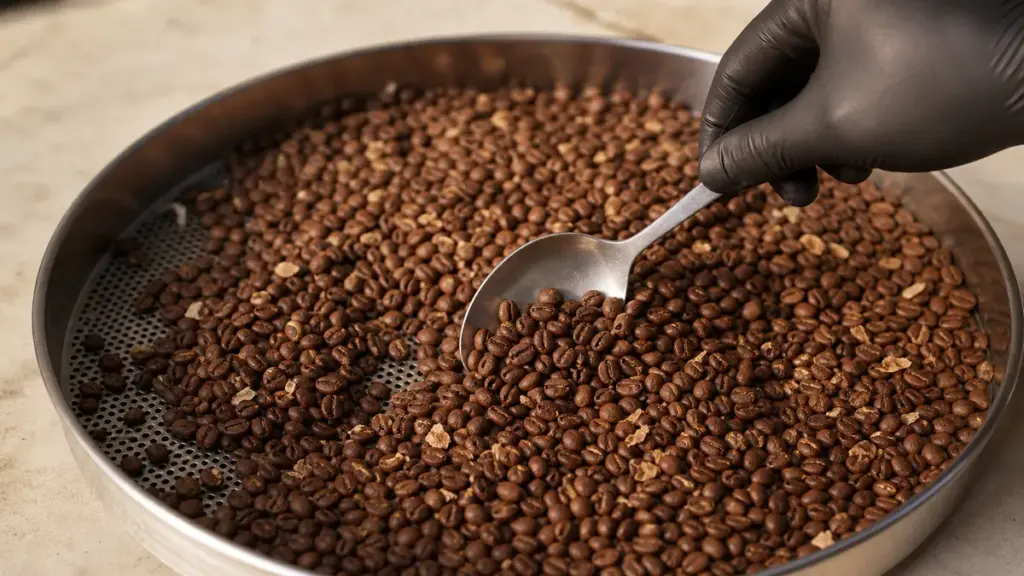
Start the timer and watch the changes. Beans move from green through yellow and tan towards brown. Early grassy or hay-like aromas give way to toasted-grain smells. Observe from a normal operating position rather than leaning over the exhaust.
-
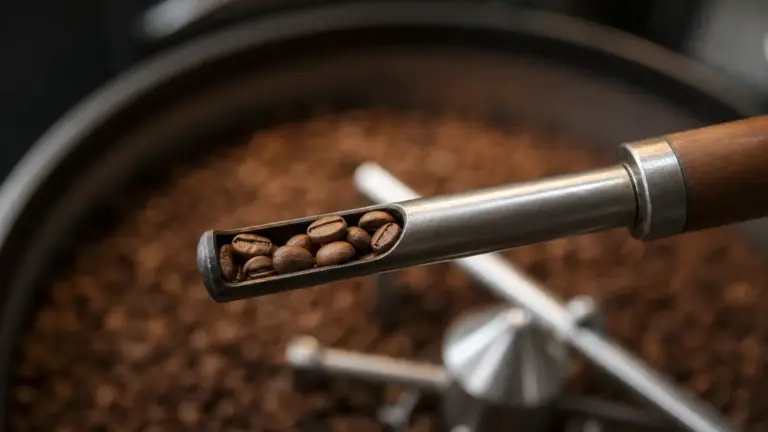
Listen for first crack. This is the distinct popping stage associated with bean expansion. Record its start, but do not use the first isolated pop as an automatic finishing signal. Continue observing the whole batch.
-
Choose a conservative endpoint. For a first roast, finish after the main first-crack activity has subsided, before second crack’s finer snapping begins. Temperature and time are equipment-specific: the CBR-101 guide lists approximately 250°C and 17 minutes for its “City” roast, but these are manufacturer guide settings, not universal bean-temperature targets or a guaranteed result.
-
Run the prescribed cooling cycle. Use the normal cooling control rather than unplugging the machine to finish a routine roast. Do not remove a hot chamber early unless its instructions explicitly permit that procedure.
-
Finish cooling and record the batch. Where instructed, spread discharged beans on a clean metal tray or stir them in a metal colander. Allow them to cool completely before packing. Record the green weight, settings, first-crack time, finish time and observations.
A timer is a record, not permission to ignore the beans. Stop according to the equipment’s instructions if smoke becomes excessive or operation appears abnormal.
Cool promptly, then let the beans rest
Beans retain heat after the heater stops, so cooling is part of controlling the roast. Leaving a batch piled in a hot pan or tray allows further roasting.
For pan or oven methods, have a heatproof metal cooling vessel ready before starting. Transfer carefully, wearing oven gloves, and spread or stir the beans to release heat. Keep loose chaff away from flames and appliance intakes; do not use a household vacuum on hot debris.
Resting is different from cooling. Roasted beans release carbon dioxide, a process called degassing, and coffee can brew differently as that gas escapes.
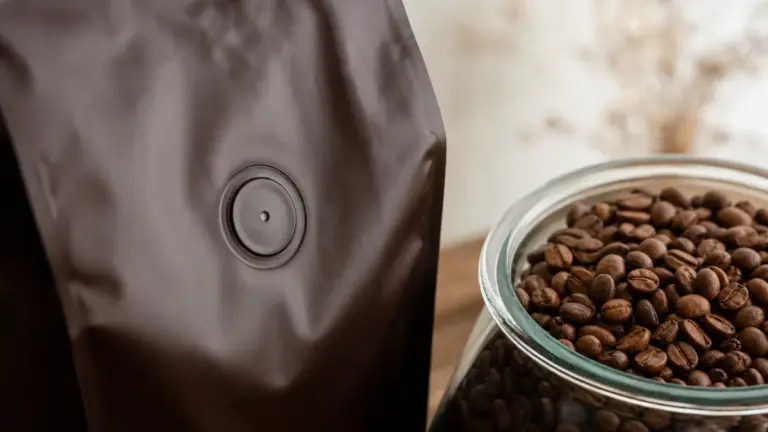
Sweet Maria’s recommends an initial 12 to 24 hours of rest in its home-roasting guidance. Use that as a starting point for tasting, not a claim that every coffee peaks the following day. Once completely cool, a food-safe bag with a one-way valve provides a practical way to release gas while limiting air entry.
Read roast cooling, degassing and freshness for the fuller storage and resting guidance.
Troubleshoot the next batch, not just the last cup
Taste before making a large adjustment. A dark patch on a bean suggests a different problem from a batch that is uniformly darker than intended.
| Symptom | Likely cause | Fix |
|---|---|---|
| Blackened patches beside pale areas | Localised scorching or inadequate movement | Improve agitation; reduce excessive initial heat |
| Uneven colour across an oven tray | Hot spots and stationary beans | Reconsider the method; do not assume extra time will even it out |
| Coffee finishes darker than intended | Late stopping or slow cooling | Start cooling earlier and improve the permitted cooling process |
| Excessive smoke from a home roaster | Over-roasting, overloading or restricted airflow | Follow the shutdown procedure; inspect and clean once cold |
| Roast does not reach the expected stage | Incorrect settings, overloading or an equipment problem | Check the manual and supplier guidance before extending the roast |
For repeatable learning, change one variable at a time. Keep the same coffee and batch weight while adjusting the finishing point, then compare your tasting notes.
Do not try to reproduce another machine’s displayed temperature exactly. A sensor measuring hot air is not measuring the same thing as a probe in the bean mass. Record what your equipment reports, alongside colour, sound and flavour.
FAQ
Can I roast coffee beans that have already been roasted?
Start with green beans rather than re-roasting finished coffee. Further heating moves roasted beans towards darker, more burnt flavours; it does not restore the original green coffee or provide a clean repeat of the roasting process. For learning, use an identified green coffee and retain enough for several comparable batches.
Do the beans need to look oily?
No, surface oil is not a requirement for a finished roast. Roast colour, texture, cracking and aroma provide more useful combined clues than oil alone. For your first batches, do not keep applying heat merely to create a glossy appearance, especially once the roast is approaching second crack.
Can I move an electric roaster outdoors to avoid smoke?
Only if its manufacturer permits outdoor operation. Some home roasters, including the CBR-101 covered by the retrieved manual, explicitly prohibit outdoor use. A sheltered patio is not automatically an approved location. Choose equipment and a ventilation arrangement that work together rather than moving an indoor appliance outside.
Where to go next
Read Coffee Roasting for the wider process, then Roasting Equipment to compare methods before choosing your setup. Roast Cooling, Degassing and Freshness explains what happens after heating stops and helps you judge the results of learning how to roast coffee at home.
Sources
-
Coffee Compass, Green Bean Zone, undated, retrieved November 2026.
https://www.coffeecompass.co.uk/collections/green-bean-zone/options
Supplier evidence for UK green-coffee availability, not an endorsement. -
Health and Safety Executive, Exposure to diacetyl vapour in food and drink manufacture, current page dated 2026.
https://www.hse.gov.uk/safetybulletins/diacetyl-vapour-exposure.htm
Occupational guidance identifying coffee-processing emissions and extraction controls. -
UK Health Security Agency, Carbon monoxide: general information, current online guidance, retrieved November 2026.
https://www.gov.uk/government/publications/carbon-monoxide-properties-incident-management-and-toxicology/carbon-monoxide-general-information
Alarm limitations, evacuation and medical advice. -
London Fire Brigade, What to do if a pan catches fire?, undated, retrieved November 2026.
https://www.london-fire.gov.uk/safety/the-home/cooking/pan-fires/
UK domestic pan-fire response. -
Los Angeles Fire Department, Cooking Safety, undated, retrieved November 2026.
https://lafd.org/cooking-safety
Supports keeping an oven door closed during an oven fire. -
NIOSH-hosted original research, Carbon monoxide emission rates from roasted whole bean and ground coffee, 2019, Journal of the Air & Waste Management Association, volume 69, issue 1.
https://pmc.ncbi.nlm.nih.gov/articles/PMC6430709/
Controlled emission measurements, not a domestic exposure assessment. -
Gene Cafe, CBR-101 Owner’s Manual, revision 03, February 2015; manufacturer-hosted download page updated February 2026.
https://genecafeusa.com/community/knowledgebase/cbr-101-start-here/1-cbr-101-user-manual
Manufacturer instructions and claimed capacities, settings and safety requirements. -
Sweet Maria’s, Stovetop Coffee Roasting Tip Sheet: Pan or Popper, undated PDF.
https://library.sweetmarias.com/wp-content/uploads/2022/11/Stovetop-Coffee-Roasting-Tip-Sheet.pdf
Practical stovetop guidance, cooling and initial resting advice. -
Sweet Maria’s, Stovetop Coffee Roasting: Skillet/Wok/Pan Roast Methods vs. Stovetop Popper Method, 2020.
https://library.sweetmarias.com/stovetop-coffee-roasting-in-a-pan-skillet-or-popper/
Pan technique, agitation and comparison with the tip sheet. -
Sweet Maria’s, Hot Air Popper Tip Sheet, undated PDF.
https://library.sweetmarias.com/wp-content/uploads/2020/08/Hot-Air-Popper-Coffee-Roasting-Tip-Sheet.pdf
Popper limitations, chaff and warranty warning; modification suggestions are not adopted here. -
Sweet Maria’s, Toaster Oven Coffee Roasting Method, 2020.
https://library.sweetmarias.com/toaster-oven-coffee-roasting-method-air-fryer-convection-toaster-oven/
First-hand supplier experiments documenting unevenness and chaff hazards, not manufacturer approval. -
Sweet Maria’s, Using Sight to Determine Degree of Roast, 2022.
https://library.sweetmarias.com/using-sight-to-determine-degree-of-roast/
Colour, aroma, cracking, surface oil and measurement limitations. -
Sweet Maria’s, Storing Your Roasted Coffee, 2018.
https://library.sweetmarias.com/storing-your-roasted-coffee/
Initial resting, degassing and storage guidance.
This piece was researched using retrieved manufacturer instructions, fire-service and public-health guidance, original emissions research and specialist home-roasting material; no first-hand testing is claimed.
Last checked: November 2026