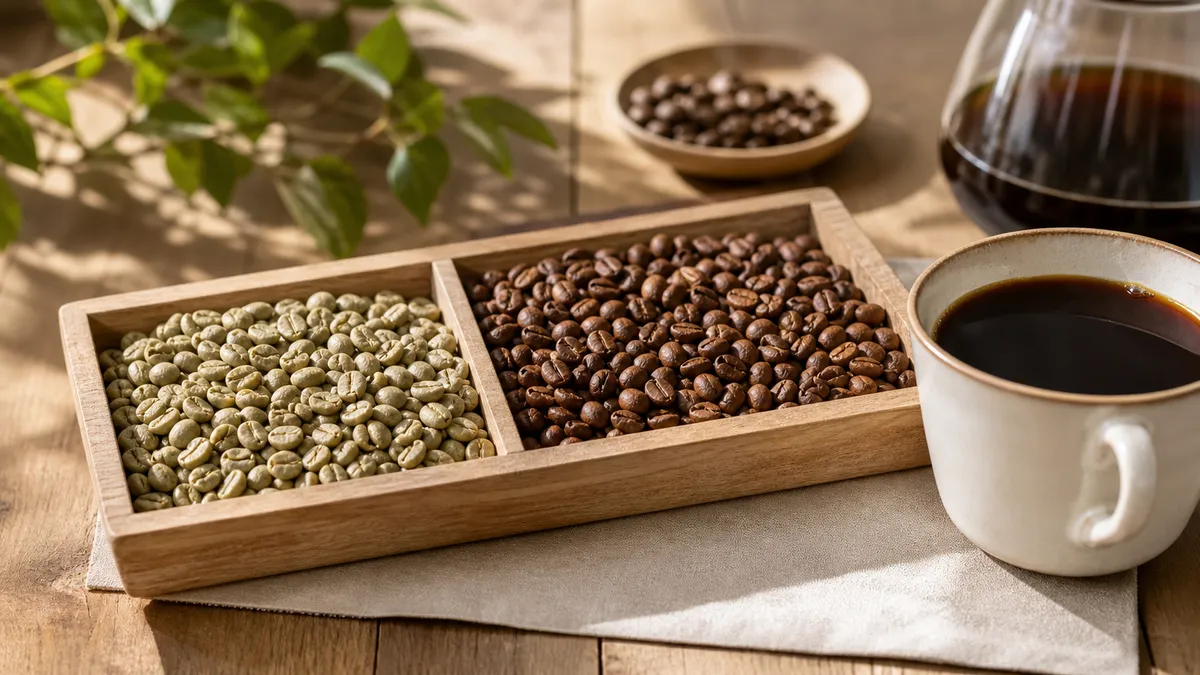
The main antioxidants in coffee are chlorogenic acids, a family of plant compounds commonly grouped with dietary polyphenols, together with substances formed during roasting, including melanoidins. Coffee can make a substantial contribution to dietary polyphenol intake, but antioxidant activity measured in a laboratory does not prove that drinking it prevents disease.
In short
- Chlorogenic acids include caffeoylquinic, feruloylquinic and dicaffeoylquinic acids.
- Light-to-medium roasts generally retain more chlorogenic acids than darker roasts, while roasting creates other antioxidant-active compounds.
- Dietary intake, laboratory antioxidant activity and demonstrated health benefits are three different measurements.
- Coffee was the largest source of estimated polyphenol intake in a studied French adult cohort, not necessarily in every population.
- Choose coffee for enjoyment and tolerance, not an antioxidant score. Decaffeinated coffee also contains antioxidant-active compounds.
Which antioxidants are in coffee?
Coffee contains a mixture of naturally occurring plant compounds and substances created when beans are roasted. Calling them all “antioxidants” is convenient, but it hides important differences in their chemistry and the evidence behind them.
Chlorogenic acids: the main polyphenol group
Chlorogenic acids, often abbreviated to CGAs, are a family rather than a single ingredient. Their main groups in coffee include:
- Caffeoylquinic acids, including the commonly measured 5-caffeoylquinic acid.
- Feruloylquinic acids.
- Dicaffeoylquinic acids.
These names describe compounds in which quinic acid is joined to acids such as caffeic or ferulic acid. Despite its name, caffeic acid is not caffeine.
Their chemical structures allow them to participate in reactions that can limit oxidation under laboratory conditions. However, the amount detected in a drink is not a direct measurement of protection inside the body.
Melanoidins: compounds created by roasting
Melanoidins are complex brown materials formed during roasting through browning reactions involving sugars and amino-containing compounds. They are not one molecule with one fixed structure.
Laboratory studies can separate larger melanoidin-rich fractions from smaller compounds such as chlorogenic acids, then measure their contributions to antioxidant activity. Both contribute, but their relative importance changes with the roast.
Some phenolic compounds also become associated with melanoidins during roasting. The distinction between “natural polyphenols” and “roasting products” is therefore not completely tidy.
Trigonelline and other compounds
Trigonelline is a naturally occurring alkaloid, a nitrogen-containing plant compound, rather than a polyphenol. It belongs in the discussion of coffee’s bioactive ingredients, but should not be presented as having the same established role as chlorogenic acids.
Roasting reduces trigonelline and creates breakdown products. Coffee also contains smaller phenolic compounds, including caffeic and ferulic acids, while caffeine is a separate alkaloid with its own physiological effects. Antioxidant research should not be used to blur these distinctions; see caffeine and health for that separate question.
What does “antioxidant” actually mean?
In chemistry, an antioxidant limits oxidation in a particular system. A laboratory test might measure how effectively a coffee sample reacts with a test radical or transfers electrons under specified conditions.
That finding is useful, but it is not the same as showing that the drink protects human tissues. Three questions need to stay separate:
- Laboratory activity: what happens when coffee or an isolated compound meets a chemical test reagent?
- Dietary intake: how much of a compound do people consume, estimated from food composition and dietary records?
- Human outcomes: does consuming it change a meaningful biological marker or improve health?
A coffee can perform strongly in the first category without having demonstrated benefits in the third. Even dietary intake is not the same as absorption: swallowing a compound does not tell us how much reaches a particular tissue, or in what form.
Different antioxidant assays can also produce different rankings. In a coffee-roasting experiment using three complementary tests, the results depended partly on the assay and reference compound used. An impressive-looking antioxidant number therefore needs its method attached.
For the wider interpretation of nutrition studies, start with coffee and health.
How roasting changes antioxidants in coffee
Roasting does not simply remove antioxidants. It changes the mixture.
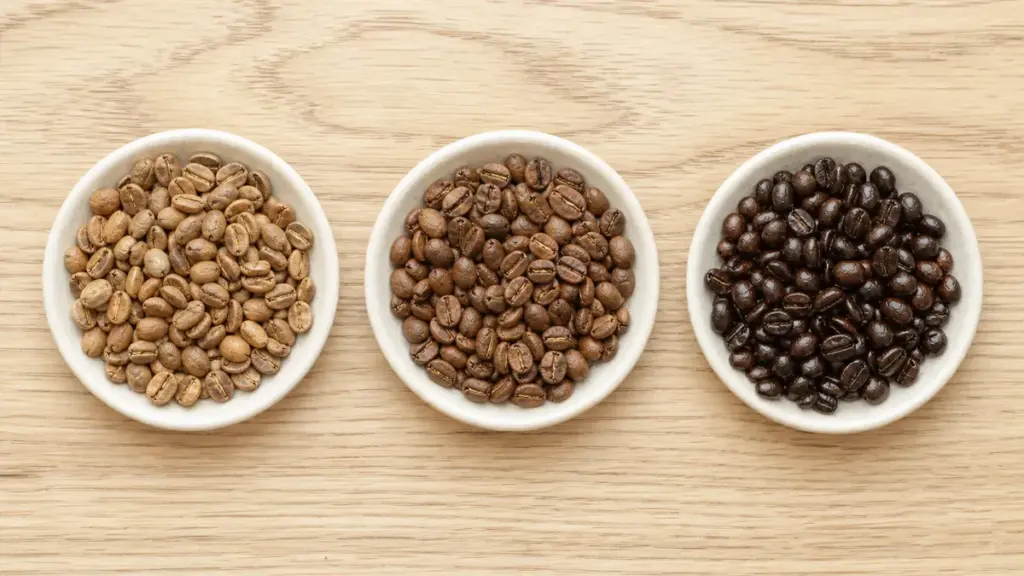
Chlorogenic acids are broken down or transformed as roasting progresses. For otherwise comparable coffees, light-to-medium roasts generally retain more of these compounds than dark roasts. A study comparing roast levels in pot and filter coffee also found declining chlorogenic acid and trigonelline signals as roasting became darker.
At the same time, browning reactions create melanoidins and other compounds that can contribute to laboratory antioxidant activity. This helps explain why a roasted coffee can retain substantial activity even after losing some original chlorogenic acids.
There is an important qualification to the familiar claim that “dark roasting creates more melanoidins”. More extensive roasting changes the melanoidin fraction, but its measured antioxidant contribution does not necessarily increase continuously. Experimental work has found that further heating can also reduce activity in these larger compounds.
The useful distinction is:
- If the question is chlorogenic acid retention, lighter roasting generally has the advantage.
- If the question is total laboratory antioxidant activity, the result depends on the compounds formed, those lost and the test used.
- If the question is which roast improves health, those chemical measurements alone cannot answer it.
A roast preference is not a medical decision. There is no sound basis for choosing a coffee solely because its beans are paler or darker.
How much does coffee contribute to the diet?
Coffee can be a major dietary source because it combines phenolic compounds with frequent consumption. However, widely repeated “number one antioxidant source” claims come from different kinds of research.
Polyphenol intake in French adults
Pérez-Jiménez and colleagues estimated the intake of individual polyphenols in 4,942 French adults, using dietary records and the Phenol-Explorer food-composition database. Their 2011 paper identified coffee as the largest contributor, accounting for approximately 44% of estimated total polyphenol intake in the cohort.
That is evidence about estimated consumption in a particular population. It does not mean that coffee supplies 44% of everyone’s polyphenols, or 44% of the body’s antioxidant protection.
What Svilaas and Vinson actually measured
Svilaas and colleagues’ Norwegian research, published in 2004, likewise identified coffee as the largest contributor to estimated dietary antioxidant intake. However, its estimates used foods’ measured antioxidant capacity, rather than a comprehensive inventory of individual polyphenols.
Joe Vinson’s widely reported US findings were presented at an American Chemical Society meeting in 2005. The society’s announcement described coffee as the leading dietary antioxidant source, based on food measurements combined with consumption data. This was not a clinical trial demonstrating disease prevention.
These studies support the narrower conclusion that coffee can be a leading contributor to dietary polyphenols or estimated antioxidant capacity in some Western populations. They do not all measure the same thing, and they do not establish a universal ranking.
Nor does a high position in such a ranking make coffee a substitute for food. The NHS recommends a variety of fruit and vegetables because they provide different combinations of fibre, vitamins, minerals and other nutrients.
What happens after you drink it?
The coffee in the cup is not the chemical mixture that ultimately circulates in the blood.
Bioavailability describes the extent to which consumed substances, or their breakdown products, become available to the body. Human studies show that coffee’s chlorogenic acids undergo substantial metabolism. Researchers detect metabolites, meaning chemically altered products, as well as some unchanged compounds in blood and urine.
The colon matters too. A study comparing findings in people with an ileostomy, where intestinal contents leave the body before reaching the colon, with findings in people with an intact colon demonstrated the importance of colonic metabolism. Gut microbes help transform compounds that reach this part of the digestive system.
Consequently, exposing a laboratory preparation directly to coffee extract cannot reproduce all the conditions after drinking coffee. Concentration, metabolism and the compounds reaching tissues may all differ.
More in the cup also need not mean proportionately more circulating material. A small controlled human study found trends towards lower proportional bioavailability at its highest chlorogenic acid dose. This is another reason not to turn chemical content into a “more is better” rule.
What does the evidence demonstrate?
The table separates evidence for composition from evidence for biological effects. “Strong” here means strong for the stated question, not proof that coffee improves overall health.
| Claim | Type of evidence | Strength and limitation | Source |
|---|---|---|---|
| Coffee contains several chlorogenic acids and other bioactive compounds | Chemical analysis of coffee brews | Strong for identifying compounds; does not establish clinical benefit | Macheiner and colleagues, 2023 |
| Roasting changes the compounds responsible for antioxidant activity | Controlled roasting and laboratory assays | Strong for chemistry under the tested conditions; rankings depend on method | Opitz and colleagues, 2014 and 2017 |
| Coffee can dominate estimated dietary polyphenol intake | Dietary records linked to food-composition data | Useful population-specific intake evidence; not a measure of tissue protection | Pérez-Jiménez and colleagues, 2011 |
| Coffee-derived phenolic metabolites reach the circulation | Controlled human feeding studies | Direct evidence of absorption and metabolism; not disease prevention | Stalmach and colleagues, 2010 and 2014 |
| Coffee consistently reduces markers of damage in humans | Randomised intervention trials | Mixed results; studies used different coffees, participants and measurements | Bakuradze and colleagues, 2015; Shaposhnikov and colleagues, 2018 |
The human trials illustrate why caution matters. A trial involving 84 healthy men found fewer spontaneous DNA strand breaks after four weeks of a particular dark-roast coffee compared with water. This was a biomarker finding, not evidence that the participants developed fewer diseases.
Another randomised trial involving 160 healthy adults found no significant effect on its measured markers of DNA and lipid oxidation after eight weeks. These findings are not directly interchangeable because the interventions and measurements differed.
Neither trial isolates “antioxidants” as the sole explanation. For disease-specific evidence, use coffee’s role in disease rather than extrapolating from a laboratory score.
How to use this information
Treat “contains antioxidants” as a description of composition, not a promise of protection. When reading a claim, ask what was measured, whether people were studied, and whether the result concerned a short-term marker or an actual health outcome.
There is no reason in this evidence to increase coffee consumption simply to pursue antioxidants. EFSA’s caffeine assessment found that habitual intakes up to 400 mg a day, spread across the day, raise no safety concerns for healthy non-pregnant adults. This is population guidance, not a target, and individual sensitivity varies.
The NHS advises no more than 200 mg daily from all sources during pregnancy. Antioxidant content does not cancel that guidance. For personal questions involving pregnancy, medicines or a medical condition, speak to a midwife, pharmacist or GP.
Choose a coffee you enjoy and tolerate, including decaffeinated coffee if appropriate. Let moderation and sensitivity, rather than an antioxidant ranking, guide the practical decision.
FAQ
Does decaffeinated coffee still contain antioxidants?
Yes, decaffeinated coffee still contains antioxidant-active compounds. Removing caffeine does not mean removing every other coffee constituent. The American Chemical Society’s account of Vinson’s research reported similar antioxidant levels in the caffeinated and decaffeinated coffees assessed, but that should not be read as a guarantee that every regular and decaffeinated product has an identical composition.
Is instant coffee missing the polyphenols found in ground coffee?
No, instant coffee can contain chlorogenic acids and their related compounds. Chemical analysis of commercial ground and instant coffees has identified caffeoylquinic, feruloylquinic and dicaffeoylquinic acids in both. Product composition still varies, so “instant” versus “ground” is not enough information to calculate the polyphenols in a particular serving.
Does a high antioxidant score mean a coffee will help me live longer?
No, a laboratory antioxidant score cannot establish a longer life expectancy. It measures chemical behaviour under test conditions, not survival or disease incidence. Even a favourable change in a human biomarker is a different outcome from living longer. Those questions require their own evidence, rather than a conversion from antioxidant activity into years of life.
Where to go next
Read Coffee and Health for the framework used to assess benefits and risks, then Caffeine and Health to separate stimulant effects from other coffee compounds. Coffee’s Role in Disease examines condition-specific evidence, while Coffee and Longevity addresses the longer-term outcomes that antioxidant claims alone cannot establish.
Sources
-
Medical University of Vienna and collaborators. Macheiner and colleagues, Comprehensive Analysis of Metabolites in Brews Prepared from Naturally and Technologically Treated Coffee Beans, 2023.
https://pubmed.ncbi.nlm.nih.gov/36670958/
Chemical analysis supporting the identification of coffee constituents. -
American Chemical Society, ACS Food Science & Technology. Effect of the Roast Level on Lipophilic and Hydrophilic Compounds in Pot and Filter Coffee Beverages, 2025.
https://pubs.acs.org/doi/10.1021/acsfoodscitech.5c00066
Experimental comparison of compounds across roast levels. -
Zurich University of Applied Sciences and collaborators. Opitz and colleagues, Antioxidant Generation during Coffee Roasting: A Comparison and Interpretation from Three Complementary Assays, 2014.
https://pubmed.ncbi.nlm.nih.gov/28234339/
Primary research on roasting and assay-dependent antioxidant measurements. -
Zurich University of Applied Sciences and collaborators. Opitz and colleagues, Understanding the Effects of Roasting on Antioxidant Components of Coffee Brews by Coupling On-line ABTS Assay to High Performance Size Exclusion Chromatography, 2017.
https://pubmed.ncbi.nlm.nih.gov/28008674/
Primary research separating antioxidant-active coffee fractions. -
University of Oslo and collaborators. Svilaas and colleagues, Intakes of antioxidants in coffee, wine, and vegetables are correlated with plasma carotenoids in humans, 2004.
https://pubmed.ncbi.nlm.nih.gov/14988447/
Dietary antioxidant-intake research in Norwegian adults. -
INRA, Clermont Université and collaborators. Pérez-Jiménez and colleagues, Dietary intake of 337 polyphenols in French adults, 2011.
https://pubmed.ncbi.nlm.nih.gov/21490142/
Retrieved full-text copy: https://cafeesaude.com/wp-content/uploads/2012/01/Subst%C3%A2ncias-J-Perez-Jiminez-et-al-American-Journal-of-Clinical-Nutrition-Volume-93-June-2011.pdf
Dietary records and food-composition estimates from the SU.VI.MAX cohort. -
American Chemical Society. Coffee is number one source of antioxidants, research announcement, 28 August 2005.
https://www.eurekalert.org/news-releases/560866
Primary organisational announcement of Vinson’s conference findings, not a clinical trial report. -
University of Glasgow and collaborators. Stalmach and colleagues, Bioavailability of chlorogenic acids following acute ingestion of coffee by humans with an ileostomy, 2010.
https://pubmed.ncbi.nlm.nih.gov/20226754/
Human absorption and metabolism study. -
University of Glasgow and University of Leeds. Stalmach, Williamson and Crozier, Impact of dose on the bioavailability of coffee chlorogenic acids in humans, 2014, Royal Society of Chemistry accepted manuscript.
https://pubs.rsc.org/en/content/getauthorversionpdf/c4fo00316k
Controlled human dose study. -
University of Kaiserslautern and collaborators. Bakuradze and colleagues, Consumption of a dark roast coffee decreases the level of spontaneous DNA strand breaks: a randomized controlled trial, 2015, published online in 2014.
https://pubmed.ncbi.nlm.nih.gov/24740588/
Randomised human biomarker trial. -
NorGenoTech, University of Oslo and collaborators. Shaposhnikov and colleagues, Coffee and oxidative stress: a human intervention study, 2018, published online in 2016.
https://pubmed.ncbi.nlm.nih.gov/27858150/
Randomised trial reporting no significant effect on measured DNA and lipid oxidation markers. -
European Food Safety Authority. Caffeine, current topic page summarising the 2015 Scientific Opinion on the safety of caffeine.
https://www.efsa.europa.eu/en/topics/topic/caffeine
Population caffeine-safety guidance. -
NHS. Foods to avoid in pregnancy, current guidance retrieved November 2026.
https://www.nhs.uk/pregnancy/keeping-well/foods-to-avoid/
Pregnancy caffeine limit. -
NHS. Why 5 A Day?, reviewed September 2026.
https://www.nhs.uk/live-well/eat-well/5-a-day/why-5-a-day/
Guidance on dietary variety, fibre, vitamins and minerals. -
Poznań University of Economics and collaborators. Jeszka-Skowron and colleagues, The influence of roasting and additional processing on the content of bioactive components in special purpose coffees, 2015.
https://pubmed.ncbi.nlm.nih.gov/26344987/
Chemical analysis of chlorogenic acid groups in ground and instant coffees.
This article was researched using retrieved primary chemistry papers, human intervention studies, dietary-intake research and current NHS and EFSA guidance, with laboratory findings kept separate from clinical outcomes.
Last checked: November 2026