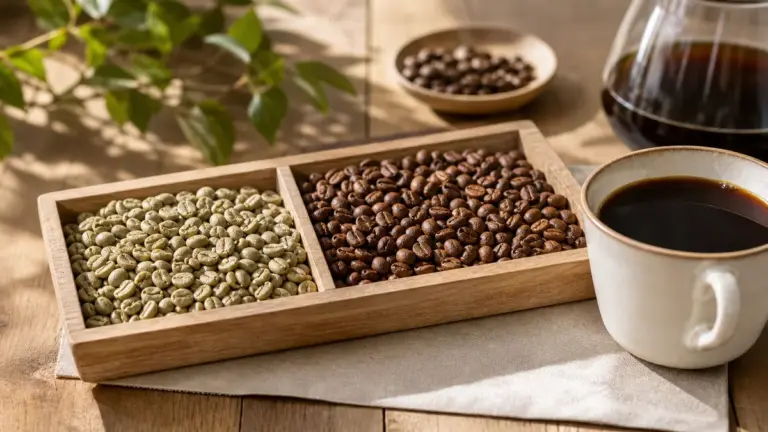
Coffee can improve exercise performance because its caffeine can help you sustain effort, particularly during endurance exercise. Strength benefits are generally smaller, and the useful amount is not necessarily the largest dose studied: individual sensitivity, side effects and sleep all matter.
In short
- Research commonly uses 3 to 6 mg of caffeine per kg of body weight, but benefits can occur below this range. These are study doses, not personal safety recommendations.
- Around 60 minutes before exercise is a common research protocol, not a precise deadline for everyone.
- Count caffeine from your whole day, including coffee, tea, gels, energy drinks and supplements.
- Regular coffee drinkers can still benefit; routinely increasing the dose to overcome supposed tolerance is not justified.
- Caffeine is permitted under WADA rules in 2026, but is monitored in competition. No Therapeutic Use Exemption is required for caffeine itself.
How coffee can help exercise
Caffeine mainly helps through its action on the central nervous system. It blocks adenosine receptors, the sites where a chemical involved in sleepiness and fatigue normally acts. This can make sustained effort more manageable and help an athlete maintain their pace or work rate.
That is different from supplying fuel. The main explanation is not that coffee suddenly gives muscles more energy or makes fat burning the decisive advantage. The Australian Institute of Sport identifies the nervous-system effects as the principal explanation at commonly effective doses.
Keep the question specific: “Can caffeine help this exercise session?” is not the same as “Is drinking more coffee good for my long-term health?” Our coffee and health overview covers that wider evidence.
What the performance evidence shows
The useful evidence comes largely from controlled experiments comparing caffeine with a placebo, an inactive comparison treatment. This supports a short-term performance effect more directly than an observational study linking coffee-drinking habits with health outcomes would.
Endurance exercise
Endurance has the most consistent support in the ISSN position stand. More recently, a systematic review published in January 2026 pooled cycling studies and found shorter completion times and greater average power after caffeine. However, the authors identified possible publication bias, meaning studies finding no benefit may be underrepresented.
Coffee itself has also been tested. In a randomised crossover trial, eight trained male cyclists or triathletes completed exercise after caffeinated coffee, isolated caffeine, decaffeinated coffee or placebo. Coffee and isolated caffeine, each providing 5 mg/kg, produced similar improvements in the cycling time trial.
This demonstrates that coffee can work as a caffeine source. It does not establish that every ordinary cup produces the same result, or that findings from a small male sample apply equally to everyone.
Strength and muscular endurance
Strength means producing force, such as completing a heavy lift. Muscular endurance means sustaining repeated contractions, such as performing repetitions before fatigue.
A 2024 review combining previous meta-analyses found small average improvements in strength and muscular endurance. These are useful possibilities, not a promise that coffee will add a noticeable amount to every lift or set. The review examined acute performance, so its results should not be presented as proof of greater muscle growth over months.
Evidence summary
The strength descriptions below are editorial summaries, not formal certainty grades.
| Claim | Type of evidence | Strength and limitation | Source |
|---|---|---|---|
| Caffeine can improve endurance performance | Position stand and systematic review with meta-analysis | Consistent overall support; individual responses vary and publication bias remains possible | ISSN, 2021; Wu et al., 2026 |
| Caffeine can improve strength and muscular endurance | Review of meta-analyses | Small average benefits; does not establish long-term muscle growth | Taghizadeh Bilondi et al., 2024 |
| Coffee can deliver a performance benefit | Randomised crossover trial | Direct evidence, but a small, male-only sample | Hodgson et al., 2013 |
| Some high-intensity activities can improve | Position stand reviewing experimental research | Task-dependent, not a universal benefit across every sprint or workout | ISSN, 2021 |
| Habitual caffeine use does not necessarily remove the benefit | Systematic review and meta-analysis | No clear overall modifying effect; individual tolerance remains possible | Carvalho et al., 2022 |
These findings support a possible short-term benefit, not a guaranteed improvement for an individual session.
Caffeine doses studied are not safety targets
Exercise papers often express caffeine intake in mg/kg, meaning milligrams of caffeine per kilogram of body weight. The ISSN position stand identifies 3 to 6 mg/kg as a commonly effective research range. A separate meta-analysis also found benefits below 3 mg/kg, so the upper end is not a necessary target.
To understand a paper, multiply body weight by its stated dose. For a hypothetical 70 kg participant:
- 2 mg/kg × 70 kg = 140 mg caffeine.
- 3 mg/kg × 70 kg = 210 mg caffeine.
- 6 mg/kg × 70 kg = 420 mg caffeine.
These are arithmetic examples, not suggested intakes. The last example alone exceeds EFSA’s daily no-concern benchmark for healthy adults, while 210 mg is already above its single-dose benchmark.
Keep the safety guidance separate
EFSA’s 2015 assessment gives these population benchmarks:
| Situation | Guidance | Qualification |
|---|---|---|
| Single intake | Up to 200 mg raises no safety concerns for healthy adults | Approximately 3 mg/kg for a typical adult, not an instruction to scale upwards |
| Intense exercise | The same 200 mg finding applies within two hours before exercise | Under normal environmental conditions |
| Total daily intake | Up to 400 mg, spread throughout the day | Healthy, non-pregnant adults |
| Pregnancy | NHS advice is no more than 200 mg daily | Count all sources, not just coffee |
These are population assessments, not targets or guarantees of symptom-free use. Individual sensitivity, health conditions and medicines can change what is appropriate.
For everyday intake, read how much coffee is too much. Pregnancy calls for separate consideration, covered in coffee during pregnancy, rather than adopting an athletic dosing formula.
Timing coffee before exercise
About 60 minutes before exercise is the most commonly used timing in caffeine research. However, absorption and suitable timing depend partly on the caffeine source; a protocol using capsules or caffeinated chewing gum should not automatically be transferred to coffee.
Treat an hour as a practical reference point, not a countdown that makes coffee ineffective if you miss it. In the direct coffee trial described above, participants consumed their drinks one hour before exercise, but that study did not establish a universally optimal minute.
Coffee also introduces uncertainty about dose. Caffeine concentration varies with the beans, preparation and serving, so “one strong coffee” is not a reliable measurement in milligrams. Where available, use published caffeine information for the actual drink rather than assuming all cups are interchangeable.
Side effects can outweigh the benefit
A 2026 systematic review of randomised trials in athletes found that caffeine increased reported side effects compared with placebo. These included abdominal discomfort, anxiety, nervousness, insomnia, headache and a racing heartbeat. Several effects became more likely as dose increased.
A faster session is not a useful result if it comes with shaking hands, an unsettled stomach or an unpleasantly pounding heart. Reduce or stop pre-exercise caffeine if it causes symptoms, rather than treating discomfort as evidence that it is working. Our coffee and anxiety guide explores that particular trade-off.
Sleep deserves equal attention. EFSA notes that even 100 mg close to bedtime can disturb sleep in some adults. For evening exercise, choosing decaf or skipping pre-workout coffee may be more sensible than pursuing a small performance advantage.
If you have a heart condition, troublesome palpitations, pronounced caffeine sensitivity or take medicines, discuss caffeine use with a GP or pharmacist. In pregnancy, speak to your midwife rather than applying adult exercise-study doses. FSA guidance specifically advises professional advice where supplements or dosage are uncertain.
Does regular coffee drinking cause tolerance?
Tolerance means that repeated exposure reduces a particular response. Feeling less noticeably stimulated is not necessarily the same as losing every exercise benefit.
A 2022 systematic review and meta-analysis found no clear overall relationship between habitual caffeine intake and caffeine’s acute performance effect. Benefits remained apparent across endurance, strength and power outcomes. This argues against assuming that regular coffee drinkers must take progressively larger amounts.
Individual tolerance may still occur. Research is difficult to interpret because studies use different habitual-intake measures and abstinence periods. Withholding caffeine can also create withdrawal symptoms, so a subsequent improvement may partly reflect their relief rather than an additional performance advantage.
There is no established need for a pre-race caffeine withdrawal ritual. In a controlled trial of habitual users, a four-day withdrawal period did not increase the performance benefit of an acute caffeine dose. Do not abruptly change a comfortable routine just because someone recommends a “reset”.
Is caffeine allowed under anti-doping rules?
Yes. As checked in November 2026, caffeine is not prohibited under WADA rules. The 2026 Prohibited List explicitly identifies it as a monitored substance that is not prohibited. The separate 2026 Monitoring Program lists caffeine for in-competition monitoring only. Monitoring tracks patterns of use; it is not a ban.
Caffeine was removed from the prohibited list in 2004. No Therapeutic Use Exemption, usually shortened to TUE, is required for caffeine itself.
That permission does not make every pre-workout product acceptable. Supplements can contain other prohibited stimulants or be contaminated. Athletes should check their governing rules and seek qualified anti-doping advice before using supplements, rather than treating “contains caffeine” as approval of the whole product.
A sensible way to assess your own response
For a healthy adult who already tolerates coffee, the practical question is whether a familiar drink helps without creating unwanted effects. The Australian Institute of Sport recommends trialling caffeine strategies before major competition.
- Choose an ordinary training day, not an important race or maximal lifting attempt.
- Keep your usual routine recognisable. Record the coffee, serving and timing rather than increasing everything at once.
- Count other caffeine. Include tea, gels, energy drinks, supplements and relevant medicines.
- Record the result and the drawbacks. Note pace or repetitions alongside stomach comfort, anxiety and that night’s sleep.
- Do not chase a missing benefit with larger doses. If coffee makes the session less comfortable, exercising without it is a reasonable decision.
This is a way to organise observations, not a controlled experiment or a substitute for individual medical advice.
FAQ
Will decaf improve my workout?
Decaf should not be expected to reproduce a caffeine-driven performance benefit. In the small direct comparison described above, decaffeinated coffee did not improve cycling time-trial performance compared with placebo. That does not make decaf a poor choice: it may simply suit someone who enjoys coffee but does not want pre-exercise caffeine.
Does coffee help build muscle?
Short-term improvements in lifting performance do not prove greater muscle growth. The strength review discussed here examined acute outcomes such as force production and muscular endurance, not whether drinking coffee produces more muscle over a training programme. Treat claims that coffee directly builds muscle as going beyond the evidence presented.
Do I need a pre-workout supplement instead of coffee?
No, a supplement is not necessary simply to obtain caffeine’s potential benefit. Coffee has produced a performance improvement in a controlled trial. Supplements bring separate concerns about total caffeine, dosing and, for tested athletes, prohibited ingredients or contamination. Avoid trying to copy laboratory caffeine doses by measuring concentrated powder with kitchen utensils.
Where to go next
Read Coffee and Health for the wider evidence and How Much Coffee Is Too Much? to put pre-workout caffeine into your daily intake. Coffee and Anxiety is the useful next read if stimulation feels unpleasant, while Coffee During Pregnancy explains why coffee and exercise research should not determine pregnancy guidance.
Sources
-
International Society of Sports Nutrition, Guest et al. International society of sports nutrition position stand: caffeine and exercise performance, 2021.
https://pmc.ncbi.nlm.nih.gov/articles/PMC7777221/ -
Frontiers in Nutrition, Wu et al. Effect of caffeine ingestion on cycling performance: a systematic review and meta-analysis, published January 2026.
https://pmc.ncbi.nlm.nih.gov/articles/PMC12832238/ -
Heliyon, Taghizadeh Bilondi et al. The effect of caffeine supplementation on muscular strength and endurance: A meta-analysis of meta-analyses, 2024.
https://pmc.ncbi.nlm.nih.gov/articles/PMC11336343/ -
PLOS ONE, Hodgson, Randell and Jeukendrup. The metabolic and performance effects of caffeine compared to coffee during endurance exercise, 2013, retrieved through its PubMed record.
https://pubmed.ncbi.nlm.nih.gov/23573201/ -
Sports Medicine, Carvalho et al. Can I Have My Coffee and Drink It? A Systematic Review and Meta-analysis to Determine Whether Habitual Caffeine Consumption Affects the Ergogenic Effect of Caffeine, 2022, PubMed abstract.
https://pubmed.ncbi.nlm.nih.gov/35536449/ -
Sports Medicine, Negaresh et al. Caffeine Use in Sport: A Systematic Review and Meta-analysis of Acute Side Effects and Implications for Athlete Health and Safety, 2026, PubMed abstract.
https://pubmed.ncbi.nlm.nih.gov/42033594/ -
European Food Safety Authority. Caffeine, current topic page summarising its 2015 scientific opinion.
https://www.efsa.europa.eu/en/topics/topic/caffeine -
Food Standards Agency. Food supplements containing caffeine, current consumer guidance, undated PDF.
https://www.gov.uk/government/publications/food-supplements-containing-caffeine -
NHS. Foods to avoid in pregnancy, current guidance, accessed 2026.
https://www.nhs.uk/pregnancy/keeping-well/foods-to-avoid/ -
World Anti-Doping Agency. The 2026 Prohibited List, effective 1 January 2026, and The 2026 Monitoring Program, September 2025 versions.
https://www.wada-ama.org/sites/default/files/2025-09/2026list_en_final_clean_september_2025.pdf
https://www.wada-ama.org/sites/default/files/2025-09/2026_list_monitoring_program_en_final_clean_september_2025.pdf -
United States Anti-Doping Agency. Substance Profile: Caffeine, 2021, current page accessed 2026.
https://www.usada.org/spirit-of-sport/substance-profile-caffeine/ -
Australian Institute of Sport, Australian Sports Commission. Caffeine: What is it?, undated, current guidance accessed 2026.
https://www.ausport.gov.au/ais/nutrition/supplements/group_a/performance-supplements2/caffeine/what-is-it -
Journal of Sports Sciences, Irwin et al. Caffeine withdrawal and high-intensity endurance cycling performance, 2011, PubMed abstract.
https://pubmed.ncbi.nlm.nih.gov/21279864/ -
US Food and Drug Administration. Pure and Highly Concentrated Caffeine, current safety advice, accessed 2026.
https://www.fda.gov/food/information-select-dietary-supplement-ingredients-and-other-substances/pure-and-highly-concentrated-caffeine
Research combined retrieved peer-reviewed reviews and controlled-trial reports with official safety guidance and WADA’s applicable 2026 documents; no first-hand testing was undertaken.
Last checked: November 2026